Skip to content
WORLD MODELS · TIMELINE

World Models: 36 Years from Internal Models to WAMs

1990–2026 · Five lineages · 33 milestones

Early explorationLatent-space eraVideo generation · Physical AI · VLAWAM unification1990200020102018202020222023202420252026Model-based RL · Latent DynamicsVideo-generation World ModelsJEPA Predictive EmbeddingsVLA · World Action ModelsEmbodied / Physical World ModelsWorld Models1990 · SchmidhuberPILCO2011 · Deisenroth & RasmussenWorld Models2018 · Ha & SchmidhuberPlaNet2018 · DeepMindMuZero2019 · DeepMindDreamer2019 · Hafner et al.DreamerV22020 · Hafner et al.TD-MPC2022 · Hansen et al.DreamerV32023 · Hafner et al.I-JEPA2023 · Meta AIGAIA-12023 · WayveUniSim2023 · GoogleSora2024 · OpenAIGenie2024 · DeepMindV-JEPA2024 · Meta AI1X World Model2024 · 1X TechnologiesGenie 22024 · DeepMindCosmos2025 · NVIDIAV-JEPA 22025 · Meta AIGenie 32025 · DeepMindRT-22023 · Google DeepMindOpenVLA2024 · Stanford et al.π02024 · Physical IntelligenceGR00T N12025 · NVIDIAHelix2025 · Figure AIWAMs Survey2026 · Fudan University · Shanghai Innovation Institute · NUSACT2023 · StanfordRDT / H-RDT2024 · Tsinghuaπ0.52025 · Physical IntelligenceOpenVLA-OFT2025 · Stanford · BerkeleyGR00T N1.72026 · NVIDIAXiaomi-Robotics-02026 · XiaomiGigaWorld-Policy-02026 · GigaWorld Team
The x-axis is non-linear (1990–2017 compressed). Hover a node for details.← swipe to explore the full timeline →
WAM PHYLOGENY · 2023–2026

Branching Evolution: From VLA to World Action Models

61 site-collected papers · four lineages · taxonomy per arXiv:2605.12090

Vertical axis is paper date (non-linear; the dense 2026 band is expanded). WAM unifies VLA's p(a|o,l) and world models' p(o′|o,a) into the joint distribution p(o′,a|o,l), splitting into cascaded (imagine, then act) and joint (one model generates both) families; the bottom band is the RoboDojo arena snapshot (Aug 2026, 34 models). Hover for details; click a node to open the paper.
PAPERSep 28, 2026

NavJev: Efficient Vision-Language Navigation via Action-Centric Visual Compression and Discriminative Action-Semantic Memory

Recent zero-shot Vision-and-Language Navigation (VLN) methods increasingly rely on multimodal large language models (MLLMs) to reason over visual observations, navigation instructions, and candidate actions. Although effective, repeatedly invoking autoregressive multimodal reasoning at every navigation step introduces substantial inference latency, limiting the responsiveness of embodied agents. We propose NavJev, an efficient VLN framework that reformulates online navigation from repeated multimodal generation into compact visual compression followed by lightweight typed action selection. Specifically, Action-Centric Visual Compression (ACVC) integrates waypoint geometry, BLIP captions, and RAM semantic tags into compact representations of candidate actions, while Discriminative Action-Semantic Memory (DASM) filters shared semantics and maintains discriminative action-specific evidence across navigation steps. Based on these representations, Jev directly performs structured probabilistic decisions over the available action set. Experiments on R2R-CE show that NavJev achieves 27.0% SR and 22.4% SPL with only 0.65 s per navigation step, while substantially reducing inference latency and cost compared with MLLM-based VLN methods. The project page is available at https://kai-sheng-caesar.github.io/NavJev/.

Kai Sheng, Liuyi Wang, Jinlong Li

Vision-language navigationZero-Shot
Delta Intelligence unveils Delta-0: a humanoid foundation model for whole-body loco-manipulation across 69 DoFs
VIDEOSep 28, 2026

Delta Intelligence unveils Delta-0: a humanoid foundation model for whole-body loco-manipulation across 69 DoFs

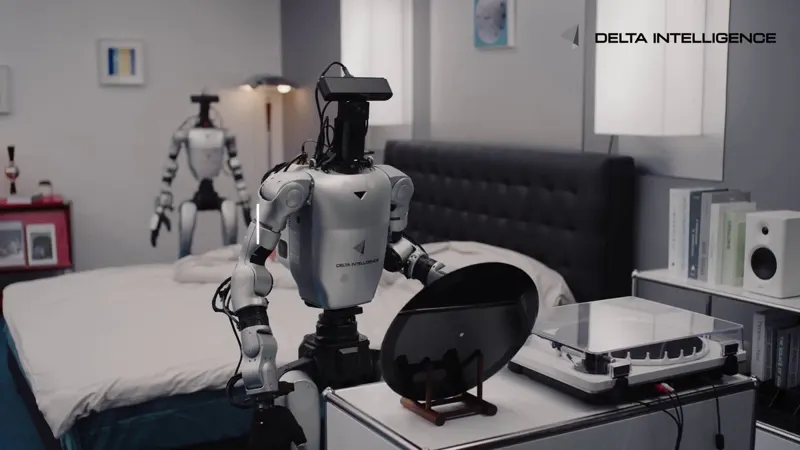
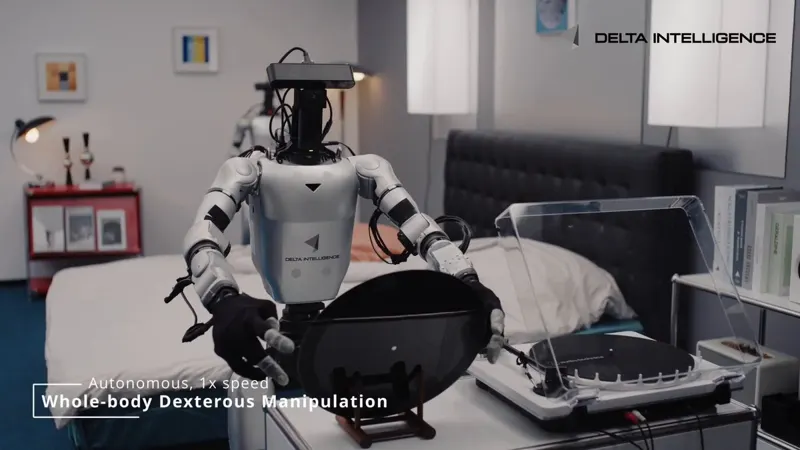
Delta Intelligence has released Delta-0, a humanoid foundation model for whole-body loco-manipulation built on a co-designed brain and controller. The brain is a latent world-action model: a mixture-of-transformers with three branches (vision-language reading multi-view observations and instructions, a vision branch predicting future frames in DINO semantic feature space, and an action branch modelling whole-body motion from proprioception), trained jointly in four modes - forward dynamics, inverse dynamics, visual planning and policy-only. The controller converts motion commands into joint targets across 69 degrees of freedom through a delta-action interface shared by policy output, teleoperation and human corrections; in zero-shot evaluation on roughly 3 h 31 min of everyday-task motion it beats HEFT, MimicLite v1.1, SONIC v1.1 and ScaleBFM XL on both global root error and MPJPE. Pretraining uses more than 10,000 hours of paired egocentric video and whole-body human motion, plus a 154-dimensional shared action representation padded to 180 so single-arm, dual-arm, ego, UMI and humanoid data all live in one action space; high-precision tracking coverage rises from 29.2% to 72.6% as motion data goes from 10% to 100%. Evaluation runs a real-to-sim-to-real loop, rebuilding deployment scenes into simulation assets with 3D reconstruction and LLM agents, running repeatable autonomous rollouts, then returning selected checkpoints to hardware. Real-world RL post-training uses a value model that estimates cost-to-go, giving positive or negative conditioning signals to autonomous action chunks and to human-in-the-loop corrections - on the dishwasher task in a mirrored kitchen layout the success rate climbs from 20% (4/20) after SFT to 65% (13/20). The demo video covers six long-horizon household tasks: loading a record on a turntable, making a bed, picking a toy off the floor, opening a dishwasher, pressing a step trash can and sitting down on a sofa.

As an Amazon Associate, we earn from qualifying purchases.