Skip to content
WORLD MODELS · TIMELINE

World Models: 36 Years from Internal Models to WAMs

1990–2026 · Five lineages · 33 milestones

Early explorationLatent-space eraVideo generation · Physical AI · VLAWAM unification1990200020102018202020222023202420252026Model-based RL · Latent DynamicsVideo-generation World ModelsJEPA Predictive EmbeddingsVLA · World Action ModelsEmbodied / Physical World ModelsWorld Models1990 · SchmidhuberPILCO2011 · Deisenroth & RasmussenWorld Models2018 · Ha & SchmidhuberPlaNet2018 · DeepMindMuZero2019 · DeepMindDreamer2019 · Hafner et al.DreamerV22020 · Hafner et al.TD-MPC2022 · Hansen et al.DreamerV32023 · Hafner et al.I-JEPA2023 · Meta AIGAIA-12023 · WayveUniSim2023 · GoogleSora2024 · OpenAIGenie2024 · DeepMindV-JEPA2024 · Meta AI1X World Model2024 · 1X TechnologiesGenie 22024 · DeepMindCosmos2025 · NVIDIAV-JEPA 22025 · Meta AIGenie 32025 · DeepMindRT-22023 · Google DeepMindOpenVLA2024 · Stanford et al.π02024 · Physical IntelligenceGR00T N12025 · NVIDIAHelix2025 · Figure AIWAMs Survey2026 · Fudan University · Shanghai Innovation Institute · NUSACT2023 · StanfordRDT / H-RDT2024 · Tsinghuaπ0.52025 · Physical IntelligenceOpenVLA-OFT2025 · Stanford · BerkeleyGR00T N1.72026 · NVIDIAXiaomi-Robotics-02026 · XiaomiGigaWorld-Policy-02026 · GigaWorld Team
The x-axis is non-linear (1990–2017 compressed). Hover a node for details.← swipe to explore the full timeline →
WAM PHYLOGENY · 2023–2026

Branching Evolution: From VLA to World Action Models

61 site-collected papers · four lineages · taxonomy per arXiv:2605.12090

Vertical axis is paper date (non-linear; the dense 2026 band is expanded). WAM unifies VLA's p(a|o,l) and world models' p(o′|o,a) into the joint distribution p(o′,a|o,l), splitting into cascaded (imagine, then act) and joint (one model generates both) families; the bottom band is the RoboDojo arena snapshot (Aug 2026, 34 models). Hover for details; click a node to open the paper.

NavVerse (CoRL 2026): a 200-scene, 10K-episode indoor-to-outdoor navigation benchmark — best zero-shot VLA reaches 11.6%, then halves across the door
VIDEOOct 2, 2026

NavVerse (CoRL 2026): a 200-scene, 10K-episode indoor-to-outdoor navigation benchmark — best zero-shot VLA reaches 11.6%, then halves across the door

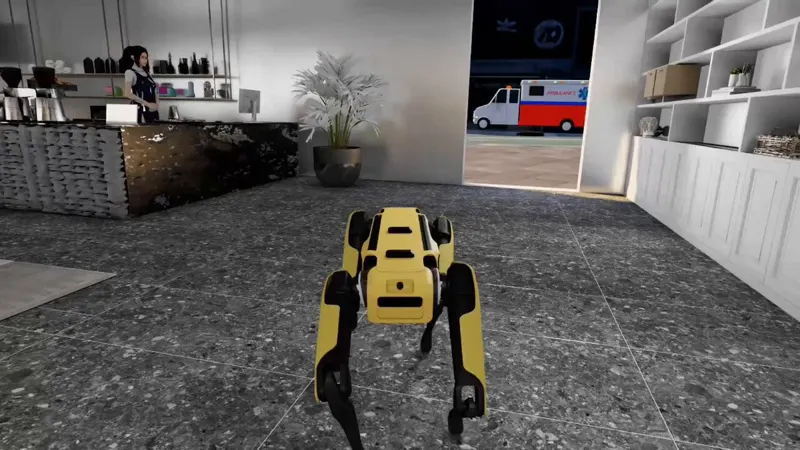
UMich-CURLY (@GhaffariMaani) released NavVerse at CoRL 2026 (171-second demo video): it asks whether today's robots can walk out the door and complete a task outside. The example request — "find a place to get burgers and fries" — requires leaving a building, transitioning into a very different outdoor environment, understanding what kind of place satisfies the request, and physically navigating there. NavVerse evaluates that chain in physics-based simulation: 200 scenes (100 indoor + 50 outdoor urban + 50 connected indoor-to-outdoor assembled via door-to-facade so robots walk from corridor to street with no teleportation), 10,000 episodes, and three tasks (ObjNav, VLN, and the newly proposed PlaceNav at place level), all through an executable robot interface (simulated Spot quadruped with RGB-D) with metrics spanning success (SR/SPL), efficiency (CE) and safety (CR/ADO/NSR). Results from four zero-shot baselines (modular, RL, VLA, VLA-RL) are brutal: the strongest VLA, UniNaVid, reaches only 11.62% ObjNav / 11.38% PlaceNav / 10.67% VLN, and going from pure outdoor to connected scenes PlaceNav plunges 17.65% to 3.64% (a 14.01-point absolute drop); 25-48% of connected episodes never reach the outdoors at all, and every method's coverage efficiency declines post-exit (spinning in place). Paper, project page and code are all open.

PAPERSep 30, 2026

Social-WM: Safety-Aware Latent World Models for Robot Social Navigation

Safe social navigation requires a robot to anticipate not only the future consequences of its actions, but also whether a nominal action can actually be executed under surrounding physical and social constraints. We present Social-WM, an efficient latent world-model planning framework trained from egocentric RGB video sequences. Our key observation is that social-navigation experience contains a systematic discrepancy between the nominal action and the realizable action: a nominal forward action may be fully executed in free space, but needs to be constrained when heading towards a pedestrian or obstacle. Social-WM learns these safety-relevant consequences directly through action-conditioned future prediction, where the target is the actual observed future following each command. We further introduce a realizable inverse-dynamics objective that associates observed latent transitions with the action actually realized rather than the nominal one. At deployment, candidate actions are imagined through the latent world model, and the inverse dynamics model estimates their realizability; nominal–realizable discrepancy then provides a safety signal before execution. The learned dynamics and realizability model remain goal-independent and support both position- and image-goal navigation. On Social-HM3D, Social-WM achieves 63.77% success while reducing human collisions to 21.67%, and maintains strong performance under zero-shot transfer to Social-MP3D, without explicit pedestrian tracking, privileged human state, or online reinforcement learning.

Zhihao Zheng, Mooi Choo Chuah

Social NavigationWorld Models
PAPERSep 30, 2026

EWAM: Emergent Depth-Wise Specialization in a Unified Embodied Model – From Semantic Understanding through Visual Foresight to Action

Vision-language-action (VLA) policies emphasize semantic understanding, whereas world-action models (WAMs) learn predictive representations of environment dynamics. Systems that expose a policy to both sources often still concentrate action computation on a single expert. We present EWAM, an action-centric unified embodied model whose asymmetric joint attention lets action tokens read semantic, current-visual, predicted-future, and action information at every layer while the perceptual experts retain their distinct roles. Without layer-wise supervision, EWAM develops an emergent depth-wise specialization: action queries attend mainly to vision-language features in shallow layers, to predicted future frames in intermediate layers, and to action tokens themselves in deep layers. This handoff replicates across tasks and is stable across denoising steps. Checkpoint tracking and causal interventions show that it is learned and that action generation depends on it. EWAM is pretrained in two separate regimes, one on cross-embodiment robot trajectories and one on human egocentric video. In simulation and real-robot experiments, it surpasses existing VLA, WAM, and hybrid baselines. Human egocentric data improve both cross-embodiment transfer and real-robot robustness, and subtask-phase supervision improves long-horizon completion. Together, these results suggest that unified embodied learning can induce an ordered internal progression from semantic understanding, through visual foresight, to action formation.

Hao Wang, Jiajun Wen, Jingzhi Liu

VLAWorld-action models
SoL-Refiner: one-step refinement turns low-res video into 4K - NVIDIA speed-of-light video refiner
VIDEOSep 30, 2026

SoL-Refiner: one-step refinement turns low-res video into 4K - NVIDIA speed-of-light video refiner

NVIDIA Research (Efficient AI Team and Singapore Lab; arXiv:2609.37969; Haozhe Liu et al.) presents SoL-Refiner. High-resolution video generation is costly because inference scales with the number of spatiotemporal tokens; generating low-resolution first and refining is the practical alternative, but conventional multi-step refinement introduces a second sampling bottleneck. SoL-Refiner transforms low-resolution outputs from diverse base generators into 4K video with a single denoising step. Its three-stage recipe combines high-resolution continual training, frame-based RL post-training, and one-step distribution-matching distillation with both bidirectional and streaming inference. The authors also introduce Refiner-Bench, a video refinement benchmark built from the outputs of different video generators, with a shared-input protocol comparing refiners at roughly 2K output resolution. At 2K, the one-step SoL-Refiner outperforms all external refiners on VBench and UniPercept averages; at 3840x2176 it improves both metrics over the three-step LTX-2.3 Refiner; the complete acceleration stack delivers an 8.91x speedup in refinement latency over the same baseline in the 2K latency setting. Measured on the project page: the MiniMax H3 deployment pipeline drops from 152.3s to 5.64s (27.03x; five-second 1344x768 at 24 fps on GB200 GPUs), and the SANA-Video compute pipeline from 20.04s to 12.54s (1.60x; 1x H100, 81 frames at 16 fps).

As an Amazon Associate, we earn from qualifying purchases.