Skip to content
← Tags

#Vision-language-action (VLA) (47)

UniWAM: Unified World-Action Model

UniWAM: Unified World-Action Model

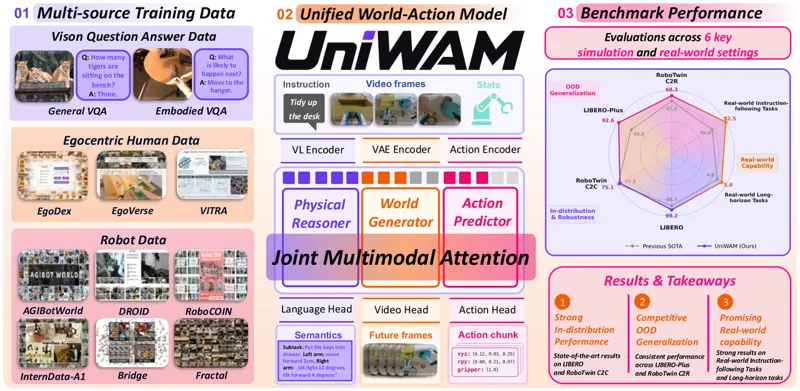
Vision-language-action models benefit from the understanding and reasoning capabilities of pretrained vision-language models, but action-only supervision provides limited grounding in world dynamics. Conversely, world-action models inherit spatiotemporal priors from video generation models, yet remain limited in semantic understanding and reasoning under distribution shifts. We introduce UniWAM, a unified architecture that integrates a physical reasoner, a world generator, and an action predictor to jointly learn semantic understanding of the physical world, visual generation, and action prediction. To ensure the quality of the training data, we developed a rigorous data cleaning and annotation pipeline for both human egocentric data and robot data. To adapt the vision-language component to embodied tasks while preserving its inherited language capabilities, we represent low-level actions in natural language and introduce a pre-training recipe that assigns complementary supervision from visual question answering (VQA) data, human egocentric data, and robot demonstrations to the appropriate model components. During post-training, future visual noise augmentation reduces reliance on precise future predictions, while history-conditioned flow matching uses encoded action history to initialize action generation. Together, these designs significantly reduce denoising steps while maintaining performance. UniWAM achieves state-of-the-art (SOTA) performance across multiple evaluations, including in-distribution performance, robustness, generalization, instruction following, and long-horizon task execution. Furthermore, we uncover a log-linear scaling law of unified human-robot co-training, demonstrating the effectiveness of large-scale pre-training on a mixture of human and robot data.

Wenxuan Song, Jiayi Chen, Jingbo Wang · 128 views · Oct 1, 2026
World-action modelsVision-language-action (VLA)
Oct 1, 2026

Reinforcement Learning Enables Scaling Generalist Robot Policy Improvement

Reinforcement Learning Enables Scaling Generalist Robot Policy Improvement

The introduction of generalist robot policies has enabled a single, large model to learn to perform a variety of tasks from a vast pre-training corpus. While these models often exhibit powerful zero-shot generalization capabilities, they typically require an adaptation phase to achieve sufficient performance in deployment. Iterated self-improvement via reinforcement learning (RL) has demonstrated promise in enabling this adaptation, yet such approaches have been largely explored in single-task settings - where the goal is to simply improve on a narrow deployment task - which lies in stark contrast to the multi-task capabilities of the base policy. In this work we ask whether generalist robot policies are capable of multi-task, generalist improvement in deployment - targeting many diverse tasks simultaneously - and what algorithmic recipe enables this. To answer this question, we first develop a set of structured evaluations to test generalist improvement capabilities, and systematically evaluate algorithmic and practical design choices regarding value estimation, policy extraction and resource allocation. We show that not only can generalist policies be improved online across diverse tasks, but that the right recipe can enable generalization and increase performance on tasks not considered during online training. We characterize when this generalization occurs and show that both the training task distribution and the use of value-based RL are critical. To the best of our knowledge, this is among the first evidence for online generalist improvement for robot foundation models.

Michal Korniak, Marco Bagatella, Ralf Römer · 248 views · Nov 4, 2026
Vision-language-action (VLA)Reinforcement Learning
Nov 4, 2026
RynnUnify: Towards Unified Embodied Brain

RynnUnify: Towards Unified Embodied Brain

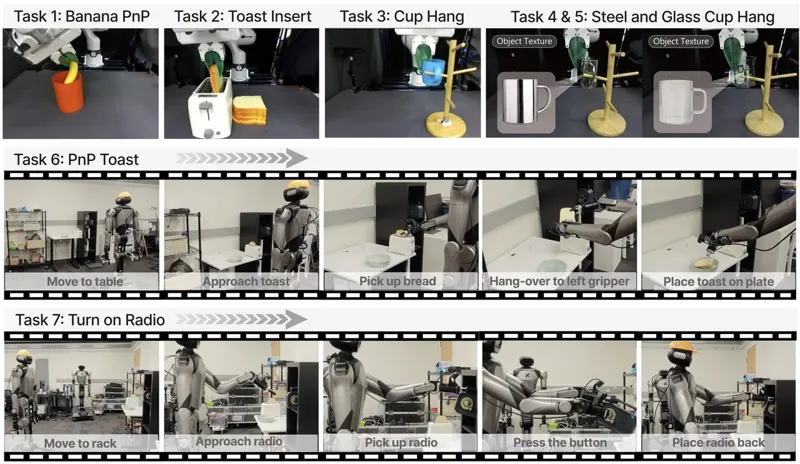
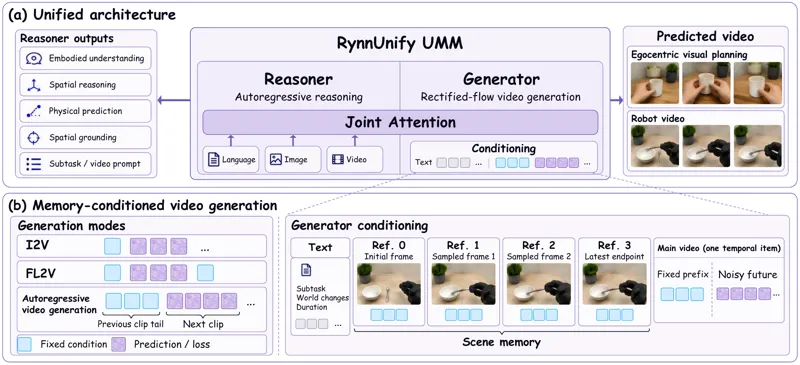
We introduce RynnUnify, a 16B unified embodied model that combines strong embodied understanding with long-horizon visual planning through interleaved video–language reasoning. With capabilities spanning spatial reasoning, physical prediction, and grounding, RynnUnify connects an understanding of the physical world with visual anticipation of how it evolves across successive subtasks. Building on these capabilities, we further develop an agentic extension through reinforcement learning to selectively use video predictions for reasoning about unobserved states and interaction outcomes. We also develop a world-action extension of the full RynnUnify model, translating its understanding and prediction capabilities into robot control. To evaluate these capabilities, we introduce Rynn-VP and Rynn-GEU for long-horizon visual planning and anticipatory reasoning. Experiments show that RynnUnify achieves the highest average embodied understanding score among the evaluated unified multimodal models and improves the Rynn-VP overall score by 9.75 points over Cosmos 3 Nano. Its agentic extension improves the Rynn-GEU average by 6.0 points over direct reasoning, while the world-action extension achieves 51.5% success on 20 selected composite RoboCasa365 tasks and 46.7% average success across three real-robot tasks. Together, these results establish RynnUnify as a shared foundation for embodied understanding, visual planning, and robot control, taking a step toward a unified embodied brain.

Minghao Zhu, Bohan Hou, Kun Xiang · 328 views · Oct 23, 2026
RynnUnifyEmbodied AI
Oct 23, 2026
Agentic World Action Models

Agentic World Action Models

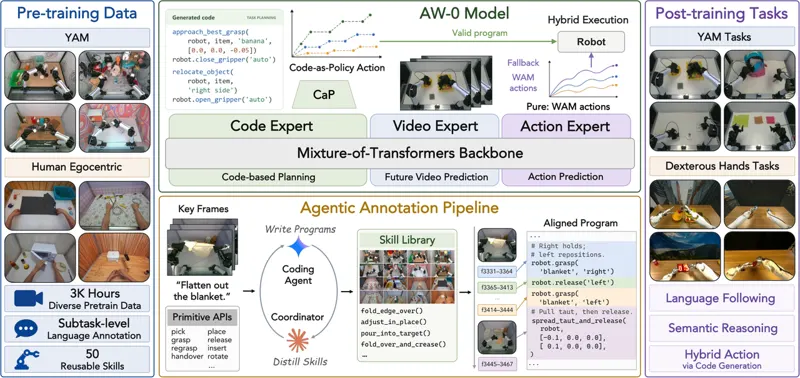
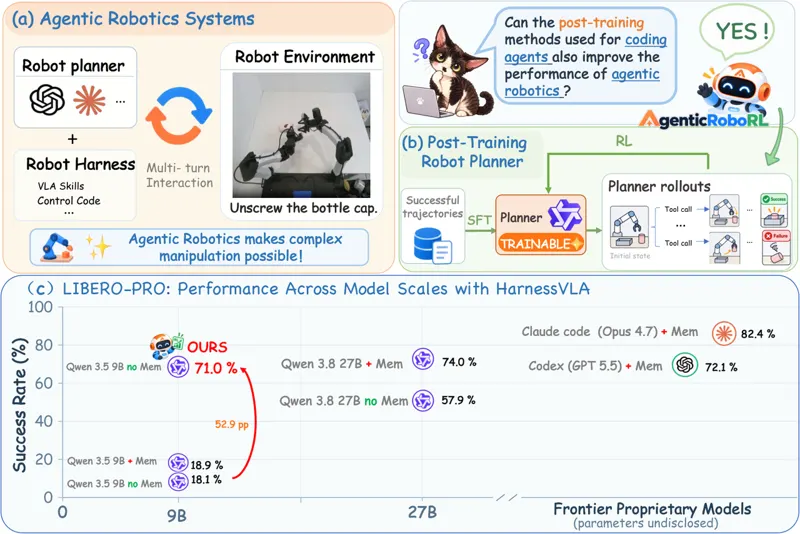
Recent world action models provide visual foresight and future prediction for robot manipulation, but lack explicit mechanisms for compositional skill reuse. Agentic robotics combines code-based planning and reasoning with reusable skills, but often lacks predictive grounding in physical dynamics. We introduce AW-0, an agentic world action model framework that integrates code-based planning with joint video and action prediction. We jointly model code, future video, and robot actions as three coupled generative streams within a unified mixture-of-transformers architecture. Within this architecture a code expert generates parameterized skill routines and control logic while video and action experts generate future visual states and low-level motor commands. Code serves two complementary roles: it structures multi-step prediction and control within the world model and represents skills as reusable programs for subsequent agentic execution. We further introduce an automated curation pipeline that labels robot and human video trajectories with aligned programs and consolidates recurring routines into reusable skill libraries. Evaluations on RoboTwin 2.0 and physical bimanual manipulation tasks show improved task performance over VLA and WAM baselines, alongside gains in language following, semantic reasoning and robustness, demonstrating that agentic code enables connection between planning, prediction and execution within WAMs.

Liu, Zhuoyang, Niu, Dantong, Zhang, Botong · 377 views · Oct 21, 2026
World-action modelsVision-language-action (VLA)
Oct 21, 2026
Juno: Taming Predictive Latents for Vision-Language-Action Models

Juno: Taming Predictive Latents for Vision-Language-Action Models

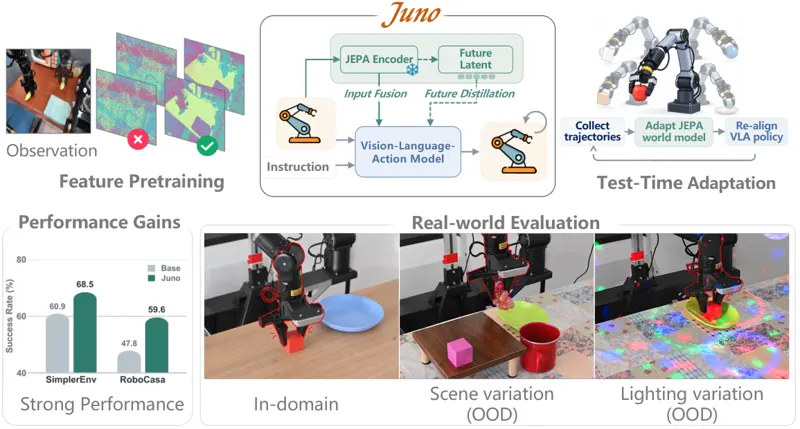
Joint-embedding predictive architectures (JEPAs) predict masked or future observations in representation space, offering a natural source of predictive latents for vision-language-action (VLA) models. Yet making these latents useful across pretraining, policy learning, and deployment requires addressing three failures: mismatch with embodiment-specific control, interference with action learning, and teacher miscalibration under distribution shifts. We introduce Juno, a unified framework built around one action-conditioned JEPA that serves as a control-aligned representation backbone, a predictive teacher, and an adaptable dynamics model. During pretraining, we train it on embodiment-matched trajectories and use a dynamic CLS loss to transfer motion-weighted patch dynamics to a compact global state. During policy learning, we fuse current-frame JEPA patches into VLA perception and use a decoupled reasoning branch with separate transformation parameters to distill future latent states for action generation. During deployment, we adapt the world model on all observed transitions, including failed rollouts, freeze the adapted teacher, and re-align the policy on verified executions using LoRA adapters and a trainable action head, without expert corrections or task rewards. On SimplerEnv, Juno raises average success from 60.9% to 68.5% over Qwen3GR00T, the strongest baseline, and test-time adaptation further reaches 72.7%; on a real robot, it retains 70%–75% success under background, height, and object shifts where the base policy collapses to 0%.

Yuchen Zhu, Chenyi Xu, Yulin Zhang · 289 views · Oct 7, 2026
Vision-language-action (VLA)World Models
Oct 7, 2026

As an Amazon Associate, we earn from qualifying purchases.