Skip to content
← Tags

#Unitree (64)

Action-Aligned Latent Planning for Versatile Humanoid Loco-Manipulation

Action-Aligned Latent Planning for Versatile Humanoid Loco-Manipulation

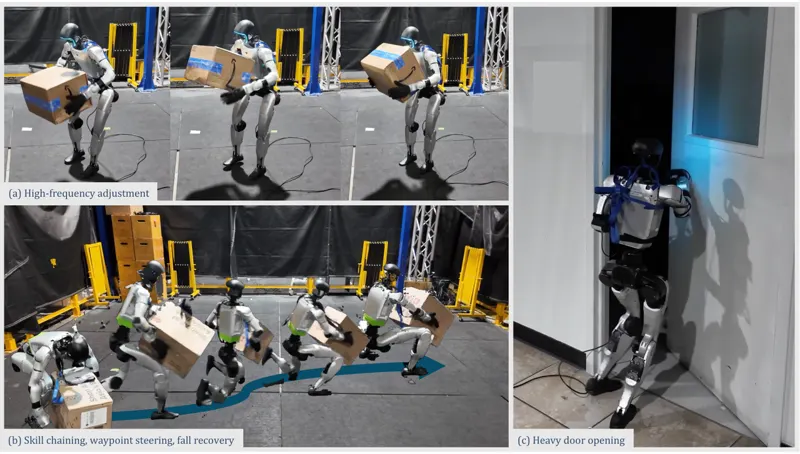
FIBER addresses a representation problem at the heart of versatile humanoid loco-manipulation: high-level planners need a compact abstraction, but kinematic or contact targets do not encode the state-dependent control responses that make contact-rich interaction succeed, while predicting low-level actions forces an offline planner to model high-frequency closed-loop feedback. FIBER resolves this by using the executable latent space of a frozen behavioral foundation model (BFM) as the shared planning representation. Its latent policy projection (LPP) maps each independently acquired task expert into that space by identifying latent commands whose BFM-induced actions match the expert's local control responses in physical joint-target space, regularized by a semantic term that anchors each command to the BFM backward representation of the same state. Because projection only requires the expert's actions, experts may differ in observations, objectives, and training pipelines, and are discarded once projected. Closed-loop latent rollouts from all projected skills are then aggregated to train a single perceptive flow-matching planner entirely offline, conditioned on egocentric depth, proprioception, and steering tokens derived from language or waypoints; at deployment it replans in a receding-horizon loop while the frozen BFM supplies 50 Hz state feedback. The paper further contributes AH-BFM, an adaptive-horizon BFM trained with multi-gamma forward-backward learning that keeps both short-horizon tracking fidelity and long-horizon behavioral coherence in one latent space, and successor-feature-guided behavior reuse, which composes an acquired interaction such as box carrying with native whole-body behaviors like crouching or running. In IsaacSim, across 128 variations per task, FIBER reaches 42.0% mean success versus 11.6% for projected latent replay and 3.5% for kinematic planning; on a real Unitree G1 it transfers zero-shot with 6/10 box pickup, 4/10 door opening, and 2/10 object grasping, running a 5 Hz TensorRT planner and the 50 Hz BFM on a single laptop GPU.

Yutang Lin, Guanya Shi, C. Karen Liu · 269 views · Oct 17, 2026
HumanoidMobile Manipulation
Oct 17, 2026
Perceptive Humanoid Parkour: Chaining Dynamic Human Skills via Motion Matching

Perceptive Humanoid Parkour: Chaining Dynamic Human Skills via Motion Matching

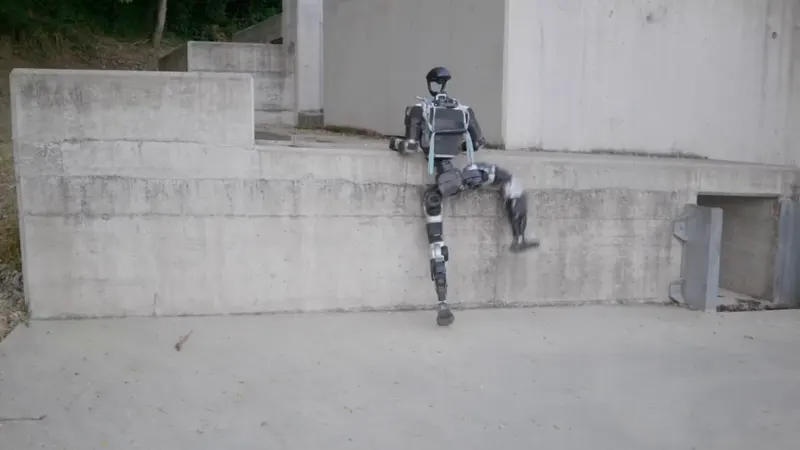
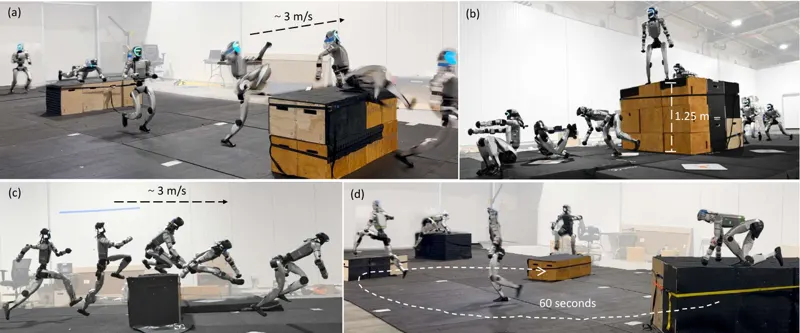
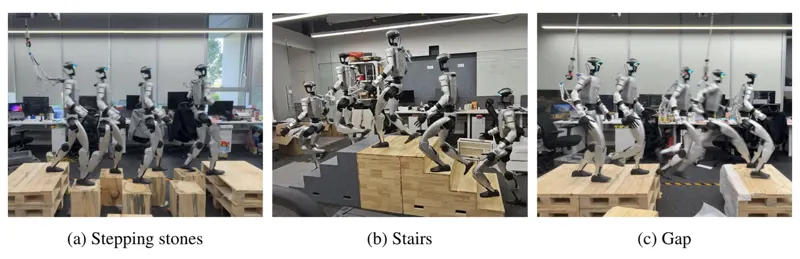
While recent advances in humanoid locomotion have achieved stable walking on varied terrains, capturing the agility and adaptivity of highly dynamic human motions remains an open challenge. In particular, agile parkour in complex environments demands not only low-level robustness, but also human-like motion expressiveness, long-horizon skill composition, and perception-driven decision-making. In this paper, we present Perceptive Humanoid Parkour (PHP), a modular framework that enables humanoid robots to autonomously perform long-horizon, vision-based parkour across challenging obstacle courses. Our approach first leverages motion matching, formulated as nearest-neighbor search in a feature space, to compose retargeted atomic human skills into long-horizon kinematic trajectories. This framework enables the flexible composition and smooth transition of complex skill chains while preserving the elegance and fluidity of dynamic human motions. Next, we train motion-tracking reinforcement learning (RL) expert policies for these composed motions, and distill them into a single depth-based, multi-skill student policy, using a combination of DAgger and RL. Crucially, the combination of perception and skill composition enables autonomous, context-aware decision-making: using only onboard depth sensing and a discrete 2D velocity command, the robot selects and executes whether to step over, climb onto, vault or roll off obstacles of varying geometries and heights. We validate our framework with extensive real-world experiments on a Unitree G1 humanoid robot, demonstrating highly dynamic parkour skills such as climbing tall obstacles up to 1.25m (96% robot height), as well as long-horizon multi-obstacle traversal with closed-loop adaptation to real-time obstacle perturbations.

Zhen Wu, Xiaoyu Huang, Lujie Yang · 227 views · Feb 17, 2026
HumanoidParkour
Feb 17, 2026

LEGS: Fine-Tuning Teleop-Free VLAs for Humanoid Loco-manipulation in an Embodied Gaussian Splatting World

LEGS: Fine-Tuning Teleop-Free VLAs for Humanoid Loco-manipulation in an Embodied Gaussian Splatting World

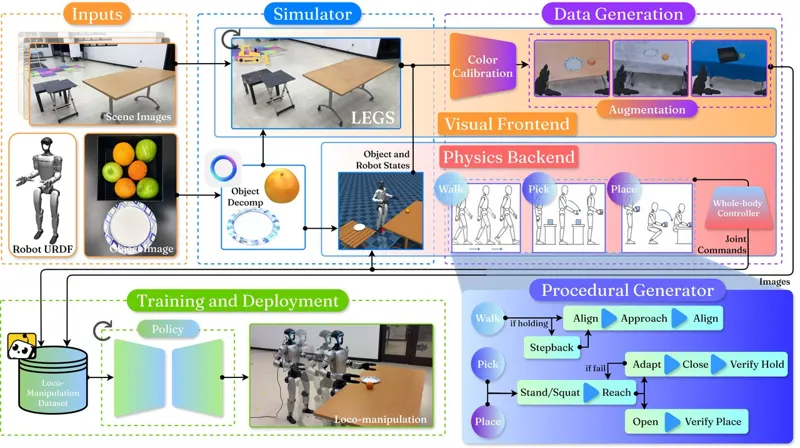
Training vision-language-action (VLA) policies for humanoid loco-manipulation is constrained by the high cost and complexity of collecting human teleoperation demonstrations. VLA policies fine-tuned in simulators have, until now, failed to transfer effectively in humanoid loco-manipulation tasks. We present LEGS (Loco-manipulation via Embodied Gaussian Splatting), a hybrid simulator that composites a mesh foreground (robot, objects, props) over a photorealistic 3D Gaussian Splatting (3DGS) background reconstructed from a handheld scene capture. LEGS uses a procedural motion-primitive generator to synthesize labeled demonstrations at scale without human teleoperation, and a deterministic two-stage color calibration to align the rendered 3DGS image to the robot's deployment camera. On a Unitree G1 humanoid robot, across three pick-and-place tasks of increasing whole-body difficulty and three VLA backbones (psi_0, pi_0.5, GR00T N1.6), a policy trained purely on LEGS data matches or exceeds one trained on human teleoperation demos on every experiment. It also outperforms a mesh-only simulation baseline that ablates the effect of the 3DGS background, showing that photorealistic rendering is a key enabler for synthetic data transfer. Humanoid motion is recorded independently of scene appearance in LEGS, allowing the same auto-generated demonstrations to be re-rendered under new backgrounds and object meshes–covering a new scene at more than 15x lower cost than teleoperation–to augment training data for robustness to scene variations. Under combined object-and-scene appearance shift, the policy trained on re-rendered LEGS-AUG data maintains task success while the baseline trained on teleoperation data fails entirely. Our project page is located at https://legsvla.github.io/.

Kim, Hojune, Chen, Timothy, Sun, Jiankai · 987 views · May 31, 2026
HumanoidVLA
May 31, 2026
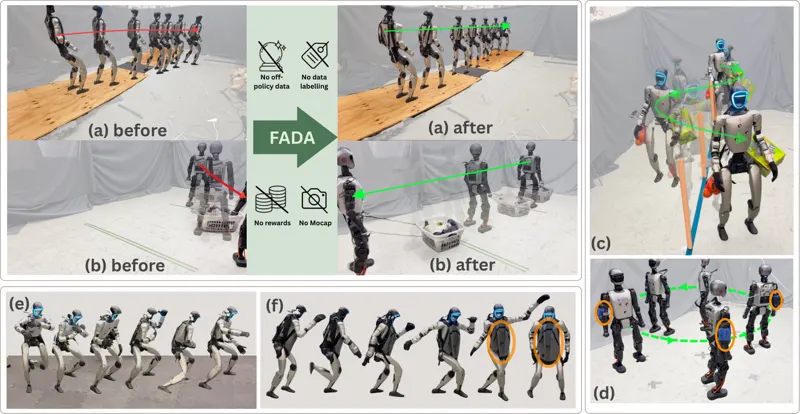
FADA: Few-Shot Domain Adaptation via Dynamics Alignment for Humanoid Control

FADA: Few-Shot Domain Adaptation via Dynamics Alignment for Humanoid Control

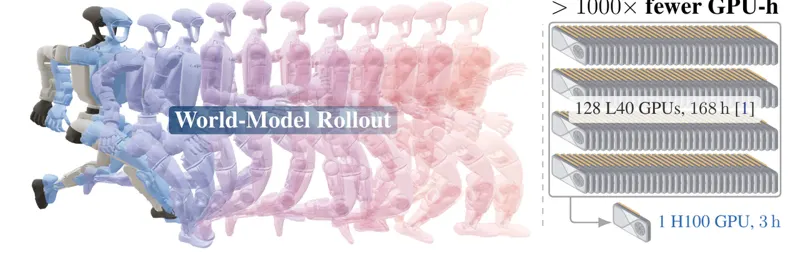
High-precision humanoid control is limited by target-domain dynamics mismatch, where the same control objective can induce different realized motions under changes in terrain, payload, or actuator response. Existing methods either pursue zero-shot transfer through domain randomization or in-context adaptation without target-domain specialization, or require heavy adaptation pipelines that leverage target-domain data, such as model calibration, residual learning, or policy retraining. In this paper, we present FADA (Few-Shot Domain Adaptation via Dynamics Alignment), a three-stage Planner-Inverse Dynamics Model (Planner-IDM) framework for few-shot adaptation in humanoid control. FADA first trains an oracle policy with privileged information and then distills the oracle behavior into a deployable Planner-IDM student through DAgger. At deployment, FADA freezes the planner and finetunes only the IDM using approximately 2 minutes of target-domain rollouts with standard supervised learning. Rather than requiring optimal demonstrations or rewards, FADA uses the paired actions and observations that are observed during these rollouts as supervision, aligning the IDM's action generation with target-domain dynamics. Experiments show that FADA outperforms both in-context and end-to-end adaptation baselines, improving task performance under dynamics shifts and enabling real humanoid robots to execute diverse high-precision whole-body tasks. Implementation details and qualitative hardware rollout videos are available at https://lecar-lab.github.io/FADA-humanoid/.

Angchen Xie, Nikhil Sobanbabu, Ishayu Shikhare · 571 views · Jun 26, 2026
HumanoidFew-Shot Learning
Jun 26, 2026

As an Amazon Associate, we earn from qualifying purchases.