Skip to content
Tags
ReST-RL: Reinforcing LLM Reasoning through Unified Self-Training and Value-Guided Search

ReST-RL: Reinforcing LLM Reasoning through Unified Self-Training and Value-Guided Search

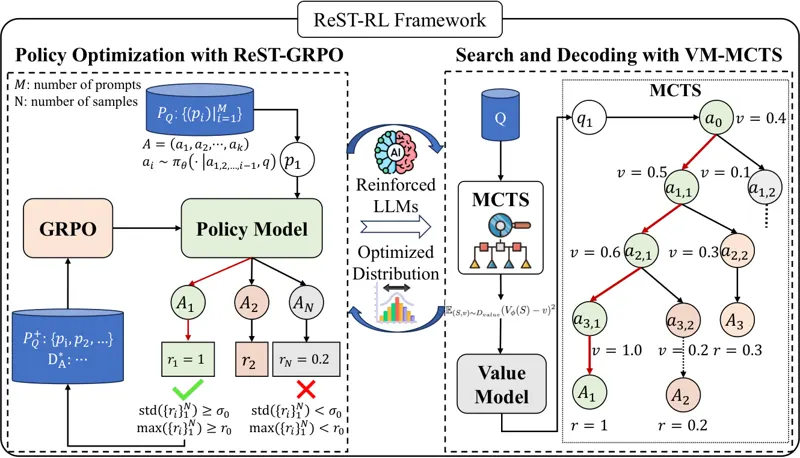
GRPO is the representative RL method for improving LLM reasoning, yet it only ever sees one sparse reward at the end of a whole trajectory: when the rewards inside a sampled group land close together, the group-relative advantage collapses into noise and the policy learns almost nothing. ReST-RL reconnects policy optimization and value-guided search into a single self-training pipeline. Stage one, ReST-GRPO, first filters out low-information prompts by reward standard deviation, then draws prefixes from each prompt's highest-reward trajectory under a discrete exponential distribution and uses them as fresh online-GRPO starting contexts. A selected prefix is context only; its suffix is re-sampled and optimized rather than imitated. Stage two, VM-MCTS, runs MCTS under the now-static policy to self-collect value targets and trains a value model that predicts expected terminal reward. At inference the same model both allocates the tree search through UCT and ranks completed candidates in a Best-of-N fashion, so search and verification share one state-value scale. On coding benchmarks including APPS, BigCodeBench and HumanEval, Qwen3-8B moves from 0.503 to 0.689 average. In matched policy-value controls, ReST-GRPO + VM-MCTS reaches 0.642 on APPS-500 while GRPO + VM-MCTS reaches only 0.538, so the stage-one distributional shift survives value learning. End-to-end accounting puts ReST-GRPO at 1,752 GPU-hours against 2,080 for GRPO, hitting a 9% gain in 71 hours instead of 207. A value model trained only on code trajectories also transfers to MATH, Omni-MATH and GPQA-Diamond without target-domain tuning.
Sining Zhoubian, Dan Zhang, Jie TangAug 27, 2025
Reinforcement LearningGRPOMonte Carlo Tree SearchAug 27, 2025
Show-Harness: Just a VLM Agent Can Play Robots

Show-Harness: Just a VLM Agent Can Play Robots

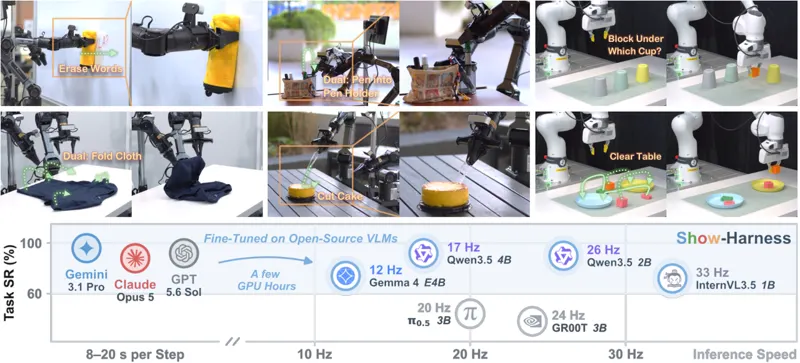
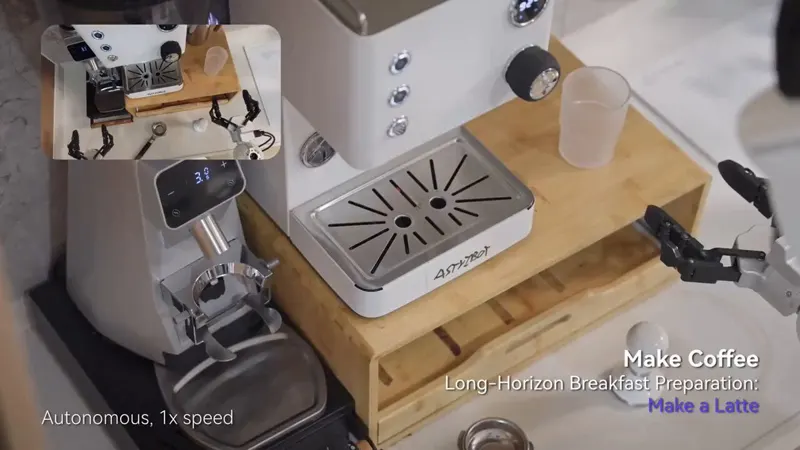
Foundation vision-language models (VLMs) exhibit broad intelligence about the world, yet translating this intelligence into robot control remains challenging. We present Show-Harness, an Embodied Harness that enables VLMs to "play" robots through a compact semantic interface linking intent to action. Show-Harness exposes discrete semantic action units that VLMs can naturally reason over, while embodiment-specific interpreters deterministically ground them into local robot actions, keeping the VLM directly responsible for fine-grained physical decisions. Through the same interface, Show-Harness demonstrates the feasibility of (1) directly unlocking closed-source frontier VLMs for zero-shot robot control, and (2) adapting small-scale open-source VLMs for low-cost deployment with just a few GPU-hours of fine-tuning. We further develop GUMI (GUI Manipulation Interface), which extends the same semantic action space to GUI-based demonstration collection, allowing humans and agents to "play" robots across embodiments without specialized teleoperation hardware. Extensive experiments show that Show-Harness-equipped VLM agents generalize robustly across tasks, embodiments, and environments, outperforming representative agentic and VLA paradigms. These results suggest that the right interface can unlock substantial embodied capability from foundation VLMs, without requiring additional model capacity or costly embodiment-specific pretraining.

Yanzhe Chen, Zechen Bai, Zhijun CaoSep 9, 2026
Vision-language modelsAgentic HarnessSemantic Action InterfaceSep 9, 2026