Skip to content
Tags

#Novel view synthesis (4)

WilLaGS: Latent-Conditional 3D Appearance Fields for Robust Gaussian Splatting In-the-Wild

WilLaGS: Latent-Conditional 3D Appearance Fields for Robust Gaussian Splatting In-the-Wild

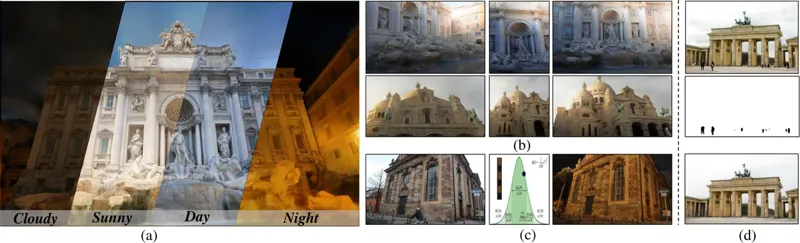
3D Gaussian Splatting (3DGS) delivers real-time and high-fidelity rendering but remains challenged by unconstrained in-the-wild scenes, where drastic appearance variations and transient objects violate multi-view consistency. Existing methods are fundamentally limited by independent and discrete embeddings that struggle to capture continuous environmental changes or model spatially-varying local illumination. To address these limitations, we propose WilLaGS, a unified framework for robust 3D scene reconstruction and generative appearance synthesis under unconstrained settings. Specifically, we introduce a generative appearance model where a β-VAE learns a structured and continuous manifold of global appearance. Conditioned on the latent code, we construct a 3D neural appearance field that generates dynamic Tri-Plane features to encode spatially-varying local illumination effects. Furthermore, to suppress transient artifacts, we present a self-supervised perceptual masking mechanism that leverages a Teacher-Student (EMA) architecture to derive a stable scene consensus, robustly identifying inconsistent regions via perceptual discrepancies. Extensive experiments on multiple datasets demonstrate that WilLaGS achieves state-of-the-art performance in reconstruction quality and novel view appearance synthesis, while maintaining real-time rendering efficiency.
Yuhao Bai, Qianqiu Tan, Lilong ChenAug 28, 2026
3D Gaussian SplattingGaussian Splattingβ-VAEAug 28, 2026
StreamSplat: Streaming Feed-Forward 3D Gaussian Splatting

StreamSplat: Streaming Feed-Forward 3D Gaussian Splatting

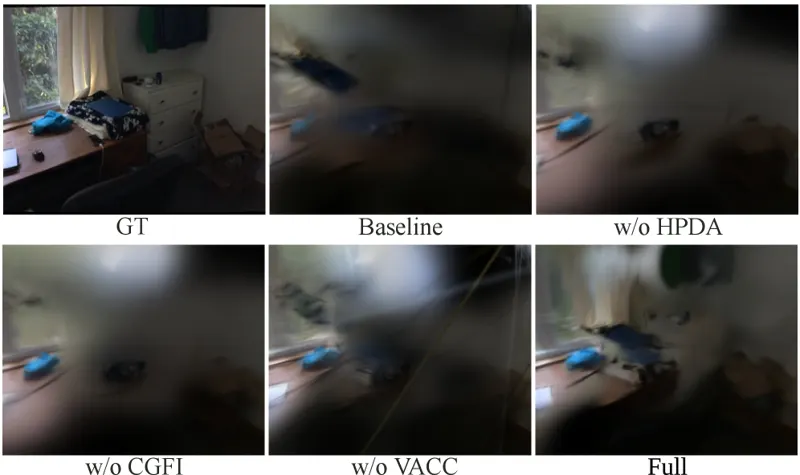
Feed-forward 3D Gaussian Splatting enables efficient novel-view synthesis without per-scene optimization, but most existing methods assume a fixed set of context views and process them jointly. This limits their applicability to online scenarios where calibrated views arrive sequentially and the scene must be updated causally. We present StreamSplat, a streaming feed-forward 3DGS framework that incrementally maintains a persistent geometry-grounded scene state and decodes it into renderable 3D Gaussians after each input chunk. StreamSplat centers on a Voxel-Aligned Causal Cache (VACC), which stores historical 3D tokens in a memory-bounded voxel structure so that memory grows with explored scene geometry rather than stream length. To better reuse history during causal prediction, we introduce History-Projected Depth Anchoring (HPDA) to project cached geometry as depth guidance for current cost-volume estimation, and Cache-Guided Feature Injection (CGFI) to inject cached latent evidence into Gaussian-token regression. Experiments on DL3DV, RealEstate10K, and ScanNet show that StreamSplat remains competitive with state-of-the-art feed-forward 3DGS methods under sparse causal inputs, despite not using future views or full-scene context. More importantly, it scales to long input streams with 256, 512, and 1024 views where fixed-view baselines run out of memory, yielding sustained improvements in novel-view synthesis quality as more observations arrive. The code will be made publicly available upon acceptance.

Changhao Song, Yuxuan Wang, Qibiao LiAug 3, 2026
3D Gaussian Splatting3D reconstructionStreaming InferenceAug 3, 2026
GrainGS: Gradient-Decoupled Gaussian Splatting for Efficient Dynamic Novel View Synthesis

GrainGS: Gradient-Decoupled Gaussian Splatting for Efficient Dynamic Novel View Synthesis

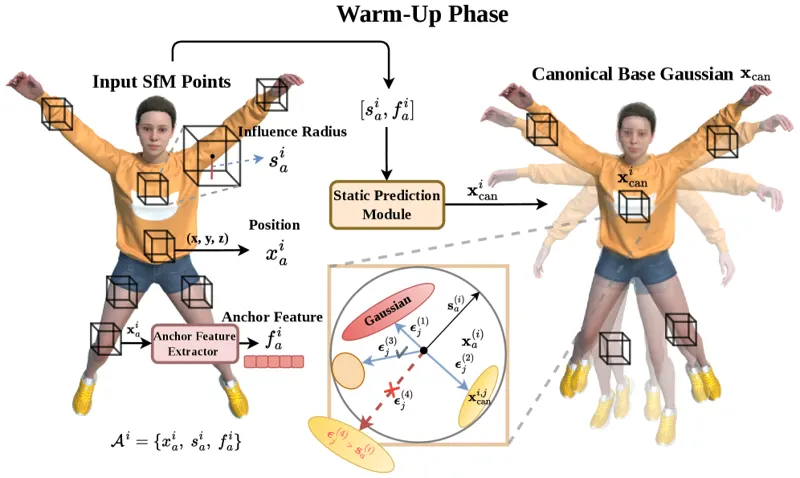
Dynamic scene reconstruction with 3D Gaussian Splatting requires a balance between fine-grained motion modeling, structural stability, and compact representation. Existing per-primitive methods provide flexible local deformation but often suffer from redundant primitive growth, while anchor-based methods improve spatial regularity at the cost of suppressing locally varying motion. To address these issues, we present GrainGS, a dynamic Gaussian framework that combines a hierarchical anchor scaffold with per-Gaussian deformation. A static warm-up stage first establishes a time-invariant canonical representation from observations across all timestamps. During joint training, a stop-gradient operation blocks the deformation-mediated gradient pathway to the canonical positions while preserving their direct refinement through the reconstruction objective. Each Gaussian then predicts independent temporal offsets for position, rotation, and scale, enabling detailed local motion within a structurally constrained scaffold. A canonical-residual appearance decomposition further models frame-dependent photometric changes without forcing them into geometric deformation. Experiments on synthetic monocular and real-world multiview benchmarks show that GrainGS achieves high reconstruction quality, real-time novel view synthesis, and compact storage. Under the synthetic benchmark setting, it reaches an average peak signal-to-noise ratio of 36.98 decibels, renders at 435.6 frames per second, and requires 4.67 megabytes of storage.

Jiahao He, Yihua Shao, Zhengkai ZhaoJul 23, 2026
3D Gaussian SplattingDynamic SceneNovel view synthesisJul 23, 2026