Skip to content
← Tags

#Multi-Agent Systems (12)

DiscoveryRSI: Recursively Learning to Discover Valuable Hypotheses

DiscoveryRSI: Recursively Learning to Discover Valuable Hypotheses

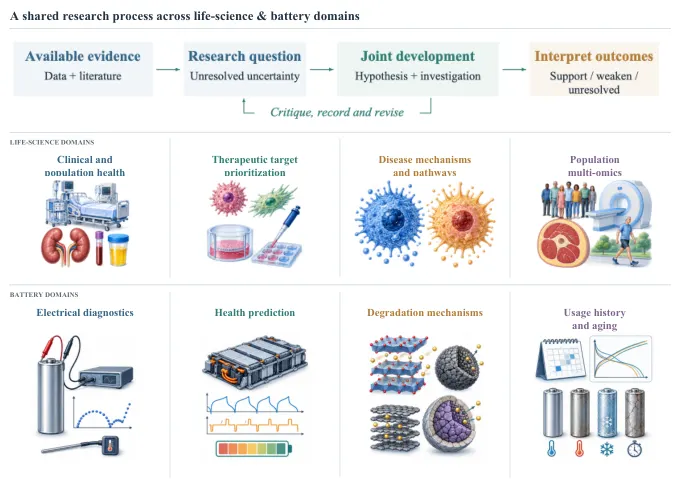
Scientific discovery requires developing worthwhile hypotheses into practical investigations, yet learning from this evolving research process remains challenging. We introduce an operational definition of valuable and testable research hypotheses: evidence-grounded claims about consequential uncertainties, coupled with feasible investigations, explicit decision criteria, and alternative explanations. Our DiscoveryRSI framework develops hypothesis trees through multi-agent evolutionary search, compiles selected investigations into executable Harbor tasks, and recursively learns through three mechanisms: hypothesis credit optimization attributes scientific assessments to documented research contributions; harness replay identifies productive strategies and recurring failures to refine research workflows; and rediscovery applies accepted improvements to new investigations, generating further experience for subsequent learning. We also introduce DFM-Bench, which provides comprehensive assessment of hypothesis quality and cumulative research progress at the levels of hypotheses, revisions, development paths and research runs. Across four life-science domains, automated evaluation shows that hypothesis quality rises from 4.86 for the base model to 5.39 after two rounds of self-improvement, with the large gains in falsifiability and data resolvability. We further validate hypothesis quality through expert review, comparing our DiscoveryRSI-27B with other research agents. Preliminary human assessments show that DiscoveryRSI-27B scores higher than GPT-6 Luna on hypothesis importance and whether claims are plausible and evidence-bounded. DiscoveryRSI-27B achieved a 6.3% rate of hypothesis correspondence with research published after the model cutoff, largely outperform GPT-6 with 2.5% and Claude Opus 5 with 2.3%, while delivering greater human-rated improvement along research paths.

Jianyuan Zhong, Chenwei Wu, Zhaochen Yu · 392 views · Oct 16, 2026
Scientific DiscoveryMulti-Agent Systems
Oct 16, 2026
The Agentic Scientist: Orchestrating Coding Agents for Automated Scientific (Co-)Discovery

The Agentic Scientist: Orchestrating Coding Agents for Automated Scientific (Co-)Discovery

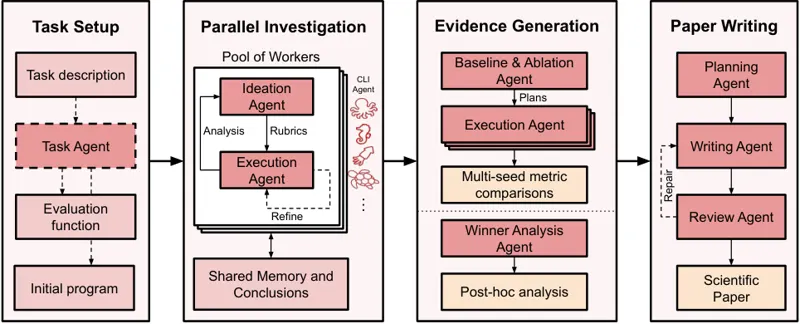
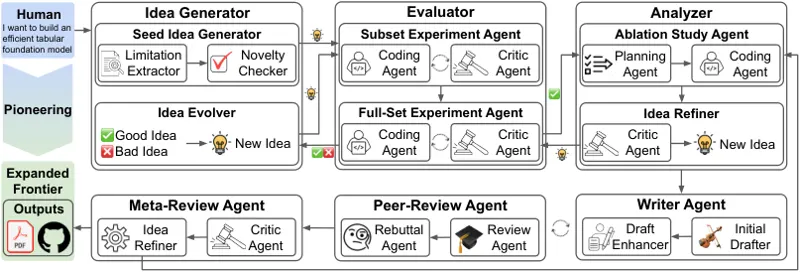
Modern coding agents are fundamentally reshaping the role of human input for computational research: they write code, launch in silico experiments, analyze their results, and autonomously operate with ever-increasing time horizons. Despite these developments, fully autonomous research agents suffer from a limited ideation radius and myopic hill-climbing search dynamics. To bridge this gap, we introduce The Agentic Scientist, an end-to-end distributed pipeline for human researchers to conduct computational research alongside modern coding agents. Building on its predecessor, our system decomposes research into task drafting, idea generation, planning, sandboxed experimentation, result aggregation, baseline and ablation construction, post-hoc analysis, and report writing. Importantly, each step in the pipeline is powered by the next generation of coding agents and leverages agentic self-verification. The overall research process is driven by a meta-controller that manages parallel research agents and enforces rubric verification at each stage. This design enables the same orchestration layer to be reused across heterogeneous domains with different execution environments, agentic coding harnesses, and evaluation metrics. Our system can be used across a spectrum of autonomy: either as a co-scientist tool or to perform end-to-end scientific investigation. Within the co-scientist setting, we leveraged a development version of our system to submit a single research paper, which got accepted for publication at ALIFE 2026. We further apply The Agentic Scientist fully autonomously to open problem-solving tasks in machine learning, and demonstrate the system's capability of scientific discovery across different domains of computational research. Our ablations suggest that reliable scientific autonomy depends not only on base model capabilities, but also on the cross-agent orchestration layer.

Robert Tjarko Lange, Luca Grillotti, Yutaro Yamada · 614 views · Oct 13, 2026
AI ScientistCoding Agent
Oct 13, 2026

As an Amazon Associate, we earn from qualifying purchases.