Skip to content
← Tags

#Motion retargeting (32)

METATRON: A Promptable Whole-Body Execution Layer for Humanoids

METATRON: A Promptable Whole-Body Execution Layer for Humanoids

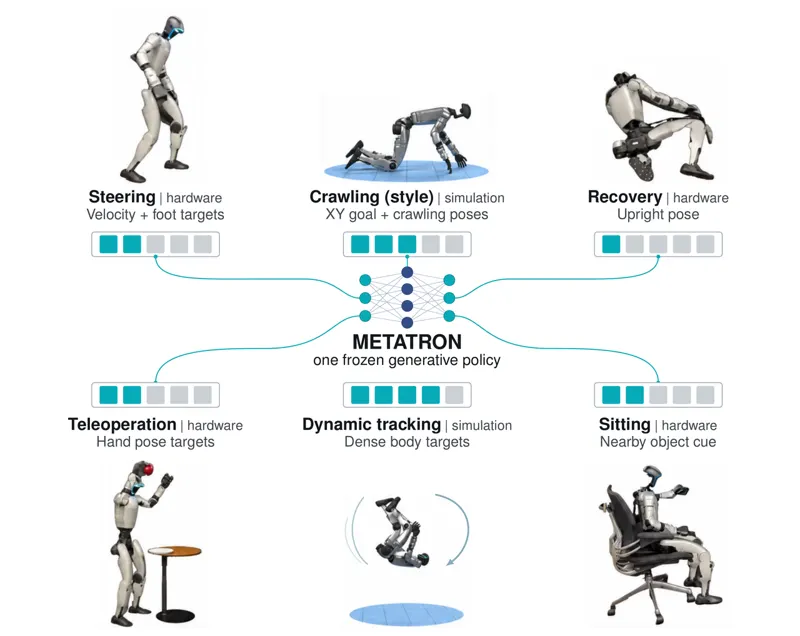
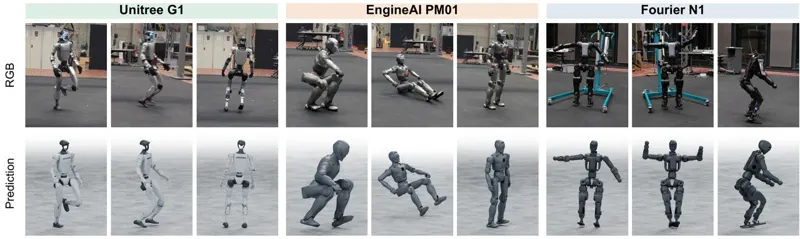
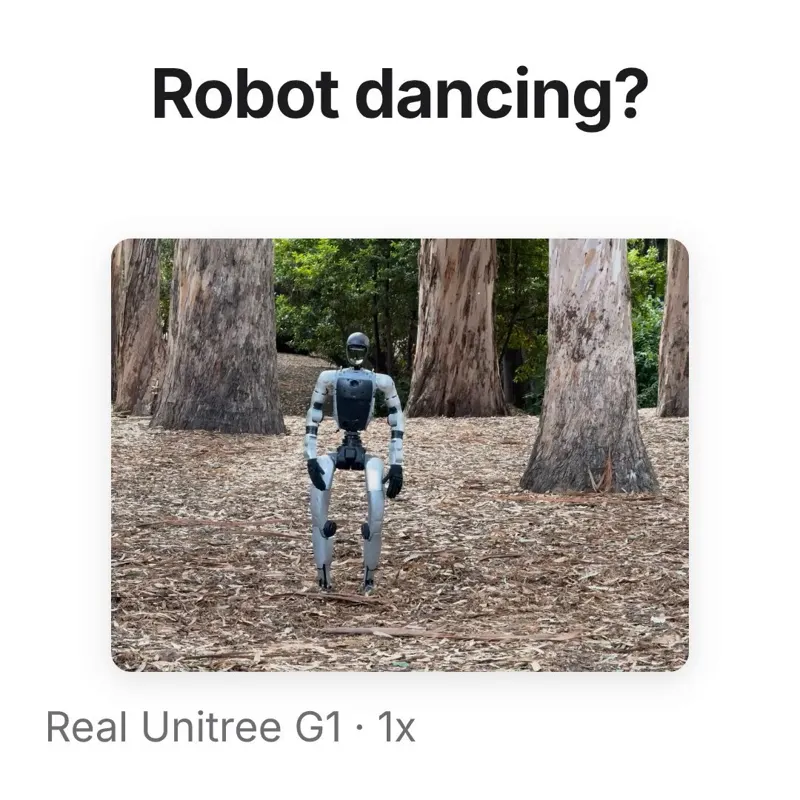
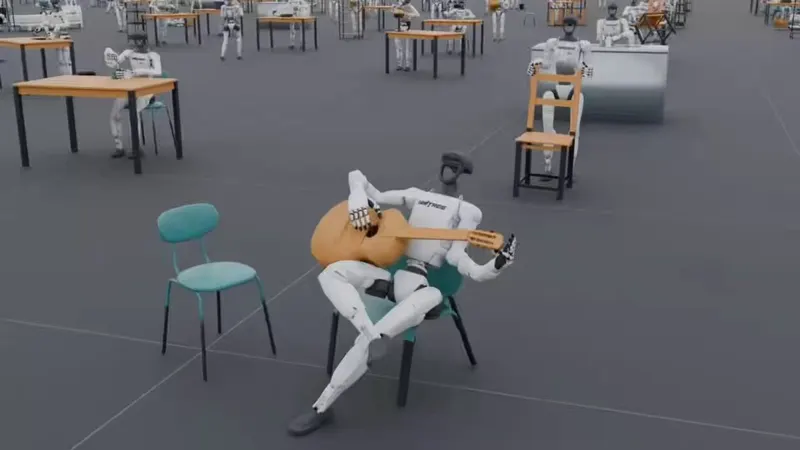
Humanoid controllers often require task-specific training despite sharing the need for balance and whole-body coordination. We present Metatron, a promptable whole-body execution layer combining a generative base policy with a programmable skill layer. The base policy receives partial goals, collectively called a prompt, that can combine timed body-part targets, velocity commands, and style cues. It produces diverse whole-body motions consistent with these goals. Training combines motion capture, synthetic recovery trajectories, and retargeted scene-interaction motions. After training, the policy is frozen. Stateful programs called skills express task intent as prompts at each control step, drawing rough geometric sketches that the policy turns into coordinated movement. Skills are ordinary code, refined by coding agents that analyze motion data and fit compact rules without task-specific policy training. On the physical Unitree G1, one frozen checkpoint supports walking, recovery, teleoperated object pickup, and sitting on furniture. Comparative evaluations show higher reaching success and push robustness than the tested reference-tracking pipelines. The same recipe produces climbing and acrobatics on a simulated character. Metatron enables coding agents to turn learned motor capabilities into new skills through code, without further policy training.

Chen Tessler, Yifeng Jiang, Alec Otto · 316 views · Oct 27, 2026
HumanoidWhole-Body Control
Oct 27, 2026

Humanoid Mobility via Attention-based Contacts

Humanoid Mobility via Attention-based Contacts

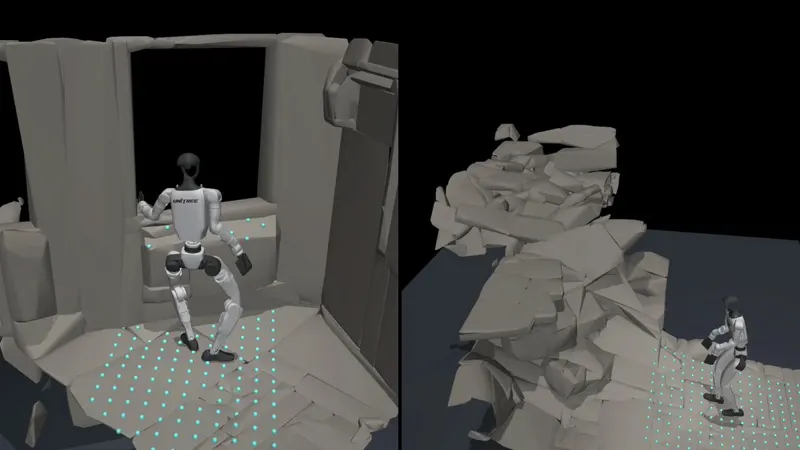
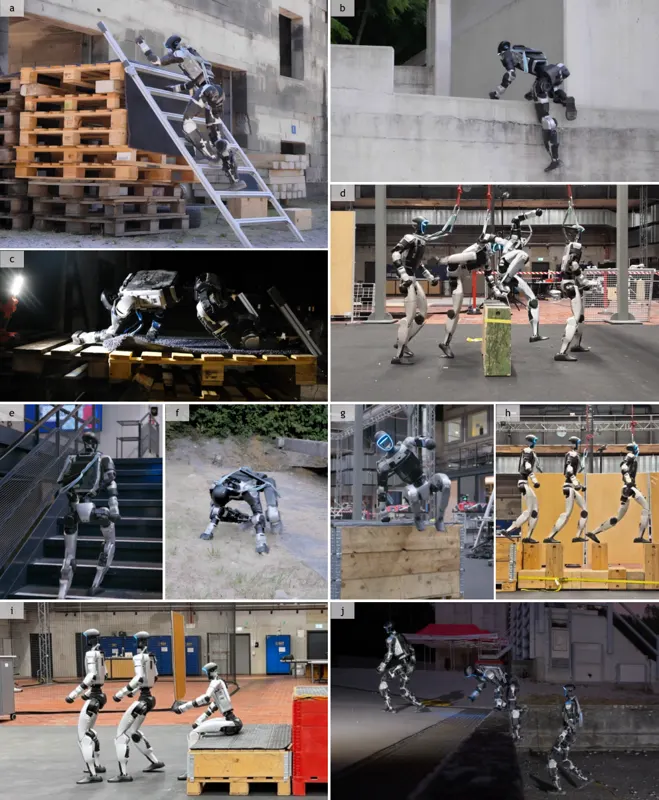
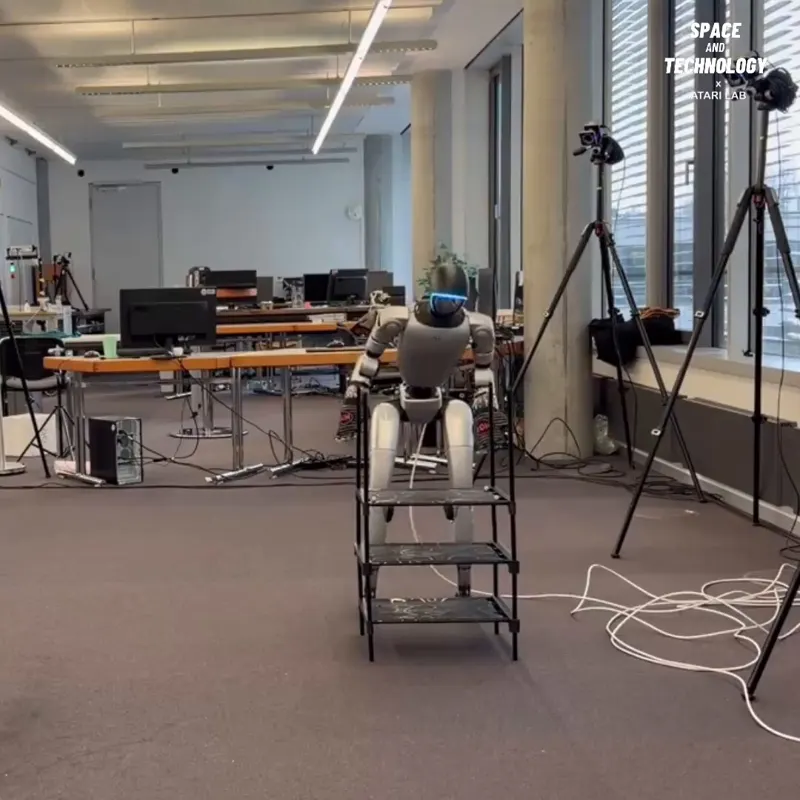
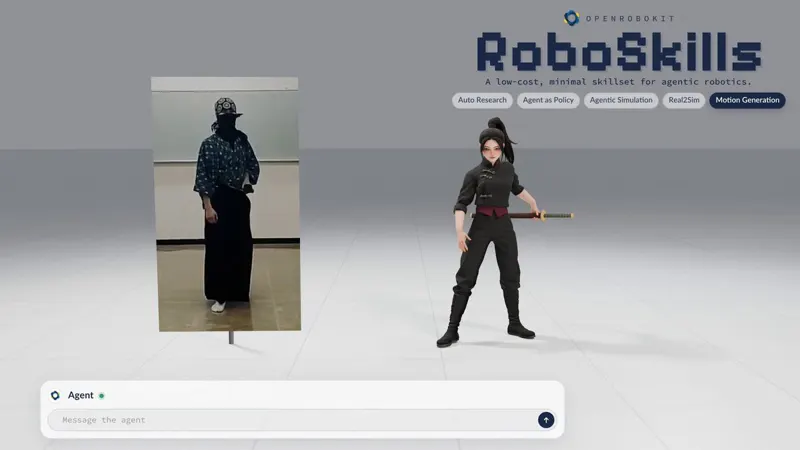
Humanoid mobility over complex terrain requires accurate foot placement and coordinated whole-body motion capable of robust adaptation. Reinforcement learning (RL) policies trained without motion references generalize well across terrains, yet eliciting effective whole-body coordination through reward design and exploration alone remains challenging. In contrast, reference-based methods yield natural motions but struggle to adapt beyond the predefined trajectories in their training data. We introduce a learning framework that bridges these two approaches by using motion data strictly as a training prior. An explicit, self-supervised, attention-based contact planner predicts future body-environment contacts, while a contact-conditioned tracker translates these plans into coordinated whole-body motion. Together, they establish contact as an interface between sensory observations and control actions. This abstraction allows the policy to internalize the contact-aware structure of locomotion rather than directly replicating kinematics. Consequently, a single policy can exploit data-driven motion priors for natural whole-body coordination while retaining the flexibility to discover environment-dependent behaviors through reinforcement learning. Building on the learned contact planner and tracker, a subsequent fine-tuning stage bootstraps their acquired capabilities to explore environment variations beyond those covered by the original motion data. Operating entirely from onboard observations without any reference inputs at deployment, this framework enables versatile humanoid mobility in challenging environments.

Junzhe He, Kehan Wen, Chong Zhang · 377 views · Oct 22, 2026
HumanoidLocomotion
Oct 22, 2026
DONIC: Generalist Dexterous Bimanual Tracking Control from Human Demonstrations

DONIC: Generalist Dexterous Bimanual Tracking Control from Human Demonstrations

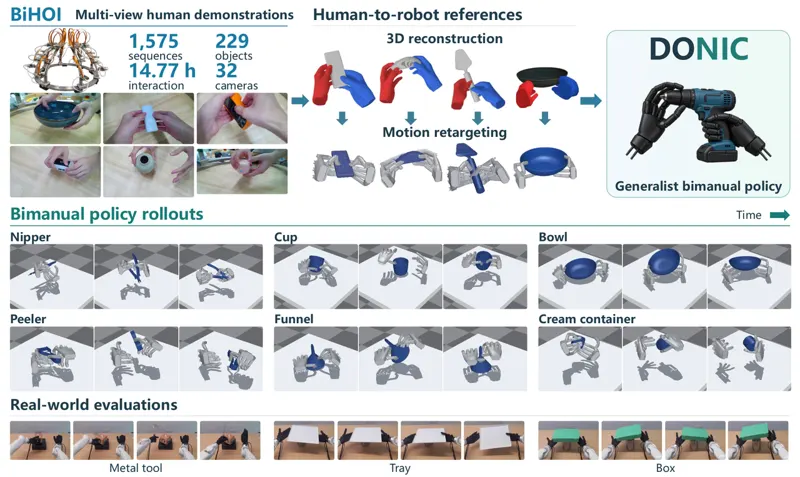
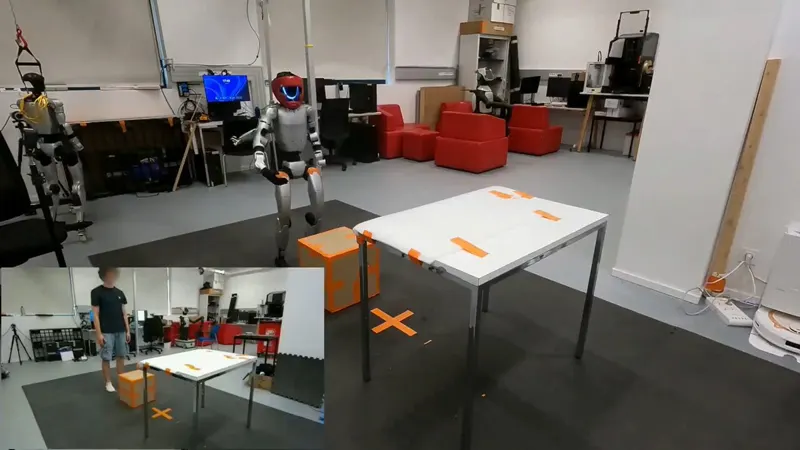
Despite recent progress in dexterous reference tracking, existing models focus primarily on single-hand manipulation and a limited range of interactions, leaving the bimanual dexterous behaviors common in real life unaddressed. The scarcity of contact-rich bimanual manipulation data and the increased complexity of coordinating contacts make developing a generalist bimanual tracker particularly challenging. Therefore, we present 1) DONIC, the first generalist bimanual tracker jointly trained across operation categories and human-motion sources, together with 2) BiHOI, a multi-view dataset of 1,575 sequences spanning 229 objects and emphasizing sustained bimanual interaction, where reconstructed interactions are retargeted into robot references. DONIC combines proximal policy optimization with behavioral cloning in a feedback loop that recycles verified successful executions into training demonstrations. An object-centered per-hand reward maintains object-motion feedback while supervising each hand according to its reference contact role. Clip-Centered Advantages remove reference-dependent advantage offsets while preserving within-trajectory differences. Together, these designs enable one single policy to learn coordinated manipulation across heterogeneous references. Without finetuning, a single checkpoint achieves 86.79% success on unseen trajectories of training objects and 57.32% on held-out objects, surpassing the state-of-the-art bimanual tracking baselines by 77.36 and 45.73 percentage points.

Mingze Sun, Ziang Cao, Yuan Fei · 218 views · Oct 21, 2026
Dexterous ManipulationBimanual Manipulation
Oct 21, 2026

As an Amazon Associate, we earn from qualifying purchases.