Skip to content
← Tags

#Egocentric Vision (13)

OmniEgoCap: Device-Agnostic Sequence-Level Egocentric Motion Reconstruction

OmniEgoCap: Device-Agnostic Sequence-Level Egocentric Motion Reconstruction

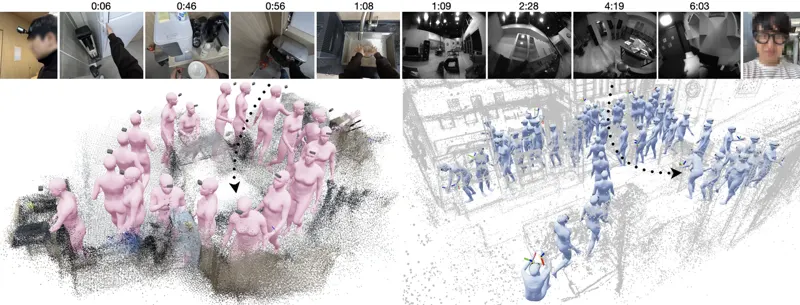
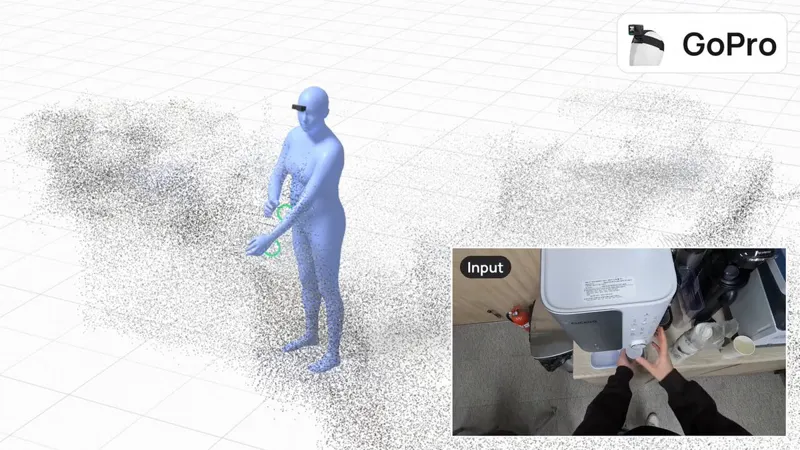
Commercial egocentric devices capture human behavior in everyday settings, yet full-body motion reconstruction must generalize across diverse cameras and mountings. This is challenging because head trajectories under-determine body motion, while hand observations are intermittent and camera-dependent: a hand may disappear simply because it has left the camera's field of view. Existing methods treat such absences as missing data, relying on fixed visibility regimes or post-hoc optimization, and fail to generalize across devices. We present OmniEgoCap, a sequence-level diffusion framework for device-agnostic egocentric full-body motion reconstruction. Our key insight is that egocentric videos contain sequence-level evidence about both the wearer and the camera-induced visibility structure, enabling OmniEgoCap to infer consistent body shape and coherent motion from sparse head and hand cues. To prevent overfitting to a single camera setup, we further introduce geometry-aware visibility augmentation, which synthesizes visibility patterns from realistic variations in camera geometry. We also present OmniEgoDB, the first mocap benchmark that pairs ground-truth motion with recordings from multiple consumer egocentric devices. Experiments on synthetic, real-device, and in-the-wild settings demonstrate superior motion reconstruction, robust cross-device generalization, and coherent in-the-wild results.
Kyungwon Cho, Jeonghyeon Na, Hanbyul Joo · 51 views · Dec 22, 2025
Egocentric VisionMotion Capture
Dec 22, 2025
Social-WM: Safety-Aware Latent World Models for Robot Social Navigation

Social-WM: Safety-Aware Latent World Models for Robot Social Navigation

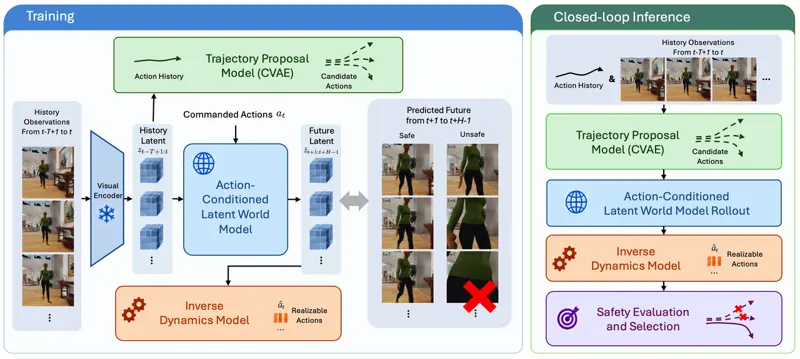
Safe social navigation requires a robot to anticipate not only the future consequences of its actions, but also whether a nominal action can actually be executed under surrounding physical and social constraints. We present Social-WM, an efficient latent world-model planning framework trained from egocentric RGB video sequences. Our key observation is that social-navigation experience contains a systematic discrepancy between the nominal action and the realizable action: a nominal forward action may be fully executed in free space, but needs to be constrained when heading towards a pedestrian or obstacle. Social-WM learns these safety-relevant consequences directly through action-conditioned future prediction, where the target is the actual observed future following each command. We further introduce a realizable inverse-dynamics objective that associates observed latent transitions with the action actually realized rather than the nominal one. At deployment, candidate actions are imagined through the latent world model, and the inverse dynamics model estimates their realizability; nominal–realizable discrepancy then provides a safety signal before execution. The learned dynamics and realizability model remain goal-independent and support both position- and image-goal navigation. On Social-HM3D, Social-WM achieves 63.77% success while reducing human collisions to 21.67%, and maintains strong performance under zero-shot transfer to Social-MP3D, without explicit pedestrian tracking, privileged human state, or online reinforcement learning.

Zhihao Zheng, Mooi Choo Chuah · 250 views · Sep 30, 2026
Social NavigationWorld Models
Sep 30, 2026

As an Amazon Associate, we earn from qualifying purchases.