Skip to content
AeroAct: Action-Centered World-Action Models for Language-Conditioned Quadrotor Flight

AeroAct: Action-Centered World-Action Models for Language-Conditioned Quadrotor Flight

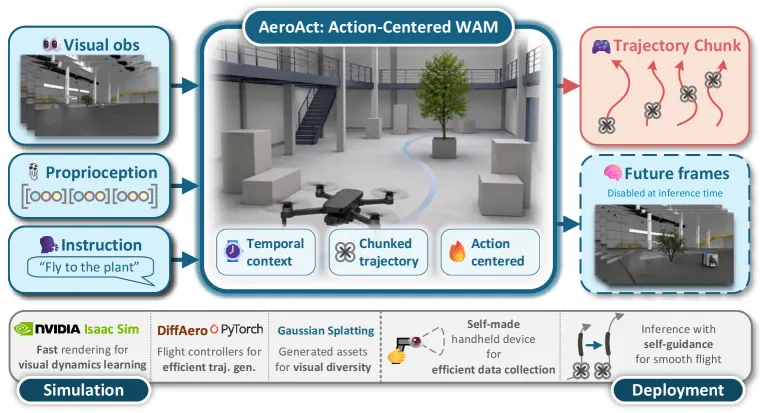
Language-conditioned quadrotor flight requires a policy to ground semantic goals, anticipate the visual consequences of ego-motion, and output control references that remain smooth and dynamically executable under rapidly changing first-person views. Existing aerial vision-language navigation and vision-language-action methods commonly use discrete actions, high-level waypoints, or instantaneous velocity commands, which provide limited supervision about how flight actions change future observations. We present AeroAct, an action-centered world-action model (WAM) for quadrotor navigation. To the best of our knowledge, AeroAct is the first WAM instantiated and demonstrated for real-world aerial flight. The model adapts a pretrained video diffusion Transformer to predict local trajectory-action chunks from egocentric visual history, proprioception, and language. Future first-person frames are used during training as dense consequence supervision, while deployment directly decodes actions without generating future video. To obtain aligned visual, state, language, and dynamically feasible action data, we build a DiffAero-based pipeline with complementary Isaac Lab and 3D Gaussian splatting renderers. We further introduce a low-cost handheld collection device that couples camera observations with motion estimates to recreate flight-like egocentric trajectories, and a self-guidance procedure that improves temporal consistency across overlapping trajectory chunks. Closed-loop simulation and real-world experiments show that temporal visual context improves target tracking and object-search performance, and that WAM-based policies can be executed on a physical quadrotor.

UAVQuadrotor
Xinhong Zhang, Qiyuan Zhu, Yubo Huang · 613 views · Jul 16, 2026
JoyNexus: Service-Oriented Multi-Tenant Post-Training for VLA Models

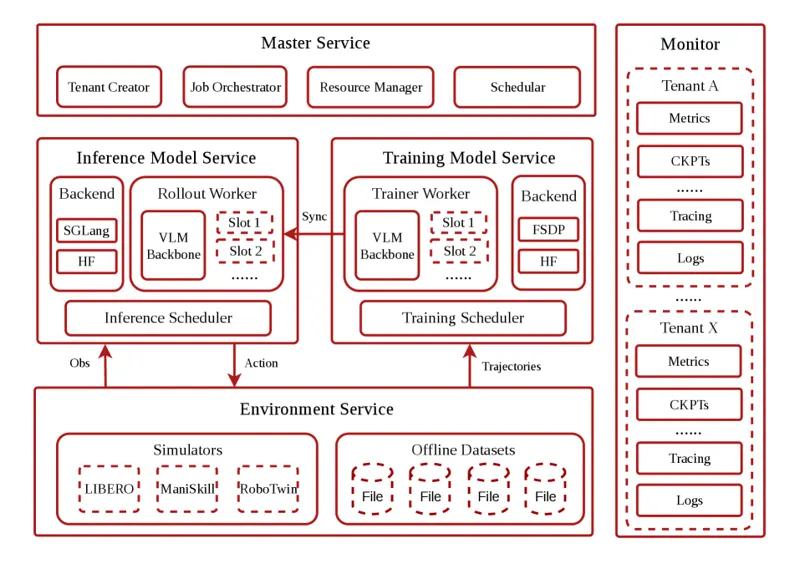
JoyNexus: Service-Oriented Multi-Tenant Post-Training for VLA Models

The post-training of Vision-Language-Action (VLA) models is essential due to the diversity of simulators, robot embodiments, and task objectives. Existing compute services, whether offered as direct accelerator rental or batch-workload submission, typically allocate an exclusive set of GPU and CPU resources to a single tenant. While this paradigm maximizes client flexibility, it burdens users with infrastructure adaptation, and the fixed card-hour accounting model renders short or bursty workloads both expensive for tenants and inefficient for the service provider. To address these challenges, we present JoyNexus, a unified service for multi-tenant VLA supervised fine-tuning, reinforcement learning, and evaluation. JoyNexus decouples the Training Model Service, Inference Model Service, and Environment Service, each accessed through APIs and backed by resident shared base models with tenant-specific slots. Tenants can directly invoke high-level semantic APIs for training, rollout, and evaluation, or compose custom algorithms using lower-level APIs and their assigned endpoints. Multiple tenants submit workloads concurrently; their action modules, optimizers, rollout records, and policy versions remain isolated, and the service is scheduled by the global Training Queue and Inference Queue. To further improve multi-tenant training efficiency, JoyNexus introduces group batching for heterogeneous VLA data schemas that share a compatible model-facing prefix, enabling a single shared backbone forward pass over grouped samples. Finally, we evaluate JoyNexus through workload simulation and a group-batching pipeline in a realistic embodied scenario. Results show that, compared with isolated single-tenant execution, JoyNexus reduces aggregate GPU time and improves service utilization via cross-tenant scheduling on shared resources.

VLAPost-training
Haoran Sun, Wentao Zhang, Junyang Hua · 571 views · Jul 17, 2026

As an Amazon Associate, we earn from qualifying purchases.