Skip to content
AgentGarten: Code Worlds for Evolving Agents

AgentGarten: Code Worlds for Evolving Agents

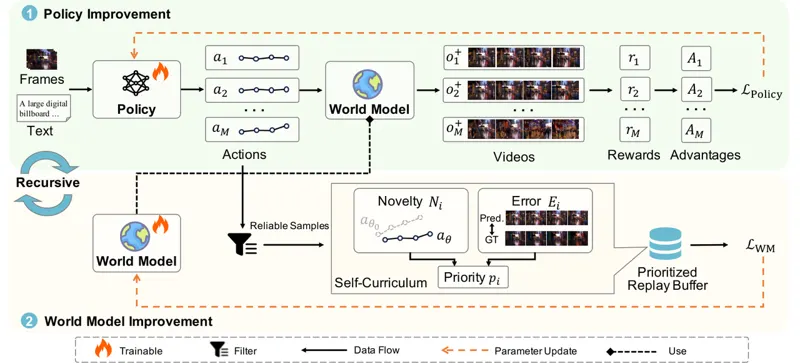
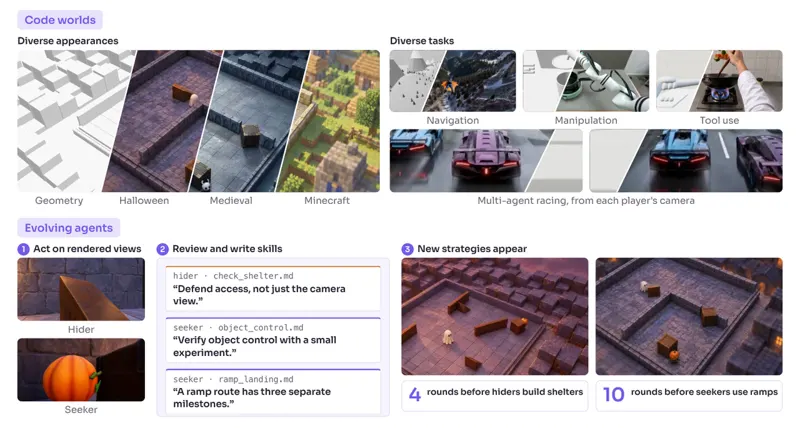
Interactive virtual worlds allow agents to learn through exploration and interaction. What agents can learn is bounded by the environments they practice in, which must be faithful, with consistent state, rules, and dynamics, and realistic, with observations that follow the real-world visual distributions. Achieving both across diverse worlds remains a bottleneck. We introduce AgentGarten, a framework that couples simulators and game engines with a shared neural renderer to build real-time interactive environments. Its simulation backends maintain persistent world state and execute program-defined interaction rules, while the renderer generates visual observations from structured conditions exported through a common interface. To build the neural renderer, we adapt a pretrained video model to geometry conditions, distill it with our proposed Adversarial Forcing, and optimize inference for real-time interaction. Adversarial Forcing makes history prefilling differentiable through exact replay, so that losses on later predictions update how the renderer encodes prior observations, and adds real-data adversarial supervision to improve its visual quality. In AgentGarten, agents perceive the world through visual observations, interact with it in real time, and improve by distilling each round of experience into playbooks that subsequent agents inherit and refine. Our empirical study demonstrates a substantial gain in learning efficiency, with agents learning from just 4 rounds compared with millions for a conventional reinforcement learning counterpart. As new worlds can be written as code and rendered through the same interface, environments can scale in both number and difficulty alongside their agents, a step toward agents that keep evolving through interactive experience.

World ModelsNeural rendering
Jiawei Chi, Shangchen Miao, Zhiyuan Shi · 675 views · Oct 8, 2026
Temporal Visuo-Tactile Learning for Dexterous Grasp Stability

Temporal Visuo-Tactile Learning for Dexterous Grasp Stability

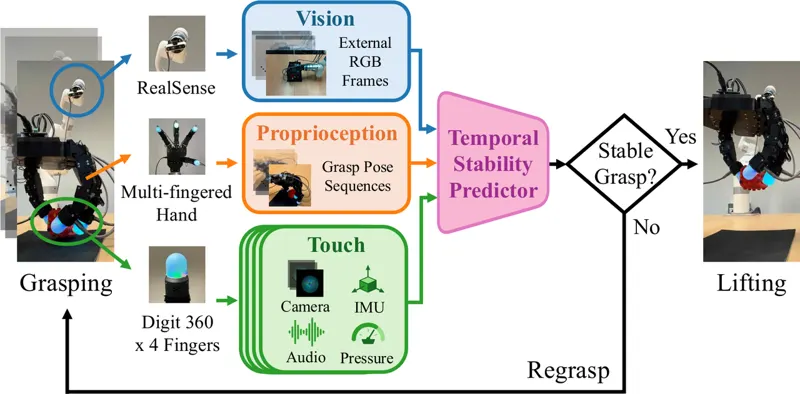
Most robotic grasping research picks a pose from vision and closes a parallel gripper, while humans rely on fingertip touch and almost never drop things. The LASR Lab at TU Dresden reframes the question as "is this multi-fingered grasp stable before we lift?" and answers it with data. They mount four Digit 360 sensors on the fingertips of a 16-DoF Tilburg Hand on a 7-DoF xArm7 and automatically collect 10,000 grasp trials over 200 objects (105 rigid, 95 deformable, 1.9-244 g), recording external RGB-D, proprioception and four tactile streams (camera, audio, IMU, pressure) throughout each grasp. Stability labels come from SAM 3 measuring post-lift object height and agree with manual verification on 92.34% of trials. The predictor consumes a 3-second window anchored at grasp initiation: 16-frame RGB and tactile clips go through pretrained VideoMAEv2-Base, 100-step proprioception and 224-step audio/IMU/pressure go through Transformers, fingertip features are fused across modalities, time and fingers by weight-shared factorized attention, and everything is aggregated by attention fusion into a post-lift stability probability. Under 5-fold object-disjoint cross-validation, vision+proprioception+touch reaches 83.55% and removing touch costs 3.99 points (79.56%). Tactile spatial resolution matters monotonically (79.40% at 1x1 up to 83.55% at 112x112), and freezing touch to its final frame costs 2.07 points, so the useful signal is high-resolution and dynamic. Deployed as an online lift-or-regrasp gate (threshold 0.95, up to five regrasps) on 20 objects excluded from training, the visuo-tactile gate reaches 82.0% success among executed lifts, 10.5 points above a non-tactile gate. The ~1.2 TB dataset is public on OPARA.

Dexterous ManipulationTactile Sensing
Ken Nakahara, Aleksei Buvailik, Prokhor Kotov · 651 views · Oct 7, 2026
RoboPrompt: Intuitive Robot Policy Steering with Sparse Human Input

RoboPrompt: Intuitive Robot Policy Steering with Sparse Human Input

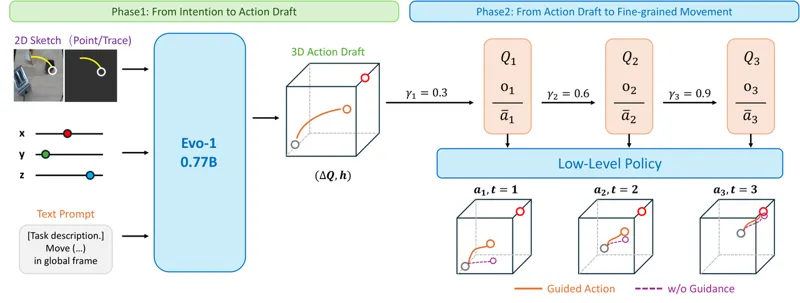
End-to-end robot policies trained through imitation learning remain constrained by limited data diversity, making reliable zero-shot deployment in real-world settings challenging. Shared-autonomy methods enable human correction through teleoperation, but specialized hardware and operator training hinder deployment at scale. Other approaches incorporate human guidance as additional policy inputs, often requiring architectural changes and dedicated training for steerability, which limits their applicability across policies. We present RoboPrompt, a general-purpose, lightweight robot policy steering system that enables users to guide policy behavior through intuitive, sparse inputs, including drawn traces, target points, and coarse directional instructions. RoboPrompt decouples human-intention translation from the underlying policy: a reusable module converts human guidance into action drafts, which are refined through the diffusion or flow-matching dynamics of the base policy. By controlling action generation in noise space, RoboPrompt balances human intent with the policy prior without modifying the base policy architecture or fine-tuning it for steerability. Experiments demonstrate effective steering across Diffusion Policy, π_0.5, and FastWAM. We further use steered rollouts for online policy improvement through DAgger. After 2-3 rounds of iteration, average success rates increase by 15.5% for π_0.5 across three tasks and by 21.3% across three policies(Diffusion Policy, π_0.5, FastWAM) on the Insert Bread task, while average human intervention counts decrease by 44.0% (2.86 to 1.60) and 81.9% (2.60 to 0.47), respectively.

ManipulationImitation Learning
Yanwen Zou, Chenyang Shi, Guoxuan Xu · 541 views · Oct 7, 2026
UniLM-Nav: A Unified Framework for Zero-Shot Last-Mile Navigation

UniLM-Nav: A Unified Framework for Zero-Shot Last-Mile Navigation

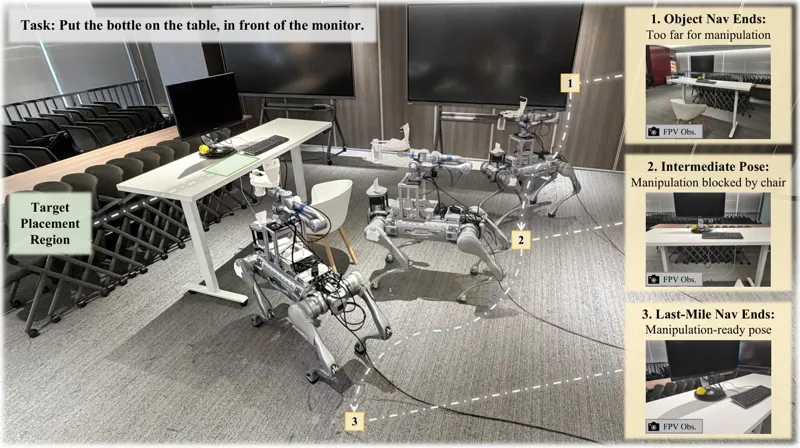
Mobile manipulation requires a robot to navigate to a target object or receptacle and then perform intended manipulation. However, reaching the vicinity of the target does not guarantee a manipulation-ready base pose, a problem known as last-mile navigation. Prior methods for last-mile navigation either rely on manual pose annotation or task-specific training, limiting their scalability to open-vocabulary settings with fine-grained spatial constraints. We propose UniLM-Nav, a unified framework for zero-shot open-vocabulary last-mile navigation. UniLM-Nav decomposes last-mile navigation into view selection, task-conditioned affordance grounding, and geometry-aware base-pose reasoning, all resolved with a shared multimodal large language model (MLLM) backend. Specifically, UniLM-Nav first selects a reference view that best captures the target object or receptacle from recently collected observations. It then grounds task-relevant affordance point in the selected view and lifts the result into the robot-centric coordinate frame. Finally, conditioned on the grounded affordance, task context, and robot geometry, it infers a manipulation-ready base pose for the robot. We evaluate UniLM-Nav on the OVMM benchmark, where it outperforms the previous state-of-the-art method, MoTo, by 3.13 percentage points. Analyses show that the components of our method are crucial to final performance, and that the choice of MLLM also has a substantial effect. We further deploy UniLM-Nav on a Unitree B2 quadruped robot with a 6-DoF Unitree Z1 manipulator, validating its applicability to real-world mobile manipulation tasks.

Mobile ManipulationLast-Mile Navigation
Zhuofan Zhang, Tianxu Wang, Guoxi Zhang · 404 views · Jul 7, 2026
ID Balancing: Stable Training of Extremely Sparse MoE via PID-Based Load Control

ID Balancing: Stable Training of Extremely Sparse MoE via PID-Based Load Control

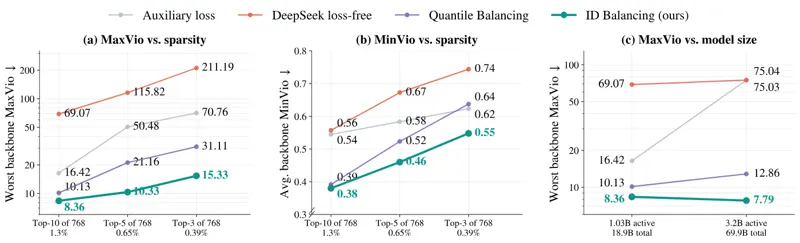
Scaling Large Language Models (LLMs) via Mixture-of-Experts (MoE) enables massive parameter growth with nearly constant per-token computation. However, further scaling the parameter count requires increasingly sparse routing, where expert load imbalance becomes more severe. This imbalance reduces parameter utilization and training efficiency, and can undermine training stability, becoming a bottleneck to reliable scaling. In this work, we unify two representative auxiliary-loss-free methods as incomplete Proportional-Integral-Derivative (PID) controllers: DeepSeek's loss-free method acts as a fixed-step integral controller, while Kimi K3's Quantile Balancing functions as a generalized proportional controller. Building on this control perspective, we propose ID Balancing, an Integral-Derivative controller. It scales its integral term with load error and activates its derivative term only when imbalance worsens, enabling stronger corrections for large or worsening errors and smaller updates near balance. Evaluated across Top-$10$, Top-$5$, and Top-$3$ routing over $768$ experts, ID Balancing reduces worst-case backbone MaxVio and training-average backbone MinVio by over 50% and 12%, respectively, relative to the best baselines in the Top-$3$ setting. When the total parameter count increases from $18.9$B to $69.9$B (Top-$10$-of-$768$), ID Balancing's worst-case backbone MaxVio remains nearly unchanged and is approximately 89.6% lower than that of the auxiliary-loss baseline. ID Balancing also maintains competitive language-modeling and downstream performance. The advantages of ID Balancing grow as sparsity increases, making it a promising solution for scaling larger, sparser MoE models.

Mixture-of-ExpertsLoad Balancing
Peng Jin, Zihan Qiu, Zekun Wang · 170 views · Sep 30, 2026

As an Amazon Associate, we earn from qualifying purchases.