Skip to content
Reinforcement Learning Enables Scaling Generalist Robot Policy Improvement

Reinforcement Learning Enables Scaling Generalist Robot Policy Improvement

The introduction of generalist robot policies has enabled a single, large model to learn to perform a variety of tasks from a vast pre-training corpus. While these models often exhibit powerful zero-shot generalization capabilities, they typically require an adaptation phase to achieve sufficient performance in deployment. Iterated self-improvement via reinforcement learning (RL) has demonstrated promise in enabling this adaptation, yet such approaches have been largely explored in single-task settings - where the goal is to simply improve on a narrow deployment task - which lies in stark contrast to the multi-task capabilities of the base policy. In this work we ask whether generalist robot policies are capable of multi-task, generalist improvement in deployment - targeting many diverse tasks simultaneously - and what algorithmic recipe enables this. To answer this question, we first develop a set of structured evaluations to test generalist improvement capabilities, and systematically evaluate algorithmic and practical design choices regarding value estimation, policy extraction and resource allocation. We show that not only can generalist policies be improved online across diverse tasks, but that the right recipe can enable generalization and increase performance on tasks not considered during online training. We characterize when this generalization occurs and show that both the training task distribution and the use of value-based RL are critical. To the best of our knowledge, this is among the first evidence for online generalist improvement for robot foundation models.

Vision-language-action (VLA)Reinforcement Learning
Michal Korniak, Marco Bagatella, Ralf Römer · 69 views · Nov 4, 2026
RLSR: Reinforcement Learning from Self Reward

RLSR: Reinforcement Learning from Self Reward

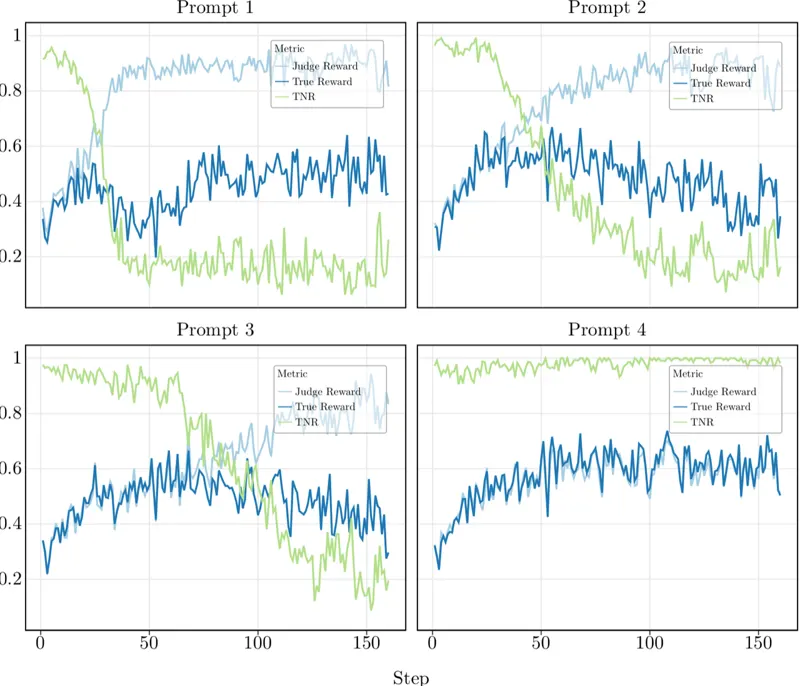
Large language models can generate solutions to complex problems, but training them with reinforcement learning typically requires verifiable rewards that are expensive to create and not possible for all domains. We demonstrate that LLMs can effectively self-improve through self-judging without reference solutions, leveraging the inherent asymmetry between generating and verifying solutions. Our experiments show that models can provide reliable reward signals without ground truth answers, enabling reinforcement learning in domains where verifiable rewards are impractical. By implementing self-judging across Countdown puzzles and integration problems, we achieve performance comparable to formal verification without ground truth solutions. Most notably, Qwen 2.5 7B DeepSeek Distilled trained with self-rewards qualifies for the prestigious MIT Integration Bee competition, performance through self-supervised improvement. When combined with synthetic question generation, we establish a complete self-improvement loop where models generate practice problems, solve them, and evaluate their own performance without any external validation. Our findings demonstrate that LLM judges can provide effective reward signals for training, unlocking reinforcement learning in countless domains previously limited by reward engineering challenges. This work represents a significant step toward autonomous AI systems that continuously improve through self-directed learning rather than human-guided training, potentially accelerating progress across domains where training data is scarce or evaluation is complex.

Reinforcement LearningLarge Language Models
Toby Simonds, Kevin Lopez, Akira Yoshiyama · 195 views · May 12, 2025
Post-Training Large Language Models via Reinforcement Learning from Self-Feedback

Post-Training Large Language Models via Reinforcement Learning from Self-Feedback

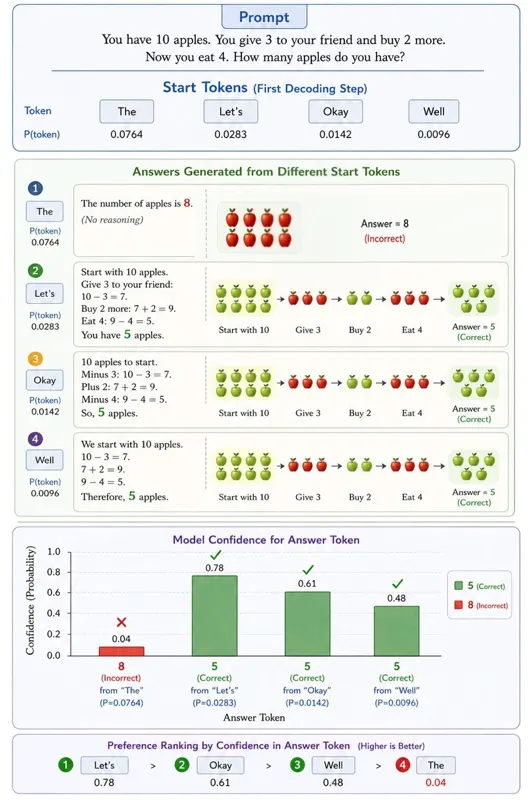
Large Language Models (LLMs) often produce plausible but poorly-calibrated answers, limiting their reliability on reasoning-intensive tasks. Recent research suggests that Chain-of-Thought (CoT) reasoning paths are inherent in pre-trained LLMs and can be elicited by simply altering the decoding process, where the presence of a CoT path correlates with higher answer confidence. Building on these insights, we present Reinforcement Learning from Self-Feedback (RLSF), a post-training stage that utilises the model's intrinsic confidence as a self-generated reward. By generating multiple CoT decoding beams from a frozen LLM, we compute the confidence of each final answer span and rank the resulting traces accordingly to create synthetic preferences. These preferences are subsequently utilised to fine-tune the policy through standard preference optimisation, requiring no human labels, gold answers, or externally curated rewards. RLSF simultaneously (i) refines the model's probability estimates–restoring well-behaved calibration–and (ii) strengthens step-by-step reasoning, yielding improved performance on arithmetic reasoning and multiple-choice question answering. By converting a model's own uncertainty into structured self-feedback, RLSF affirms reinforcement learning on intrinsic model behaviour as a principled and data-efficient component of the LLM post-training pipeline. Our results demonstrate that leveraging these inherent reasoning capabilities provides a robust path for enhancing model reliability without manual prompt engineering or external supervision.

Large Language ModelsReinforcement Learning
Carel van Niekerk, Renato Vukovic, Benjamin Ruppik · 366 views · Jul 29, 2025
Learning Multi-Phase Robot Loco-Manipulation via Phase-Conditioned Policy Optimization

Learning Multi-Phase Robot Loco-Manipulation via Phase-Conditioned Policy Optimization

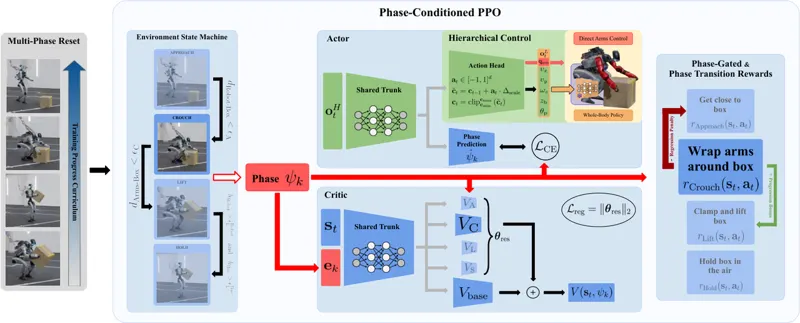
Complex whole-body loco-manipulation requires executing diverse maneuvers, such as crouching, grasping, and locomotion, within a single long-horizon task. While performing simple pick-and-place behaviors is well-established, scaling to complex, long-horizon tasks remains difficult. Currently, this challenge is addressed by relying on human motion data and correspondingly humanoid platforms, which limits platform independence and introduces substantial data processing overhead. Instead, we extend proximal policy optimization (PPO) to train a single policy for multi-phase tasks across diverse robotic hardware, leveraging prior task structure to shape behavior. Our method adapts PPO using a phase-conditioned critic, phase-gated reward functions, and a multi-phase reset curriculum to guide exploration. To support varied hardware, we employ a decoupled hierarchical control architecture that separates lower-level balancing dynamics from high-level phase execution. We demonstrate multi-stage loco-manipulation skills on hardware on both the Unitree G1 and a Boston Dynamics Spot equipped with a manipulator arm, and validate our design choices through ablations. Our approach enables the acquisition of complex loco-manipulation behaviors purely through environment interaction while directly incorporating high-level task structure into policy learning.

Whole-Body Loco-ManipulationPhase-Conditioned PPO
Simone Manni, Annika Wollschläger, Dario Bellicoso · 291 views · Oct 26, 2026

As an Amazon Associate, we earn from qualifying purchases.