PAPER DEEP DIVE
Navigent: A Geometry-Grounded Agentic Framework for Vision Language Navigation
Navigent couples a frozen multimodal language model with a geometry-grounded execution critic (GEC) for vision-language navigation. The agent keeps up to eight uniformly sampled historical views, proposes short action prefixes, and checks every executed primitive against measured displacement, selected visual anchors, entrance bearings, and near-field depth. A discrepancy interrupts the remaining action batch and triggers reobservation, local correction, or recovery along previously traversed nodes. An offline loop then revises prompts and critic logic using full-episode repair-minus-regression outcomes without changing model weights. Navigent reaches 84.0% SR and 72.9% SPL on R2R-CE and 86.0% SR and 69.1% SPL on RxR-CE validation-unseen, and succeeds in 27 of 30 real-world trials on an AgileX SCOUT MINI.
Paper: Xinyu Zhou, Weiren Cai, Yitong Chen, Shenghai Yuan, Zihang Mu, Boyu Ma, Jiahua Dong, Yanshuo Lu, Jiaqi Bai, and Jianfei Yang. MARS Lab, Nanyang Technological University. Released November 25, 2026. arXiv:2611.34249; full text; evaluation code; project page.
Executive Summary
Navigent treats navigation as a control loop in which a frozen multimodal language model proposes local intent while deterministic geometry checks whether the robot's body, camera, and selected landmarks are behaving as that intent predicts. The model is still responsible for semantics, route choice, and stopping. The geometry layer is responsible for noticing that a forward command produced almost no motion, that an anchor moved behind the robot, or that the robot is moving away from a doorway it intended to approach.
This separation matters because an action sequence can look plausible while being disconnected from physical execution. A robot may be blocked, slide sideways, misread its heading, or pass a relevant entrance without recognizing the transition. Navigent interrupts the unexecuted tail of an action batch when it finds such evidence, returns a fresh observation to the model, and permits either a local correction or a return along a previously traversed route. An offline loop then edits prompts and critic code using full-episode repair and regression outcomes, without changing model weights.
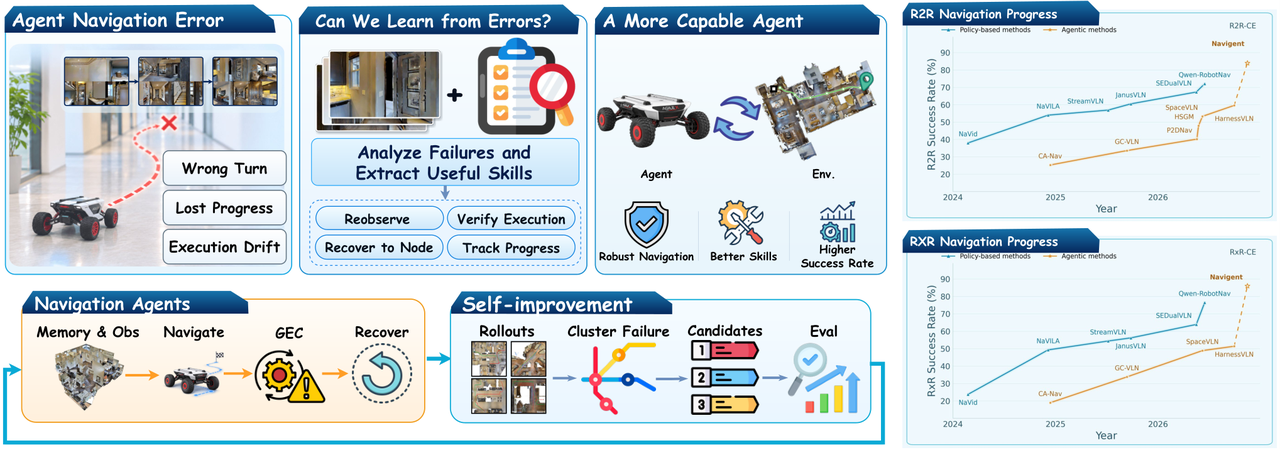
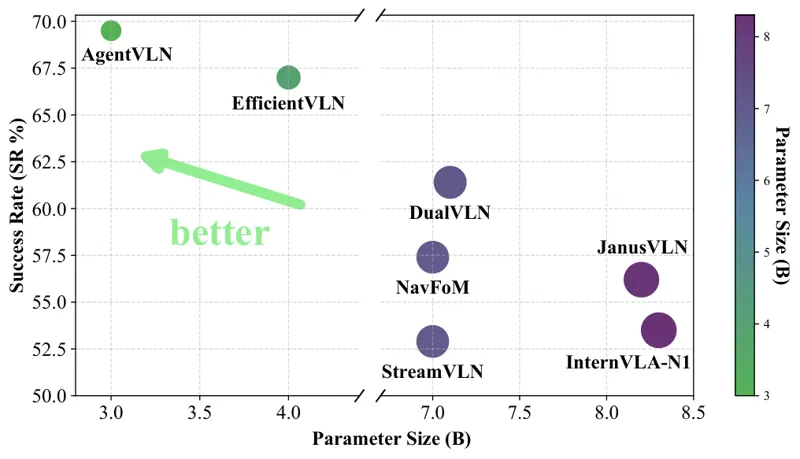
Figure 1: The paper motivates geometry-grounded execution checks with navigation errors and compares Navigent on R2R-CE and RxR-CE.
Why Long-Horizon VLN Breaks
Vision-language navigation combines language grounding with continuous control. The instruction may contain a sequence such as “enter the room behind the sofa, pass the table on your left, then stop before the blue bin.” Each phrase depends on perspective, visibility, and order. A correct answer to “what is in the image?” is not enough: the agent must also know whether it has already crossed a doorway, whether the named object belongs to the current branch, and whether a short forward command changed the relevant relation.
Policy-based systems learn this mapping from large collections of trajectories and can be efficient at inference. Their competence is tied to the training distribution and policy architecture. General-purpose multimodal agents offer another route: use visual reasoning and tools to decompose the route at runtime, then issue actions in a closed loop. The weakness of this approach is execution latency and semantic uncertainty. The model cannot see the result of an action until it has been executed, and a long open-loop action batch compounds any mistaken assumption.
Navigent identifies two complementary kinds of inconsistency. Action-to-motion inconsistency asks whether commanded movement agrees with measured displacement. Motion-to-landmark inconsistency asks whether movement changes the distance and bearing of a selected visual target in the expected direction. The first catches stalls, collisions, and lateral drift. The second catches a robot that is moving but approaching the wrong place or moving away from the place it claims to approach.
The design deliberately avoids hidden evaluation information. Target coordinates, reference routes, and benchmark goal distances are not supplied to the navigator. The geometry layer can use the robot's own pose, camera depth, and observed route history. Its conclusions therefore concern local consistency, not privileged knowledge of the correct answer. This distinction is essential: a geometric warning is evidence for reconsideration, not a certificate that the model selected the right doorway.
System Walkthrough
At each decision, the robot has a current composite of directional RGB views, a chronological archive of earlier composites, a list of visited nodes, and measured self-motion. The current view is outside the historical-image budget. Up to eight archived images are attached to the model call. The archive stores frame identifiers so the model can refer to observations and relate them to executed primitives.
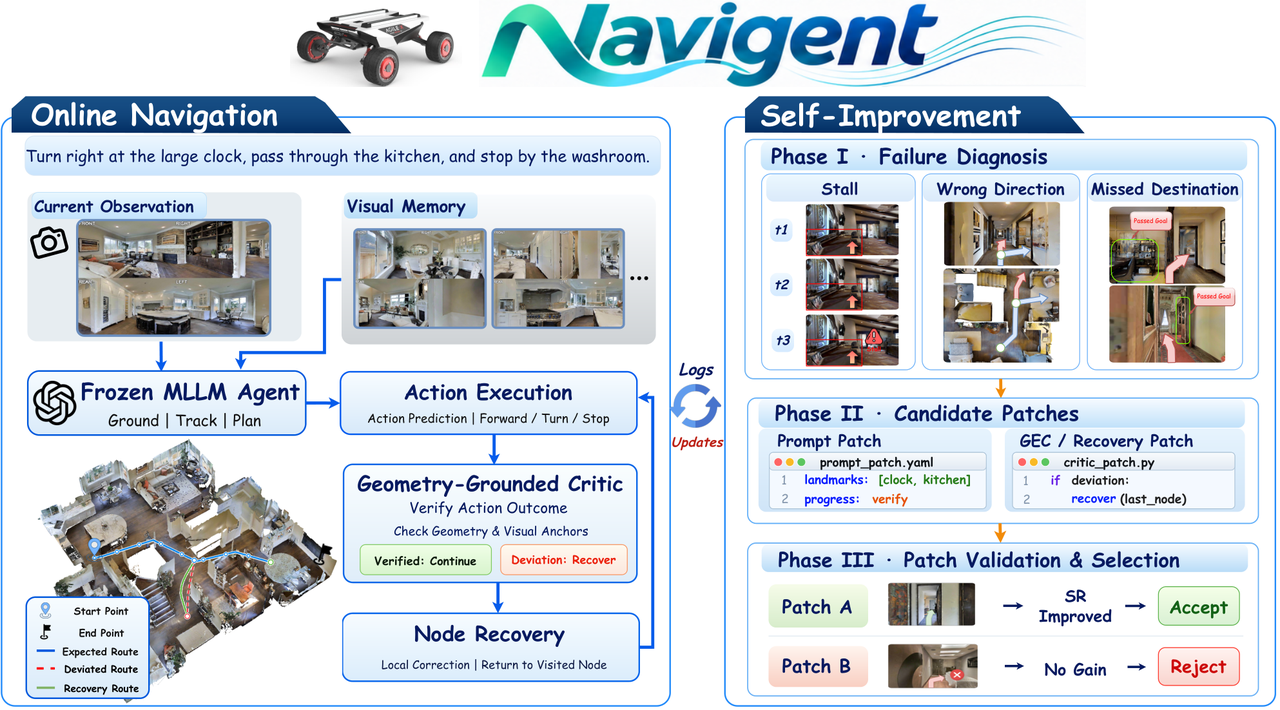
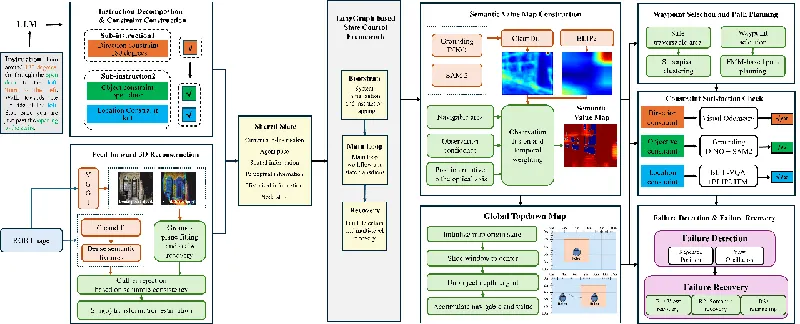
Figure 2: Online navigation combines visual memory, GEC, and node recovery. Offline self-improvement revises prompts and critic logic while keeping the navigation model frozen.
The agent proposes a short action prefix rather than committing to a long route. The executor expands forward commands into fixed primitives and runs the critic after every primitive. If a check fails, the remaining commands are discarded. The model receives the new image, measured pose, primitive count, blocked state, and critic report. It can then inspect, adjust the approach, or choose a previously visited node for recovery.
History selection is uniform over the executed trajectory. Suppose the archive contains $n_t$ observations and the budget is eight, so $K_t=\min(n_t,8)$. The selected indices are:
$$i_j=\left\lfloor\frac{j(n_t-1)}{K_t-1}\right\rfloor,\quad j=0,\ldots,K_t-1.$$The rule always includes the first and most recent observations after the archive exceeds the budget and distributes the remaining slots across the interval. It does not ask a second model which frames are semantically important. That choice reduces cost and variance, but it can omit a brief but decisive turn if the uniform grid misses it.
The selected images retain the camera orientation under which they were captured. This is important for interpreting doors and corridors because the same physical opening can appear in different panorama tiles after the robot rotates. The current four-view observation plus historical views form a visual ledger, while visited nodes provide a graph of actually traversed connections rather than an imagined floor plan.
def uniform_history_indices(total, count=8):
    if count == 0 or total == 0:
        return []
    if total <= count:
        return list(range(total))
    if count == 1:
        return [0]
    return [i * (total - 1) // (count - 1)
            for i in range(count)]
The implementation confirms the paper's memory contract in eval/memory.py and eval/model.py. The latter resolves each selected frame inside a registered archive root, rejects paths outside that root, encodes the image, and attaches it to the model request. The check is not central to the scientific claim, but it shows that the published runtime treats historical images as an explicit, bounded resource rather than allowing arbitrary filesystem retrieval.
Action, Motion, and the Prefix Contract
Let the model's proposed action sequence at decision $t$ contain $H$ commands. The executor runs a prefix of length $h$:
$$\hat{\mathcal{A}}_t=(a_{t,1},\ldots,a_{t,H}),\qquad \mathcal{A}_t^{\mathrm{exec}}=(a_{t,1},\ldots,a_{t,h}).$$This notation expresses a practical safety property. The model can plan several local commands, but the robot must obtain a new observation before the full plan is exhausted. A critic interruption may make the executed prefix even shorter. The published prompt limits a decision to one to three commands, with forward distances selected from 25, 50, 75, or 100 centimeters and turns from 15 to 90 degrees in 15-degree increments.
After a forward primitive, the executor records the horizontal displacement $(\Delta x_k,\Delta z_k)$ and the heading $\theta_k$ before execution. It projects the motion onto the commanded direction:
$$d_k^{\parallel}=\Delta x_k\cos\theta_k+\Delta z_k\sin\theta_k,$$ $$d_k^{\perp}=-\Delta x_k\sin\theta_k+\Delta z_k\cos\theta_k.$$The parallel term measures progress along the intended heading; the perpendicular term measures sideways error. A negative forward component or excessive lateral displacement means that the robot moved in a direction incompatible with the command. A sequence of small forward components means that it may be blocked. The reference implementation uses 0.075 meters and two consecutive low-motion primitives for stall detection, and 0.15 meters for a lateral conflict. These are engineering thresholds that must be calibrated for a different platform.
The critic also checks declared stair motion. With $\sigma=1$ for ascent and $\sigma=-1$ for descent, signed vertical progress is:
$$g_k=\sigma\Delta y_k.$$A measured change opposite to the declared direction is treated as contradiction. Correct vertical progress does not prove that one complete tread was climbed, and repeated forward motion without height change should trigger a new inspection of the approach or landing. The code's evidence language is unusually careful here: it reports direction and local consistency, not stair counts or floor completion.
Visual Anchors and Entrance Candidates
Motion projection alone cannot tell whether the robot is approaching the intended landmark. Navigent therefore asks the model to select a visible point in a named camera view. The executor samples depth around that point, converts the pixel ray through the camera model, rotates it into the robot frame, and adds the measured camera pose to obtain a world-space anchor. After each primitive, it compares the anchor's horizontal distance and relative bearing.
An interruption occurs when an anchor that was in front crosses behind the robot, or when a forward action expected to reduce distance instead increases it by more than 0.35 meters. These are deliberately local tests. A ray through an open doorway may hit a wall behind it, and a reflective or sparse depth patch may produce an unstable point. The anchor is therefore a depth-supported surface hypothesis attached to the model's visual choice, not an object detector or a verified doorway.
Entrance monitoring extends the same idea to boxes around candidate openings. The model proposes normalized bounding boxes in named views; the executor turns each center into an anchor and keeps only a small active set. A nearby candidate can generate a conflict when its bearing crosses from front to rear, or when the robot accumulates enough distance away from it. The code uses a 0.45-meter cumulative-away threshold for instruction-relevant candidates and 0.7 meters for weak candidates, with additional range and source-depth limits.
The separation between geometry and semantics is visible in the messages returned to the model. Geometry can say that a selected point moved behind the robot. It cannot say that the point was the instructed entrance, that the room beyond it was correct, or that the robot crossed the doorway. The model must combine the warning with route history and current visual evidence. This design reduces false certainty, but it also means the quality of an anchor selection can cap the usefulness of the check.
Recovery Through Walked Nodes
When an interruption occurs, the navigator can make a local adjustment or return to a visited node. Return is executed by following the recorded trajectory in reverse chronological order, not by drawing a straight line through unknown space. The path has a bounded primitive budget and remains subject to the same motion and anchor critics. If the return is incomplete, the selected node and remaining distance are carried into the next decision.
This choice makes node recovery conservative. A node is a measured place that the robot actually visited, and an edge is a connection it actually traversed. The graph is not a map completion mechanism. The robot cannot infer that a nearby doorway is connected merely because its coordinates are close, nor can it shortcut across a room it has never observed. The approach trades path optimality for auditability and physical plausibility.
Recovery is also not an automatic inverse-action replay. A reverse sequence may be invalid if the environment changed, if the robot's heading differs, or if the recorded connection was only a local action path. Navigent keeps the model in control of selecting the node and of deciding after re-observation whether the route has been recovered. Geometry verifies arrival at the node; visual evidence still has to verify whether the semantic branch is correct.
Depth Precheck and Route Review
Before a forward command, the executor samples a central depth corridor and estimates near-field clearance. The reference code uses a 25th-percentile depth in a narrow body corridor, a 0.5-meter lookahead, and a 0.18-meter body radius. A near surface becomes a possible-obstacle warning, while insufficient valid depth becomes unknown. The runtime only interrupts immediately at a very short clearance, allowing the model to decide how to inspect or shorten the approach for less urgent warnings.
The depth check does not certify floor traversability. A horizontal camera can miss a low step, a glass panel, or a surface outside the sampled corridor. The paper therefore treats depth as a pre-execution warning that complements, rather than replaces, post-execution motion checks. A warning should change the observation strategy; it should not be converted into an unsupported claim that the route is blocked.
Event-triggered route review adds semantic progress checking. It examines the current observation, retained keyframes, and original instruction, then offers a fallible assessment of branch conflict, stagnation, or direction change. The reviewer does not veto the navigator and cannot certify completion. The model must respond with a concrete local action or current-frame counterevidence when review asks for inspection.
flowchart TD
    A[Instruction and current four-view RGB-D] --> B[Uniform history up to 8 frames]
    B --> C[Frozen MLLM proposes short action prefix]
    C --> D[Depth precheck]
    D -->|near obstacle| R[Interrupt and reobserve]
    D -->|continue| E[Execute one primitive]
    E --> F[Pose displacement projection]
    E --> G[Track visual and entrance anchors]
    F --> H{Geometric conflict}
    G --> H
    H -->|no| I{Prefix remains}
    I -->|yes| E
    I -->|no| J[New observation and decision]
    H -->|yes| R
    R --> K[Local adjustment or recorded-route return]
    K --> J
    J --> L{Model selects STOP}
    L -->|no| C
    L -->|yes| M[Check ordered event consistency]
Offline Improvement Without Weight Updates
Navigent's offline loop starts from a fixed training collection:
$$D_{\mathrm{train}}=\{e_i\}_{i=1}^{N}.$$Each episode defines an instruction, environment, and starting state. The current agent version $C_r$, including prompts and critic code, is run over the set. The system records binary success, observations, model responses, executed primitives, and measured motion. Failures provide candidate mechanisms; successes act as regression controls.
An offline GPT-6 author receives the code, outcomes, chronological indices, and paths to complete records. It can inspect images and execution traces, group failures by observable behavior, and generate three candidate patches from the same parent. Each patch must state supporting evidence, a competing explanation, the expected behavior change, a risk to successful controls, and a result that would falsify the diagnosis. Patches target general prompt or GEC mechanisms rather than episode-specific answers.
Every candidate is rerun from the original starting state over the complete fixed set. Let $R_{r,j}$ be the number of failures repaired by candidate $j$, and $L_{r,j}$ the number of successes broken. The selection objective is:
$$\Delta_{r,j}=R_{r,j}-L_{r,j}.$$The best candidate is accepted only if its net gain is positive:
$$C_{r+1}=\begin{cases}C_r^{(j^*)}, & \Delta_{r,j^*}>0,\\ C_r, & \text{otherwise}.\end{cases}$$This repair-minus-regression score is stricter than counting repaired failures alone. It prevents a patch from appearing useful by fixing a conspicuous error while silently breaking an equal number of successful routes. It also allows the optimizer to do nothing when no candidate clears the bar. The model weights, observation interface, memory budget, action horizon, and scoring protocol remain fixed.
The procedure is not a general continual-learning system. It evolves instructions and runtime verification code, not the multimodal representations or action policy inside the model. The paper names richer experience adaptation and knowledge reuse as future work. That limitation is important when comparing Navigent with methods that update weights: Navigent gains auditability and avoids catastrophic parameter drift, but it may need new prompt and critic engineering when the environment or platform changes.
Benchmark Evidence
Evaluation uses Habitat on R2R-CE and RxR-CE validation-unseen splits, with 1,839 and 3,669 episodes. Metrics include navigation error, oracle success, success rate, SPL, and normalized dynamic time warping on RxR-CE. The Open-Nav100 subset is held separately for ablations and candidate evaluation. The navigator receives measured self-pose, depth, RGB, and visited nodes, but not target coordinates, a reference path, or benchmark goal distance.
| Method | R2R NE | R2R OSR | R2R SR | R2R SPL | RxR NE | RxR SR | RxR SPL | RxR nDTW |
|---|---|---|---|---|---|---|---|---|
| HarnessVLN | 4.08 | 70.7 | 59.6 | 43.6 | 6.50 | 51.4 | 38.1 | 55.6 |
| AgentVLN | 3.88 | 73.5 | 67.2 | 64.7 | 3.92 | 69.5 | 61.3 | 74.6 |
| OmniNav | 3.74 | 74.6 | 69.5 | 66.1 | 3.77 | 73.6 | 62.0 | — |
| Navigent | 2.22 | 86.1 | 84.0 | 72.9 | 1.92 | 86.0 | 69.1 | 79.7 |
On R2R-CE, Navigent gains 24.4 SR points and 29.3 SPL points over HarnessVLN while reducing NE by 1.86 meters. It gains 16.8 SR and 8.2 SPL points over AgentVLN, and 14.5 SR and 6.8 SPL points over OmniNav. On RxR-CE, the same system reaches 86.0% SR, 69.1% SPL, and 79.7 nDTW, improving SR by 34.6, 16.5, and 12.4 points over the three comparison rows. The consistency across SR, SPL, and NE is stronger evidence than a single headline success rate.
The comparison is not a controlled neural-architecture study. HarnessVLN is the closest agentic reference, but the systems differ in models, prompting, execution interfaces, recovery, and inference budgets. OmniNav represents a learned policy and may have different training data and deployment assumptions. Navigent's result supports the value of geometry-grounded execution inside its own agentic stack; it does not isolate the exact contribution of every implementation detail across all possible models.
Ablations and the Cost of Recovery
The cumulative Open-Nav100 ablation begins with a basic policy that detects stalled forward motion from measured pose. Adding prompt refinement raises SR from 73% to 78%. A depth warning raises it to 80%. Visual anchors then lift SR to 81%, OSR to 85%, and reduce NE to 2.47 meters. Route review produces the best SR and SPL at 82% and 72.3%, but NE rises to 3.54 meters.
| Configuration | SR | SPL | NE | OSR |
|---|---|---|---|---|
| Basic | 73 | 63.6 | 3.10 | 78 |
| + prompt refinement | 78 | 68.5 | 3.29 | 80 |
| + depth warning | 80 | 69.9 | 3.05 | 81 |
| + visual anchor | 81 | 70.0 | 2.47 | 85 |
| + route review (full) | 82 | 72.3 | 3.54 | 85 |
The final trade-off is not a reporting mistake. Route review can keep an agent searching or recovering when the current branch is ambiguous. That behavior may convert an eventual navigation failure into success while making the successful endpoint farther from the goal than a more aggressive stop would have been. SR asks whether the robot stopped in the success region; NE measures the final geometry. A system optimized for one can look worse on the other.
Holding the prompt fixed and toggling GEC plus review provides a clearer marginal estimate. Without them, Open-Nav100 gives 77% SR, 69.5 SPL, 4.09 meters NE, and 80% OSR. The full system gives 82% SR, 72.3 SPL, 3.54 meters NE, and 85% OSR. Thus the execution and route checks add five SR points and 2.8 SPL points in this setting while also reducing NE.
| State inputs | SR | SPL | NE | OSR |
|---|---|---|---|---|
| Full | 82 | 72.3 | 3.54 | 85 |
| Without pose and nodes | 76 | 70.6 | 3.32 | 83 |
| Without nodes | 79 | 69.0 | 3.01 | 82 |
| Without pose | 79 | 69.1 | 2.72 | 83 |
Removing either pose or visited nodes lowers SR from 82% to 79%; removing both reaches 76%. Yet the no-pose variant has a lower NE than the full system. This counterexample is useful: endpoint distance alone can favor a policy that stops differently or succeeds on a different subset. SR, SPL, NE, and OSR expose different failure modes and should be interpreted together.
Historical-frame selection changes the input without changing the critic. Uniform 8 reaches 82% SR and 72.3 SPL. No reattached history reaches 78% and 68.2 SPL. The other eight-frame strategies fall between 77% and 80% SR, while Uniform 4 reaches 78% SR and 67.6 SPL. The result supports broad temporal coverage, not merely a larger image count: four uniformly selected frames are insufficient, and eight frames chosen by the wrong temporal policy are also weaker.
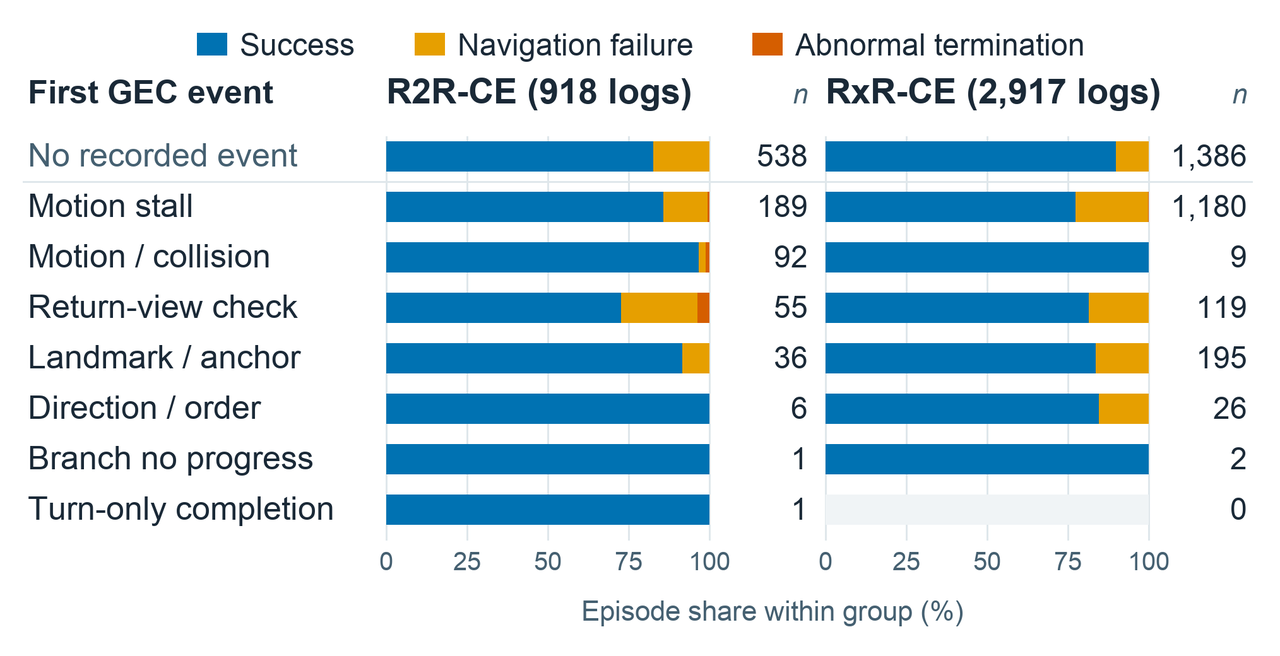
Figure 6: Outcomes by first recorded GEC event. Groups include no event, motion stall, motion or collision, return review, landmark or anchor, direction or order, branch without progress, and turn-only completion.
The logged-event analysis covers 918 R2R-CE episodes and 2,917 RxR-CE episodes. A no-event group contains 538 and 1,386 episodes respectively, while motion-stall groups contain 189 and 1,180. These counts are not directly comparable success scores because the event categories describe where the system first found suspicious execution. They are useful for diagnosing which recovery pathways deserve deeper study, especially categories with substantial abnormal termination or navigation failure.
Real-World Deployment
The physical system uses an AgileX SCOUT MINI chassis, an Intel RealSense D456 RGB-D camera, wheel odometry, and calibrated camera-to-base extrinsics. The authors evaluate two indoor and four outdoor tasks, repeating each five times. A trial is successful only when the robot executes STOP within one meter of the designated target. Navigent succeeds in 27 of 30 trials, or 90%.
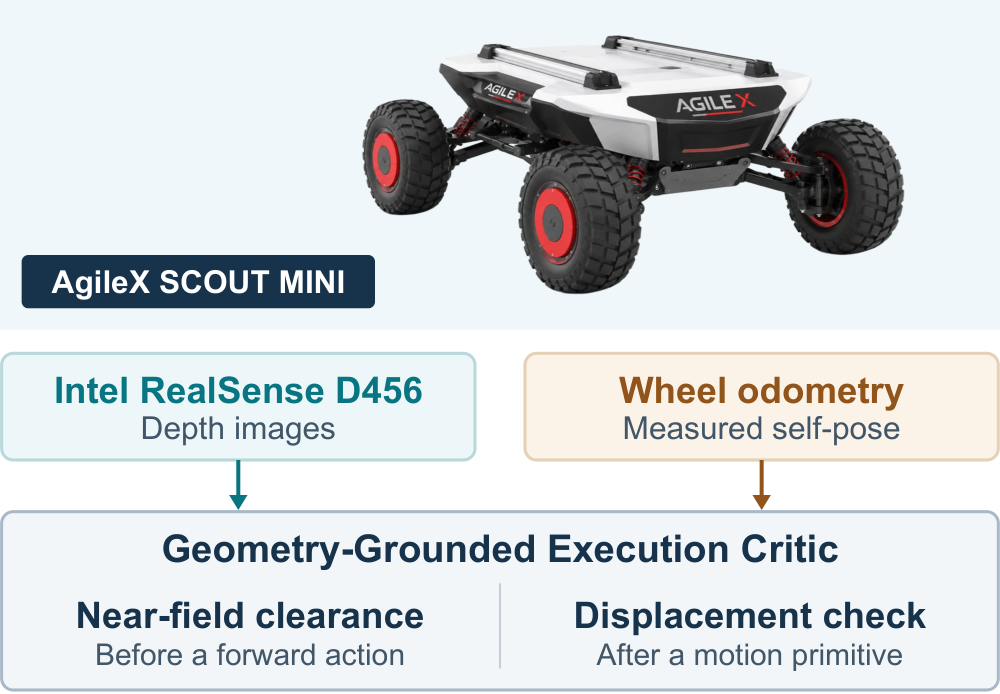
Figure 7: AgileX SCOUT MINI, Intel RealSense D456, wheel odometry, and the depth and displacement inputs used by GEC.
| Environment | Instruction | Successes | SR |
|---|---|---|---|
| Indoor | Black, then blue cylinder | 4/5 | 80% |
| Indoor | Black-blue cylinder shuttle | 5/5 | 100% |
| Outdoor | Approach the gray chair | 5/5 | 100% |
| Outdoor | Approach the green trash bin | 4/5 | 80% |
| Outdoor | Stop at the second pillar | 4/5 | 80% |
| Outdoor | Water dispenser, then green bin | 5/5 | 100% |
| Overall | — | 27/30 | 90.0% |
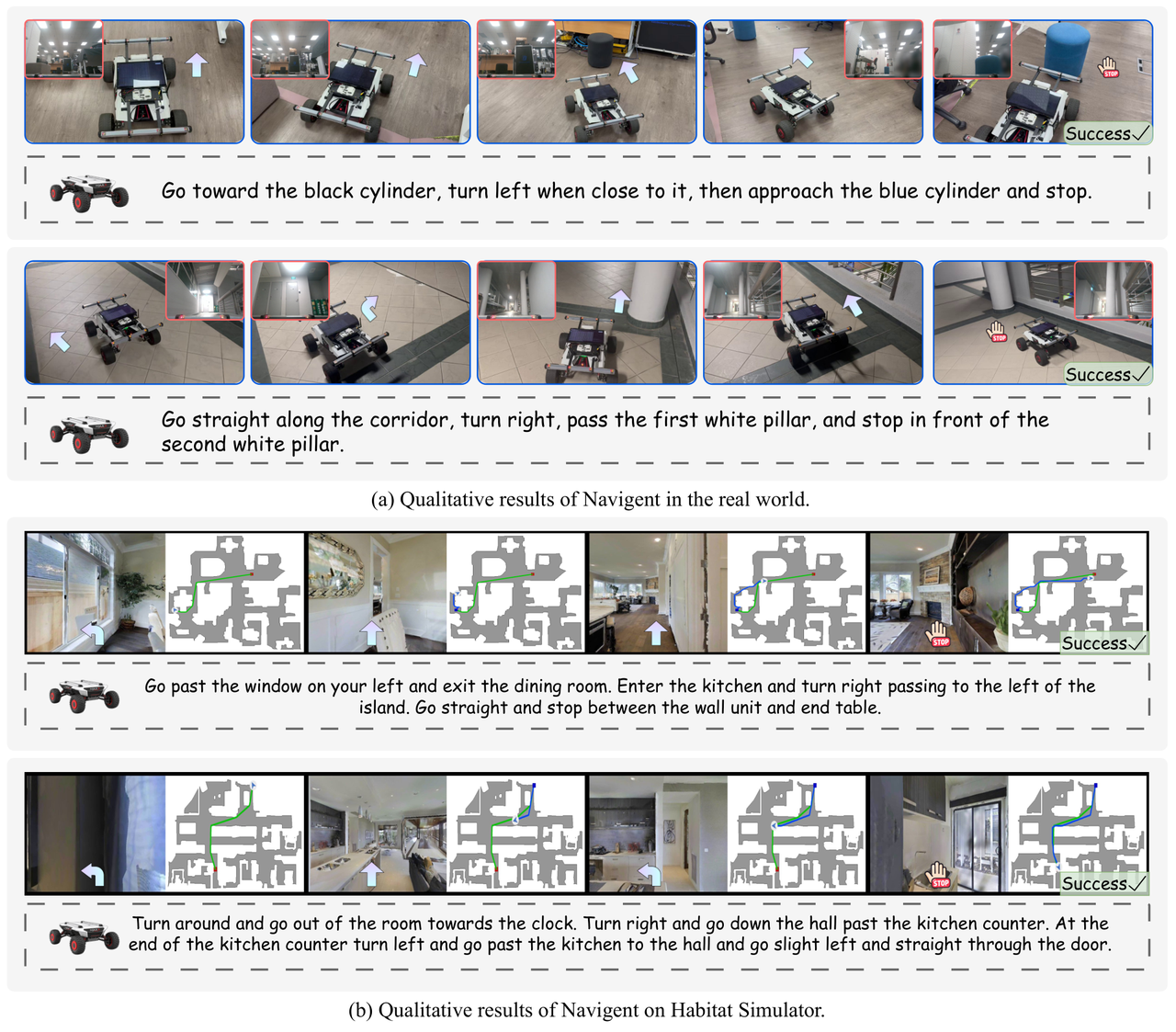
Figure 5: Qualitative trajectories in real-world environments and Habitat, including ordered landmark tasks around cylinders, chairs, pillars, a water dispenser, and a green bin.
The physical evaluation is encouraging because the same conceptual loop survives outside Habitat: wheel odometry supplies displacement, RealSense supplies near-field geometry, and the model still selects semantics. It is not yet a broad reliability study. Thirty trials across six mostly static tasks do not estimate performance under pedestrians, reflective glass, severe occlusion, uneven terrain, or long multi-floor routes. Wheel-slip and odometry drift can make a geometrically consistent measurement biased, while depth failures can remove the anchor signal exactly where it is most needed.
Code-Level Correspondence
The public repository provides an evaluation runtime rather than packaged weights. It expects Python 3.9, Habitat-Sim 0.2.4, Habitat-Lab, Matterport3D scenes, and R2R-CE or RxR-CE episode files. The code maps cleanly to the paper: eval/memory.py implements uniform history sampling, eval/critics.py handles stall and motion contracts, eval/geometry.py contains target-anchor and depth utilities, eval/entrances.py maintains entrance candidates, and eval/runtime.py composes them after each primitive.
The runtime makes the interruption semantics explicit. It measures the actual pose before and after a primitive, calls stall and motion critics, updates target and entrance anchors, and breaks the action loop if any check requires a new decision. This is a stronger implementation of “closed loop” than simply taking a new image after a fixed number of decisions: the image request is triggered by the physical evidence of a mismatch.
row["gt_height_delta_m"] = float(delta[1])
stallcheck = stallcritic.check(
    action, delta[[0, 2]], oldheading, steps)
motioncheck = motioncritic.evaluate(...)
targetcheck = targetcritic.after_primitive(...)
entrance_alerts = entrances.after_primitive(...)

if (stallcheck["interrupt"]
        or targetcheck["interrupt"]
        or motioncheck["interrupt"]):
    interrupted = True
    break
Limitations
The authors explicitly state that self-improvement currently refines navigation prompts and execution-critic logic. It does not update model weights and does not yet cover richer forms of experience adaptation or knowledge reuse. The system can revise its checking and prompting procedure from trajectories, but it does not internalize a broad navigation policy into the model. A new distribution may therefore require new candidate patches and another expensive validation cycle.
Offline improvement is compute-intensive. Each round reruns the fixed training set for the parent and three candidate patches, then evaluates the selected version. The paper reports navigation metrics but not total token use, API expenditure, wall-clock time, or energy. This makes it difficult to compare Navigent's gains with a policy that performs one inexpensive forward pass. Full replay is methodologically useful for regression control, yet it may become impractical for large datasets and long-horizon robots.
The geometric critic has an intentional semantic ceiling. Its anchors and entrance boxes are selected by the model, and the projected point can lie on the wrong surface. Depth can fail on glass or dark materials. The critic can establish local inconsistency but cannot verify doorway identity, room labels, or the full instruction. In addition, the real-world sample is small and static; long-duration robustness and recovery under moving obstacles remain untested.
There is also a missing deployment-level policy for aborting or asking for help. Bounded return attempts and inspection limits reduce loops, but a consistently wrong semantic hypothesis can still consume the episode budget. A mature robot should reason about the cost of further recovery, the risk of entering an unknown area, and when to request human assistance. These are system-level questions beyond the paper's benchmark protocol.
Takeaways
Navigent's strongest idea is architectural rather than model-specific: semantic planning and physical verification should exchange evidence at the granularity of an executed primitive. The language model supplies flexible interpretation and a short plan. Geometry supplies measurements with a narrow, explicit meaning. When they disagree, the robot stops extending the plan and observes again. The offline loop then treats successful routes as regression controls while searching for prompt and critic repairs.
The results show that this combination reaches 84.0% SR on R2R-CE, 86.0% on RxR-CE, and 27 successful trials out of 30 in the reported real-world setup. They also reveal a real operational trade-off: route review improves completion and path efficiency while worsening final endpoint error, and pose removal can improve NE while reducing SR. Reliability claims should therefore be read across several metrics, not reduced to a single distance or success number.
The next step is to make the self-improvement loop broader and more economical without losing its audit trail. That could mean reusable scene memories, failure-mode libraries, learned anchor reliability, or critic policies calibrated by real sensor uncertainty. It also requires larger dynamic-world evaluations and cost reporting. Navigent provides a concrete foundation for that work: a frozen multimodal reasoner is useful only when its physical assumptions remain continuously accountable.