PAPER DEEP DIVE
AgentVLN: Towards Agentic Vision-and-Language Navigation
AgentVLN uses a vision-language model as the navigation brain, bridging 3D topological waypoints into image-aligned prompts while adding self-correction, active exploration, and query-driven depth reasoning for long-horizon edge-deployable navigation.
One-Sentence Summary
AgentVLN uses Qwen2.5-VL-3B as a high-level navigation controller, projects feasible 3D routes into image-space prompts, and closes the loop with corrective atomic actions and on-demand depth queries.
Why Vision-and-Language Navigation Is Still Hard
A vision-and-language navigation agent must connect a sentence to a sequence of physical decisions. The instruction might refer to a room, a relation such as “left of the sofa,” and a final object that is not visible at the start. The robot must resolve the language, build spatial context, select a route, and later decide that it has reached the correct destination.
Strong two-dimensional visual recognition does not settle these questions. A language model may identify a doorway correctly while still having no reliable estimate of its width, the camera-to-door distance, or whether the floor beyond the opening is traversable. Those quantities matter because the final output is not a caption but a trajectory in metric space.
The paper groups prior systems into two broad families. Single-system models learn a direct mapping from visual-language context to action chunks from large trajectory datasets. Dual-system models often keep a vision-language model as a high-level planner and add a trajectory generator for low-level motion. Both are plausible architectures, but they face different failure modes.
Single-system policies can become black-box approximations of geometry when the training data are expected to teach spatial structure implicitly. Dual-system policies can suffer from a representation disconnect: a trajectory generator operates in 3D, while the vision-language planner reasons over a 2D image. The paper argues that this mismatch is one source of unstable long-horizon execution.
Deployment adds another constraint. Many recent VLN systems use models with at least seven billion parameters, and some add monocular depth or 3D feature fusion as separate modules. Remote inference then introduces network delay on top of autoregressive decoding. A robot that needs frequent closed-loop corrections cannot treat those delays as negligible.
AgentVLN responds with a division of labor rather than a single monolithic policy. The vision-language model interprets the instruction, compares explicit visual candidates, and schedules skills. Perception handles mapping and geometric measurements. Planning converts the selected target into a collision-aware route and low-level control. The research question is therefore how to give the model enough spatial evidence without asking it to become a metric 3D solver.
Formal View: A Partially Observable Semi-Markov Process
The navigation problem is modeled as a partially observable semi-Markov decision process. The state contains the robot's global position and pose. Observations contain onboard sensor streams. The action space is a library of skills instead of a fixed set of continuous velocities or single-step turns.
$$\mathcal{M}=\langle\mathcal{S},\mathcal{O},\mathcal{F},\mathcal{T},\mathcal{I},\mathcal{H}\rangle$$Here $\mathcal{S}$ is the state space, $\mathcal{O}$ is the observation space, $\mathcal{F}$ is the skill set, $\mathcal{T}$ describes transitions, $\mathcal{I}$ is the instruction, and $\mathcal{H}$ is temporal history. The semi-Markov formulation is necessary because one skill can execute for several control steps before the high-level controller is queried again.
At decision time $t_k$, the policy selects a skill from the current history, observation, and instruction. The policy is parameterized by the vision-language model, and its output is a skill identifier or a structured skill invocation.
$$c_k\sim\pi_\theta(f\mid H_{t_k},o_{t_k},I),\quad f\in\mathcal{F}$$Skills are separated into perception-level and planning-level groups. A perception skill can return a map, frontier, target depth, or visual prompt immediately, so its temporal duration is effectively zero. A planning skill executes a closed-loop route for several steps and then returns control to the vision-language model.
$$P(s_{t_k+\tau},\tau\mid s_{t_k},f_{c_k})=\sum_{a_1\ldots a_\tau}\left(\prod_{i=0}^{\tau-1}P(s_{t_k+i+1}\mid s_{t_k+i},a_{t_k+i})\pi_{f_{c_k}}(a_{t_k+i})\right)\beta_{f_{c_k}}(s_{t_k+\tau})$$The termination term $\beta$ determines when a skill ends and a new high-level decision cycle begins. This is the mechanism that prevents the expensive language model from being invoked at every wheel or leg-control step. It also makes the planner responsible for reliable motion during the interval between semantic decisions.
Method: A Five-Part Navigation Loop
1. The model acts as a brain, not a trajectory generator
Qwen2.5-VL-3B receives the current RGB frame, eight historical frames, the instruction, and perception-generated prompts. It may request a map, select a visible route candidate, ask for a local distance, issue a corrective micro-action, or stop. This output vocabulary is much smaller and more structured than a dense sequence of 3D positions.
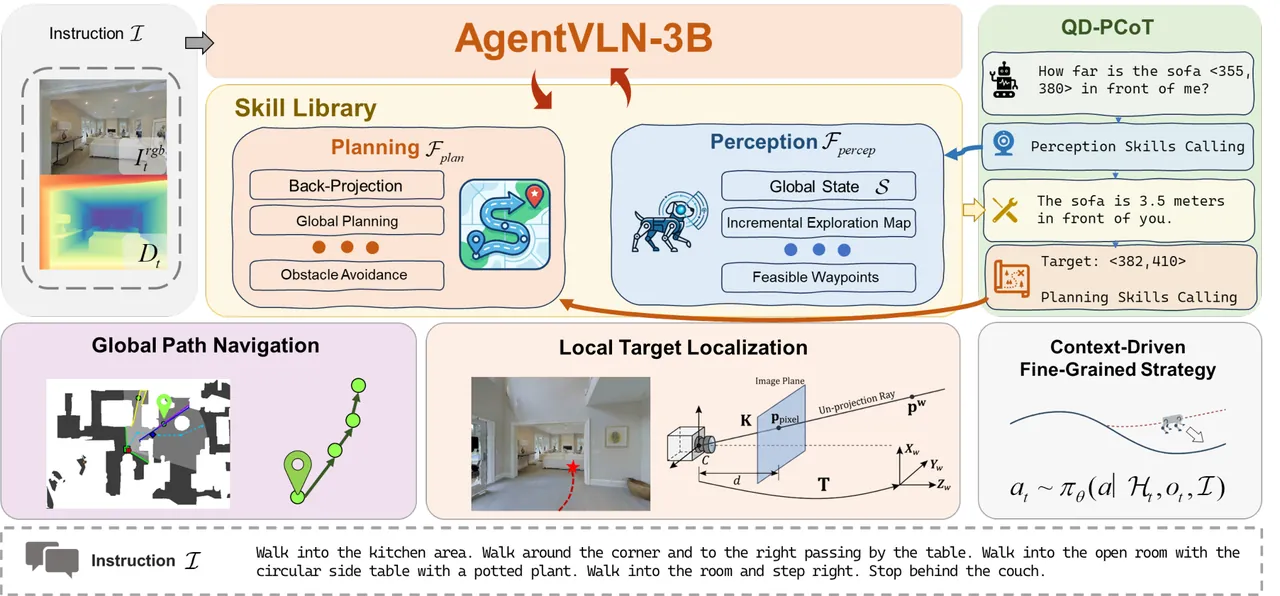
Figure 2: The VLM-as-Brain architecture separates semantic scheduling from geometric perception and physical planning.
Figure 2 shows why the architecture is not simply a prompt wrapped around a vision-language model. The model is embedded in a stateful loop. Perception updates the map and adds visual evidence. Planning executes the selected route. The model then sees a new observation and chooses whether to continue, recover, localize, or stop.
The model still has substantial authority: it decides which evidence is semantically relevant and when the task has reached its final stage. The difference is that the evidence is prepared for the decision interface. The model does not need to invent a metrically valid route from raw pixels alone.
2. Cross-space mapping exposes feasible 3D routes in the image
During global navigation, a perception skill uses RGB, depth, and pose to update an occupancy map. A valid image pixel with depth $d$ is back-projected into the camera frame and transformed into world coordinates by the robot pose $T_t=[R_t\mid t_t]$.
$$P^w=R_t(dK^{-1}p_{img})+t_t$$The camera intrinsic matrix $K$ maps normalized camera coordinates to pixels. The inverse operation recovers a camera-space ray, depth scales that ray, and the pose places the point in the world. The equation answers a concrete question: where does this pixel lie in the environment?
After the map and planner produce a feasible world-space path point $P^w_{path}$, the system applies the reverse transform and perspective projection to put it back on the current image.
$$s\,p^{img}_{path}=KR_t^{-1}(P^w_{path}-t_t)$$The result is a visual prompt that is already aligned with a traversable 3D route. The language model can compare the semantic fit of several routes without first solving their metric geometry. This is the central meaning of the paper's claim that implicit 3D topology is converted into explicit pixel-aligned prompts.
This interface is stronger than simply supplying a depth map. A depth map still asks the model to infer reachability, obstacle boundaries, and how a local surface relates to a longer route. A projected path candidate has already passed through the map and planner, so the semantic decision is narrower.
3. Context-driven micro-actions recover from occlusion and drift
Sometimes no reliable route projection is visible. The robot may face a blind corner, a narrow passage, or a viewpoint from which the route is occluded. Instead of committing to a long blind displacement, AgentVLN emits a small set of corrective actions conditioned on the temporal context.
$$a_t\sim\pi_\theta(a\mid H_t,o_t,I),\quad a\in\{\text{Forward},\text{Left},\text{Right}\}$$These actions are used to look around, recover from a wrong heading, or leave a local dead end. They are not a replacement for global planning. Once a useful path projection appears again, the controller returns to the perception-planning loop.
The ablation makes the value of this recovery layer visible. Adding the brain-style controller and cross-space mapping raises success from 38.6% to 59.7%. Adding fine-grained correction raises success to 65.6% and SPL to 63.4%. The gain is consistent with the long-horizon error model: a small uncorrected deviation can contaminate every later decision.
4. QD-PCoT asks for missing metric evidence
Local target localization starts when visual evidence strongly matches the destination described in the instruction. At this point, monocular RGB may identify the object but not its distance. The paper explicitly identifies scale uncertainty and depth-perspective ambiguity as causes of localization failure.
Query-Driven Perceptual Chain-of-Thought lets the model generate an intermediate question when it detects ambiguity. The question might ask how far away the target is. A perception skill supplies the answer, and the result is appended to the model context. The model then produces a target pixel with additional geometric evidence.
The selected pixel is lifted into the camera frame using the corresponding depth value. The focal lengths $f_x,f_y$ and principal point $c_x,c_y$ make the conversion explicit.
$$P^c_{target}=d_{target}K^{-1}p^{img}_{target}=\begin{bmatrix}\frac{(u_{target}-c_x)d_{target}}{f_x}\\\frac{(v_{target}-c_y)d_{target}}{f_y}\\d_{target}\end{bmatrix}$$A rigid-body transform with the current pose then places the target in the world coordinate system, where the planner can consume it.
$$P^w_{target}=R_tP^c_{target}+t_t$$QD-PCoT adds no parameters. Its advantage is a different inference path: the model can request evidence rather than making a blind coordinate guess. The intermediate query also gives developers an interpretable trace when the final docking point is wrong.
5. Training data follows the same coarse-to-fine stages
The authors argue that existing VLN datasets mainly provide coarse instruction-waypoint pairs. Such data do not directly supervise high-level skill calls, local target queries, or recovery behavior. They therefore construct AgentVLN-Instruct in Habitat and route samples according to whether the target is visible in the current RGB frame.
Global-path samples train the model to invoke perception and select expert-aligned waypoints. Local samples train target-pixel prediction with multi-round perceptual evidence. The dataset also injects trajectory noise and supplies fine-grained actions when no visual waypoint is available, so the model observes recovery situations rather than only clean expert paths.
This routing matters because one policy is being asked to solve two different problems. Early in an episode, semantic route selection dominates. Near the destination, metric localization and precise stopping dominate. A dataset that labels both stages as the same action-prediction task would obscure that distinction.
flowchart TB
    INS[Instruction] --> VLM[Qwen2.5-VL-3B controller]
    RGB[Current RGB] --> VLM
    HIST[Eight-frame history] --> VLM
    VLM -->|perception skill| MAP[Occupancy map]
    MAP --> FRONT[Feasible 3D frontiers]
    FRONT --> PROJ[Project frontiers to pixels]
    PROJ --> VLM
    VLM -->|route selected| NAV[Planning skill]
    VLM -->|no usable route| REC[Forward Left or Right recovery]
    REC --> RGB
    NAV --> MOVE[Robot motion]
    MOVE --> RGB
    VLM -->|target visible| ASK[QD-PCoT geometry query]
    ASK --> DEPTH[Depth evidence]
    DEPTH --> VLM
    VLM --> PIX[Target pixel]
    PIX --> POINT[Back-project to world target]
    POINT --> NAV
    NAV --> CHECK{Target reached}
    CHECK -->|yes| STOP[STOP]
    CHECK -->|no| RGB
Code Evidence: The Geometry Is Implemented Explicitly
The public coordinate transformer computes camera intrinsics from image size and the configured 110-degree horizontal field of view. The implementation matches the paper's perspective-projection model rather than treating projection as an opaque learned operation.
# agentvln/eval/habitat_utils/coordinate_transformer.py:25-33
self.hfov_rad = np.deg2rad(self.hfov)
self.vfov_rad = 2 * np.arctan(
    np.tan(self.hfov_rad / 2) * self.height / self.width
)
self.fx = self.width / (2 * np.tan(self.hfov_rad / 2))
self.fy = self.height / (2 * np.tan(self.vfov_rad / 2))
self.cx = (self.width - 1) / 2.0
self.cy = (self.height - 1) / 2.0
The transformer converts a world point into the agent frame, applies the inverse rotation, and then projects it with the standard pinhole equations. A non-positive forward coordinate is rejected as behind the camera before visibility is evaluated.
# agentvln/eval/habitat_utils/coordinate_transformer.py:87-112
relative_pos = world_point - agent_state.position
local_pos = quaternion_rotate_vector(
    agent_state.rotation.inverse(), relative_pos
)
camera_pos = np.array([local_pos[0], -local_pos[1], -local_pos[2]])
u = self.fx * camera_pos[0] / camera_pos[2] + self.cx
v = self.fy * camera_pos[1] / camera_pos[2] + self.cy
The dataset code also shows that temporal context is a deliberate bounded window. Historical steps are uniformly sampled when more than the configured maximum are available, and their image tokens are inserted into the prompt.
# agentvln/datasets/vln_nav_dataset.py:705-714
all_history_steps = valid_steps[:current_pos]
max_hist = self.config.max_history_frames
if len(all_history_steps) <= max_hist:
    selected_steps = all_history_steps
else:
    indices = np.linspace(
        0, len(all_history_steps) - 1, max_hist, dtype=int
    )
    selected_steps = [all_history_steps[i] for i in indices]
Training freezes the visual encoder and projector separately. That corresponds to the paper's implementation detail and clarifies where adaptation happens: the language-model side learns instruction-conditioned skill decisions over the supplied visual representation.
# agentvln/train/train_vln.py:143-160
for name, param in model.named_parameters():
    if "visual" in name and "merger" not in name:
        param.requires_grad = False
for name, param in model.named_parameters():
    if "visual" in name and "merger" in name:
        param.requires_grad = False
Evaluation Setup
The experiments use R2R-CE and RxR-CE Val-Unseen splits. R2R-CE provides continuous indoor navigation with relatively concise instructions. RxR-CE adds longer and more detailed multilingual directions. The reported metrics include navigation error, oracle success, success rate, success weighted by path length, and normalized dynamic time warping.
Observations are $640\times480$ RGB images with a 110-degree field of view. The model uses eight temporal frames and Qwen2.5-VL-3B as its base. Training uses AdamW with a peak learning rate of $2\times10^{-5}$, a warmup ratio of 0.03, a batch size of 128, and 32 A100 GPUs.
The deployment claim should be read separately from the training setup. Edge inference is local because the deployed model is small and does not require a cloud service. The offline instruction-tuning run was still large. A 3B model improves the deployment side of the tradeoff without making the research pipeline inexpensive to reproduce.
Main Results: Better Arrival and Better Routes
On R2R-CE, AgentVLN reports an NE of 3.88 meters, OS of 73.5%, SR of 67.2%, and SPL of 64.7%. Compared with the 8.3B InternVLA-N1, this is a 9.0-point absolute gain in SR and a 10.7-point gain in SPL. Compared with the 4B EfficientVLN, the gains are 3.0 SR points and 8.8 SPL points.
| Method | Parameters | NE m | OS % | SR % | SPL % |
|---|---|---|---|---|---|
| AgentVLN | 3B | 3.88 | 73.5 | 67.2 | 64.7 |
| EfficientVLN | 4B | 4.18 | 73.7 | 64.2 | 55.9 |
| DualVLN | 7.1B | 4.05 | 70.7 | 64.3 | 58.5 |
| InternVLA-N1 | 8.3B | 4.83 | 63.3 | 58.2 | 54.0 |
The OS gap is smaller than the SR gap. This pattern suggests that several models can reach the neighborhood of the goal at some point, but they differ in whether they stop correctly and whether the full route is efficient. AgentVLN's combined SR and SPL improvement is therefore more informative than navigation error alone.
RxR-CE shows a similar profile. AgentVLN reaches 69.5% SR, 61.3% SPL, and 74.6% nDTW. Its NE of 3.92 meters is slightly worse than EfficientVLN's 3.88, yet SR improves by 2.5 points, SPL by 7.0 points, and nDTW by 6.2 points. On longer instructions, the main benefit is better execution and path alignment rather than a smaller final-distance error in isolation.
| Method | Parameters | NE m | SR % | SPL % | nDTW % |
|---|---|---|---|---|---|
| AgentVLN | 3B | 3.92 | 69.5 | 61.3 | 74.6 |
| EfficientVLN | 4B | 3.88 | 67.0 | 54.3 | 68.4 |
| DualVLN | 7.1B | 4.58 | 61.4 | 51.8 | 70.0 |
| InternVLA-N1 | 8.3B | 5.91 | 53.5 | 46.1 | 65.3 |
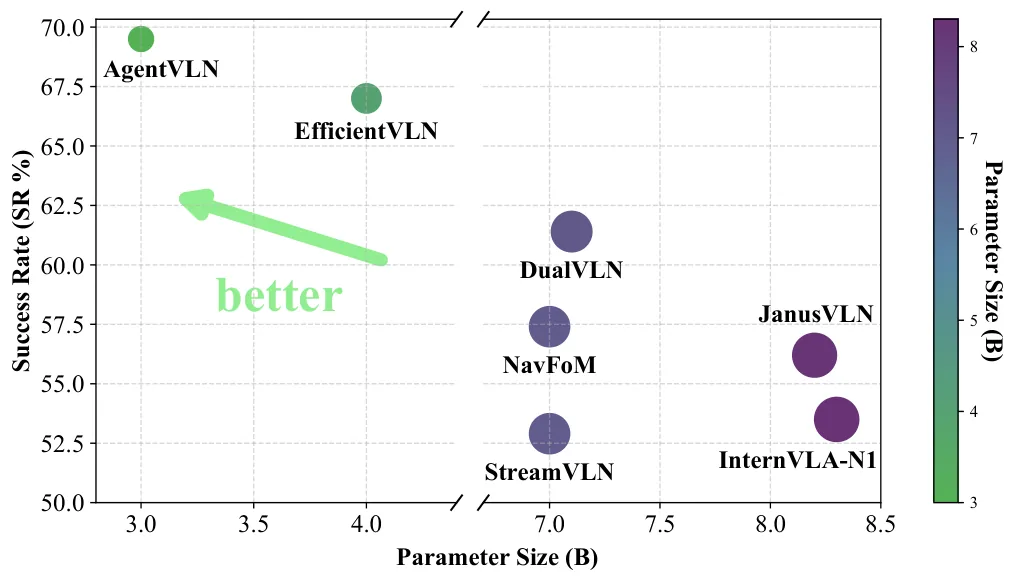
Figure 1: RxR-CE success rate versus parameter scale. AgentVLN occupies the smaller-model, higher-success region.
Figure 1 matters because it prevents the result from being read as a single benchmark outlier. The model is competitive while using fewer parameters than most large VLN baselines. For a robot designer, that combination is relevant to latency, memory, power, and whether local inference is practical.
Ablation: Each Loop Cuts a Different Error Path
The baseline without explicit geometric guidance reaches only 38.6% SR and 35.1% SPL. Adding cross-space mapping and the brain-style controller raises SR to 59.7% and lowers NE to 4.67 meters. Most of this gain comes from replacing an implicit low-level search with explicit route candidates and skill scheduling.
Context-driven correction then raises SR to 65.6% and SPL to 63.4%. QD-PCoT adds a smaller but still positive gain, reaching 67.2% SR, 64.7% SPL, and 3.88 meters NE. The order of gains matches the architecture: first make the route decision tractable, then repair local deviations, then improve precise target grounding.
| Brain | Correction | QD-PCoT | NE m | OS % | SR % | SPL % |
|---|---|---|---|---|---|---|
| No | No | No | 6.53 | 48.5 | 38.6 | 35.1 |
| Yes | No | No | 4.67 | 65.1 | 59.7 | 55.6 |
| Yes | Yes | No | 3.90 | 72.1 | 65.6 | 63.4 |
| Yes | Yes | Yes | 3.88 | 73.5 | 67.2 | 64.7 |
The temporal-context study is especially useful. With no effective history, SR falls to 56.7%. Eight frames produce the best result at 67.2% SR and 64.7% SPL. Longer windows degrade because old visual features compete with the current visual prompt and disperse attention. The fixed window is therefore a learned design constraint, not an arbitrary implementation default.
Simulation Traces and Physical Deployment
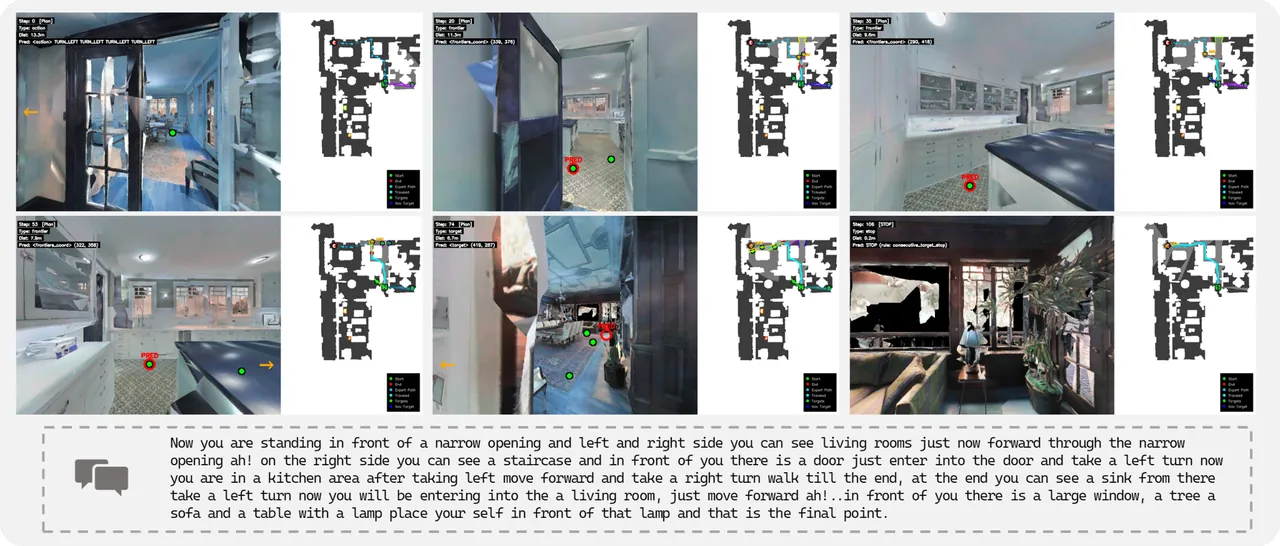
Figure 3: Habitat trajectories, maps, and visual prompts. Green points come from perception skills, while red circles mark selected or predicted waypoints.
Figure 3 highlights the transition between macro and micro behavior. In narrow passages or severe occlusion, the model can temporarily leave route selection and issue a small correction. When a valid projected route becomes visible again, planning resumes. This explicit switching is easier to inspect than a policy that always emits the same type of action at the same frequency.
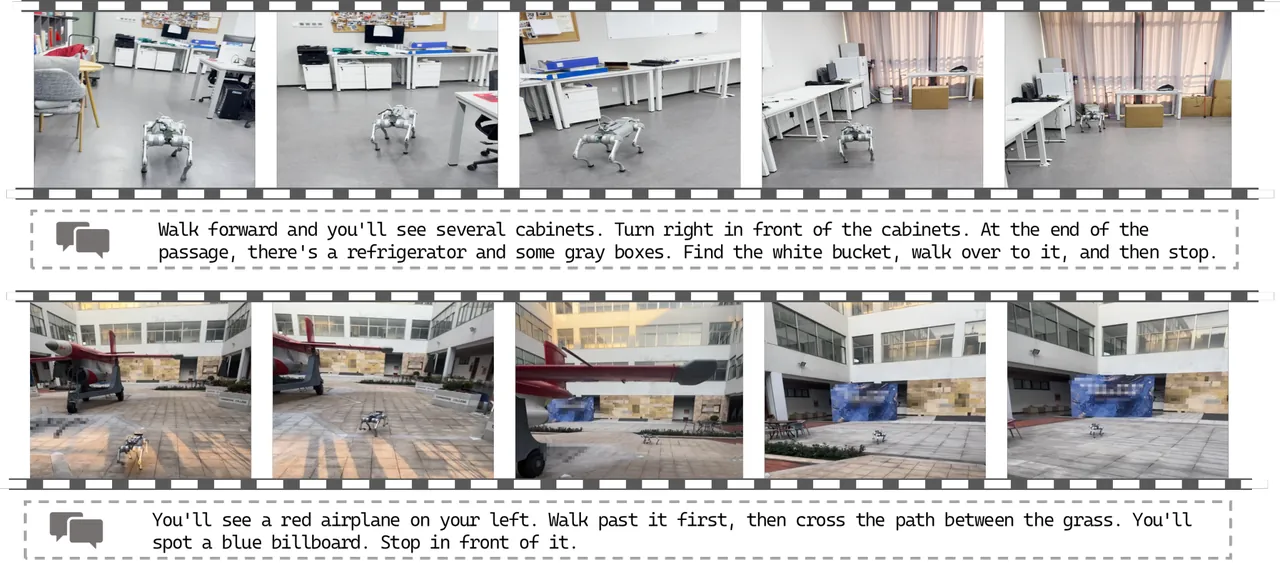
Figure 4: Indoor and outdoor deployment on a Unitree Go2 with an Intel RealSense D455 camera.
The physical system uses a Unitree Go2, an Intel RealSense D455, and RTAB-Map for local SLAM. A perception skill updates the occupancy grid and provides visual prompts. The selected local target is transformed into a world point and passed to path generation and robot control. The paper demonstrates indoor confined spaces and outdoor scenes with changing illumination.
The modular sensor story is also important. Replacing RGB-D with LiDAR would require changing perception skills, not retraining the whole language model. This is a strong software boundary, but it also moves responsibility to the new skill library. A bad map, calibration error, or delayed localization can still break the full system even when the language decision is correct.
Limitations and Open Risks
The authors explicitly report that extending temporal context beyond eight frames causes attention dilution and can worsen spatial hallucination. This means the method does not solve long-term memory by simply increasing the input window. Multi-floor buildings, very long routes, and tasks that require remembering a distant earlier view still need a separate memory selection or compression mechanism.
The authors also identify monocular scale ambiguity as a core local-localization limitation. QD-PCoT reduces the problem by asking for missing depth, but the answer depends on the perception library. Transparent surfaces, textureless objects, inaccurate calibration, or poorly chosen questions can still produce a wrong metric target that later propagates through projection and planning.
The real-world section is primarily qualitative. The paper shows successful indoor and outdoor cases but does not provide a table of repeated trials, per-scene success rates, collision rates, or degradation under different lighting and calibration conditions. Simulation provides stronger statistical evidence, while physical robustness remains less quantified.
The training data are generated in Habitat. Visibility labels, waypoints, and depth supervision come from the simulator. Real sensor noise, dynamic obstacles, floor-surface variation, and human traffic are not guaranteed to follow that distribution. The deployment demonstrates feasibility, but it does not establish that every simulation gain transfers at the same magnitude.
A reproducibility limitation comes from the current public state of the repository. Training and inference code are available, and the dataset has been released. Pretrained checkpoints and installation instructions are still pending. Researchers can inspect the implementation, but they cannot yet reproduce the reported benchmark results end to end from a clean environment using only published artifacts.
Conclusion
AgentVLN's main contribution is an interface design for embodied intelligence. A compact vision-language model handles semantic intent and skill selection. A geometry-aware perception layer supplies feasible routes and depth evidence. A planning layer turns the selected target into motion. Cross-space projection makes the interface visual, correction handles long-horizon drift, and QD-PCoT requests evidence when the target is metrically ambiguous.
The R2R-CE and RxR-CE results show that this decomposition can beat larger baselines on success and path efficiency. The ablation separates the gains of scheduling, correction, and target localization instead of attributing everything to scale. The Go2 experiments demonstrate a plausible physical path, while the absence of detailed real-world statistics and released checkpoints leaves important verification work for later.
For embodied-system engineers, the transferable lesson is to assign each component the kind of evidence it can handle well. A language model should choose among grounded options and call measurement tools. A geometry module should own metric transforms. A planner should own collision-free execution. The final system is stronger when those boundaries are explicit and testable.