PAPER DEEP DIVE
NavProbe: Evidence-Grounded Reasoning with Active Memory Retrieval for Zero-Shot Navigation
Long-horizon navigation requires an agent to revise its intermediate objectives as evidence accumulates. Full visual histories are costly to process, while compact summaries may omit details needed to reconsider earlier decisions. We introduce NavProbe, a hierarchical zero-shot navigation agent that couples a dynamic subgoal agenda with active evidence retrieval. A compact index links summaries of visited places, transitions, and landmarks to their visual and geometric records. When the current context is insufficient, a task executive retrieves targeted evidence to generate, revise, or resolve subgoals. Reusable conclusions are used to update the index, and a skill policy converts the revised task state into parameterized navigation actions. NavProbe achieves 71.7% SR and 55.8% SPL on R2R-CE and 55.3% SR and 38.6% SPL on RxR-CE, outperforming strong zero-shot baselines. It also achieves 79.3% SR on HM3D-v2 ObjectNav, with qualitative real-robot demonstrations illustrating physical deployment. Code is available at https://github.com/liujy25/NavProbe.
NavProbe is a zero-shot navigation agent from Jingyang Liu, Sujia Yao, Jiayuan Gu, and Lan Xu at ShanghaiTech University. The second arXiv version appeared on October 3, 2026. The authors provide an MIT-licensed implementation at https://github.com/liujy25/NavProbe. The full paper is available at https://arxiv.org/abs/2609.27526.
The paper addresses a specific weakness in long-horizon embodied navigation: a robot may remember an abundance of observations yet still fail to determine whether a route condition was actually satisfied. Feeding every past frame to a vision-language model creates a context full of redundant and stale evidence. Replacing that history with a short natural-language summary removes the evidence needed to test the summary when a contradiction appears. NavProbe proposes an intermediate representation: compact entity knowledge points back to persistent visual and geometric records, and retrieval is performed only when a current task-state question cannot be answered from context.
This distinction matters because navigation progress is not equivalent to target recognition. A route instruction may require a turn after a landmark, passage through a doorway, a vertical transition, or a stop beside an object. A system that recognizes the final destination but loses the order of the route has not necessarily satisfied the instruction. NavProbe therefore treats the current agenda, the evidence predicates attached to subgoals, and the execution history as first-class state that can be revised when old observations are inspected again.
Central claim: historical memory is useful for navigation when retrieval answers a question that can change task state, and when every resulting state revision can be traced back to a place, transition, or landmark record.
The operational problem
Consider an instruction that asks the robot to enter a dining room after passing a particular section of a corridor. The robot may already have generated a trajectory toward the dining area, but the relevant question is whether the required turn occurred after the referenced landmark. A current image can show the next local route, but it cannot by itself establish what happened several decisions earlier. Full-history prompting can answer the question in principle, yet it also presents many unrelated images and may cause the model to latch onto a visually salient but temporally wrong cue.
Object-goal navigation creates a related failure. A detector may report a television in a scene where the detected region is only partially visible, reflective, or semantically ambiguous. If the agent treats the detection as a completed target and stops, the episode fails even though an earlier panorama might contain enough context to reject the detection. NavProbe gives the agent a mechanism to return to that panorama, reassess the landmark, reopen search, and choose a different physical action.
The design also separates routine state from historical evidence. The task executive routinely reads a compact agenda and entity index. Raw visual records enter the active context only after a query selects them. Execution can extend memory with new observations and trajectories, while the Entity Knowledge Manager can preserve conclusions that are likely to remain useful. These operations affect different representations and should not be conflated into a single transcript.
The formulate-probe-verify-act cycle
At decision step $t$, the task executive receives the current observation $O_t$, task state $\mathcal{T}_t$, and compact memory index $\mathcal{I}_t$. It first decides whether the agenda should be advanced, revised, or left unchanged. If a completion predicate cannot be assessed, it formulates a query and retrieves the historical fields needed to answer that query. The executive then interprets the returned evidence and commits any resulting state change. Only after this reasoning phase does the skill policy choose a navigation action.
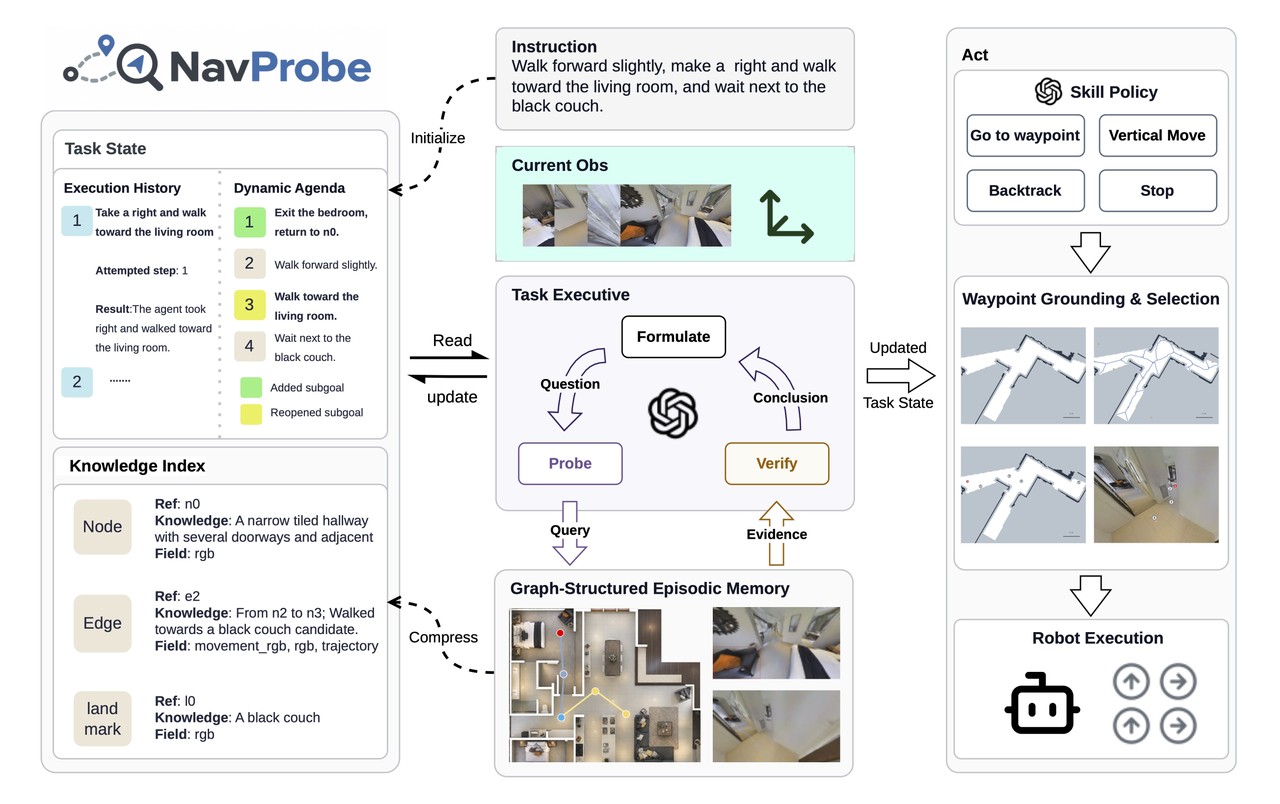
The separation is more than software modularity. It prevents the action policy from silently rewriting task progress while grounding a waypoint, and it prevents a retrieval request from directly commanding low-level motion. The task executive may conclude that a previously completed subgoal should be reopened, but a separate skill decision must then choose whether to backtrack, approach, move vertically, or continue ordinary waypoint navigation.
Task state is represented as an agenda and history:
$$ \mathcal{T}_{t}=(\mathcal{A}_{t},\mathcal{H}_{t}),\qquad \mathcal{A}_{t}=[g_{1,t},\ldots,g_{K_{t},t}] $$
where $\mathcal{A}_t$ contains active subgoals and $\mathcal{H}_t$ records earlier outcomes. The agenda length $K_t$ can change during an episode. A subgoal carries a natural-language objective, an execution status, and evidence-checkable predicates. A predicate is marked either confirmed or unconfirmed; unconfirmed means that the available evidence does not yet establish the claim, not that the claim has been disproved.
Three memory roles
Task state remembers what to pursue
Task-state memory records the current agenda and prior decisions. Its operations include adding a subgoal, rewriting its content, reordering priorities, completing it, abandoning it, and reopening it. Reopening is essential for recovery: new evidence can invalidate a completion that appeared reasonable at an earlier step. The implementation applies a batch of agenda and predicate updates through a copied state and commits only after every operation succeeds. This prevents partially applied updates from leaving a subgoal removed while its conditions or history remain in an inconsistent form.
In vision-and-language navigation, instruction clauses provide an initial agenda that can be refined as the environment is observed. In object-goal navigation, the target supplies the top-level goal while the executive generates intermediate objectives such as inspecting a candidate room, revisiting a location, or checking a visible region. Completing an intermediate objective can therefore mean proving a candidate negative, not completing the whole episode.
The episodic graph remembers where things happened
The persistent episodic record is a topological graph:
$$ \mathcal{G}_{t}=(V_{t}^{P},E_{t}) $$
Place nodes retain panoramic observations, transition edges retain executed trajectories, and landmark records retain detections and estimated positions. An occupancy map $M_t$ separately represents free, occupied, and unexplored space for path and waypoint generation. The graph is not intended to replace geometric navigation. It gives semantic and spatial queries stable identities, allowing the executive to request a specific place, edge, or landmark rather than an undifferentiated slice of past frames.
Retrievable fields observed in the implementation include node.rgb, node.landmarks, edge.rgb, and edge.trajectory. The abstraction is deliberately narrower than the complete memory: a question about a turn should return the relevant transition views and path evidence, not every panorama recorded so far. This design makes the retrieval request inspectable. It also creates a testable engineering surface, because the selected entity references and fields can be logged independently of the model's natural-language conclusion.
Entity knowledge remembers conclusions
Each place, transition, or landmark has a compact entity-knowledge summary linked to its records. The index can be written as:
$$ \mathcal{I}_{t}=\{(e,\mathcal{K}_{e}^{E},\mathcal{A}_{e}) \mid e\in V_{t}^{P}\cup E_{t}\cup V_{t}^{L}\} $$
Here $\mathcal{K}_e^E$ is the entity's semantic knowledge and $\mathcal{A}_e$ identifies its retrievable fields and record references. The executive normally reads the summary, but can ask for the underlying evidence when the summary is insufficient or conflicts with the current observation.
The Entity Knowledge Manager receives retrieval rounds, the entities that were actually inspected, the executive's conclusions, and existing knowledge. It may add a fact, update a fact, or remove a claim that the inspected evidence invalidates. It does not reopen the images. This restriction makes compression auditable: a new fact must concern a listed retrieved entity and must be supported by the textual conclusion. Missing or unavailable fields cannot be turned into negative scene facts merely because the retrieval returned nothing.
Source inspection adds a useful safety distinction. An issued edge instruction records what the agent intended to execute, not proof that the route or endpoint was achieved. Likewise, a local stop from the navigation stack is not evidence that the original task's stopping relation has been satisfied. Reusable knowledge therefore preserves instructions and observed outcomes as different kinds of claims rather than treating every action record as completed progress.
How evidence is requested and returned
When the executive cannot resolve a task-state question from the observation, agenda, and compact index, it constructs a query $q_t^r$ for reasoning round $r$. It then selects entity-field pairs and retrieves their original records:
$$ R_{t}^{r}=\{(e_{j},\mathcal{F}_{j})\}_{j=1}^{m_{r}}, \qquad D_{t}^{r}=\operatorname{Retrieve}(R_{t}^{r}) $$
where $m_r$ is the number of requested pairs, $\mathcal{F}_j$ is a subset of the retrievable fields for entity $e_j$, and $D_t^r$ contains the returned images and geometric records. The query states what must be checked; the references define the evidence scope. This is the technical basis for claiming that NavProbe retrieves selectively rather than merely reducing a long prompt by arbitrary truncation.
A temporary workspace retains the query, references, observations, conclusions, and unavailable fields for the current decision step. Later reasoning rounds can use the prior conclusion without keeping every raw image permanently in context. The original records remain in episodic memory. At most six retrieval rounds are allowed per decision. If the budget is exhausted, the final batch must still be interpreted before the revised state is committed.
The recorded usage pattern supports the claim that retrieval is event-driven. Across 600 VLN-CE executions, 2,127 of 4,554 decisions used retrieval, or 46.71%. The first decision of each episode has no prior history, so excluding those 600 decisions raises the rate to 53.79% over the remaining 3,954 decisions. A retrieval-triggering decision used an average of 1.82 rounds. The agent therefore skips historical inspection in a substantial fraction of decisions instead of querying memory on every environmental step.
Evidence changes progress, not just attention
The executive converts retrieved records into a conclusion $c_t^r$ that states whether and how the evidence supports or contradicts the question. That conclusion can add a subgoal, rewrite its description, mark a predicate confirmed, complete an objective, or reopen an objective from history. In a route task, evidence that a turn occurred before the instructed landmark can reopen the corresponding execution condition. In object navigation, a past panorama can show that a candidate doorway was overlooked and motivate a new inspection objective.
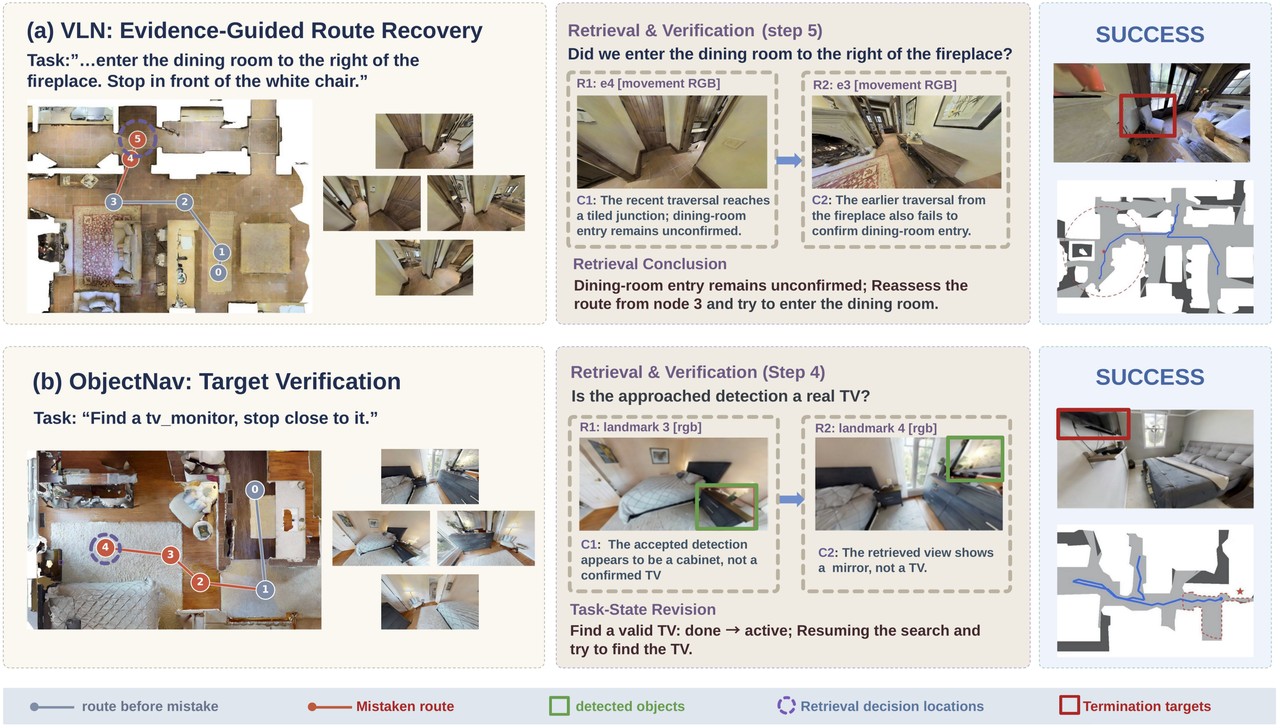
The figure illustrates why the stored evidence type matters. A transition image and trajectory are suited to questions about route order. A place panorama is suited to questions about what was visible from a visited location. A landmark record is suited to checking whether a detection and its spatial relation are reliable. Treating these entities as interchangeable might produce a plausible sentence, but would remove the ability to audit which historical observation actually supported the revision.
Retrieval conclusions do not replace fresh perception. Historical evidence can establish what was previously observed or executed. It cannot prove that the current local path is traversable or that the robot still faces the same direction. The skill prompt therefore insists on the current labeled panorama for local waypoint and stopping decisions. This is an important boundary for long-horizon robots, where a historically valid landmark can be spatially stale after another movement or rotation.
The overall state-to-action mapping is summarized by:
$$ a_{t}=(d_{t},\theta_{t})=\pi_{\mathrm{skill}}(O_{t},Y_{t}) $$
Here $Y_t$ contains the committed task-state assessment, retrieval conclusions, and available spatial context. The action type $d_t$ selects a navigation skill, while $\theta_t$ supplies its arguments, such as a waypoint label, a visited node, or a vertical direction. The task executive determines what progress means; the policy determines which local physical action is currently supported.
Waypoint generation and skill execution
For ordinary movement and vertical transitions, NavProbe extends visual waypoint grounding with Frontier-Skeleton Sampling. Given the occupancy map $M_t$, FSS samples frontier anchors on explored-unexplored boundaries and skeleton anchors on the medial axis of free space. It computes a collision-free path to each anchor and selects a visible waypoint under distance and occlusion constraints. Candidates receive matching labels in the current RGB view and bird's-eye-view map, allowing the skill policy to choose a label that the geometric executor can resolve.
The combination is practical rather than decorative. Frontier anchors encourage exploration when a goal is not visible. Skeleton anchors provide stable routes through narrow or cluttered free-space regions where a straight line to a frontier can be obstructed. For stairs, the detected vertical region is temporarily treated as traversable before applying FSS. Backtrack selects a previously visited place and physically returns through the navigation stack so that the next decision can use a fresh observation instead of an old panorama.
The paper describes GoToWaypoint, VerticalMove, Backtrack, and Stop. The public implementation additionally exposes approach_to_stop, which approaches a stopping region without declaring the episode complete. This distinction is consistent with the paper's broader state philosophy, but it is an implementation detail that should be considered when comparing logs or reproducing the reported skills. A local stopping maneuver is not automatically the same event as successful task termination.
flowchart TD
  A["Fresh observation and original task"] --> B["Executive checks agenda and predicates"]
  B --> C{"Further evidence required?"}
  C -- "No" --> D["Commit task-state assessment"]
  C -- "Yes" --> E["Form query and select entity fields"]
  E --> F["Retrieve place, edge, or landmark records"]
  F --> G["Inspect RGB and trajectory evidence"]
  G --> H["Revise, complete, abandon, or reopen subgoal"]
  H --> I["Consolidate supported conclusions into EKM"]
  I --> C
  D --> J["Skill policy selects a local action"]
  J --> K["FSS waypoint, vertical move, backtrack, or approach"]
  K --> A
Evaluation protocol
The experiments cover R2R-CE and RxR-CE for vision-and-language navigation and HM3D-v2 for object-goal navigation. R2R-CE contains concise route instructions, while RxR-CE uses longer instructions with denser spatial grounding. Both VLN benchmarks run in Habitat on Matterport3D scenes. To compare with Uni-LaViRA, the authors evaluate the same stratified 100-episode subset for each benchmark and report the mean of three independent runs per NavProbe configuration.
All VLM calls use GPT-5.5 with role-specific prompts. The paper reports YOLO-World landmark detection at a confidence threshold of 0.6. Simulator RGB-D frames are 960 by 540 with a 135-degree horizontal field of view. The camera is mounted at 1.2 meters with a negative 30-degree pitch, and images passed to the model are fitted within 640 by 360. Each decision uses a four-view panorama at relative headings of 0, 90, 180, and 270 degrees.
Habitat-Lab's ShortestPathFollower executes the metric waypoint selected by NavProbe; waypoint generation remains part of the agent. An episode is capped at 40 navigation decisions and 500 simulator actions, with a forward step of 0.25 meters. The success radius is 3.0 meters for VLN-CE and 1.0 meter for HM3D-v2 ObjectNav. The per-decision retrieval budget is:
$$ R_{\max}=6 $$
The reported metrics are NE, OSR, SR, and SPL for R2R-CE; NE, SR, SPL, and nDTW for RxR-CE; and SR and SPL for object-goal navigation. Lower NE is better, while higher values are better for the remaining metrics.
| Method | R2R NE | R2R OSR | R2R SR | R2R SPL | RxR NE | RxR SR | RxR SPL | RxR nDTW |
|---|---|---|---|---|---|---|---|---|
| Uni-LaViRA, GPT-5.5 rerun | 4.02 | 73.3 | 61.7 | 45.0 | — | — | — | — |
| Uni-LaViRA, reported | 3.66 | 73.7 | 60.7 | 47.7 | 6.48 | 51.3 | 34.0 | 53.7 |
| NavProbe | 3.45 | 78.0 | 71.7 | 55.8 | 5.39 | 55.3 | 38.6 | 53.9 |
Main results and interpretation
On R2R-CE, NavProbe reaches 71.7% SR, 55.8% SPL, 78.0% OSR, and 3.45 meters NE. Against the authors' GPT-5.5 rerun of Uni-LaViRA, this is a gain of 10.0 SR points and 10.8 SPL points. The rerun controls the high-level reasoning model family and is therefore more informative than a comparison based only on previously published numbers. It still does not isolate individual architectural components, because the surrounding prompts, memory interfaces, and skill implementations are not held constant.
On RxR-CE, NavProbe obtains 55.3% SR and 38.6% SPL, compared with the reported Uni-LaViRA values of 51.3% and 34.0%. NE improves from 6.48 to 5.39 meters. Yet nDTW is almost unchanged at 53.9 versus 53.7. The pattern suggests better success termination, endpoint proximity, and path efficiency rather than a wholesale change in trajectory shape. That interpretation is consistent with a method designed to correct completion conditions and reopen mistaken progress decisions.
| Method | SR ↑ | SPL ↑ |
|---|---|---|
| VLFM | 62.6 | 31.0 |
| InstructNav | 58.0 | 20.9 |
| ApexNav | 76.2 | 38.0 |
| DSCD-Nav | 73.0 | 38.7 |
| ReMemNav | 67.8 | 36.6 |
| Uni-LaViRA | 77.7 | 46.1 |
| NavProbe | 79.3 | 43.8 |
ObjectNav exposes a tradeoff that the headline success rate alone hides. NavProbe improves SR by 1.6 points over Uni-LaViRA but loses 2.3 SPL points. It finds the target more often, while successful trajectories are less path-efficient on average. Reopening a prior room or revisiting an old landmark can rescue a search but also adds travel distance. The paper does not decompose this tradeoff by target category or failure mode, so it is not safe to infer that retrieval is uniformly more efficient.
Ablation evidence
The ablation table examines task-state memory, active retrieval, knowledge consolidation, and the form of historical context. Removing task-state memory reduces R2R-CE SR from 71.7% to 63.3% and SPL from 55.8% to 51.4%. This indicates that carrying an explicit agenda and execution history across decisions contributes independently of the current image and instruction. Removing the Entity Knowledge Manager reduces SR to 65.0% and SPL to 51.1%, even though retrieval remains available.
| Configuration | NE ↓ | OSR ↑ | SR ↑ | SPL ↑ |
|---|---|---|---|---|
| NavProbe | 3.45 | 78.0 | 71.7 | 55.8 |
| Without task-state memory | 3.94 | 72.0 | 63.3 | 51.4 |
| Without EKM | 4.20 | 67.7 | 65.0 | 51.1 |
| Without retrieval and EKM | 4.65 | 69.3 | 57.3 | 43.1 |
| Full graph context | 3.83 | 70.3 | 62.0 | 48.8 |
The comparison with no EKM but retrieval enabled versus no retrieval and no EKM provides a useful partial estimate of access to raw evidence. With consolidation absent in both variants, enabling retrieval raises SR from 57.3% to 65.0%, SPL from 43.1% to 51.1%, and lowers NE from 4.65 to 4.20 meters. This supports the claim that inspecting original visual and geometric records provides information beyond compact entity summaries.
The full-graph variant replaces selective entity-field retrieval with the corresponding graph history in the reasoning context. It reaches 62.0% SR, 48.8% SPL, and 3.83 meters NE, well below the complete system. The result favors query-directed evidence selection in this experimental setting. It does not yet quantify computational efficiency, because the paper does not report the token counts, model calls, latency, or cost of the full-graph and selective configurations.
What the retrieval queries ask
Across 3,862 retrieval queries, action execution appears in 68.44%, spatial or route relations in 55.72%, and landmark or target identification in 29.05%. The labels are non-exclusive, and 48.24% of queries involve at least two dimensions. The distribution indicates that memory is used to audit the execution of instructions, not only to identify the final object. This is consistent with the paper's distinction between finding a target and satisfying a multi-stage route.
| Query dimension | Queries | Share |
|---|---|---|
| Action execution | 2,643 | 68.44% |
| Spatial or route relation | 2,152 | 55.72% |
| Landmark or target identification | 1,122 | 29.05% |
| At least two dimensions | 1,863 | 48.24% |
These statistics also expose an evaluation opportunity. The paper reports what the queries asked, but not how often each dimension led to a state revision, how often a revision improved the episode, or how often retrieved evidence reinforced an already correct decision. Those conditional outcomes would distinguish recovery from confirmation and help estimate when the extra retrieval work is actually worthwhile.
Real-world demonstration
The authors deploy the system on a Galaxea R1Pro with a ZED2 RGB-D camera and a MID-360 LiDAR. Voxel-SLAM supplies pose estimation, while Nav2 executes metric goals selected by NavProbe. The demonstration includes two multi-stage instructions: pass a robot dog and stop near a blue-gray armchair, and pass a black screen, turn at a corner, and stop at a vending machine. Figure 3 shows representative execution stages and onboard views.
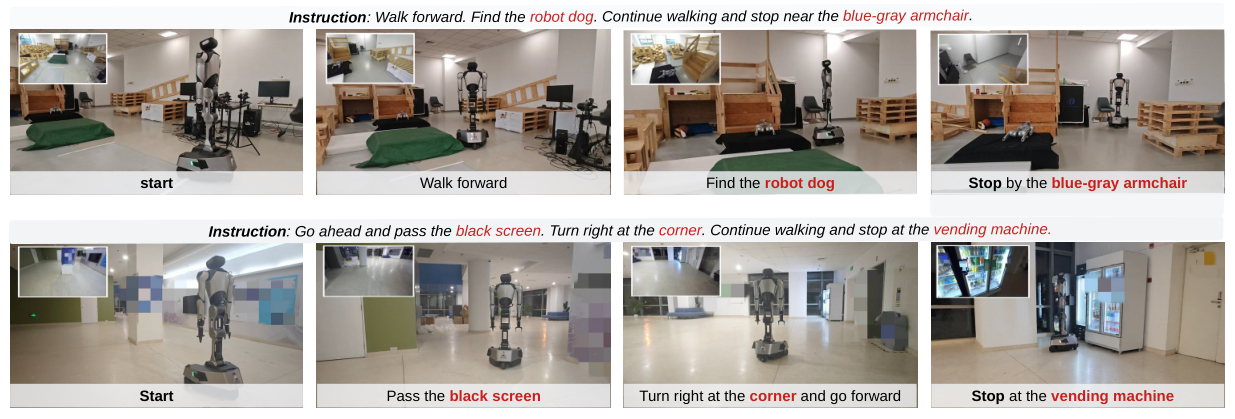
The deployment establishes that the agent can be connected to real pose estimation, LiDAR, RGB-D perception, and a robot navigation stack. It also introduces practical conditions absent from Habitat, including localization drift, sensing noise, and dynamic surroundings. The paper reports the demonstration qualitatively, however, without an episode count, success rate, collision rate, recovery rate, or repeated physical trials. It is evidence of integration and feasibility, not a quantitative real-world validation.
Repository-level engineering notes
The public repository's default detector configuration uses GroundingDINO, while the paper's implementation section reports YOLO-World. Both detectors support open-vocabulary categories, but their prompt behavior, confidence calibration, and runtime cost can differ. The repository also contains a YOLO-World adapter, so the discrepancy is a configuration issue rather than evidence that one detector is unavailable. A faithful reproduction should explicitly confirm the detector, weights, category prompt, and 0.6 threshold used for each experiment.
The source also makes action semantics explicit. For example, an issued edge instruction records the traversal intent, not proof that the endpoint was reached. The skill prompt states that historical images can help interpret a route but cannot replace the fresh panorama needed for the current waypoint or stopping frame. These are meaningful safeguards for a memory-based agent, because a language model can otherwise turn "the instruction says turn left" into "the robot has already turned left."
Task-state updates use strict status and operation contracts, including active or done agenda items and confirmed or unconfirmed predicates. Completing an item requires a non-empty result, and reopening restores a historical item into the active agenda. Entity knowledge has a separate transactional contract with known knowledge identifiers and a required current graph node. These choices make the system less permissive than free-form text memory, but they create clear points for runtime rejection and test coverage.
The memory design also raises deployment questions that the paper does not answer. Every visited place can retain panoramas, every transition can retain trajectories, and every landmark can retain detections and positions. Storage and indexing costs therefore grow with episode length. Selective retrieval reduces repeated context injection, but the project does not report retrieval latency, knowledge-index size, model-call count, or cloud API expense. These metrics are necessary before claiming a practical compute advantage over full-history prompting.
Limitations
The first limitation is stated directly by the authors: the main results use the same stratified 100-episode subsets as Uni-LaViRA rather than the complete R2R-CE, RxR-CE, and HM3D-v2 validation or test splits. Three runs reduce some variance within that subset, but they do not remove subset bias. The paper appropriately calls these evaluated subsets; readers should not treat the percentages as full-benchmark leaderboard values.
The second limitation concerns the real-robot evidence. The Galaxea demonstration shows that the architecture can operate with real localization and navigation components, but it does not quantify generalization. Dynamic pedestrians, changing lighting, localization drift, manipulator occlusion, and repeated landmark encounters could alter retrieval reliability. A stronger claim would require repeated physical episodes and reported failures by category.
The third limitation is the success-efficiency tradeoff in ObjectNav. NavProbe improves SR but trails Uni-LaViRA in SPL. Revisiting old regions and reopening search can recover failed episodes while adding distance to successful ones. Applications with strict time, energy, or aisle-congestion constraints should not select the method solely from SR. The paper would benefit from a Pareto analysis rather than treating success rate as the only headline objective.
The fourth limitation is unreported operational cost. Retrieval happens in 46.71% of all decisions and uses multiple rounds when triggered. Each retrieval can be followed by task-state and skill reasoning, while the full-graph ablation may inject much more context. Without tokens, wall-clock latency, API calls, and hardware requirements, it is difficult to place the method on the accuracy-cost frontier or to determine whether it can run onboard.
The fifth limitation is causal isolation. Removing task-state memory changes persistence, history maintenance, and the information passed to action selection. Removing retrieval also removes the input to EKM. The full-graph variant changes context organization without reporting its size. The ablations support the complete design, but they do not assign independent additive effects to every component under a fully controlled compute budget.
What to reuse
The most transferable idea is the separation of three questions: what is the current task state, where is the supporting evidence, and what can be concisely remembered from it? A robot benefits from storing these separately because each has a different mutation rule. Agenda updates change priorities and completion conditions; graph records append observations and traveled paths; entity knowledge compresses audited conclusions while retaining pointers to the source. Collapsing the three into a chat transcript makes those rules hard to enforce.
A practical reproduction should log retrieval triggers, query dimensions, selected references, retrieved field sizes, reasoning rounds, state revisions, and action outcomes. It should also record whether a revision reopened a completed subgoal, changed a route, or merely confirmed an existing decision. These logs would answer the next research question more directly than another aggregate success rate: under what conditions does evidence access improve behavior enough to justify its cost?
For real deployment, the historical graph should carry source time, pose confidence, and invalidation metadata. SLAM drift can make a geometrically valid old landmark misleading after substantial travel. A robust system should use old evidence primarily for semantic and temporal questions, while continuing to rely on fresh sensors and local planning for traversability, collision risk, and stopping distance. Knowledge consolidation should also support expiry or confidence revision when the geometry underlying a summary changes.
Conclusion
NavProbe combines a revisable subgoal agenda, a graph-structured episodic memory, and compact entity knowledge indexed back to raw visual and geometric records. It invokes retrieval only for unresolved task-state questions, interprets the returned evidence, revises progress, and then selects a navigation skill. On the evaluated subsets it reaches 71.7% SR on R2R-CE, 55.3% SR on RxR-CE, and 79.3% SR on HM3D-v2 ObjectNav, while ablation results support the combined role of task state, retrieval, and knowledge consolidation.
The paper makes a strong case for evidence-grounded task progress rather than history as an ever-growing prompt. Its main open problems are empirical and operational: full-split validation, quantitative real-world trials, retrieval latency and cost, and controlled isolation of each architectural component. Those measurements will determine whether active memory retrieval becomes a standard navigation primitive or remains a compelling but expensive mechanism for correcting difficult episodes.