PAPER DEEP DIVE
A Glimpse of Training VLMs as Foundation Models for Robotic Manipulation
Recently, GPT-6 Astra demonstrates strong generalization in robot control, yet limited disclosure of its training leaves open how such capabilities can be reproduced. We introduce nanoAstra, an approach to training vision-language models (VLMs) for generalizable manipulation that combines semantic action modeling with capability-preserving supervised fine-tuning (CP-SFT). nanoAstra represents robot behavior as semantic steps composed of reusable, parameterized action primitives, guided by explicit progress descriptions. Meanwhile, CP-SFT uses an explicit robot-specific system prompt to constrain manipulation outputs to a structured action space, aiming to focus adaptation on robot-specific contexts and promote specialization while minimizing interference with broader pretrained capabilities. With this formulation, we train nanoAstra on more than 5,000 hours of robot data together with general VQA data. On RoboTwin 2.0's randomized benchmark, nanoAstra-9B achieves a 17.8% zero-shot success rate, substantially outperforming advanced VLA and WAM baselines as well as similarly sized VLMs. With inference faster than the corresponding motion execution on a single H20 GPU, our model supports action-chunk-like streaming execution that overlaps inference with motion, reducing the robot's idle time from 35.0% to 6.9%.
Paper Metadata
Title: A Glimpse of Training VLMs as Foundation Models for Robotic Manipulation (nanoAstra)
Authors: Meng-Hao Guo, Yi Zhang, Zhe-Han Mo, Han-Zheng Wang, Jia-Jun Wang, Xin-Sheng Chen, Jiaxi Song, Yi-Xuan Deng, Jia-Ning Li, Xuanyu Chu, Hengrui Zhang, Huan-ang Gao, Yongming Rao, Shi-Min Hu (Tsinghua University; Yongming Rao is with Tencent Hunyuan).
Paper: arXiv 2611.29338 (2026-11-22, cs.RO); Project page: nanoastra.github.io; Code: Hugo-AGI/nanoAstra — the repository exists, but the README states that code will be released later; no source was public at the time of this reading.
Subject: A 9B vision-language model (initialized from Qwen3.5-9B) with no separate action-prediction head. It emits task progress descriptions plus executable semantic steps through its native text interface, trained on more than 5,000 hours of real robot manipulation data mixed with general VQA data — no simulated trajectories anywhere in training.
One-Sentence Summary
nanoAstra reorganizes robot supervision from dense control steps into semantic steps with explicit progress descriptions, then fine-tunes a VLM under a robot-specific system prompt that softly confines outputs to a structured response space while co-training on general VQA data (CP-SFT); the resulting 9B model reaches 17.8% zero-shot success on RoboTwin 2.0's randomized benchmark, beating every evaluated VLA, WAM, and larger general-purpose VLM, and streaming inference cuts robot idle time from 35.0% to 6.9%.
Background and Motivation
Recent evaluations of GPT-6 Astra suggest that general-purpose VLMs can exhibit substantial manipulation capability without task-specific fine-tuning, yet Astra's training recipe is barely disclosed, leaving the community unable to reproduce that capability curve. This paper asks a concrete, reproducible question: how should large-scale robot experience be represented and used to train VLMs toward manipulation foundation models? The answer combines two complementary designs — semantic action modeling and capability-preserving supervised fine-tuning (CP-SFT).
Today's manipulation foundation models fall into two families. Vision-language-action (VLA) models transfer pretrained visual and linguistic knowledge into control; world-action models (WAMs) use future visual prediction to support action learning. Both still struggle to generalize to unfamiliar task configurations and novel skill compositions. The authors locate one contributing cause in how supervision is organized: mainstream policies predict action chunks of densely sampled control steps, such as $[(0.01,-0.03,\ldots,1.00),(0.02,-0.04,\ldots,1.00),\ldots]$, where each vector specifies motion and gripper commands at one sampled instant.
Such targets are physically well-defined but never identify coherent motion units or their role in the task. The same underlying behavior yields different sequences under different control frequencies, execution speeds, and local corrections, forcing the model to recover reusable behavior from fragmented trajectory samples and encouraging dependence on demonstration-specific execution patterns. In other words, both the content and the granularity of supervision are at issue: the model learns surface statistics of trajectories rather than behavior structure.
A second motivation is capability retention. Full fine-tuning of a VLM on robot data risks catastrophic forgetting: manipulation skill rises while general visual question answering collapses. Rather than introducing a new architecture, this work uses a robot-specific system prompt, structured targets, and general VQA co-training to confine adaptation to robotic contexts and leave the pretrained output distribution elsewhere as intact as possible — a deliberately conservative, reproducible route.
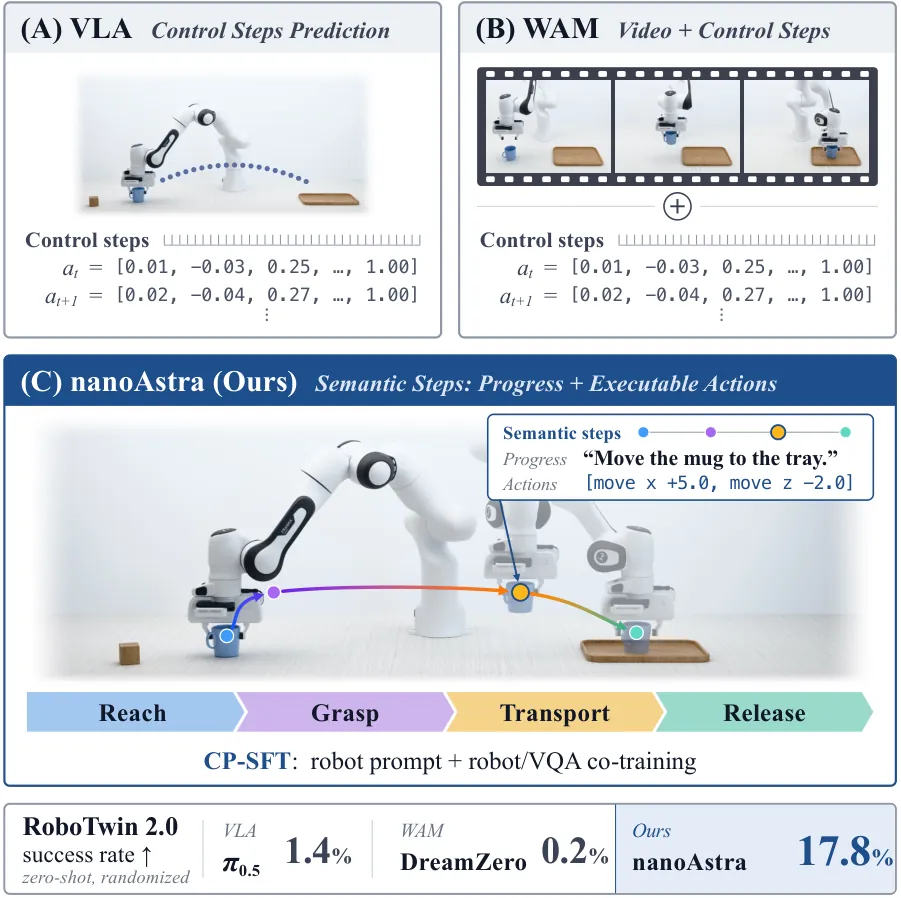
Figure 1: VLA and WAM rely on dense control-step prediction; nanoAstra organizes behavior into reusable semantic steps with explicit progress guidance and executable actions (paper Figure 1).
Preliminaries: Action Chunks, Semantic Steps, Response Spaces
An action chunk — the standard output of recent VLAs — predicts several future control steps at once to amortize autoregressive latency, at the cost of tying supervision granularity to control frequency. A semantic step raises granularity to the level of behavior: it is composed of reusable, parameterized action primitives covering translation, rotation, gripper control, and waiting, e.g. move x +5.0, rotate z +15, gripper open, wait. Each step carries separate command lists for the left and right arms; the arms execute concurrently, and an inactive arm is written as wait.
The companion concept is the progress description. High-level task instructions rarely specify intermediate goals, giving limited guidance about what to do next. Dense progress descriptions state what the robot should currently accomplish, while action primitives define how to execute it; together they form a structured response — a progress field followed by an ordered steps list. A training example thus changes from "observation → control vectors" to "observation at a decision point → progress plus executable behavior."
The third notion is the response decoding space. Given a robot system prompt $c_r$, structured outputs live in a space spanned by progress descriptions and legal action sequences; remove $c_r$ and the same model answers in free-form language. This soft constraint is the geometric intuition behind CP-SFT: supervision happens only inside the output subspace associated with robotic contexts.
Method I: A Five-Stage Pipeline for Semantic Action Modeling
The data comes from four heterogeneous sources — ABC-130K, AgiBot World, HiFi-UMI, and HY-UMI — spanning real robot demonstrations and hand-held gripper recordings. The pipeline unifies them into VLM-compatible supervision through five stages: data filtering, convention and camera alignment, subtask segmentation with dense captions, semantic step construction at behavioral decision points, and mixing with general vision-language data.
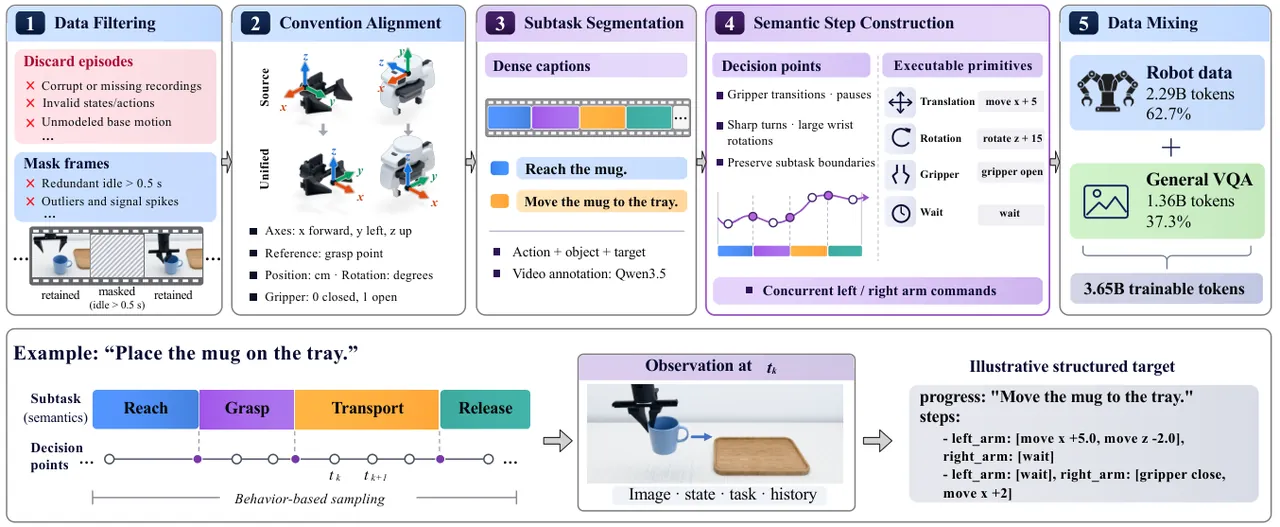
Figure 2: The five-stage pipeline and a structured target example for "Place the mug on the tray" (paper Figure 2).
Data filtering operates at episode and frame levels. Episode-level discards cover corrupted timing or content (abnormal frame rates or durations, timestamp gaps, video–state desynchronization, missing videos, invalid values), state–action inconsistency, physically implausible arm or gripper signals, mobile-base motion beyond what the arm-only action interface can express, and camera extrinsics that fail quality checks and cannot be reliably re-calibrated. Frame-level masking removes idle segments longer than 0.5 s before, after, and between motions, plus action outliers, jerky motions, and signal spikes; an episode is dropped only when such frames dominate it.
Convention and camera alignment fixes the problem that the same command means different geometry in different datasets. Robot demonstrations use a robot-base frame while hand-held grippers use a fixed scene frame; dataset-specific quaternion layouts and 6D rotation representations are converted to a common quaternion. In the text interface, positions and translations are in centimetres, rotation angles in degrees, and gripper opening is mapped to $[0,1]$ (0 closed, 1 open). To weaken dependence on dataset-specific absolute positions, the coordinate origin is translated by an offset sampled independently per axis within $\pm 30$ cm and held fixed for the episode. End-effector reference points are unified to the gripper fingertip midpoint where kinematics allow; the same transformations apply to current states, history, and action targets.
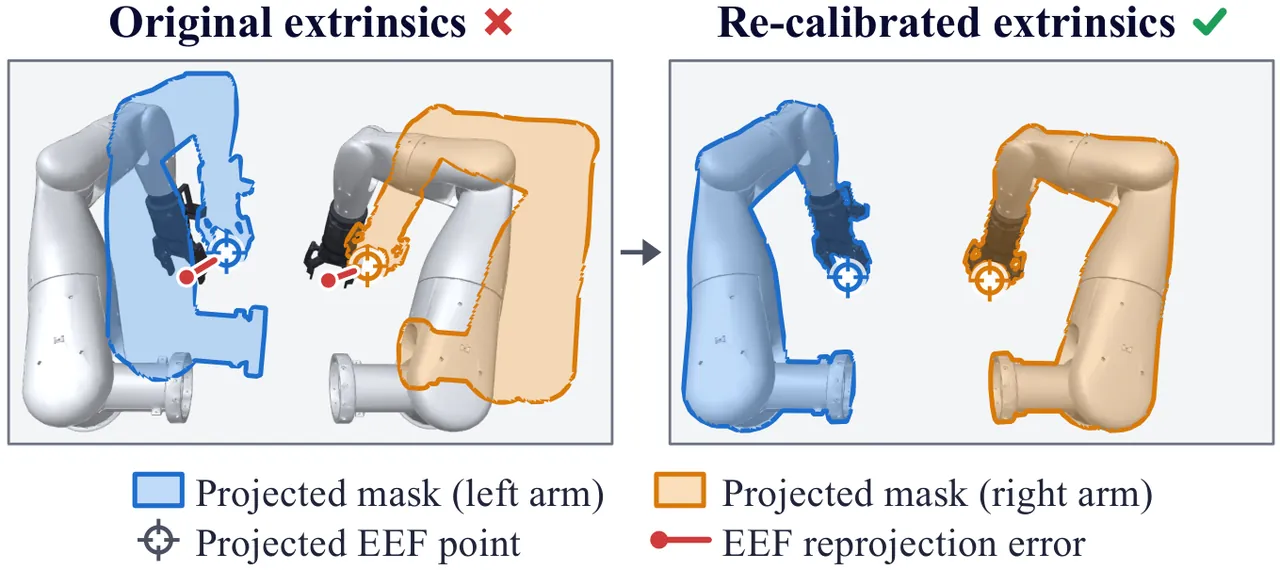
Figure 3: Projecting the robot model at recorded joint states into the image; original extrinsics misalign projected arm masks and EEF points, re-calibration aligns them (paper Figure 3).
Geometric consistency between text and image is handled explicitly: some datasets withhold camera extrinsics, and released ones can be inaccurate, so projected end-effectors miss the visible grippers. The authors re-calibrate the main camera by projecting the robot model into arm masks and EEF points and correcting extrinsics against the reprojection error. This step is a prerequisite for a shared action vocabulary whose parameters carry consistent geometric meaning across sources.
Subtask segmentation with dense captions: gripper transitions and manipulation events localize operation segments in time; Qwen3.5-122B-A10B then captions the corresponding clips, specifying action, manipulated object, and target. The resulting semantic timeline supplies dense progress descriptions — each later action step carries a local goal explaining its role in the overall task.
Semantic step construction: subtasks are still too coarse (grasping includes reaching and closing), so episodes are cut along unified end-effector trajectories and gripper states at gripper transitions, pauses, sharp turns, and large wrist rotations; subtask boundaries are always retained as cuts, so no step spans two subtasks. The start frame of each interval is a decision point where observation and action prediction are sampled, removing redundant supervision from near-identical control frames and organizing targets around changes in behavior.
flowchart LR
  S[ABC-130K / AgiBot
HiFi-UMI / HY-UMI] --> F[Filtering
episode + frame level]
  F --> A[Convention + camera alignment
cm / degrees / gripper 0-1
extrinsic re-calibration]
  A --> T[Subtask segmentation
Qwen3.5-122B-A10B
dense progress captions]
  T --> C[Semantic step construction
decision-point cuts
left / right arm commands]
  C --> M[Data mixing
robot 2.29B tokens
+ VQA 1.36B tokens]
  M --> R[CP-SFT full fine-tuning
Qwen3.5-9B
56 x H20]
Data recipe: after filtering, 5,310.5 hours across roughly 818K episodes yield 14.9M semantic action samples; the four sources contribute 1,203.4 h (ABC-130K), 990.0 h (AgiBot), 1,784.6 h (HiFi-UMI), and 1,332.5 h (HY-UMI). These are mixed with 1.55M general vision-language examples from Honey-Data-V2 covering VQA, grounding, chart and document understanding, counting and reasoning, spatial and embodied understanding, STEM, and captioning. The mixture holds about 3.65B trainable tokens: 2.29B (62.7%) robot and 1.36B (37.3%) general vision-language.
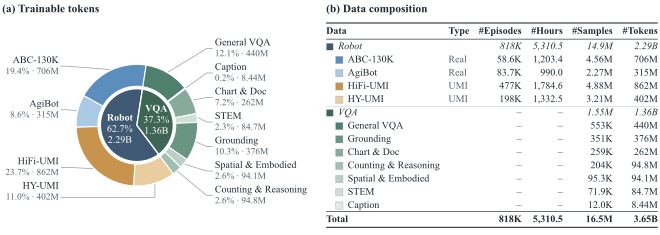
Figure 4: Trainable-token distribution and per-dataset statistics (paper Figure 4).
| Source | Type | Episodes | Hours | Samples | Tokens |
|---|---|---|---|---|---|
| ABC-130K | Real robot | 58.6K | 1,203.4 | 4.56M | 706M |
| AgiBot | Real robot | 83.7K | 990.0 | 2.27M | 315M |
| HiFi-UMI | Hand-held (UMI) | 477K | 1,784.6 | 4.88M | 862M |
| HY-UMI | Hand-held (UMI) | 198K | 1,332.5 | 3.21M | 402M |
| General VQA (Honey-Data-V2) | Vision-language | — | — | 1.55M | 1.36B |
| Total | 818K | 5,310.5 | 16.5M | 3.65B |
Method II: CP-SFT — Soft Constraints and Numerical Supervision
The first instrument of CP-SFT is a softly constrained response decoding space. A robot-specific system prompt $c_r$ specifies the embodiment, coordinate conventions, executable action vocabulary, and response format. Given an input $x$ of visual observations, robot states, a task instruction, and interaction history, the VLM predicts task progress $g$ and executable semantic steps $A$. The structured response space is
$$\mathcal{Y}_{r}(c_{r})=\left\{\operatorname{Serialize}(g,A)\mid g\in\mathcal{G},\ A\in\mathcal{A}(c_{r})\right\} \tag{1}$$
where $\mathcal{G}$ is the set of natural-language progress descriptions and $\mathcal{A}(c_r)$ contains action sequences conforming to the robot interface. The system prompt and structured targets jointly confine manipulation supervision to $\mathcal{Y}_r(c_r)$: adaptation focuses on robotic contexts, aiming to minimally change the pretrained output distribution outside them. Note the constraint is soft — all weights are updated, no layers are frozen; the confinement comes from input conditioning and target format, not architectural isolation.
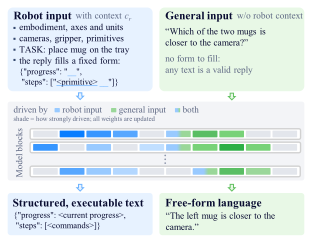
Figure 5: Robot inputs with $c_r$ produce structured executable text; general inputs without $c_r$ produce free-form language. The middle panel sketches how strongly each input drives every transformer block (paper Figure 5).
The second instrument is numerical supervision. Action parameters are numbers written as text, and plain cross-entropy treats "predicting 9 instead of 1" the same as "predicting 9 instead of 8," although the latter is geometrically far closer. The authors adapt a Wasserstein number-token loss: for a number $\nu$, let $D_\nu$ index its digits, digit $j$ having target value $d_j$ and decimal place $10^{e_j}$ (e.g. $e_j=1,0,-1$ for the three digits of 12.5). Place weights are $w_j=10^{e_j}/T_\nu$ with $T_\nu=\sum_{j\in D_\nu}10^{e_j}$; letting $\widetilde{p}_j$ be the softmax restricted to the ten digit tokens,
$$\ell_{\nu}^{\mathrm{digit}}=\sum_{j\in D_{\nu}}w_{j}\sum_{v=0}^{9}\widetilde{p}_{j}(v)\,|v-d_{j}| \tag{2}$$
$$\ell_{\nu}^{\mathrm{sign}}=\frac{2|y_{\nu}|}{T_{\nu}}\,\sigma(z_{\mathrm{flip}}-z_{\mathrm{true}})$$
Here $y_\nu$ is the target number and $z_{\mathrm{true}}, z_{\mathrm{flip}}$ are logits of the correct sign-bearing token and its sign-flipped counterpart; the sign term is zero without an explicit sign. Place weighting emphasizes significant digits, the sign term captures errors invisible to digit-only supervision, and digit-only normalization separates numerical proximity from digit probability mass. Averaging over the $N_s$ numbers in a supervised response gives $\ell_s^{\mathrm{num}}=|N_s|^{-1}\sum_{\nu\in N_s}(\ell_\nu^{\mathrm{digit}}+\ell_\nu^{\mathrm{sign}})$, set to zero when $N_s$ is empty. The final objective is
$$\mathcal{L}=\frac{1}{|\mathcal{B}|}\sum_{s\in\mathcal{B}}\left(\ell_{s}^{\mathrm{CE}}+\lambda\,\ell_{s}^{\mathrm{num}}\right),\qquad \lambda=0.3 \tag{3}$$
$\ell_s^{\mathrm{CE}}$ is the mean cross-entropy over supervised tokens, and $\mathcal{B}$ contains all original samples in an optimizer step across GPUs and gradient accumulation, ensuring equal sample weighting regardless of packing. The loss changes no architecture — only how much a numerical error is charged.
Experimental Setup and Zero-Shot Results
The model is initialized from Qwen3.5-9B and trained with ms-swift for one epoch on 56 H20 GPUs. The effective global batch is 56 data packs (about 188 original samples on average) per optimizer step with one gradient-accumulation step; AdamW with peak learning rate $1\times10^{-5}$, cosine schedule, warmup ratio 0.01, weight decay 0.1; maximum sequence length 8,192 tokens, a budget of 392 visual tokens per image, bfloat16 mixed precision with DeepSpeed ZeRO-2, and full fine-tuning of the entire 9B model. Evaluation uses 50 tasks of RoboTwin 2.0's randomized setting, averaging 10 runs per task. Training contains no simulated trajectories, no RoboTwin demonstrations, and no benchmark-specific fine-tuning, so the protocol is strictly zero-shot. The model runs in closed loop: each turn takes the current observation and returns progress plus semantic steps; an episode ends on success or when the turn budget is exhausted.
| Family | Model | Zero-shot SR (%) |
|---|---|---|
| VLA | π0.5 | 1.4 |
| VLA | Xiaomi-Robotics-1 | 2.0 |
| VLA | DM0.5 | 2.4 |
| VLA | LingBot-VLA-2.0 | 10.8 |
| WAM | DreamZero | 0.2 |
| WAM | LingBot-VA | 0.0 |
| VLM (w/ thinking) | Qwen3.5-9B | 8.2 |
| VLM (w/ thinking) | Qwen3.8-27B | 10.8 |
| VLM (w/ thinking) | Qwen3.5-35B-A3B / 397B-A17B | 9.0 / 9.0 |
| VLM (w/o thinking) | Qwen3.5-9B / Qwen3.8-27B | 3.2 / 3.6 |
| VLM (w/o thinking) | Qwen3.5-35B-A3B / 397B-A17B | 3.4 / 4.0 |
| Ours | nanoAstra-9B | 17.8 |
nanoAstra-9B's 17.8% exceeds the strongest evaluated VLA (LingBot-VLA-2.0) and the strongest VLM baseline (Qwen3.8-27B with thinking) by 7.0 percentage points; evaluated WAMs reach at most 0.2%, underscoring how hard transfer is under this protocol. Thinking helps every Qwen model (3.2–4.0% without → 8.2–10.8% with), but reasoning tokens add autoregressive decoding work and can delay closed-loop action. nanoAstra reaches 17.8% without thinking — 14.6 points above its own base without thinking and 9.6 above it with thinking, and above the larger evaluated Qwen models — because structured action responses are generated directly, without an explicit reasoning trace.
Inference Efficiency and Streaming Execution
The authors define I/M as inference latency divided by the execution time of the motion that prediction produces: above 1 means prediction is slower than the motion, below 1 leaves room for pipelined overlap. On a single RTX 4090, nanoAstra takes 3.89 s to generate 3.5 commands on average, corresponding to 2.87 s of motion (I/M 1.36); on a single H20 this drops to 1.69 s against 2.66 s of motion (I/M 0.64) — inference becomes shorter than the motion it produces.
| Model | Inference | Actions | Motion | I/M |
|---|---|---|---|---|
| π0.5 | 101 ms | 45.0 steps | 2.70 s | 0.037 |
| StarVLA | 70 ms | 16.0 steps | 0.96 s | 0.073 |
| X-VLA | 143 ms | 28.6 steps | 1.71 s | 0.084 |
| Fast-WAM | 523 ms | 27.3 steps | 1.64 s | 0.32 |
| Motus | 1.93 s | 16.0 steps | 0.96 s | 2.01 |
| LingBot-VA | 8.89 s | 22.2 steps | 1.33 s | 6.67 |
| Qwen3.5-9B (w/ thinking) | 60.7 s | 1.6 cmds | 1.42 s | 42.8 |
| nanoAstra (4090) | 3.89 s | 3.5 cmds | 2.87 s | 1.36 |
| nanoAstra (H20) | 1.69 s | 3.5 cmds | 2.66 s | 0.64 |
When execution blocks on inference, VLM latency forces the robot into a stop-and-go pattern. On H20, inference is already shorter than motion, so the authors adopt streaming execution: commands run as they arrive in the token stream, and the next reply is requested before the current one finishes executing. Concretely, after step 2 of reply $k$, a new observation is taken and reply $k+1$ is requested; the remaining steps 3 and 4 are prefilled as the beginning of reply $k+1$ and keep running during inference, after which the model writes new steps. This reduces the robot's waiting share from 35.0% to 6.9% with no loss in success rate.
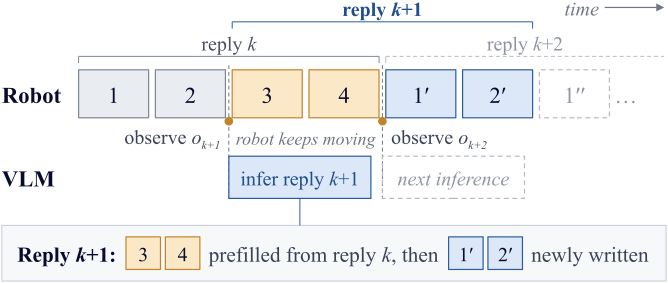
Figure 6: Streaming execution — remaining steps of reply k run while reply k+1 is inferred; the new reply is prefilled with the old steps before writing new ones (paper Figure 6).
| Execution | SR (%) | Wait per turn (steps) | Idle share |
|---|---|---|---|
| Blocking | 11.2 | 2.1 | 35.0% |
| Streaming | 12.9 | 0.2 | 6.9% |
Note that this protocol differs from the official evaluation: the simulator keeps running during inference, as on a real robot, with 5 runs per task within the official time limit, so success rates are lower than in the main table. Wait is measured in units of one step's duration (0.8 s on average), excluding first turns and turns affected by a failed step.
Cross-Benchmark Transfer and Capability Retention
RoboDojo Open covers 8 tasks with 10 seeds and 5 runs per seed — 400 episodes per model. nanoAstra-9B achieves 4.75% success (19/400) and a progress score of 5.06, both the best in the table; its untuned Qwen3.5-9B counterpart without thinking manages 0.25%, and the strongest general VLM baseline, Qwen3.5-35B-A3B, reaches 0.75%. The gains from semantic-step supervision therefore transfer beyond RoboTwin.
| Model | RoboDojo SR (%) | Score |
|---|---|---|
| Xiaomi-Robotics-1 | 0.25 | 0.25 |
| LingBot-VLA 2.0 / π0.5 / DM0.5 / DreamZero / LingBot-VA | 0.00 | 0.00 |
| Qwen3.5-9B (w/o thinking) | 0.25 | 0.25 |
| Qwen3.5-35B-A3B (w/ and w/o thinking) | 0.75 | 0.75 |
| nanoAstra-9B | 4.75 | 5.06 |
On capability retention, training loss drops rapidly during early adaptation and then decreases steadily, with its exponential moving average reaching about 0.346; VQA accuracy initially declines and fluctuates, then recovers and stabilizes at later checkpoints rather than deteriorating further. At the final checkpoint, MMMU, ERQA, CV-Bench-2D, and CV-Bench-3D reach 53.1%, 41.0%, 81.6%, and 87.6%, against initial 58.6%, 47.3%, 82.2%, and 92.6%: CV-Bench-2D nearly fully recovers (0.6-point gap), while the others retain most of their accuracy (5.0–6.3-point gaps).
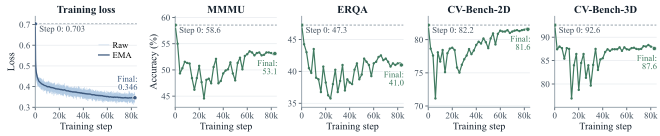
Figure 7: Training loss and four vision-language benchmarks over training steps; dashed lines mark step-0 accuracy (paper Figure 7).
| Benchmark | Initial (%) | Final (%) | Gap (points) |
|---|---|---|---|
| MMMU | 58.6 | 53.1 | 5.5 |
| ERQA | 47.3 | 41.0 | 6.3 |
| CV-Bench-2D | 82.2 | 81.6 | 0.6 |
| CV-Bench-3D | 92.6 | 87.6 | 5.0 |
Failure Analysis and Limitations
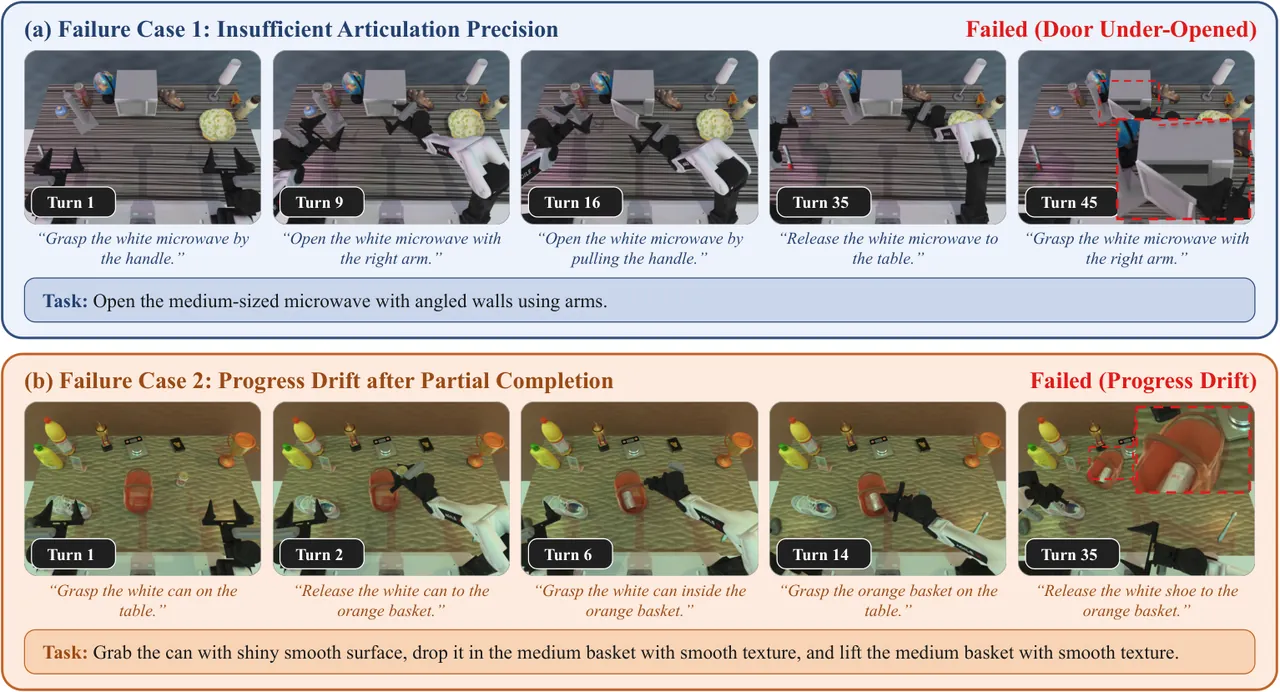
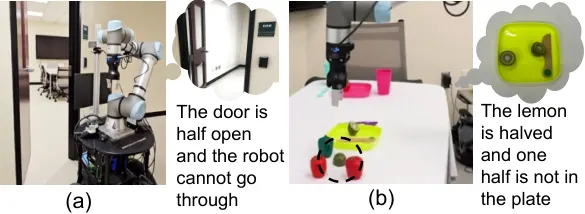
Figure 8: Failure cases — (a) microwave door under-opened; (b) progress drift after partial completion (paper Figure 8).
The authors' first failure class is insufficient articulation precision: in the microwave case, predicted progress largely follows the grasp–open–release cycle, but each opening step executes as straight-line translation, so the door opens only partially and never crosses the success threshold — straight-line primitives do not respect the arc constraint of articulated joints. The second class is task-state estimation drift: the can is placed in the basket at turn 2, yet progress returns to the completed subtask at turn 6, moves on to grasping the basket at turn 14, then drifts to a distractor shoe at turn 35, and the basket is never lifted. The authors hypothesize that object-centric primitives for articulated objects and explicit tracking of completed subtasks would improve long-horizon manipulation — an openly acknowledged limitation.
The authors also concede that capability retention is incomplete: general benchmarks still lose 5.0–6.3 points, and they suggest broader, more diverse VQA co-training data could reduce the degradation. Several further boundaries follow from the experimental design. First, 17.8% absolute success remains low — the randomized zero-shot protocol is extremely hard, but reliable deployment is far away. Second, all evaluation is in simulation (RoboTwin, RoboDojo); no real-robot closed-loop experiments are reported, so execution error of semantic steps on physical hardware is not directly validated. Third, streaming gains depend on H20-class inference speed; on a 4090 the I/M ratio still exceeds 1, so consumer hardware can only run blocking execution. Fourth, code was not yet public at the time of reading, and full fine-tuning on 56 H20 GPUs sets a substantial reproduction budget.
Conclusion
nanoAstra offers a reproducible path from VLM to manipulation foundation model: no new architecture, no action head — only a reorganization of supervision (semantic steps plus dense progress) and a reorganization of adaptation constraints (system-prompt soft confinement, VQA co-training, numerical loss). Under a strictly zero-shot protocol it surpasses the evaluated dedicated VLAs/WAMs and larger general VLMs, keeps general-capability degradation to a few points, and uses streaming inference to cut execution idle time to 6.9%. The results support a concrete hypothesis: the bottleneck of manipulation generalization may lie less in model capacity than in whether supervision exposes reusable behavior structure.
The takeaway for the community is twofold. The data pipeline itself — filtering, geometric alignment, decision-point segmentation, dense progress — is a transferable asset. And the softly constrained response space provides a more flexible alternative to frozen layers for capability preservation: specialize inside robotic contexts, stay as unchanged as possible elsewhere. Object-centric articulated primitives and explicit subtask-state tracking are the two most promising next steps.
Swap supervision from fragments of control steps to the semantics of behavior, and a VLM's native text interface can grow manipulation skill — without forgetting the world it has read.