Skip to content
← Tags

#Tsinghua University (4)

From reactive to cognitive: brain-inspired spatial intelligence for embodied agents

From reactive to cognitive: brain-inspired spatial intelligence for embodied agents

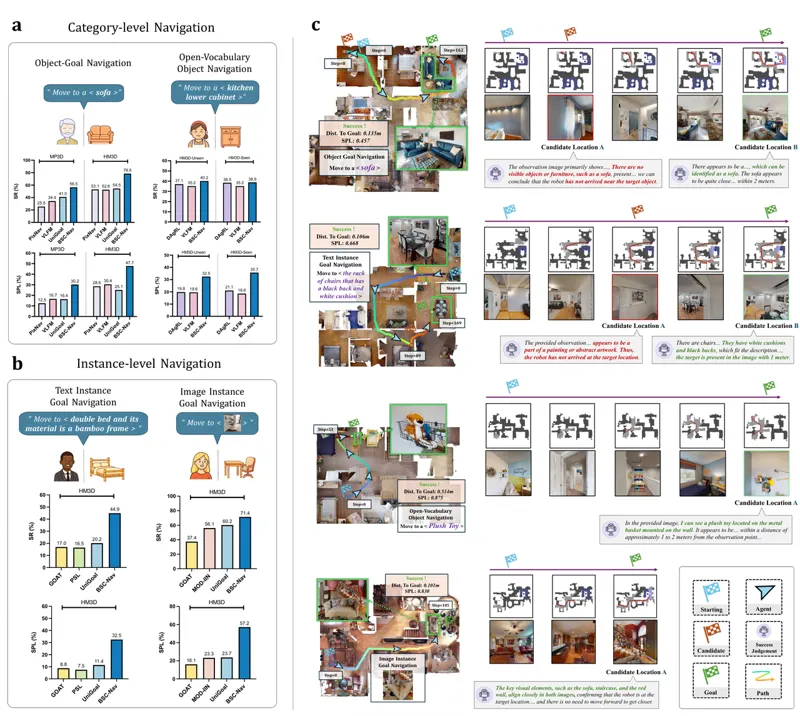
Tsinghua University and Beihang University present BSC-Nav (Brain-inspired Spatial Cognition for Navigation). The paper argues that existing embodied agents — whether end-to-end RL or "MLLM plus modular pipeline" — are fundamentally reactive and stateless: they process an observation and discard it, lacking any durable internal model of space, which yields fragmented knowledge, short-sighted planning and poor generalization. The authors borrow the answer from neuroscience, where spatial knowledge consolidates into three interconnected forms: landmarks, route knowledge, and survey knowledge. BSC-Nav instantiates these computationally in three modules. Landmark memory stores 4-tuples (world coordinates, open-vocabulary category, detection confidence, GPT-4o contextual description) with a spatial-overlap set plus confidence-weighted fusion for deduplication. The cognitive map extracts DINO-v2 patch features, projects them through inverse perspective projection and cascaded coordinate transforms into a voxel grid, and adopts a free-energy-principle-inspired surprise-driven update: a new feature is written when its mean distance to features in the n-hop neighborhood exceeds a threshold, replacing the lowest-surprise entry when the buffer is full, preserving cross-viewpoint diversity while bounding storage. Working memory retrieves hierarchically by instruction complexity — simple targets use text-only GPT-4 reasoning over landmark memory (even inferring unrecorded targets from co-located landmarks), while complex targets first have descriptions refined by GPT-4o, then "imagine" the appearance via Stable Diffusion 3.5, encoded by DINO-v2 and center-distance weighted pooled to query the cognitive map (imagine-then-localize), with similarity-weighted DBSCAN yielding candidate coordinates. Rather than greedily taking the highest confidence, candidates are ordered by H_i = lambda*p_i + (1-lambda)(1 - d_i/d_max). Across 62 MP3D/HM3D scenes and 8,195 episodes: OGN reaches 78.5% SR on HM3D (24.0 points above SOTA UniGoal), OVON zero-shot beats supervised DAgRL, IIN reaches 71.4%; SPL gains are even more consistent (IIN 57.2% vs 23.7%). On A-EQA it achieves the highest LLM-Match of 54.6, still trailing humans by 27.5. Real-world deployment on a custom platform (AgileX Ranger-mini-3.0 chassis, Franka Research 3 arm, RealSense D435i) ran 75 episodes in a ~200 m² two-floor space, with IIN reaching 100% SR on 4 of 5 targets and reliable localization to semantically plausible regions even on failure, plus long-horizon navigation-plus-manipulation demos such as "make breakfast" over three open-vocabulary objects. The paper proposes an embodied Turing test for spatial cognition probing three dimensions: real-time construction of reusable spatial representations, abstraction from sparse partial observations, and translation of high-level goals into actionable spatial plans.

Ruan, Shouwei, Wang, Liyuan, Kang, Caixin · 1.1k views · Aug 24, 2025
BSC-NavVision-language navigation
Aug 24, 2025

ReST-RL: Reinforcing LLM Reasoning through Unified Self-Training and Value-Guided Search

ReST-RL: Reinforcing LLM Reasoning through Unified Self-Training and Value-Guided Search

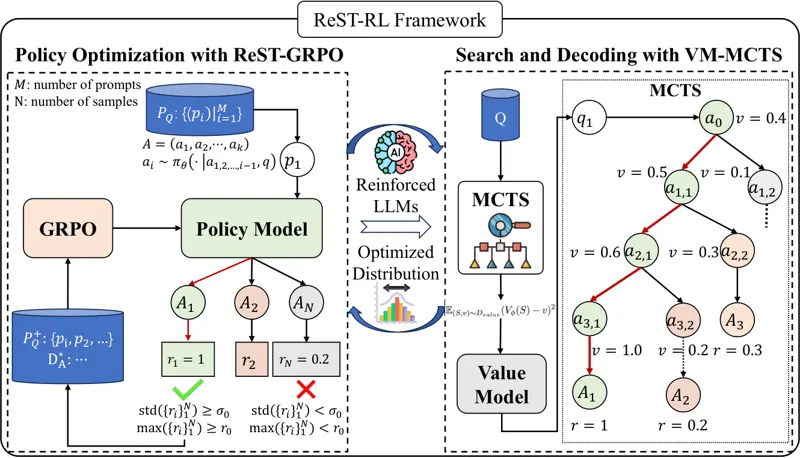
GRPO is the representative RL method for improving LLM reasoning, yet it only ever sees one sparse reward at the end of a whole trajectory: when the rewards inside a sampled group land close together, the group-relative advantage collapses into noise and the policy learns almost nothing. ReST-RL reconnects policy optimization and value-guided search into a single self-training pipeline. Stage one, ReST-GRPO, first filters out low-information prompts by reward standard deviation, then draws prefixes from each prompt's highest-reward trajectory under a discrete exponential distribution and uses them as fresh online-GRPO starting contexts. A selected prefix is context only; its suffix is re-sampled and optimized rather than imitated. Stage two, VM-MCTS, runs MCTS under the now-static policy to self-collect value targets and trains a value model that predicts expected terminal reward. At inference the same model both allocates the tree search through UCT and ranks completed candidates in a Best-of-N fashion, so search and verification share one state-value scale. On coding benchmarks including APPS, BigCodeBench and HumanEval, Qwen3-8B moves from 0.503 to 0.689 average. In matched policy-value controls, ReST-GRPO + VM-MCTS reaches 0.642 on APPS-500 while GRPO + VM-MCTS reaches only 0.538, so the stage-one distributional shift survives value learning. End-to-end accounting puts ReST-GRPO at 1,752 GPU-hours against 2,080 for GRPO, hitting a 9% gain in 71 hours instead of 207. A value model trained only on code trajectories also transfers to MATH, Omni-MATH and GPQA-Diamond without target-domain tuning.

Sining Zhoubian, Dan Zhang, Jie Tang · 846 views · Aug 27, 2025
Reinforcement LearningGRPO
Aug 27, 2025
Harness VLA: Steering Frozen VLAs into Reliable Manipulation Primitives via Memory-Guided Agents

Harness VLA: Steering Frozen VLAs into Reliable Manipulation Primitives via Memory-Guided Agents

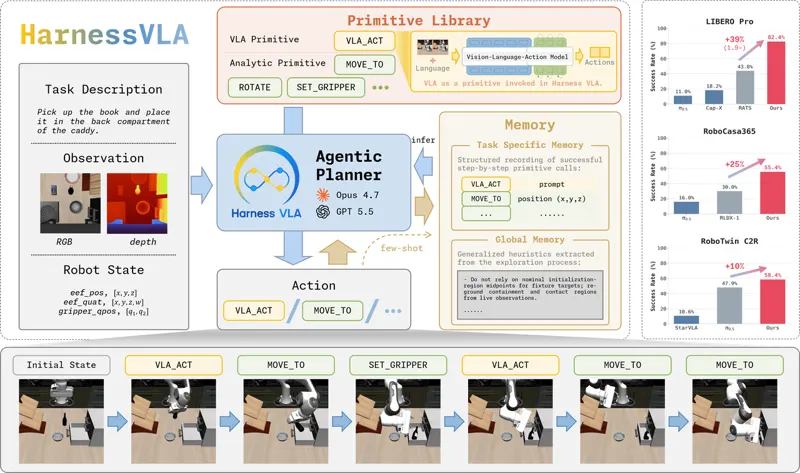
Language-conditioned manipulation requires both precise contact-rich control and robust reasoning over language, scenes, and long horizons. End-to-end Vision-Language-Action (VLA) models provide strong local visuomotor skills, but they are trained on in-distribution task trajectories and often fail under deployment perturbations such as semantic retargeting, goal re-binding, spatial-layout shifts, and unstable local contacts. LLM coding agents provide complementary semantic and compositional reasoning, but purely analytic primitives struggle with irregular grasping, constrained placement, and articulated-object interaction. We present Harness VLA, a memory-augmented agentic framework that exposes a frozen VLA as a retryable contact-rich primitive and composes it with a small fixed library of analytic primitives for grounding, staging, transport, navigation, and release. Rather than expanding the skill library, the harness learns the operating range of these fixed primitives from task-specific execution traces, global success rules, and failure models. By lifting semantic re-grounding, non-contact execution, and VLA re-staging to the planner while reserving the frozen VLA for local contact-rich phases, Harness VLA extends pretrained VLAs beyond their original trajectory distribution without finetuning. Across perturbed tabletop, household kitchen, and clean-to-randomized bimanual manipulation, Harness VLA improves over the strongest relevant baselines by 38.6 and 27.1 percentage points on LIBERO-Pro and RoboCasa365, respectively, and reaches 58.4% on RoboTwin C2R. Code is available at https://github.com/RLinf/RPent.

Yixian Zhang, Huanming Zhang, Feng Gao · 1.3k views · Jul 9, 2026
VLARobot Manipulation
Jul 9, 2026

As an Amazon Associate, we earn from qualifying purchases.