PAPER DEEP DIVE
VBot Exo2Ego Policy: Lightweight Data Collection and Exocentric-to-Egocentric Video Generation
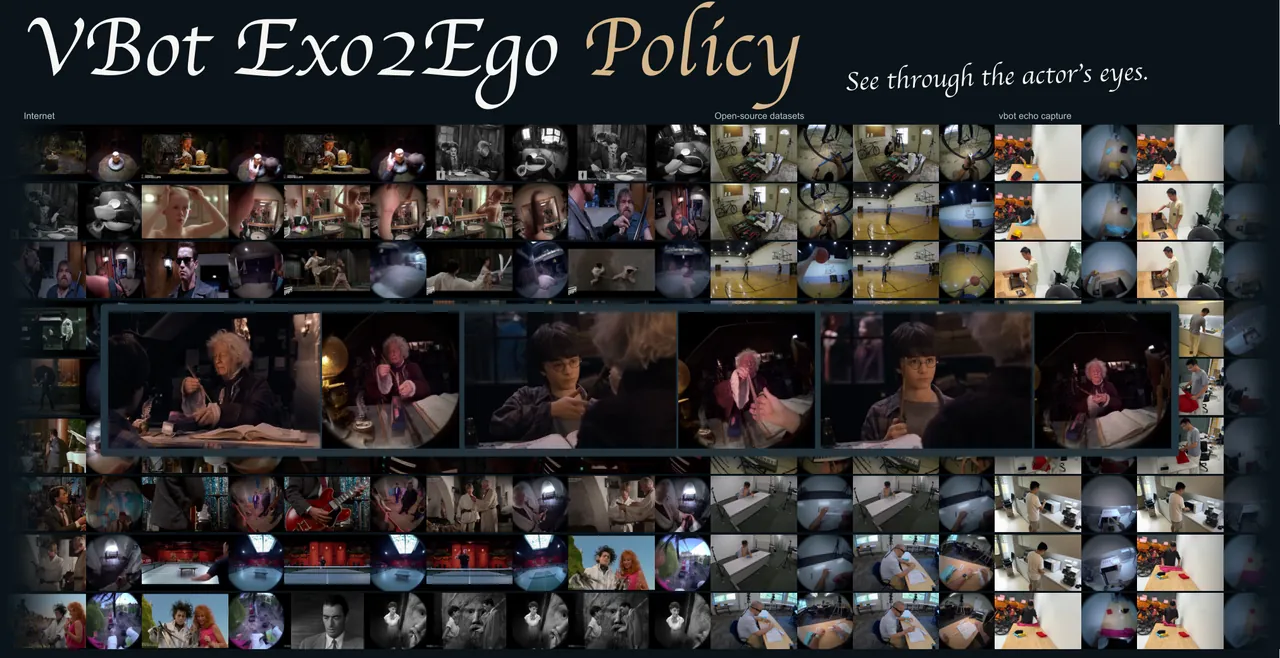
We present VBot Exo2Ego Policy, a video generation model that converts third-person videos into first-person observations of a selected actor, expanding first-person operation data from real-world footage. The system includes a lightweight collection pipeline and mobile app supporting first-person, third-person, and synchronized dual-view capture, combining accessible single-view data with paired RGB and camera geometry. Built on a pretrained video diffusion transformer, it uses geometric camera guidance plus semantic-mask and hand-keypoint supervision to improve viewpoint transfer and hand-object interaction fidelity. Camera geometry is stochastically injected and gradually removed during training so inference does not require target-camera calibration. Source-video perception and reasoning, optional actor references, and multi-shot adaptation further identify the intended actor and follow operations across camera cuts.
Paper: VBot Exo2Ego Policy: Lightweight Data Collection and Exocentric-to-Egocentric Video Generation
Authors: Tong Rao, Zhihao Zhang, Yuntian Wang, Siyu Zhou, Hailong Qin, Yinan Yu
Status: Submitted November 12, 2026; 27 pages and 11 figures. arXiv:2611.16417; full HTML paper.
Code: The paper does not link to public code or a project page, and title, author, and keyword searches on GitHub did not identify a repository that can be attributed to this work. The analysis below therefore follows the paper and its appendix; it does not claim source-level reproduction.
One-Sentence Summary
VBot Exo2Ego Policy combines a carefully constrained two-phone capture protocol with a frozen H3 video generator adapted by RGB LoRA, stochastic camera-ray conditioning, semantic masks, and ACE hand supervision to turn ordinary third-person operation footage into first-person video that retains usable hand-object evidence.
Background and Motivation
Robot manipulation data has a persistent viewpoint mismatch. Egocentric video matches the operator's observation and captures wrists, fingers, tools, and nearby objects at the scale needed for manipulation, but camera wearers must mount and carry a device. The device can obstruct movement, head motion changes the framing, and collecting every task in every environment is expensive.
Exocentric video is easier to obtain. Fixed cameras, demonstration rooms, collaboration recordings, and Internet footage can cover many tasks and people without placing a sensor on the actor. Yet a policy trained on first-person observations cannot treat an arbitrary third-person recording as an equivalent input. The cameras differ in position, orientation, scale, occlusion, and visibility of the interaction region.
Existing approaches address the gap through novel-view synthesis, dynamic reconstruction, video reshooting, camera control, or exocentric-to-egocentric generation. Geometry-driven methods can recover accurate correspondences when overlap is sufficient, but manipulation scenes often contain wide baselines, hand and object occlusion, close-range surfaces, and abrupt viewpoint changes. A purely generative model may produce a plausible first-person scene while placing a hand on the wrong object or changing the action order.
The paper's central design decision is to let capture provide trustworthy correspondence and let generation fill the first-person evidence that an ordinary third-person source does not contain. This division matters. The capture protocol is not merely a dataset announcement: it creates a common metric frame through shared observations, camera trajectories, and depth. The generator is not treated as an unconstrained video stylizer: it receives source motion, actor-specific text, and optional identity evidence.
The target output must satisfy more than visual realism. It should retain event order, object identity, wrist and finger structure, and interaction regions. It should also select the intended actor in a multi-person scene and remain coherent when the source camera cuts. These requirements connect the work to embodied data production rather than to a generic video-to-video benchmark.
The contribution can be grouped into three parts. First, the authors introduce a mobile application and protocol for egocentric, exocentric, and synchronized paired RGB-D capture. Second, they adapt MiniMax-H3 Ref2VA with an RGB LoRA, source reasoning, an optional actor reference, synchronized multi-shot training, and stochastic Plucker-ray injection. Third, they add semantic-mask and ACE-based hand objectives so that generated RGB exposes more recoverable hand and object structure.
Prerequisites
Flow Matching and Low-Rank Adaptation
For a clean video latent $z_0$, Gaussian noise $\epsilon$, and noise level $\sigma_t$, the training latent is $z_t=(1-\sigma_t)z_0+\sigma_t\epsilon$. A velocity model predicts a direction related to $\epsilon-z_0$ under a scheduler weight. The paper keeps the H3 backbone frozen and trains low-rank adapters, so the adaptation uses a large pretrained video prior without retraining all base parameters.
Camera Rays and Semantic Masks
A Plucker ray encodes the line associated with a camera pixel using its moment and direction. It gives target-camera tokens a geometry-aware signal that can be added to the visual representation. A semantic mask labels background, manipulated objects, and the wearer's hands and arms. The first signal concerns where the virtual camera is; the second concerns which pixels participate in the operation. Both are training aids in this paper rather than required deployment inputs.
Method
1. Capture Is Lightweight, but Not Uncontrolled
The capture application supports egocentric recording, exocentric recording, and synchronized paired recording with two LiDAR-equipped iPhones. It stores RGB, timestamps, intrinsics, ARKit trajectories and tracking state, and depth together with registration, validity, and confidence metadata. The paired route therefore provides more than two videos: it provides the information needed to relate frames, cameras, and near-field metric depth.
A standard operating procedure governs camera placement, mounting, image settings, and visibility of hands, objects, and key events. The egocentric phone is allowed to move naturally with the head. After the common-start setup, the exocentric phone remains fixed. Operators rehearse the task and verify that its stages remain recognizable at the model's input resolution.
The paper distinguishes three sources. Precise paired capture supplies real cross-view supervision and held-out evaluation. Real egocentric capture supports manipulation pretraining without requiring a paired third-person camera. Exocentric capture or Internet footage becomes a source for generated first-person data. Each item retains source interval, recorded or generated status, model, prompt, and generation settings. Source-aware splits keep every derivative of the same recording together.
2. A Common Start Connects Views with Little Overlap
During manipulation, the two cameras may have a wide baseline, small visual overlap, and substantial occlusion from hands and objects. Direct wide-baseline pose recovery can fail. The protocol begins with both cameras observing a shared region from nearby positions before they move to their operating views. Those common-start frames are retained and jointly reconstructed with keyframes from both streams.
The paper reports that Pi3 and DA3 work well under this arrangement, without requiring either model as a permanent component of the deployed generator. Joint reconstruction produces its own scale. A single similarity transform is fit to the predicted egocentric trajectory and the matching ARKit trajectory. The transform gives $c=sR\hat c+t$, and predicted depth is corrected as $D_{\mathrm{metric}}=s\hat D$. The two camera paths then share a metric frame.
ARKit agreement is treated as one consistency check, not proof that the exocentric pose is correct. The authors also inspect geometric agreement in jointly visible regions and use near-field LiDAR depth to validate scale. ARKit scene depth has spatially varying reliability and becomes less useful at longer range; the observed degradation near five meters is an operating boundary, not a fixed property of every device or material.
Depth preprocessing aligns RGB and depth timestamps, intrinsics, and image transforms; removes invalid, low-confidence, and out-of-range samples; and handles discontinuities and outliers. The paper notes that finite spot size and interpolation can mix foreground and background around depth edges. The pipeline therefore keeps validity and confidence rather than reducing every capture to a single pose.
3. Data Selection Depends on the Supervision Target
A vision-language model scores sampled frames from 1 to 5. For new 141-frame clips, eight uniformly spaced frames include both endpoints. The clip score is the rounded average: $\bar s=\frac{1}{N}\sum_{i=1}^{N}s_i$ and $s_{\mathrm{clip}}=\lfloor\bar s+0.5\rfloor$. The system also keeps the minimum score and the count of low-scoring frames.
RGB training retains broad lighting and motion diversity after hard anomalies are rejected. Hand and semantic supervision exclude insufficient illumination or excessively fast motion because their targets are more fragile. Mosaic artifacts, essential-content blur, blackouts, or corrupt frames reject the entire clip; a good average cannot compensate for one hard failure. Task boundaries are tied to source frames, and derived hand and mask targets are checked for missing regions, incorrect regions, boundary quality, and temporal consistency.
4. Source Reasoning Identifies the Intended Actor and Event
An exocentric clip may contain several actors and objects. The method organizes actor identities, hand and object regions, keyframe indices, and interaction relations into a structured record $S_X$. Qwen3.8-VL receives those observations and sampled exocentric frames $F_X^{\mathrm{Qwen}}$ to produce $c=\operatorname{Qwen3.8-VL}(F_X^{\mathrm{Qwen}},S_X)$.
The detailed text condition preserves keyframe evidence, such as a right-hand grasp at a specific frame and normalized boxes for the hand and cup. A concise format keeps the action and event order. Both refer to the same target actor. In a multi-person scene, an exocentric screenshot $I_a$ can identify whose viewpoint should be generated. The video and text specify the event; the optional image specifies the actor.
During training, the reference image, structured record, and text are all aligned with the wearer of the paired egocentric camera. At inference, $I_a=\varnothing$ when no reference is supplied. This interface avoids requiring identity annotations for every source video while still allowing a user to resolve ambiguous scenes.
5. A Frozen Video Backbone Learns a View-Conversion Adapter
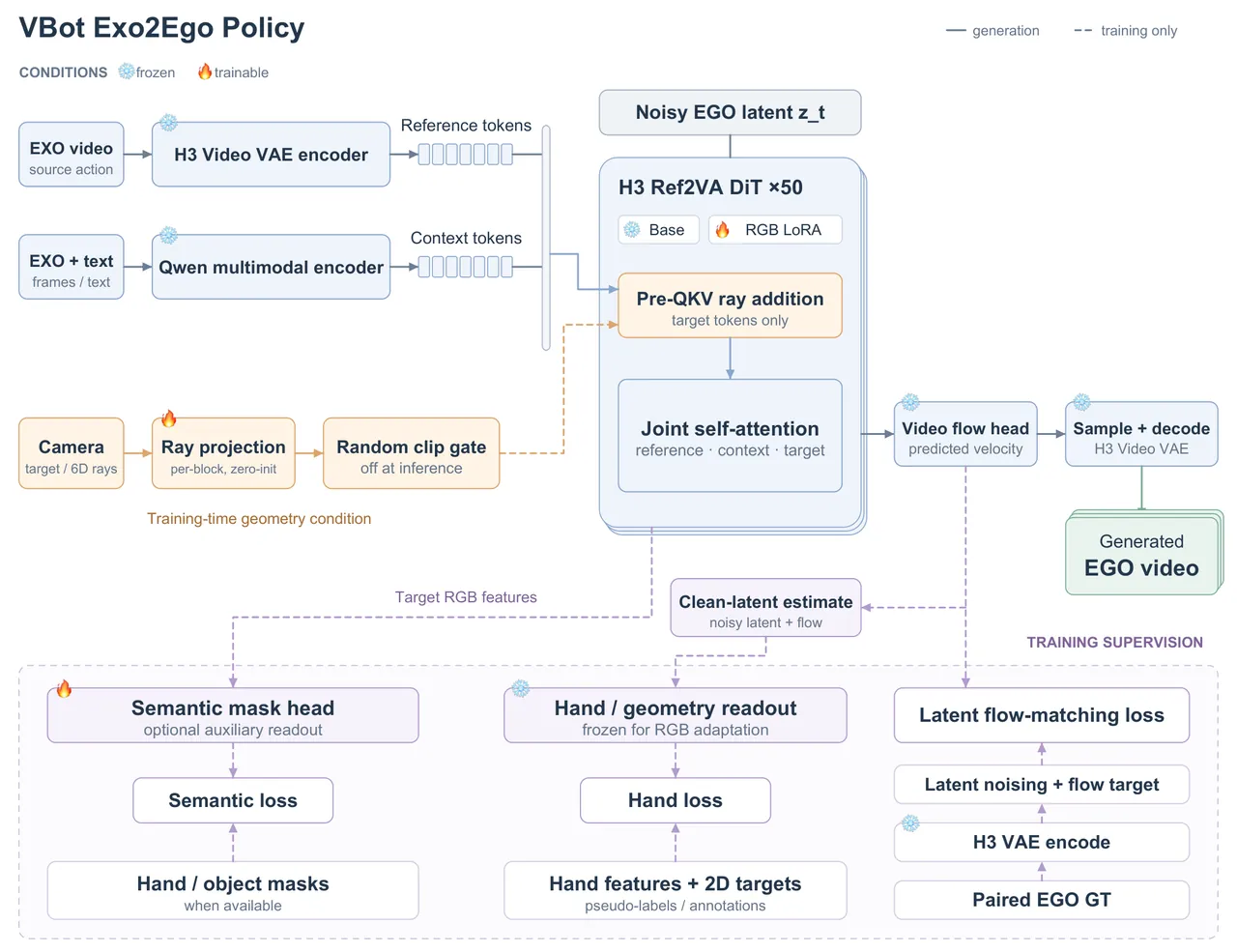
The base generator is MiniMax-H3 Ref2VA. A frozen video VAE encodes the exocentric clip, while a frozen H3 context encoder embeds source frames, text, and the optional actor reference: $\mathcal C=(E_{\mathrm{VAE}}(X),E_{\mathrm{ctx}}(F_X^{\mathrm{H3}},c,I_a))$. The adapted generator produces $\hat Y=G_\theta(X,c,I_a;\epsilon_{\mathrm{init}})$, where $\theta$ denotes the RGB LoRA parameters.
The objective follows the shared flow convention of H3. A clean egocentric target latent is $z_0=E_{\mathrm{VAE}}(Y)$, and training minimizes $\mathcal L_{\mathrm{RGB}}=\mathbb E_{t,\epsilon}[w(t)\lVert\bar v_\theta(z_t,t;\mathcal C)-(\epsilon-z_0)\rVert_2^2]$. The base parameters stay fixed, so the adapter must learn the task mapping while retaining the backbone's video prior.
This setup constrains the role of generation. Source video carries operation timing and visible object appearance. Text carries the target actor's action semantics. The LoRA carries the learned change in viewpoint and first-person appearance. Errors in any of those inputs can still propagate to the output.
6. Stochastic Rays Teach Geometry Without Requiring Calibration at Inference
Requiring a calibrated target camera at deployment would undermine the lightweight-capture claim. The paper therefore injects calibrated target geometry only during training. For every target egocentric token, a calibrated fisheye camera provides a ray. With camera center $o$ and unit direction $d$, the Plucker representation is $r=[o\times d,d]$. The rays are arranged as $R$ in the same order as the target tokens.
Each DiT block $\ell$ maps the rays through a zero-initialized projection $W_\ell$. A clip-level binary gate $b$ controls injection before the QKV projection: ${u'}_{\ell,\mathrm{EGO}}=u_{\ell,\mathrm{EGO}}+bW_\ell R$. Zero initialization preserves the pretrained model at the start. Sharing one gate across all frames, tokens, and blocks prevents a clip from receiving partial geometric clues that could make the objective inconsistent.
The ray probability follows a schedule in training progress $q$. It is $p(q)=0.5$ for $0\leq q\lt0.7$, decreases linearly as $p(q)=0.5(0.8-q)/0.1$ for $0.7\leq q\lt0.8$, and becomes $p(q)=0$ for the final 20 percent. The final phase therefore matches inference inputs: source video, text, and optional actor reference, with no target-camera rays.
The schedule acts as a curriculum and an exit path. Early training exposes both conditioned and unconditioned clips so that geometry informs the learned view transformation. Annealing then requires the RGB adapter to work without the training-only signal. Logged weighted flow MSE falls from 0.13638 to 0.12557 over updates 3001 to 5000, a 7.93 percent reduction. This is an optimization measurement, not a substitute for held-out image-quality evaluation.
7. Semantic Masks Send Interaction Gradients Back to RGB
Whole-frame RGB loss can leave hands and objects in approximately plausible places while blurring their contact boundary. The paper encodes a mask video $M$ as $m_0=E_{\mathrm{VAE}}(M)$ and trains a mask branch with the same noisy latent used by RGB. The mask adapter reads features from the RGB branch, so region-level supervision can shape the representation used to generate the image.
The mask prediction uses inverse classifier-free guidance. Let $v_m^+$ and $v_m^-$ be positive- and negative-text velocities, with guidance scale $g=4$. The effective target is $\bar v_m=(v_m^++(g-1)\operatorname{sg}(v_m^-))/g$, where stop-gradient $\operatorname{sg}$ blocks the negative branch from updating the model. A flow-matching mask loss $\mathcal L_m$ is then applied.
Training first warms up the mask adapter while keeping the RGB adapter $\theta_r^{(0)}$ fixed: $\min_{\theta_m}\mathcal L_m(\theta_r^{(0)},\theta_m)$. It then jointly optimizes both adapters with $\mathcal L_{\mathrm{joint}}=\mathcal L_{\mathrm{RGB}}+0.1\mathcal L_m$. Positive-text target keys and values remain in the graph, which yields $\nabla_{\theta_r}\mathcal L_{\mathrm{joint}}=\nabla_{\theta_r}\mathcal L_{\mathrm{RGB}}+0.1\nabla_{\theta_r}\mathcal L_m$ and $\nabla_{\theta_m}\mathcal L_{\mathrm{joint}}=0.1\nabla_{\theta_m}\mathcal L_m$.
8. ACE Features Add Hand Structure and Motion Supervision
Masks identify an interaction region but do not directly constrain individual joints. The authors use ACE-Ego-Hand as a frozen reader and as a feature target. For recorded egocentric video $Y$, ACE supplies features $F^*$, heatmaps $H^*$, 2D coordinates $J^*$, and hand presence $s^*$. The generated model is asked to match these observations.
The hand objective combines feature distance, heatmap KL, coordinate Huber loss, and presence BCE: $\mathcal L_{\mathrm{hand}}=\mathcal L_{\mathrm{feat}}+\lambda_H\mathcal L_{\mathrm{KL}}+\lambda_J\mathcal L_{\mathrm{Huber}}+\lambda_s\mathcal L_{\mathrm{BCE}}$. Feature matching represents hand appearance and structure, heatmaps preserve spatial uncertainty, coordinates anchor joint locations, and the presence term penalizes missed or spurious hands. A projector $P_\psi$ maps H3 latents to the ACE feature space.
To refine the reader with real annotations, the paper also uses 2D targets and heatmaps from HOT3D, ARCTIC, and Re:InterHand through $\mathcal L_{\mathrm{GT}}=\mathcal L_{\mathrm{KL}}(\widetilde H,H^{\mathrm{GT}})+\beta_J\mathcal L_{\mathrm{Huber}}(\widetilde J,J^{\mathrm{GT}})$. ACE pseudo-labels and dataset ground truth are kept conceptually separate: ground truth anchors localization and adapts the reader, while pseudo-labels extend supervision to more recorded clips.
In the ACEaux route, the current model prediction is converted to a clean-latent estimate $\hat z_0=z_t-\sigma_t\bar v_\theta(z_t,t;\mathcal C)$, projected to ACE features, and decoded. The training loss is $\mathcal L_{\mathrm{ACEaux}}=\mathcal L_{\mathrm{RGB}}+\lambda_h\mathcal L_{\mathrm{hand}}$. Gradients pass through the fixed reader to the RGB LoRA, so the objective evaluates the hand generated by the model rather than an unrelated static target.
The MultiLayer route reads from several generator depths. Normalized features are projected, mixed with weights $\alpha_\ell$, fused, and aligned to the ACE grid: $\hat F=A_\phi(\sum_{\ell\in\mathcal S}\alpha_\ell W_\ell\operatorname{LN}(h_\ell))$, with $\sum_\ell\alpha_\ell=1$. The readout is learned with RGB fixed and then jointly adapted. Both hand readers can be removed for normal RGB inference.
9. Synchronized Cut Training Extends the Source Interface
Internet footage can cut from one exocentric camera to another while the operation continues. The framing and scale change, but the egocentric target still belongs to one wearer. The authors build training clips from synchronized exocentric views and switch source cameras at selected points while retaining the corresponding egocentric target. The model learns to follow the same event across a source cut.
This mechanism is deliberately narrower than arbitrary video editing. It assumes a continuous synchronized event. A temporal jump can remove the evidence needed to infer intermediate motion, and an actor change can change whose first-person view is required. The paper identifies this boundary in its limitations rather than claiming general edited-video understanding.
Method Flow
flowchart LR
  A[Synchronized two-phone capture
EGO and EXO RGB-D] --> B[Common-start frames
joint reconstruction]
  B --> C[Sim3 plus ARKit
metric alignment]
  A --> D[EXO clip
actor hand object and events]
  D --> E[Qwen3.8-VL
ordered action text]
  A --> F[H3 video VAE
and context encoder]
  E --> F
  G[Optional actor reference] --> F
  C -. Training-only Plucker rays .-> H[RGB LoRA flow matching]
  F --> H
  H --> I[Semantic-mask LoRA
warm-up then joint tuning]
  I --> J[ACE features pseudo-labels
and GT keypoints]
  J --> K[EGO video with
recoverable hand-object readouts]
The diagram follows Sections 3 to 5. Solid paths form the generation interface; the dashed camera-ray path is training-only. Semantic and hand branches can be removed at deployment.
Experiments
Evaluation Protocol and Scale
The evaluation follows EgoX's seen and unseen setting protocol but uses the authors' own task-adaptation split. The fixed development-validation panel contains 546 clips from 86 captures: 475 seen-setting clips and 71 unseen-setting clips. Every model in a comparison uses the same clips. RGB metrics use 448 by 448 frames at 30 frames per second without temporal resampling. PSNR, SSIM, LPIPS, and CLIP-I are averaged within clips and then equally across clips; FVD uses one I3D implementation per subset.
The training description separates cache size from validated supervision. The RGB cache contains 210,261 entries. The semantic subset contains 13,188 egocentric temporal windows and 49,012 candidate exocentric pairings. The hand evaluation includes 539 clips with eligible ACE reference points. A cache entry is not automatically a high-quality target: viewpoint, action, actor identity, and visual quality determine whether a pair can be used.
Overall Video Fidelity
The main comparison includes the released EgoX model and an in-house EgoX/H3 adaptation. Both baselines use target-view geometric priors, while VBot uses exocentric video and text without target-camera geometry at inference. For 49-frame clips, VBot raises PSNR from 12.630 to 15.856 and lowers FVD from 306.90 to 191.55. For 141-frame clips, PSNR rises from 12.579 to 15.826 and FVD falls from 284.49 to 171.21.
| Clip and model | PSNR up | SSIM up | LPIPS down | CLIP-I up | FVD down |
|---|---|---|---|---|---|
| 49 frames, all, EgoX | 12.630 | 0.4087 | 0.5942 | 0.8427 | 306.90 |
| 49 frames, all, VBot | 15.856 | 0.4894 | 0.4955 | 0.8708 | 191.55 |
| 141 frames, all, EgoX/H3 | 12.579 | 0.3832 | 0.5971 | 0.8373 | 284.49 |
| 141 frames, all, VBot | 15.826 | 0.4891 | 0.4954 | 0.8714 | 171.21 |
| 49 frames, unseen, EgoX | 11.927 | 0.3422 | 0.6209 | 0.8338 | 1146.71 |
| 49 frames, unseen, VBot | 15.584 | 0.4568 | 0.5174 | 0.8600 | 908.01 |
Table 1: Representative values from the paper's Table 3. VBot improves all five metrics for both clip lengths and both seen and unseen subsets. The unseen set contains 71 clips from 7 captures.
The unseen improvement should not be read as solved domain generalization. VBot's 49-frame unseen FVD is 908.01, far above its 199.79 result on seen settings, and its 141-frame unseen FVD is 782.86. The method is more stable than the baselines on this panel, but the absolute distribution gap remains large. New appearance, geometry, and motion distributions are still a major failure source.
What Semantic Supervision Changes
The paper evaluates whether independent readers can recover hands and objects from generated RGB. Adding semantic joint training raises PCK at 5 percent of image width from 11.519 to 16.538 percent, PCK at 10 percent from 39.773 to 48.346 percent, official sparse object IoU from 5.471 to 7.770 percent, and SAM-reference IoU from 7.015 to 8.584 percent. The gain is concentrated in localization rather than monotonic improvement of every metric.
| Training | PCK@5% up | PCK@10% up | Joint coverage up | Official object IoU up | SAM object IoU up |
|---|---|---|---|---|---|
| RGB only | 11.519 | 39.773 | 92.433 | 5.471 | 7.015 |
| RGB plus semantic | 16.538 | 48.346 | 90.805 | 7.770 | 8.584 |
Table 2: The paper's Table 4, in percent. Semantic supervision improves localization but lowers joint coverage by 1.628 percentage points. The supervision changes the error profile rather than guaranteeing uniform gains.
Bootstrap intervals place the PCK@5% gain at [3.758, 6.096] percentage points and the official object IoU gain at [1.027, 3.592] percentage points. Neither interval crosses zero, which supports a repeatable effect on this development panel. However, the official object evaluation uses only 91 clips and 170 annotated object frames. The absolute IoU remains low, so recoverability is not equivalent to reliable manipulation-grade segmentation.
Hand Objectives Trade Localization Against Coverage
ACEaux produces the strongest hand-structure readout. Across all clips, PCK@5% rises from 11.52 to 20.02 percent, PCK@10% from 39.77 to 54.66 percent, EPE falls from 57.09 to 47.42 pixels, and joint coverage rises from 92.43 to 95.18 percent. MultiLayer gives the stronger aggregate image metrics, but its joint coverage is below the RGB-only reference. It is not a strict replacement for ACEaux.
| Model | PCK@5% up | PCK@10% up | EPE px down | Joint coverage up | Motion error down | Motion coverage up |
|---|---|---|---|---|---|---|
| RGB only | 11.52 | 39.77 | 57.09 | 92.43 | 4.316 | 92.12 |
| ACEaux | 20.02 | 54.66 | 47.42 | 95.18 | 4.078 | 94.99 |
| MultiLayer | 17.21 | 49.61 | 48.46 | 89.72 | 4.108 | 89.36 |
Table 3: All-clip values from the paper's Table 6. ACE reads both generated and recorded RGB under the same per-clip calibration. Coverage and localization must be interpreted together.
Image quality shows a similar tradeoff. On all 546 clips, ACEaux reaches PSNR 15.890 and FVD 187.37, while MultiLayer reaches PSNR 15.934 and FVD 173.28. The first is stronger for recoverable hand structure; the second is stronger on aggregate image distribution. The paper does not collapse these into one winner, which is appropriate for an embodied data pipeline.
Camera Conditioning and Qualitative Evidence
The camera-conditioning comparison reports weighted training flow MSE. Random-ray training reaches 0.12853 over updates 1 to 5000 versus 0.13897 for the historical RGB recipe, a relative reduction of 7.51 percent. Over updates 4901 to 5000, the values are 0.12436 and 0.14002, a reduction of 11.19 percent. These are optimization measurements under the recorded recipes, not direct estimates of visible video quality.
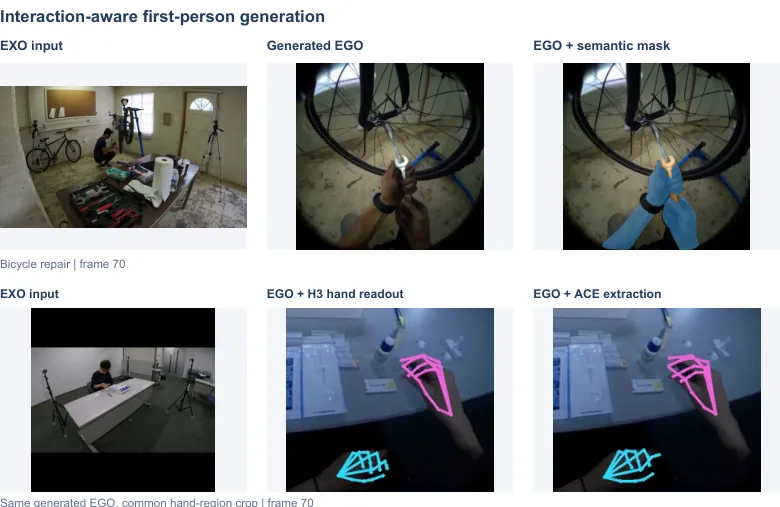
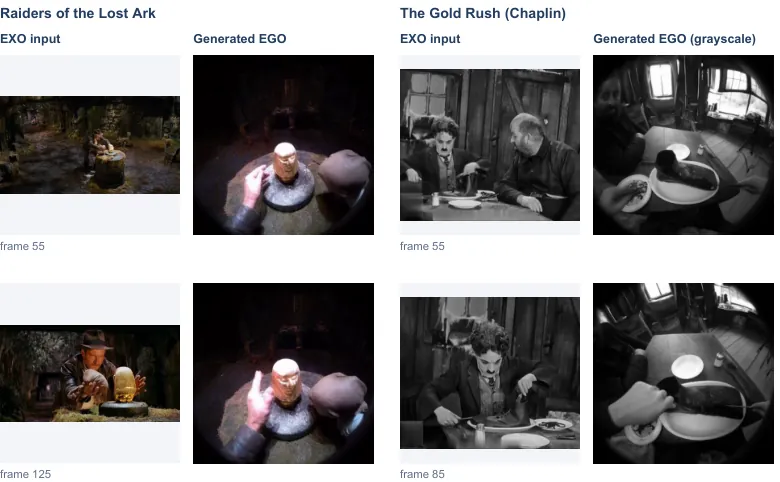
The qualitative panels provide two kinds of evidence. For bicycle repair, generated frames are paired with semantic masks and ACE hand readouts, showing whether hand-object contacts remain recoverable. For Internet footage, horizontal exocentric and generated egocentric examples show the desired viewpoint and framing. Such examples demonstrate feasibility, but they do not replace a full failure-rate analysis.
Discussion
The most important system idea is the separation of responsibilities. Capture supplies trustworthy cross-view correspondence and metric scale. The generator supplies first-person appearance and motion where direct observations are absent. Stochastic rays teach the target viewpoint but exit before deployment. Semantic and hand objectives shift evaluation from whole-frame similarity toward interaction evidence. Each component addresses a different failure mode of exocentric-to-egocentric data production.
The training-only camera interface removes a deployment dependency, but it does not make viewpoint generation universal. The model learns mappings represented by its task-adaptation data. An unseen camera, extreme framing, or source viewpoint outside the training distribution can still produce the wrong head pose or scene layout. The paper's gains come from the combination of pretrained generation, learned adaptation, and geometric curriculum, not from recovering a unique target view from every exocentric video.
PSNR, SSIM, LPIPS, CLIP-I, and FVD cover pixel fidelity, structure, perception, semantics, and distribution. They do not fully answer whether a policy can use the generated hand trajectory. ACE and object-mask readouts are a useful step in that direction, but the reader itself has errors. Semantic supervision also reduces joint coverage, demonstrating that better localization need not mean better presence or tracking. Generated data quality should be tested with downstream tasks as well as visual metrics.
Independent reproduction is currently limited by the absence of public code. Without an implementation, it is not possible to verify the exact data filters, ray gating, LoRA layer placement, ACE projector dimensions, inference sampling recipe, or the scripts behind every reported table. The paper provides enough methodological detail to understand the system, but not enough to reproduce the full pipeline from released artifacts.
Limitations
First, the exocentric source can be fundamentally underdetermined. Hand articulation, object surfaces, and head motion may be hidden. Multiple egocentric videos can then be consistent with the same visible exocentric evidence. The model chooses a plausible continuation from its learned prior, not the one true hidden state. Tasks that require exact fingertip pose, contact force, or the state of an object hidden by a hand are especially exposed to this ambiguity.
Second, auxiliary supervision inherits annotation and extractor errors. Masks, ACE pseudo-labels, and projected ground truth are imperfect observations. Their reliability can vary by device, task, viewpoint, illumination, and motion. A consistently biased pseudo-label may teach a stable but incorrect hand structure. Data selection and GT refinement reduce this risk, but they do not eliminate error propagation.
Third, synchronized camera switches do not equal arbitrary edited-video understanding. The method can follow a continuous event across synchronized viewpoints, but a temporal skip removes evidence about intermediate actions, and an actor change changes whose viewpoint is desired. The paper does not establish performance on montage-style summaries, scene changes, or alternating actors.
The evaluation panel is also smaller than the open world. It contains 86 captures, including only 7 unseen-setting captures. Unseen FVD rises sharply, object IoU remains low in absolute terms, and hand supervision introduces measurable tradeoffs. The evidence supports effectiveness under the paper's capture protocol and validation design, not yet a claim of general-purpose robot data generation.
Conclusion and Outlook
VBot Exo2Ego Policy connects lightweight capture to first-person video generation through a clear chain. Precise pairs establish viewpoint and metric correspondence. Single-view and Internet sources expand coverage. A frozen H3 backbone and RGB LoRA learn the view conversion. Stochastic rays inject calibrated geometry during training and disappear at inference. Semantic masks and ACE features pull the generated result toward usable hand-object structure. The contribution spans capture, adaptation, auxiliary supervision, and evaluation.
Three next steps would materially strengthen the line of work. The first is explicit uncertainty or multiple hypotheses for regions hidden in the exocentric video. The second is downstream policy evaluation, testing whether generated clips improve acquisition, assembly, or tool use rather than only image metrics. The third is broader coverage of actors, discontinuous edits, and novel cameras, with failure distributions reported on independently collected scenes.
For an embodied data pipeline, the paper's practical lesson is that generated video must remain auditable. Source identity, generated status, geometric alignment, auxiliary-label quality, and interaction readouts should all be recorded. Exocentric video becomes useful for robot first-person data only when it is treated as evidence with provenance and uncertainty, not as an unlimited source of free labels.
Key Takeaway
The objective is not to translate third-person footage into a first-person visual style. It is to combine camera geometry, action semantics, and hand-object evidence so that the generated view returns the operator's actionable world to the policy.
SOURCE LINKS