PAPER DEEP DIVE
From Egocentric Human Video to Robot Manipulation in the Era of Embodied Intelligence
Egocentric human video records close-range hand-object interaction and task temporal structure at a scale that could supplement costly robot demonstrations. This survey defines Ego2Robot learning as acquiring or adapting manipulation policies from such video with optional robot grounding, and organizes it into explicit embodiment transfer, explicit action and task supervision, egocentric representation pretraining, and latent action or dynamics modeling. It compares human-video, robot-demonstration, and synthetic or simulated resources, then examines physical feasibility, agent coordination, in-context adaptation, evaluation, and closed-loop predictive control.
One-Sentence Summary
This survey organizes learning from egocentric human video into four paradigms and argues that video scale is not value by itself: retained interaction information must become feasible, testable control evidence for the target robot.
Background And Motivation
Robot manipulation policies require experience across objects, scenes, tasks, and contact conditions. Collecting that experience on physical robots usually involves teleoperation, repeated execution, scene setup, and human supervision. These requirements restrict both scale and diversity. Egocentric human video offers a complementary source because a head- or body-worn camera follows the demonstrator and records hands, objects, gaze direction, and the temporal order of actions at close range.
The advantage is not merely the number of available frames. A manipulation clip can encode object affordances, hand-object contact, task stages, action outcomes, and semantic structure that can often be described in language. For robot learning, these signals may become trajectories, grasp targets, progress estimates, visual representations, or prediction targets. The survey asks how such observations can yield useful control supervision when synchronized robot actions are absent.
The difficulty follows from the observation conditions. Humans and robots differ in morphology, joint ranges, sensing, end effectors, and action spaces. A first-person camera also moves with the head and body, introducing scale changes, occlusion, motion blur, and coordinate drift. Visually similar human and robot motions may produce different outcomes because contact force, friction, and object mass are not directly observed.
Earlier reviews cover robot demonstrations, general human video, or embodied manipulation. This paper narrows its scope to egocentric human video and treats robot demonstrations plus synthetic or simulated data as supporting resources. It does not try to establish one universally superior method. Instead, it traces what information each paradigm extracts, how a robot uses that information during training or deployment, and which robot-specific grounding remains necessary.
The central position is methodological. A common narrative equates more video with more transferable capability, as if longer hours must produce stronger policies. The authors reject that one-way inference. The value of egocentric experience depends on which interaction variables survive observation, whether those variables can be made comparable across embodiments, and whether execution on the target robot can validate them.
It is important to read the work as a survey rather than a new model with new experiments. Dataset scales, representative methods, and application settings come from cited resources. The authors contribute a problem definition, a four-paradigm comparison, a data landscape, and five open challenges. Statements about individual methods must therefore be separated from the survey authors’ broader conclusions.
Problem Formulation And Scope
The paper defines Ego2Robot learning as learning or adapting robot manipulation behavior from egocentric human video, optionally with complementary robot data. The human-video collection is denoted $\mathcal{D}_{\mathrm{h}}$, while the robot collection is $\mathcal{D}_{\mathrm{r}}$. Ego-centric experience can act at two times: it can shape policy parameters during training or supply task context during deployment.
Each human video is represented as $V_{\mathrm{h}}=\{I_{\tau}^{\mathrm{h}}\}_{\tau=1}^{T_{\mathrm{h}}}$. Here, $I_{\tau}^{\mathrm{h}}$ is frame $\tau$ and $T_{\mathrm{h}}$ is the number of frames. This representation hides a central difficulty: frame-to-frame change contains both the intended hand-object interaction and global visual motion caused by the moving demonstrator. Pixel-level learning must separate useful behavior from ego-motion.
The target robot policy is written as $\pi_{\theta}(a_t \mid o_{\leq t},g,c_t)$. The parameter $\theta$ defines the policy; $a_t$ is the action at time $t$; $o_{\leq t}$ is the visual and proprioceptive observation history; $g$ is an optional task specification; and $c_t$ is optional deployment context. The specification can be a language instruction or goal image. Context can include a demonstration, retrieved experience, past robot action-observation pairs, or feedback.
These symbols clarify where video enters the system. It can enter training of $\theta$, changing representations, action priors, or predictive models. It can also enter $c_t$ at deployment, influencing the current decision through demonstrations or retrieval. The routes are complementary. A system may pretrain on large human-video collections, calibrate its action interface with robot data, and retrieve a relevant demonstration while executing a new task.
The paper does not introduce a new loss function or an end-to-end training equation. Its problem formulation organizes prior work. The review therefore offers no basis for inventing reconstruction, diffusion, or reinforcement-learning losses as if they belonged to this paper. The four paradigms differ primarily in what they preserve from video and how that information is grounded in robot actions and physical constraints.
The Four Learning Paradigms
Figure 1 presents the survey taxonomy. The routes convert egocentric video into robot-format demonstrations, interpretable supervision, visual representations, or latent-action and dynamics models. They are not strict historical stages and are not mutually exclusive. A single system may combine several routes, but each has a distinct interface from human observation to robot use.
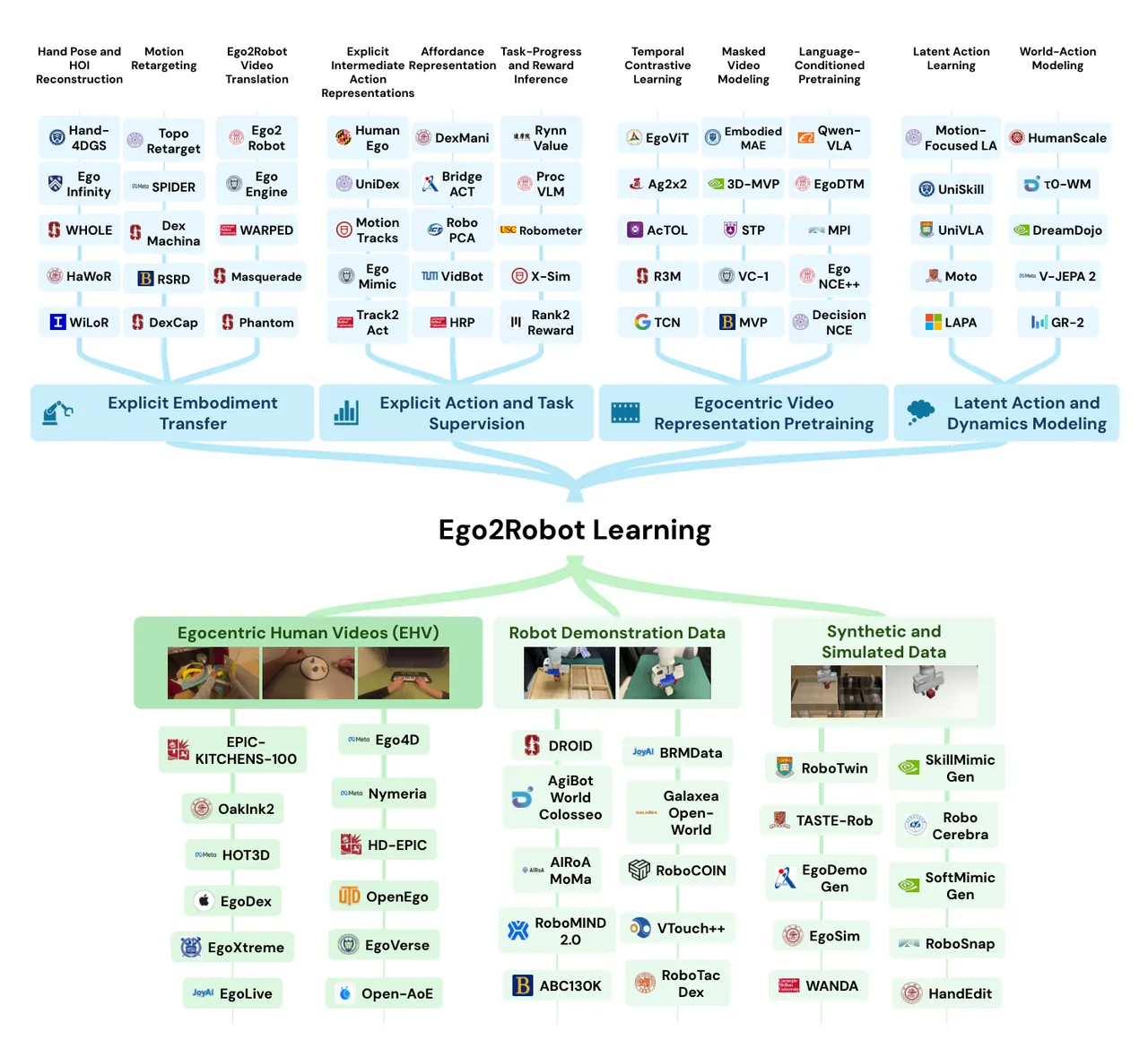
Figure 1: The survey taxonomy of explicit embodiment transfer, explicit action and task supervision, egocentric representation pretraining, latent action and dynamics modeling, and their supporting data.
flowchart LR
    H[Egocentric human video] --> I[Hand object and task interaction]
    I --> P1[Explicit embodiment transfer]
    I --> P2[Explicit action and task supervision]
    I --> P3[Egocentric representation pretraining]
    I --> P4[Latent action and dynamics modeling]
    P1 --> A[Robot format demonstrations]
    P2 --> B[Waypoints affordances progress rewards]
    P3 --> C[Vision or vision language encoder]
    P4 --> D[Latent actions world models]
    R[Robot demonstrations] --> G[Action grounding and feasibility]
    S[Synthetic or simulated data] --> G
    G --> A
    G --> B
    G --> C
    G --> D
Paradigm One: Explicit Embodiment Transfer
Explicit embodiment transfer attempts to convert human video into a robot-format demonstration. The pipeline has three connected stages: reconstruct hand pose and hand-object interaction, retarget human motion to the target embodiment, and synthesize observations that match robot appearance or viewpoint. Ideally, the output contains paired observations and actions that support imitation learning directly.
Hand reconstruction estimates joints, meshes, object trajectories, and contact relationships. Accuracy in the camera frame is insufficient for retargeting because the camera itself moves; a stationary hand can travel across the image as the demonstrator turns. World-space and joint hand-object reconstruction are more relevant because a controller needs the object and end-effector relationship in the scene, not a location in one frame.
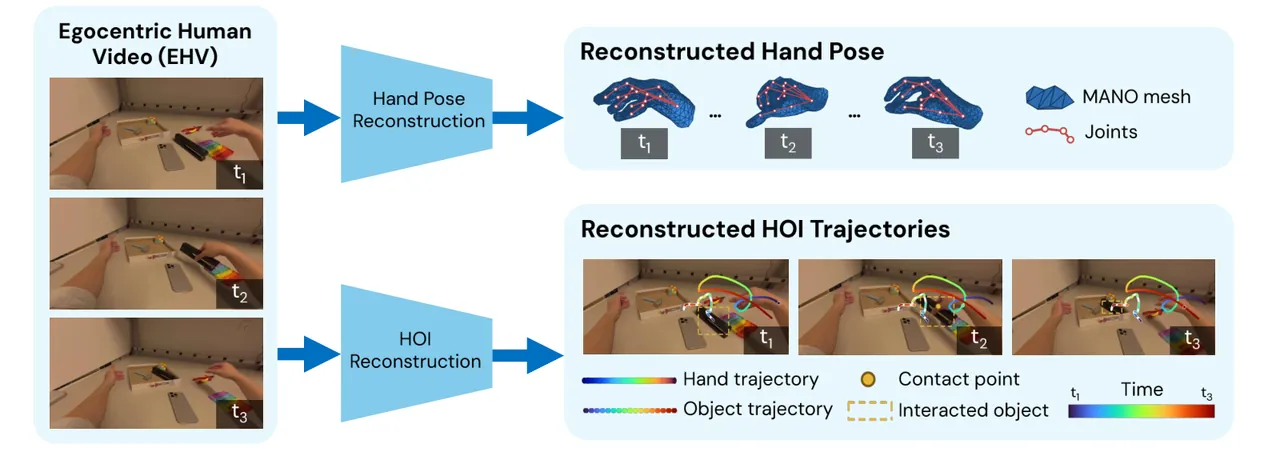
Figure 2: Recovered hand meshes, joints, interaction trajectories, and contact locations. Color indicates temporal progression, while yellow markers identify manipulated objects and contacts.
Motion retargeting maps the recovered human movement onto robot joints and end effectors. Pure geometric matching may preserve the wrist path without preserving the contact required by the task. A cup grasp, for example, can fail when the robot follows the hand trajectory but approaches from the wrong direction or collides because its gripper width and joint limits differ from a human hand. Contact objectives and physical feasibility therefore matter alongside trajectory matching.
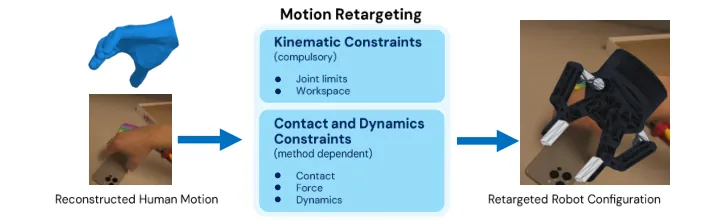
Figure 3: Retargeting must respect the target robot’s joint limits and workspace. Individual methods differ in whether they add contact and dynamics constraints.
Video translation addresses the observation gap. Replacement-based systems remove the human arm or body and overlay a rendered robot. Rendering-based systems reconstruct the scene and synthesize observations from a robot or wrist viewpoint. Translation changes what the policy sees; retargeting changes what the policy executes. The two must remain aligned, or the resulting observation-action pair describes an impossible behavior.
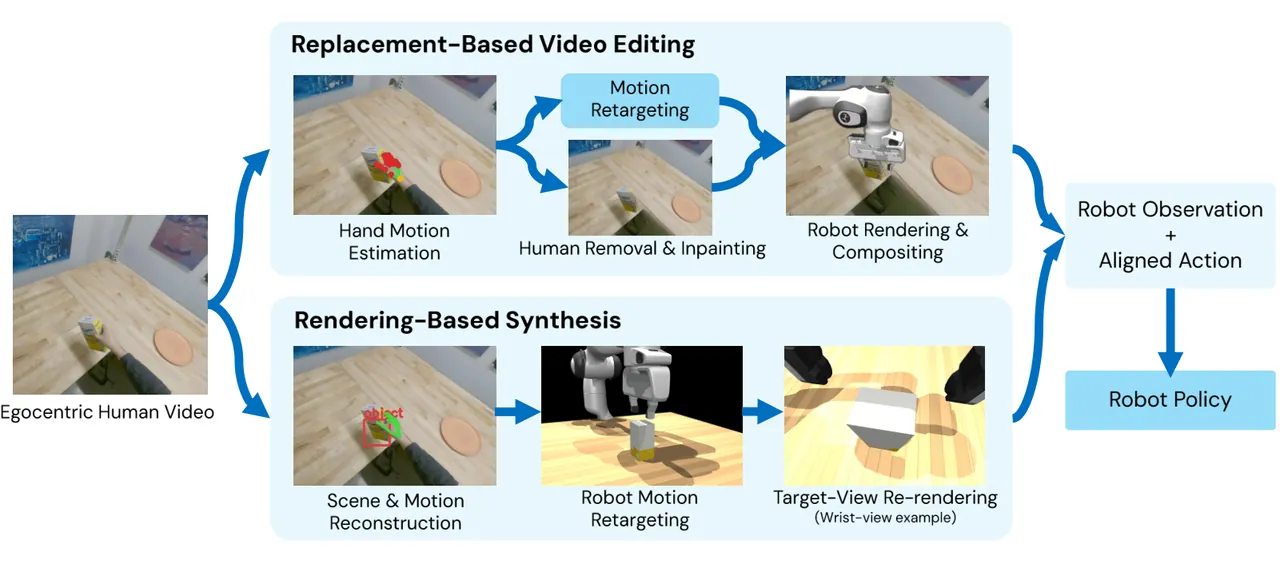
Figure 4: The survey compares replacement-based and rendering-based translation. The former keeps most of the original scene, while the latter generates observations from a reconstructed scene and target viewpoint.
This paradigm should not be read as automatic robot-data generation. No robot demonstrations does not mean no additional conditions. Monocular video may lack metric scale, object templates, occluded geometry, or free-space information. Some systems need a workspace scan, object model, calibration procedure, or simulator. The paper argues that reports should state usable-trajectory yield, conversion cost, and all required scene, object, simulation, and robot data.
Paradigm Two: Explicit Action And Task Supervision
The second route extracts compact, interpretable supervision instead of converting an entire human clip into robot observation-action pairs. It includes explicit intermediate action representations, affordances, and task-progress or reward inference. This can reduce dependence on exact visual appearance matching, but it introduces a downstream mapping from the intermediate variable to an executable robot command.
Intermediate actions may be two- or three-dimensional tracks, hand keypoints, object motion, end-effector paths, or shared human-robot action spaces. They preserve spatial structure while leaving embodiment-specific control to another module. Hand-centric targets retain fine motion but require robot-specific interpretation. Object-centric targets are easier to share across morphologies but leave the robot’s realization underdetermined.
Affordances describe where and how interaction is possible. Contact regions, grasp poses, and post-contact motion can serve as geometric targets for grasp generation and planning, as supervision for representation learning, or as conditioning inputs during policy execution. Figure 5 presents these complementary roles. The distinction matters because an accurate affordance does not by itself establish that a robot trajectory is physically feasible.
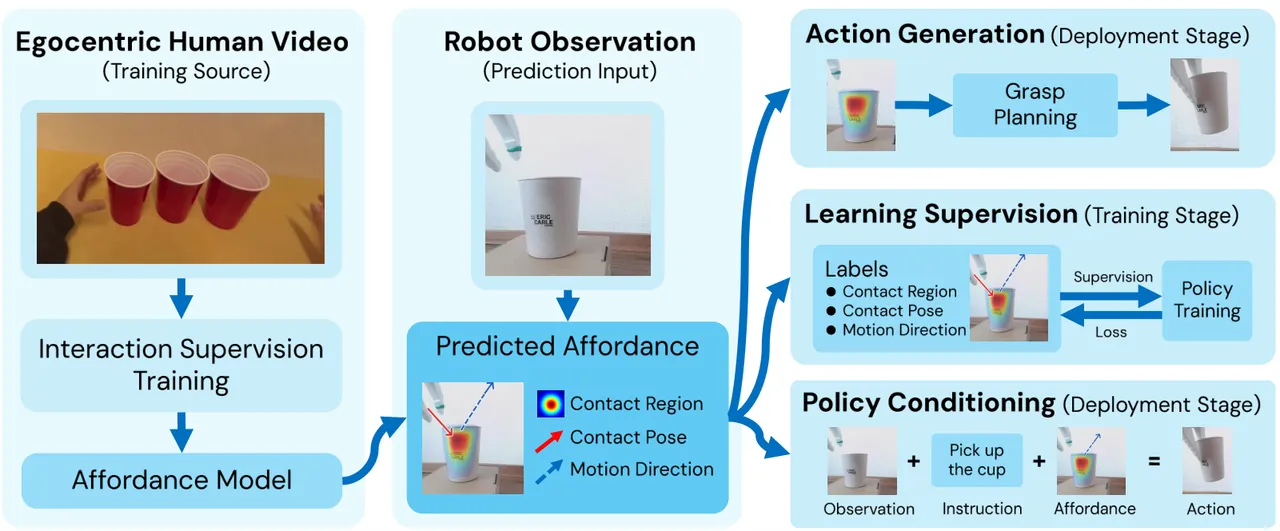
Figure 5: Human-derived affordances can ground action generation, supervise learning, or condition policies and exploration.
Progress and reward inference treats manipulation as a transition from task initiation to completion. Signals can come from goal-video similarity, temporal ranking, generative confidence, object-motion consistency, stages, or events. Figure 6 illustrates progress from zero to one for picking up a spoon and holding it beside a tray. The resulting score may support reward shaping, planning, or execution monitoring.
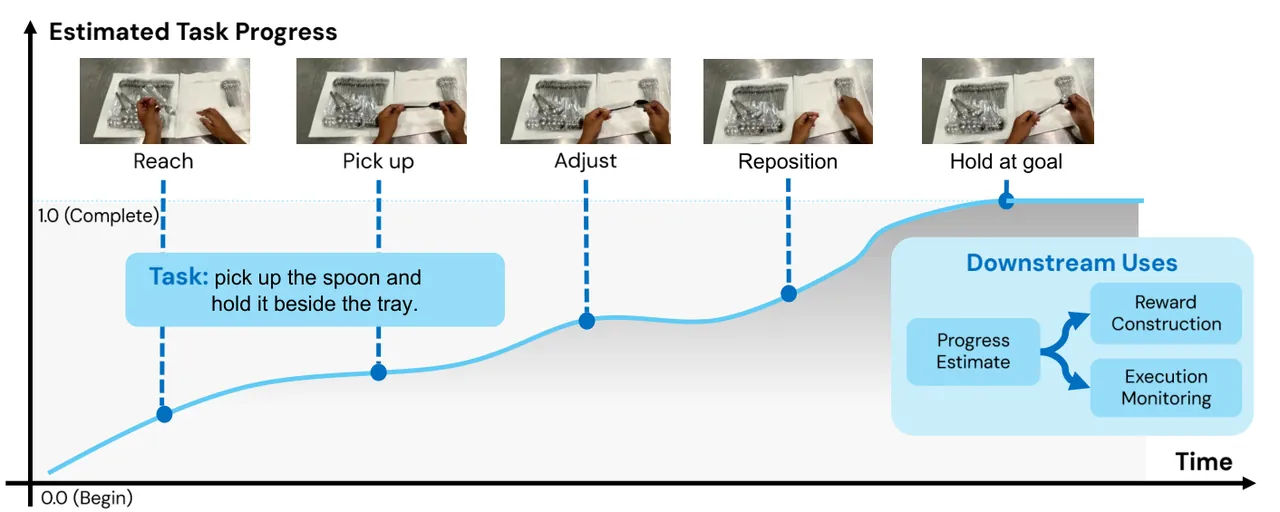
Figure 6: A progress estimate can range from 0 at task initiation to 1 at the goal. Pauses, recovery, and undoing earlier steps make elapsed time an unreliable proxy.
The main risk is that a reasonable-looking proxy may not track task success. Visual similarity can be dominated by appearance or background; a generative score can favor common trajectories; motion consistency can accompany the wrong contact. If such a signal becomes a reward, a policy may exploit scorer errors. The survey therefore argues for evaluation with failures, recovery, and valid alternative executions rather than clean demonstrations alone.
Paradigm Three: Egocentric Video Representation Pretraining
Representation pretraining does not output human actions. It trains a visual or vision-language encoder on large egocentric collections so that features capture objects, action stages, and interaction regularities. Common objectives include temporal contrastive learning, masked video modeling, and language-conditioned prediction. The encoder can be frozen for a robot policy or fine-tuned with robot data.
Temporal contrastive learning makes nearby clips positive and unrelated clips negative, encouraging the representation to encode action progression. Masked modeling hides patches or future frames and asks the model to reconstruct them, which can capture spatial and temporal structure. Language-conditioned objectives align visual states with instructions, steps, or object descriptions and provide a semantic entry point for vision-language-action models.
The route assumes that visual change in egocentric video contains regularities that transfer to robot control. If the encoder mainly captures camera motion, scene style, or human-hand appearance, the resulting features may be weak for end-effector control. Improved downstream success is therefore not enough by itself. Controlled comparisons should include equally sized non-egocentric video, a no-pretraining baseline, and multiple robot-data budgets.
Representation learning is often easier to scale than explicit motion transfer because it does not require frame-level robot actions. It is also easier to confuse understanding with acting. An encoder may recognize a cup and a grasp stage without telling the robot how to avoid the table, apply an appropriate force, or recover from a failed contact. Robot demonstrations remain necessary for action calibration, physical feasibility, and final validation.
Paradigm Four: Latent Action And Dynamics Modeling
Latent-action methods learn compact transition codes from video changes and use those codes as pretraining targets or conditioning variables. The intuition is that if a visual transition can be represented by a discrete or continuous latent, visually similar changes may correspond to similar behavioral intent. Robot adaptation usually replaces the latent-action head with a robot-action head or learns a mapping from latent codes to robot commands.
World-action models predict future states under candidate actions rather than merely generating plausible video. Human interaction provides rich environment-change supervision, while robot trajectories reveal which changes are controllable. If the latent instead encodes camera movement, lighting, or passive falling while ignoring the robot command, realistic rollouts will not imply a useful controller.
The survey emphasizes that predictive accuracy and controllability are different properties. A model can generate a plausible future while returning nearly the same outcome for different candidate actions. Reliable evaluation must intervene on actions, check whether predictions change correctly, and test unfamiliar contacts, disturbances, long-horizon error accumulation, and online latency.
The four paradigms can be composed. Human video may first train visual and temporal representations, then support latent-action or dynamics learning, then meet robot data through an action interface, and finally be corrected with execution feedback. Composition does not remove the central tension. More explicit interfaces demand accurate geometry and action recovery; more implicit interfaces demand stronger robot grounding and controllability tests.
The Training-Data Landscape
The survey groups supporting data into egocentric human video, robot demonstrations, and synthetic or simulated resources. Human video is the primary experience source. Robot demonstrations provide executable actions and real outcomes. Synthetic and simulated resources add scenes, states, and labels that are hard to collect. The three groups are not a simple sum because they differ in coverage, supervision granularity, sampling bias, and trustworthiness.
| Human-video resource | Scale reported in the survey | Primary value for Ego2Robot learning | Important boundary |
|---|---|---|---|
| Ego4D | 3,700 hours | Large-scale everyday egocentric vision, temporal structure, and language supervision | Most clips do not contain executable robot actions |
| EgoDex | 829 hours and 90 million frames | Fine hand, object, and dexterous-manipulation geometry | Geometry is still affected by estimation and annotation procedures |
| EgoVerse | 1,300 hours | Egocentric human activity intended for robot learning | Must be aligned with target tasks and embodiments |
| OpenEgo | 1,100 hours and 119.6 million frames | Large multimodal egocentric manipulation data | Aggregates six public datasets and overlaps other resources |
| EPIC-KITCHENS | 100 hours and 20 million frames | Kitchen manipulation, actions, and temporal structure | Task and scene distributions are concentrated |
| Assembly101 | 513 hours and 111 million frames | Assembly procedures, multiple views, and step understanding | Assembly actions differ from many household tasks |
| HOI4D | 2.4 million frames | Hand-object interaction and within-category manipulation variation | Frame count is not equivalent to task coverage |
These figures should not be treated as a leaderboard. Ego4D’s 3,700 hours provide broad visual experience but usually lack precise robot actions. EgoDex combines scale with geometry suited to hand-object correspondence. OpenEgo is large but explicitly overlaps other resources. Scale, task count, annotation density, and executability answer different questions, so no single total can stand in for another.
Robot demonstrations provide the control facts absent from human video: internal state, executed actions, outcomes, and failures. The reviewed resources cover platform-scale collection, cross-embodiment aggregation, real-world expansion, and contact sensing.
| Robot-data resource | Scale reported in the survey | Primary coverage | Role in Ego2Robot learning |
|---|---|---|---|
| RT-1 | 130,000 episodes and more than 700 tasks | Fleet-scale real-robot collection | Action supervision, task coverage, and policy validation |
| Open X-Embodiment | More than 1 million trajectories, 160,000 tasks, and 527 skills | Multi-robot and multi-institution aggregation | Cross-embodiment action alignment and joint training |
| DROID | 76,000 successes and 16,000 failures | Manipulation across diverse real environments | Real execution, failure learning, and policy evaluation |
| AgiBot World Colosseo | 1 million trajectories, 217 tasks, and 106 scenarios | Large-scale real scenes and tasks | Action grounding, scene coverage, and closed-loop validation |
The robot datasets are large by historical standards, but platform, task definition, and counting conventions still limit comparison. Episodes, trajectories, tasks, and skills are not interchangeable units and cannot simply be added. More importantly, the value of robot data often lies in coverage of the conversion points that human video handles poorly: contact, force, recovery, and the target robot’s action space.
Synthetic and simulated resources form the third path. Physics simulation can provide precise states and action labels; generative video can add scenes and trajectories; real-to-simulation reconstruction can create controlled variation. The risks are equally clear: contact models, asset quality, visual realism, and embodiment gaps can break transfer. The survey therefore treats simulation as a source of complementary supervision and controlled evaluation, not as a replacement for real robot execution.
Five Open Challenges
The first challenge is agent coordination. Egocentric video can describe subtask dependencies, expected object-state changes, and interaction constraints, while vision-language-action models, perception tools, and action primitives can be organized as interruptible skills. An agent must check preconditions before each step, confirm that a skill produced the required outcome, and trigger recovery or targeted data collection after failure.
The second challenge is in-context adaptation. A robot can change behavior without parameter updates by receiving demonstrations, execution history, action-effect records, or retrieved experience. Fixed weights do not mean that the entire system requires no training, because the context encoder, retrieval store, and policy are still learned. Evaluation should compare matched, mismatched, and absent context under the same checkpoint and report context length, retrieval settings, and memory reset rules.
The third challenge is cross-embodiment alignment and physical feasibility. A valid human motion may require a different robot motion that preserves the same interaction outcome. Occlusion, camera motion, and reconstruction error corrupt geometric supervision, while joint limits and actuator differences can make direct matching impossible. Ordinary video also omits force, friction, and occluded contact states, which require tactile sensing, force measurements, or execution feedback.
The fourth challenge is evaluation, attribution, and interpretability. Robot experiments have shown benefits from egocentric pretraining, but studies must establish when those benefits occur, which information causes them, how many robot demonstrations they replace, and whether gains persist on new objects and scenes. A final success rate cannot support causal attribution when architecture, auxiliary objectives, and training budgets all change together.
The fifth challenge is reliable prediction and closed-loop control. Latent actions and world-action models connect visual change to behavior, but predictive accuracy does not imply controllability. A model may encode camera motion or generate plausible video while ignoring contact mechanics. Evaluation should intervene on actions, test whether outcomes change correctly, use uncertainty to trigger replanning, and measure error accumulation, disturbance recovery, and online latency.
Limitations
The authors explicitly caution that video scale alone does not establish the value of egocentric human video; retained interaction information must support control of the target robot. This is the survey’s clearest self-imposed boundary. Large data may add visual coverage without adding executable supervision, and training-time transfer plus deployment-time context remain complementary rather than interchangeable.
The paper also leaves physical feasibility, missing contact information, and controlled evaluation open. Ordinary egocentric video does not reliably provide force, friction, or occluded contact state. Existing systems depend on scene reconstruction, simulation, extra sensors, or robot execution data to fill the gap. The authors therefore do not claim that human video can replace robot data for every task.
An independent limitation is the survey’s viewpoint-driven organization. It does not report a systematic search query, database set, inclusion and exclusion rules, deduplication process, or literature cutoff protocol. The taxonomy is useful as a research map, but it cannot guarantee complete coverage or estimate selection bias. The four paradigms should not be read as an exhaustive list, and frequency of mention should not be treated as quantitative evidence of effectiveness.
A second independent limitation is comparability of evidence. The authors compare dataset scales and note that counting conventions and overlap prevent direct totals, but they do not run a meta-analysis under a common benchmark, task suite, robot-data budget, or evaluation protocol. The four paradigms are therefore distinguished by information interfaces, not ranked by transferable effect size. Claims about which route works better still require controlled comparisons.
A final judgment is that the categories become porous in complete systems. Explicit action supervision may use latent-action models; representation pretraining may receive retrieved demonstrations at deployment; a world model may generate affordances. The taxonomy is most valuable for locating information flow and grounding requirements, not for assigning every method one permanent label. Readers should inspect the interface and validation path behind the category.
Conclusion
The survey’s main contribution is not a claim that egocentric video will replace robot data. It provides a language for deciding whether experience can transfer. Its four paradigms ask how to create robot-format demonstrations, extract interpretable supervision, learn visual representations, and model actions or future change. Its three data groups supply behavioral coverage, robot execution facts, and controlled augmentation.
The most informative future experiments will compare egocentric and non-egocentric video at equal visual scale, report the yield of usable supervision from each human trajectory, quantify robot-data efficiency, and include failure recovery, contact events, and computational cost. Human video becomes robot experience only when its interaction information survives embodiment gaps, executes in a closed loop on the target robot, and supports interpretable error attribution.