PAPER DEEP DIVE
MIDAS Hand: Modular low-Impedance Direct-drive Anthropomorphic Sensing Hand
Dexterous manipulation is limited not only by algorithms but by a shortage of accessible hand hardware that combines human-scale morphology, ease of manufacturing or maintenance, tactile sensing, and practical cost. Existing dexterous hands tend to optimize some of these properties at the expense of others. We present MIDAS Hand, a low-cost, open-source, human-scale dexterous hand with integrated tactile sensing for manipulation research. MIDAS Hand provides 16 total degrees of freedom (DoF) with 13 active DoF, directly driven actuation with measurably low backdrive torque, and 283 three-axis tactile taxels in a compact 700 g package with a bill of materials under 3,000 USD. Built from 3D-printed components, it assembles in under three hours while providing the strength, repeatability, and maintainability needed for repeated real-world experiments. Alongside the hardware, we release a full stack: design files, build documentation, control and tactile Python APIs, simulation models, and retargeting and teleoperation pipelines. We characterize MIDAS Hand through workspace and grasp-taxonomy analysis, payload and reliability tests, backdrivability measurements, and teleoperation demonstrations with tactile sensing, showing that it offers a balanced, reproducible platform for tactile dexterous manipulation and human-to-robot data collection. Project page: https://midas-hand.com
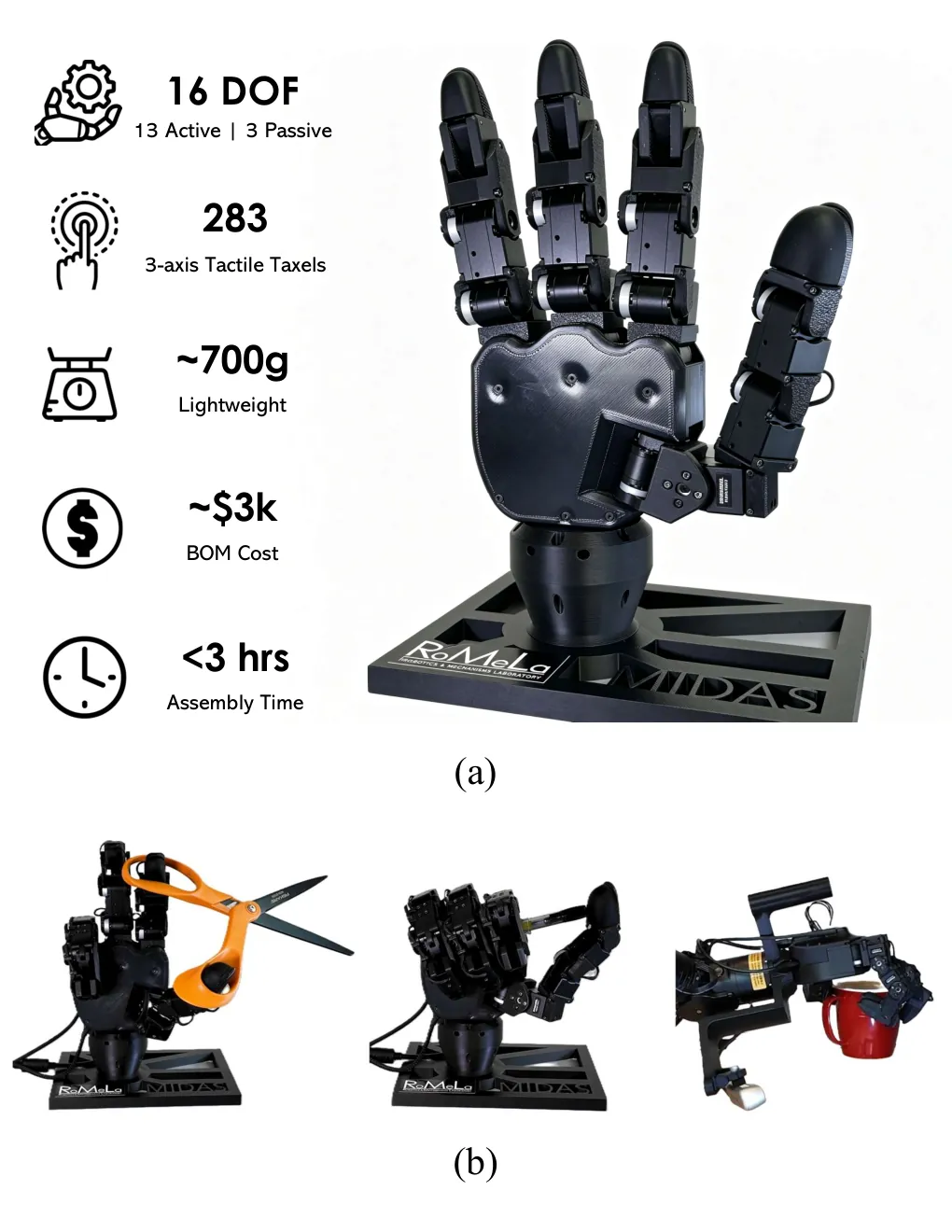
Figure 1. The complete hand, its human-scale proportions, and the specifications that define the paper's design target.
One-Sentence Summary
MIDAS Hand combines 16 joints, 13 direct-drive motors, 283 three-axis tactile taxels, a mass near 700 grams, and a bill of materials below USD 3,000 to create an open platform for tactile manipulation research and human-to-robot demonstration collection.
Why Build Another Dexterous Hand?
Dexterous manipulation research is often framed as a problem of policies, planning, and learning. The paper starts one layer lower: many laboratories cannot obtain a hand that simultaneously has human-scale geometry, enough articulated fingers, tactile sensing, serviceable parts, and a price that permits repeated real-world experiments.
Commercial hands provide mature hardware, but their cost and closed internals constrain research. Existing open platforms make different compromises. LEAP Hand is affordable and anthropomorphic but larger than a human hand and lacks tactile sensing. RUKA, RUKA v2, and ORCA rely on tendon transmission. CRAFT adds hybrid hard-soft compliance but also uses tendons. MIDAS Hand is not designed to maximize one specification. Its contribution is the integration of properties that are usually optimized separately.
Human scale matters because tools, objects, and manipulation demonstrations are organized around human hands. If the robot palm, finger lengths, and thumb opposition are close to human proportions, visual demonstrations, retargeting, teleoperation, and skill transfer have a better geometric starting point. Scale is therefore part of the software interface, not only an industrial-design choice.
Tactile sensing addresses information that cameras cannot observe directly. During contact, pressure, shear, contact location, and slip can be hidden by the hand or the manipulated object. A dense tactile array can expose these quantities at the point of interaction, which matters for grasp monitoring and tactile-reactive control.
Maintainability is the final system requirement. A research hand is repeatedly collided, overloaded, recalibrated, and modified. If a damaged fingertip requires a factory return, experiments stop. MIDAS Hand therefore turns the three non-thumb fingers into identical replaceable modules, each carrying three motors, a four-bar linkage, and a tactile sensor. The complete hand can be assembled in under three hours, and a finger can be replaced in under fifteen minutes.
Background: Active Joints, Direct Drive, and Passive Motion
An active degree of freedom is independently commanded by an actuator. A total degree-of-freedom count also includes joints whose motion is constrained by a mechanism. The thumb has four active joints. Each of the index, middle, and ring fingers has three active joints and one passive distal interphalangeal joint. The total is therefore:
$$D_{\mathrm{total}}=D_{\mathrm{active}}+D_{\mathrm{passive}}=13+3=16$$
This equation captures the central kinematic tradeoff. Three motors drive four joints in each non-thumb finger. The design saves one motor, one control variable, and associated wiring, but it gives up independent control of the distal joint.
Direct drive in this paper does not mean that the motor shaft is also the finger joint. Each motor transfers force through a short rigid linkage rather than a long tendon routed through the hand or forearm. The hand still has transmission, but it avoids tendon preload, stretch, friction, and remote actuator packs. All thirteen active joints use the same Dynamixel XM335-T323-T motor.
The passive distal joint is generated by a crossed four-bar linkage. Its angle is a nonlinear function of the PIP angle. The hardware API evaluates this relationship through a precomputed lookup table, while the simulation model represents the same coupling with closed-loop constraints.
Method
1. Four fingers at human scale
The prototype measures 205 by 120 by 55 millimeters and weighs approximately 700 grams. It has four fingers rather than five, which reduces the number of motors, custom parts, and assembly steps. The index, middle, and ring fingers can also share one module design.
The missing little finger is a deliberate simplification with a measurable cost. Grasps that need ulnar support lose a contact surface, and the paper's taxonomy experiment finds one grasp type that cannot be reproduced without that finger.
The thumb has four active degrees of freedom. Its second joint axis is oblique rather than orthogonal to the palm. This changes the thumb's sweep and allows it to oppose the other fingertips across a compact human-scale palm. The resulting opposition pattern follows the human radial-to-ulnar trend: the index has the largest shared workspace, followed by the middle and ring fingers.
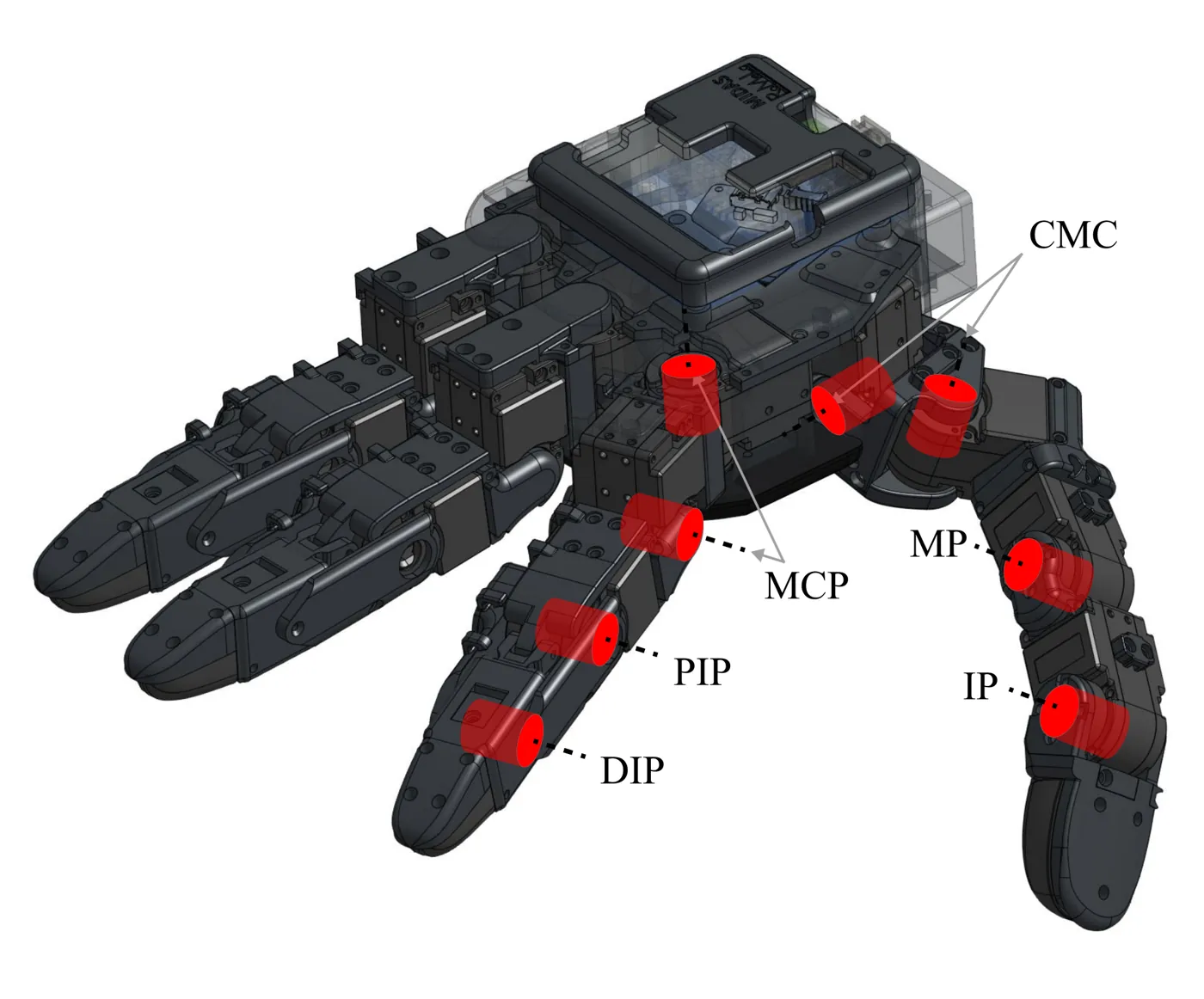
Figure 2. Joint nomenclature. The thumb uses four active joints; each opposing finger has three active joints and one passive DIP joint.
2. A crossed four-bar linkage removes one actuator
Each non-thumb finger has active MCP abduction, active MCP flexion, and active PIP flexion. The DIP joint is driven through a crossed four-bar linkage. During power grasps, this underactuation can improve compliance: the distal link moves with the contact geometry instead of requiring a separate motor command.
The coupling is nonlinear. If the active PIP coordinate is $q_{\mathrm{PIP}}$, the passive DIP and linkage coordinates can be written as:
$$q_{\mathrm{DIP}}=f_{\mathrm{DIP}}(q_{\mathrm{PIP}}),\qquad q_{\mathrm{link}}=f_{\mathrm{link}}(q_{\mathrm{PIP}})$$
The released implementation samples these functions into a lookup table rather than solving the closed linkage on every actuator update. The external state remains a 16-dimensional joint vector, but only thirteen motor commands are sent to hardware.
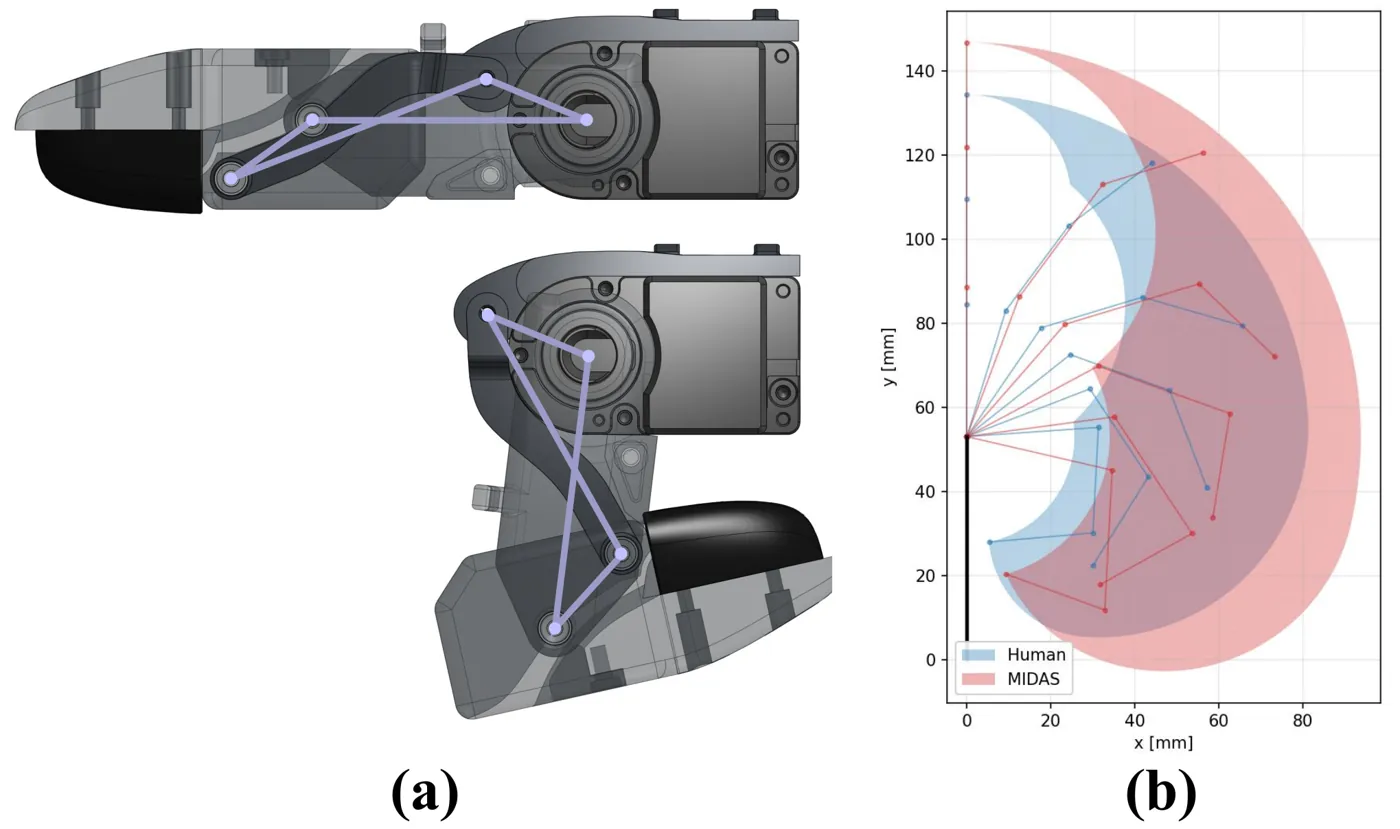
Figure 3. The passive DIP mechanism and a sagittal-plane comparison between the robotic and human index fingers. Under a matched overall finger length, the robot covers 80.1 percent of the human workspace.
3. Rigid transmission produces low mechanical impedance
Backdrive torque is the torque required to initiate joint motion from an external push. The paper disables actuator torque, locks the other joints, applies a slowly increasing force with a digital gauge, and converts the force at motion onset into joint torque through the measured moment arm. This measures passive mechanical impedance rather than the behavior of an active compliance controller.
MIDAS Hand reaches approximately 0.02 newton-meters at every active joint. This uniformity follows from using the same actuator and similar rigid linkages across the MCP, PIP, thumb CMC, thumb MP, and thumb IP joints. The passive DIP inherits the PIP compliance.
Sharpa Wave and Wuji Hand were tested with the same protocol. Sharpa Wave ranges from 0.03 to 0.62 newton-meters, with the largest resistance at proximal joints. Wuji Hand joints could not be backdriven. The comparison shows that direct drive alone does not determine impedance; transmission friction, reduction, and joint geometry still matter.
4. Tactile coverage is distributed across four contact surfaces
The index, middle, and ring fingertips use Paxini PX6AX-GEN3-DP-S2015-Elite arrays with 52 taxels each. The thumb uses the larger M2826-Omega module with 127 taxels. The total follows directly:
$$N_{\mathrm{taxel}}=3N_{\mathrm{elite}}+N_{\mathrm{thumb}}=3\times52+127=283$$
Manufacturer specifications list a 25-newton normal range, plus or minus 10 newtons of tangential force, an 83.3-hertz maximum output rate, 0.1-newton minimum recognition force, and one-millimeter spatial resolution. The paper goes beyond a specification table by showing the three-axis readings during object grasp.
The array placement is intentionally concentrated on primary contact surfaces rather than spread thinly over every phalanx. The thumb receives the largest sensing area because it participates in opposition and many power grasps. The remaining arrays sit at the fingertips, where contact localization and precision manipulation occur.
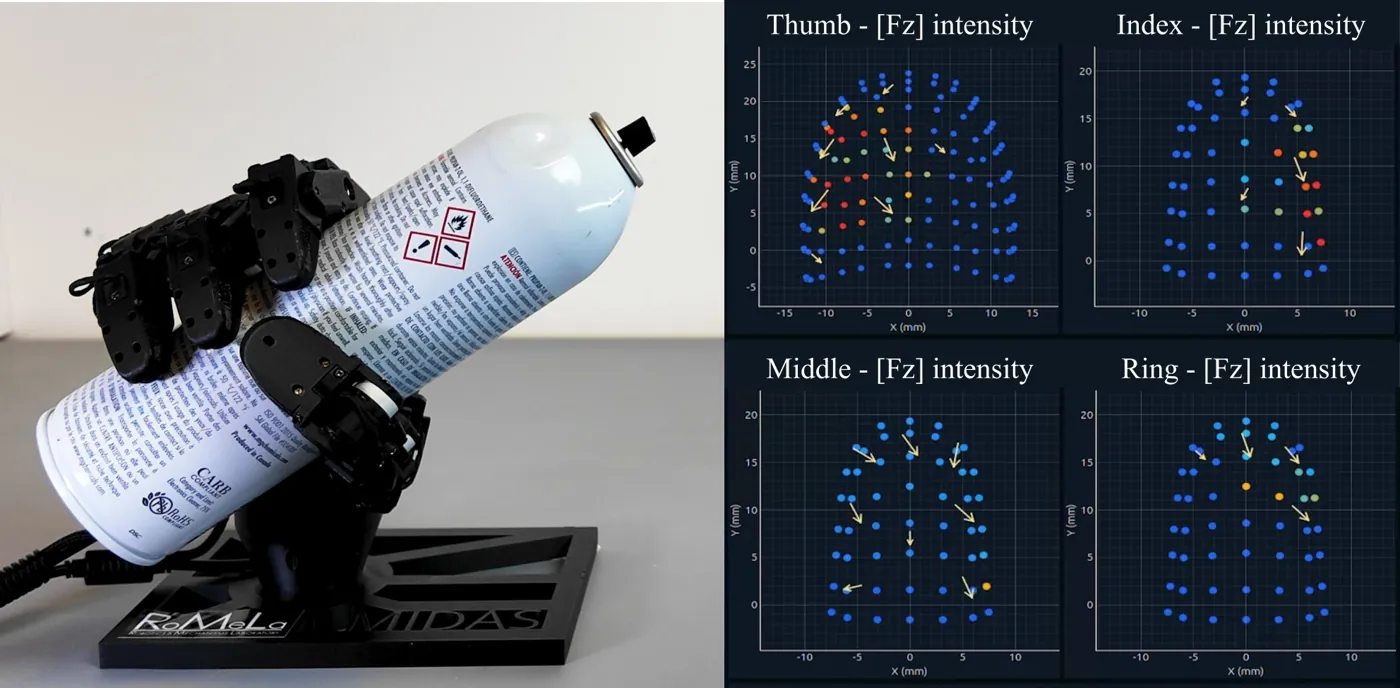
Figure 4. Tactile readings during grasping. The arrays report both normal loading and shear distributions over the contact surface.
5. Electronics are partitioned for repair and upgrade
A custom distribution board in the palm routes power and TTL communication to all Dynamixel motors. Each finger module connects through a small set of wires and can be removed without rewiring the complete hand. A U2D2 hub provides the external host link and power interface. A separate Paxini board handles tactile acquisition.
This architecture does not minimize part count as aggressively as a single custom board. It instead keeps actuator distribution, tactile acquisition, and host communication separable. A failed subsystem can be isolated, and a sensor upgrade does not require redesigning the motor bus.
6. The software API exposes 16 joints but commands 13 motors
The hardware API defines passive joint indices 5, 9, and 13 in the full joint vector. They belong to the index, middle, and ring DIP joints. Their corresponding PIP motors occupy positions 4, 7, and 10 in the 13-motor array. This explicit mapping prevents callers from rebuilding a fragile joint-order convention.
# midas_hand_api/midas_hand_api/config.py:24-31
DEFAULT_PASSIVE_JOINT_INDICES = (5, 9, 13)
DEFAULT_PIP_MOTOR_INDICES = (4, 7, 10)

# Full 16-DOF layout:
# thumb(0-3), index(4, DIP@5, 6, 7),
# middle(8, DIP@9, 10, 11), ring(12, DIP@13, 14, 15)
Simulation, retargeting, and hardware therefore share one state definition. A planner can reason about all sixteen joints, while the actuator layer sends thirteen active commands and lets the linkage determine the passive values.
7. Retargeting must include passive Jacobian motion
MediaPipe or a MANUS glove supplies 21 human hand landmarks. The retargeter converts these landmarks into vectors between joints and fingertips, then optimizes active robot joints so that corresponding vectors align. Vector objectives preserve relative finger geometry better than independently matching one angle per human joint.
The optimization becomes incorrect if the Jacobian treats the passive DIP as fixed. A small PIP change also moves the DIP and linkage, so their contributions must be folded into the PIP gradient:
$$J_{\mathrm{eff}}[:,\mathrm{PIP}]\mathrel{+}=J_{\mathrm{DIP}}\frac{\partial q_{\mathrm{DIP}}}{\partial q_{\mathrm{PIP}}}+J_{\mathrm{link}}\frac{\partial q_{\mathrm{link}}}{\partial q_{\mathrm{PIP}}}$$
# midas_hand_retargeter/midas_hand_retargeter/adaptor.py:160-192
target_jacobian[..., target_index] += (
    jacobian[..., self.idx_pin2dip[coupling_index]]
    * dip_gain[coupling_index]
)
target_jacobian[..., target_index] += (
    jacobian[..., self.idx_pin2linkage[coupling_index]]
    * linkage_gain[coupling_index]
)
This code-level mapping is one of the strongest links between the paper's mechanism and the released software. Without it, the optimizer would see a simpler robot than the one that physically executes the command.
8. From a human pose to a synchronized data stream
The full pipeline detects hand landmarks, forms vector objectives, optimizes 13 active joints, evaluates the four-bar lookup for three passive DIP joints and their linkage states, and produces a complete 16-joint configuration. The hardware receives 13 motor commands. In parallel, the tactile board streams four-finger contact data at up to 83.3 hertz.
flowchart TB
    A[MediaPipe or MANUS] --> B[21 hand landmarks]
    B --> C[Fingertip and phalanx vectors]
    C --> D[Optimize 13 active joints]
    D --> E[PIP joint targets]
    E --> F[Four-bar lookup
passive DIP and linkage]
    F --> G[Full 16-DoF state]
    F --> H[Fold passive Jacobians
into active PIP]
    G --> I[13 Dynamixel commands]
    J[Paxini four-finger arrays] --> K[Synchronized joint and tactile stream]
    I --> K
9. URDF and MJCF encode the same mechanism differently
The release includes URDF files, MJCF models with simplified contact, and setup files for simulation-based learning. The MJCF model uses thirteen actuators and three closed-loop constraints, while the hardware API uses lookup interpolation. Both representations have to produce the same PIP-DIP relationship for sim-to-real transfer to remain geometrically meaningful.
The software stack also includes automatic homing and calibration for joints and tactile sensors. These functions are not secondary conveniences. Printed parts vary across assemblies, motors may be replaced, and plastic links wear. Re-establishing the hardware zero reference avoids treating a changing physical system as a fixed simulation model.
Experimental Evidence
The experiments evaluate hardware readiness rather than autonomous manipulation performance. They ask whether the hand can yield under external force, oppose its thumb across the useful workspace, survive representative loads, remain stable over thousands of cycles, and reproduce the grasp categories expected from an anthropomorphic hand.
Hardware comparison
| Hand | Total DoF | Transmission | Tactile sensing | Mass | Reference cost |
|---|---|---|---|---|---|
| MIDAS Hand | 16 | Direct rigid linkage | 283 three-axis taxels | About 700 g | Below USD 3,000 |
| LEAP Hand | 16 | Direct | None | About 1,000 g | About USD 2,000 |
| RUKA v2 | 20 | Tendon | None | Not reported | About USD 1,500 |
| ORCA | 17 | Tendon | Binary touch | About 1,200 g | About USD 2,500 |
| Allegro v5 Plus | 16 | Direct | Pneumatic | 1,240 g | About USD 11,000 |
| Sharpa Wave | 22 | Direct | Dynamic tactile array | About 1,300 g | About USD 50,000 |
| Wuji Hand | 20 | Direct | None | Below 600 g | About USD 16,000 |
MIDAS Hand is neither the most articulated nor the lightest device in the table. Its distinctive combination is human-scale geometry, dense multi-axis touch, low mechanical impedance, and a low-cost printable structure. A comparison based only on joint count would miss the system-level contribution.
Backdrive torque and thumb opposition
| Joint | Sharpa Wave | Wuji Hand | MIDAS Hand |
|---|---|---|---|
| Index MCP | 0.35 N m | Could not backdrive | 0.02 N m |
| Index PIP | 0.11 N m | Could not backdrive | 0.02 N m |
| Index DIP | 0.03 N m | Could not backdrive | Passive |
| Thumb CMC | 0.62 N m | Could not backdrive | 0.02 N m |
| Thumb MP | 0.32 N m | Could not backdrive | 0.02 N m |
| Thumb IP | 0.07 N m | Could not backdrive | 0.02 N m |
The paper reports MIDAS Hand as roughly 3.5 to 30 times more backdrivable than Sharpa Wave under the same force-gauge protocol. The result supports the low-impedance design goal, but it is a passive mechanical measurement with motor torque disabled. It does not prove that a particular closed-loop controller will be equally compliant during contact.
Thumb opposition is defined as the fraction of a finger's contact-center workspace that also belongs to the thumb workspace. For finger $f$:
$$\eta_f=\frac{|W_{\mathrm{thumb}}\cap W_f|}{|W_f|}$$
| Opposing finger | MIDAS Hand overlap | Human reference cited by the paper |
|---|---|---|
| Index | 49.52% | 33.65% |
| Middle | 40.03% | 27.10% |
| Ring | 24.54% | 23.50% |
The absolute percentages differ from the human values, so the result should not be read as an exact anatomical copy. The important similarity is ordering: the robot preserves the same decrease from radial to ulnar fingers. That ordering affects how readily the thumb can support precision grasps across the hand.
The index-finger sagittal workspace uses a separate coverage metric:
$$\eta_{\mathrm{index}}=\frac{|W_{\mathrm{robot}}\cap W_{\mathrm{human}}|}{|W_{\mathrm{human}}|}=0.801$$
This means 80.1 percent of the human reference workspace is covered by the robot, not that the robot has only 80.1 percent of its own workspace. The paper notes that part of the robot workspace extends beyond the human reference because the printed index is proportionally longer than the population average used for comparison.
Strength, thermal behavior, and repeatability
In the fingertip load test, the index finger lifted 1.2 kilograms, after which the actuator overheated shortly afterward. The authors attribute the sustained limit to actuator thermal capacity rather than immediate structural failure. In the whole-hand test, the hand grasped and lifted approximately 9.5 kilograms. The difference is consistent with load sharing across multiple fingers instead of concentrated loading through one actuator.
The continuous reliability test ran for two hours and completed 5,143 grasp cycles. Maximum actuator temperature rose quickly and then settled near 49 degrees Celsius. Endpoint errors for the thumb, index, middle, and ring fingers remained bounded and showed no obvious increasing trend. These results cover a defined two-hour regimen, not long-term wear over months or a range of ambient temperatures.
A separate closing test measured the endpoint over 100 trials with a mechanical dial indicator. The Euclidean error of trial $i$ is:
$$e_i=\left\lVert p_i-p_i^{\mathrm{ref}}\right\rVert_2$$
The sample standard deviation is:
$$s=\sqrt{\frac{\sum_{i=1}^{N}(e_i-\bar e)^2}{N-1}}$$
The measured spread was 0.051 millimeters, with a mean of 0.207 millimeters and a standard deviation of 0.016 millimeters. The small deviation indicates repeatability under the tested closing motion. It is not a whole-hand absolute accuracy claim for arbitrary trajectories or payloads.
Grasp taxonomy and teleoperation
MIDAS Hand reproduced 32 of the 33 grasp types in the GRASP taxonomy. The success fraction is:
$$G_{\mathrm{GRASP}}=\frac{32}{33}\times100\%=96.97\%$$
The only failure requires the little finger. This is a useful negative result because the failure has a clear mechanical explanation rather than a vague classification boundary. Four fingers cover most categories, but ulnar support remains a real limitation.
Teleoperation is demonstrated with both vision-based hand tracking and a MANUS glove. Vision is easier to deploy but can be affected by occlusion and viewpoint. A glove gives a more stable hand-pose stream and can support haptic feedback when paired with a force-display device. In either case, the retargeter converts human landmarks into the robot's active joint targets in real time.
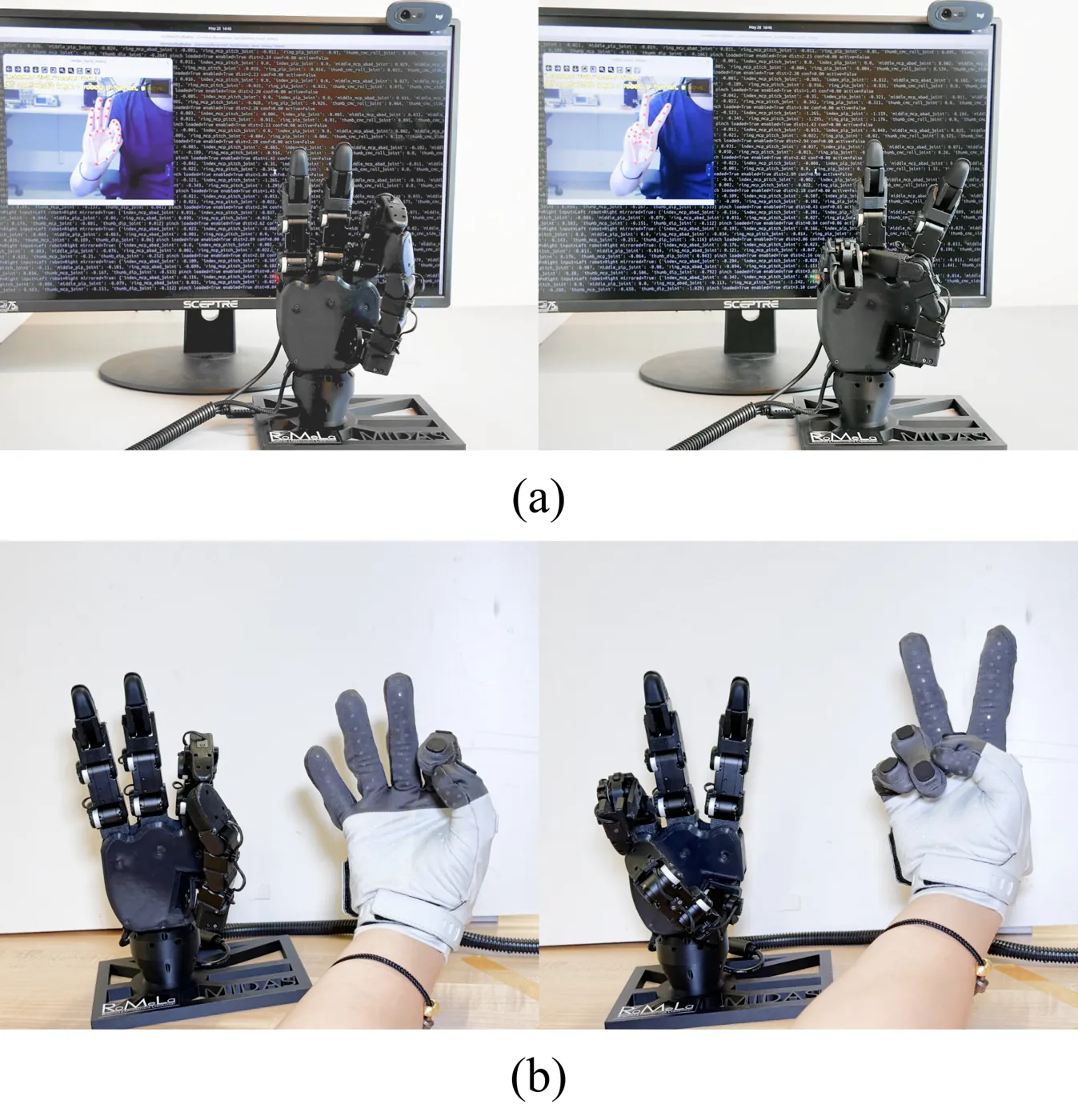
Figure 6. Vision-based hand tracking and MANUS-glove teleoperation both feed the MIDAS retargeting layer.
Why the Open-Source Stack Matters
The release includes CAD, STEP files, a bill of materials, PCB files, assembly documentation, control and tactile Python APIs, URDF, MJCF, and retargeting and teleoperation repositories. This is broader than publishing printable geometry. It gives another group a route to rebuild the control and data path around the hand.
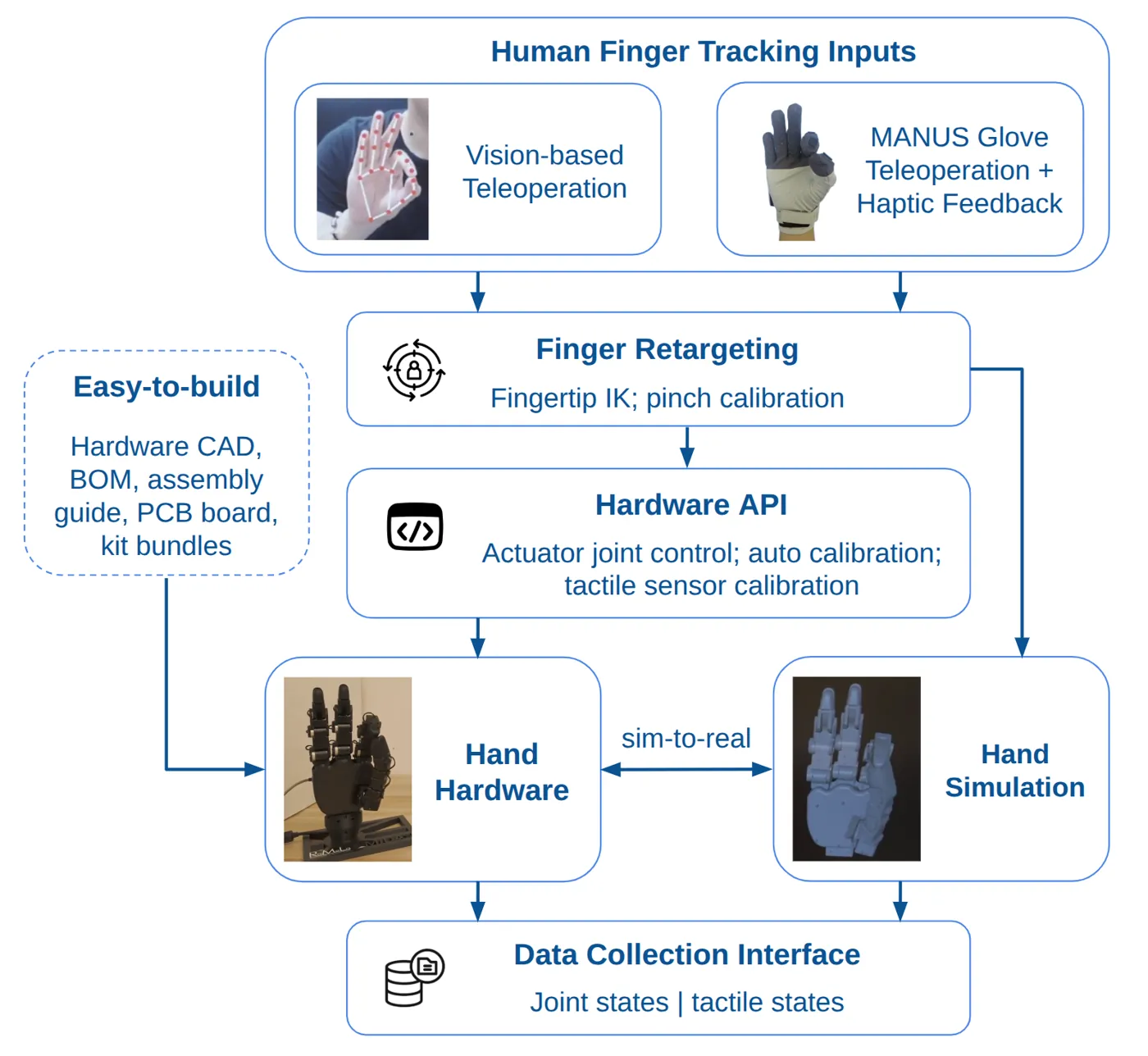
Figure 5. The released ecosystem connects hardware artifacts, human input, retargeting, the hardware API, simulation, and data collection.
The important property is interface closure. CAD alone allows printing but not reliable control. A controller alone does not establish how the passive linkage, simulation model, and physical motors correspond. MIDAS Hand connects these layers through an explicit 16-joint state, a 13-motor command vector, and a synchronized tactile stream.
Limitations
The authors explicitly identify the absence of a little finger as a limitation. It reduces support for grasps that rely on the ulnar side and may affect some in-hand manipulation motions. The 32-of-33 taxonomy result is strong, but the single failure is a concrete consequence rather than a minor omission.
The authors also state that the evaluation characterizes hardware properties rather than task-level autonomous manipulation. The experiments establish workspace, strength, repeatability, thermal behavior, tactile readout, and teleoperation, but they do not show the success rate of an autonomous manipulation policy trained or executed on the platform.
Tactile sensing has not yet been incorporated into closed-loop control. The paper demonstrates that contact can be measured, but it does not compare tactile-aware and tactile-blind controllers for slip detection, grasp stability, or policy learning. The 283 taxels are therefore a sensing foundation whose closed-loop benefit remains to be established.
A further evidence boundary is that the reported results come from one prototype and defined test setups. The open design and short assembly time support reproducibility, but the paper does not quantify unit-to-unit manufacturing variation, long-term wear, or performance across different environmental temperatures. That assessment follows from the scope of the experiments rather than from a claim made by the authors.
Conclusion
MIDAS Hand addresses a research-infrastructure problem: dexterous manipulation cannot scale when the hand itself is expensive, difficult to repair, sensor-poor, or geometrically distant from human demonstrations. The paper combines rigid direct-drive transmission, passive four-bar underactuation, modular printed construction, and commercial multi-axis tactile arrays in one open package.
The evidence defines hardware readiness rather than claiming solved manipulation. It reports approximately 0.02 newton-meters of backdrive torque, 80.1 percent human index-workspace coverage, a human-like radial-to-ulnar opposition trend, more than 9.5 kilograms of whole-hand payload, more than 5,000 continuous grasp cycles, a 0.016-millimeter repeatability standard deviation, and 32 of 33 GRASP categories.
The next research questions can now move from acquisition to use. Does tactile feedback improve grasp success? Does low mechanical impedance make contact-rich policies more robust? Can retargeted human demonstrations train transferable manipulation policies? Can independently built copies preserve calibration and data contracts? MIDAS Hand provides the hardware and software interfaces needed to test those questions.
Key takeaway: The scarce ingredient in dexterous manipulation is not one more joint, but a shared interface that lets joints, touch, simulation, and human demonstrations become repeatable experiments.