
OPEN SOURCE DEEP DIVE
Open Reality: Turn Phone Video into Robot-Ready 3D Scenes
Open Reality turns phone video into persistent, queryable 3D scenes that agents can measure, navigate, inspect, and export, with metric calibration required before robot-facing outputs.
Most 3D reconstruction demos stop when the point cloud appears. A room is visible, the camera path is tracked, and the audience can rotate the result. That is an impressive graphics milestone, but it is not yet a dependable spatial substrate for an autonomous agent. Open Reality focuses on the missing layer between a reconstructed room and a system that can measure it, reason about it, navigate through it, and export it for robot-facing tools.
The project accepts ordinary phone video, converts it into a persistent 3D scene, and exposes the scene through the Model Context Protocol. Claude Code, Codex, Cursor, and other MCP clients can then upload a video, wait for reconstruction, inspect objects, measure distances, plan a route, run a server-side scene agent, and fetch export artifacts. The most distinctive engineering decision is not the number of tools. It is the project's refusal to turn an uncalibrated monocular distance into metres. Relative geometry stays relative until a user supplies a trusted real-world distance.
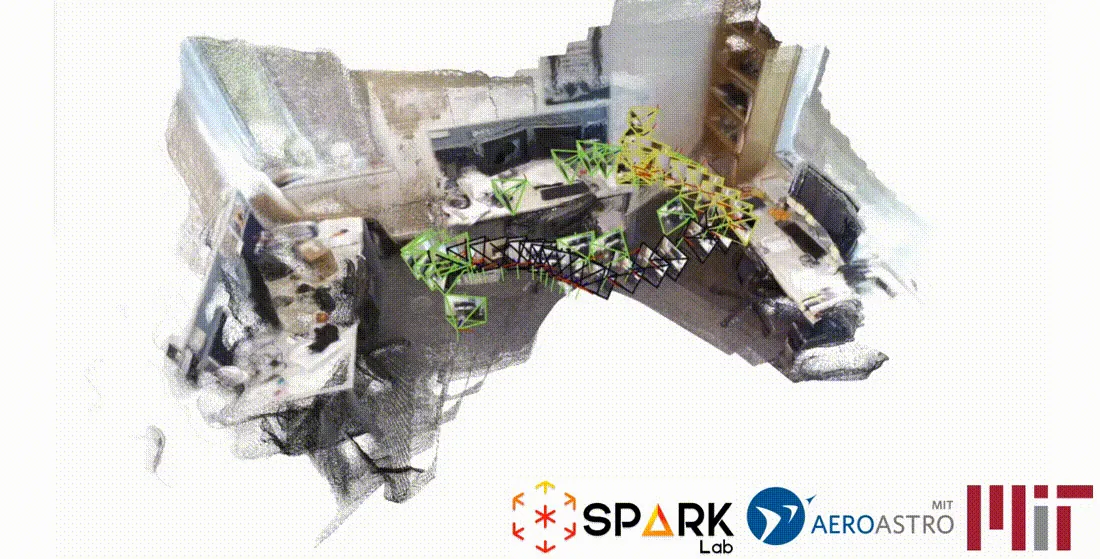
What the system actually does
A normal session begins with a video. The user may record a room in the browser, or upload an existing file through the MCP client. The broker schedules reconstruction and stores the result as a scene record. That record is not just a mesh. It can contain camera poses, RGB keyframes, dense point geometry, open-vocabulary object detections, a spatial scene graph, an evidence-backed report, measurements, navigation plans, agent runs, annotations, and derived export artifacts.
Once the scene is available, the agent can sync a local scene list and read a compact scene card before deciding what to do next. This card is deliberately boring in the right way: it reports whether the scene has a metric anchor, whether the room report is degraded, the ground frame, object counts, and the available derived data. The model does not need to ingest a huge point cloud to know whether a measurement is currently allowed.
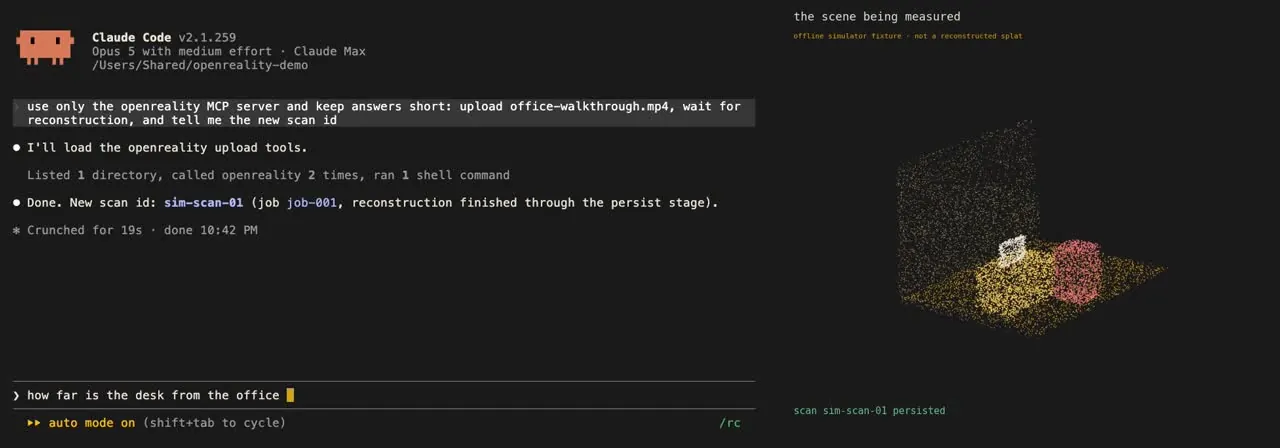
Uploads, large downloads, and long-running jobs are handled as files and jobs rather than as text in the model's context. A reconstructed scene can be queried repeatedly after the original upload session is over. Export tools prepare an artifact, poll job status, and fetch the result to a local artifacts directory. This is a better fit for MCP than passing a point cloud through a chat transcript, and it makes the local process responsible only for credentials, request shaping, polling, and disk writes.
Open Reality also ships an offline simulator. It is not a reconstruction engine. It is a mock broker that imitates uploads, jobs, scene cards, relative-unit measurements, metric anchors, scene agents, and exports with fixture data. This gives client developers and test suites a complete workflow without an account or GPU. The simulator enforces the same important distinctions as the product path, including metric gating for Isaac and a single simulated agent run per scene. It is useful evidence that the MCP contract is more than a thin wrapper around a live demo.
The process boundary is part of the design
The npm package openreality-mcp runs as a local stdio process started by the user's MCP client. It is intentionally a thin typed client. It holds credentials and talks to a broker over REST, but it does not perform reconstruction, scene-agent orchestration, or storage. The broker can be the hosted service or a user-controlled deployment that implements the same contract.
| Boundary | Responsibility | Where data lives |
|---|---|---|
| Local MCP process | Tool registration, credentials, HTTP calls, polling, artifact downloads, optional hardware bridge | Credentials, sync cursor, and downloaded artifacts under ~/.config/openreality |
| Open Reality broker | Video reconstruction, scene storage, measurement, navigation, agents, exports | Uploaded media and scene data are sent to the configured broker |
| Device MCP server | Robot arm or other hardware controls, including the device's own safety rules | Device calls stay on the local machine |
The local package uses cordis as its plugin runtime. Two services, the broker client and the MCP server, are shared with four built-in tool plugins for workspace, scene, agent, and export operations. Resource registration is included as another plugin. A tool or resource is registered as an effect with a removal function, so disposing one namespace removes exactly those registrations. Load order is based on service requirements rather than a manually maintained initialization sequence.
That architecture matters to contributors because it keeps the tool surface extensible without turning every feature into a global side effect. Optional hardware is a separate set of fibers loaded from hardware.json. A device's MCP server runs as a child process on the user's machine. Its tools are exposed under the device's prefix, and its own limits and refusals reach the model unchanged. Open Reality does not add motion planning or safety logic to a robot arm merely because the device is visible through the same assistant.
The built-in surface at the reviewed commit contains 42 tools and 2 resources. The README still contains an old "41 tools" badge, while the tool table and code have moved to 42. That inconsistency is cosmetic but worth noting. The groups are:
| Namespace | Tools | Representative operations |
|---|---|---|
workspace_* |
6 | List scenes with a sync cursor, upload video or splat data, inspect jobs, wait for jobs |
scene_* |
23 | Read a scene card, list objects, measure, plan paths, inspect planes, anchor scale, fetch keyframes, segment, share |
agent_* |
6 | Run, inspect, replay, and chat with the server-side scene agent |
export_* and artifact_* |
7 | Prepare and inspect exports, fetch artifacts, perform the composite MuJoCo export and unpack flow |
| Resources | 2 | openreality://scenes and openreality://scene/{scan_id} |
The two resources are not decorative. They let an MCP client browse scene context without inventing a separate protocol convention. The scene resource renders the same honest summary as the scene card. That includes the metric state, report status, size and ground frame, selected objects, and counts of measurements, paths, edits, agent runs, and synthetic views.
Why relative scale is treated as a product boundary
Monocular SLAM recovers a scene up to an unknown scale. The geometry can be internally consistent while the absolute size remains ambiguous. A camera moving through a small model room and a camera moving through a full-size room can produce similar images under the right assumptions. The system can recover ratios, camera motion, and object relationships, but a bare monocular pipeline cannot know that a given segment is one metre rather than two.
Many systems handle this ambiguity by presenting a number and leaving the unit to the user interface. A model then says "about 1.7 metres" because metres are the most plausible indoor unit. Open Reality treats that behavior as a failure. Measurement responses carry the numeric value together with units, scale_source, provenance, and degraded. The MCP layer passes those fields through without softening or converting them. The bundled skill tells the agent that a length is metres only when the response says the unit is metres.
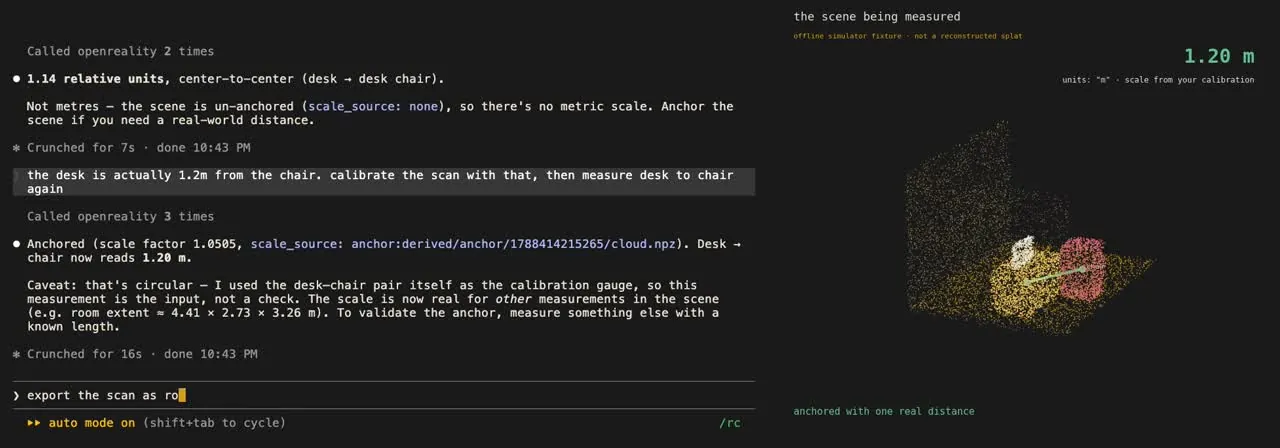
The anchor tool is the only product path from relative units to metres. It takes two picked points and a trusted physical distance between them, such as a doorway width or counter length. The broker computes a scale factor and applies it to the scene. The important part is not the arithmetic. It is that the provenance of the scale survives every later measurement and export.
Depth Anything V2 is present, but it is not trusted to set absolute scale. The project measured the model's frame-to-frame consistency on real indoor footage and found a roughly sixteen percent constant absolute bias against motion-capture ground truth. The metric-depth signal is therefore used to estimate ratios between adjacent map segments, where a constant bias cancels out. This reduces scale drift along a walk while preserving the rule that only a user-provided anchor can unlock metres.
The same doctrine gates robot-facing outputs. Isaac Sim and MuJoCo need metric geometry. If no anchor exists and no scale is supplied through a supported export path, the broker returns a typed refusal instead of producing a plausible-looking scene at the wrong size. That is a better failure mode. A policy trained in a scene with an incorrect scale can learn the wrong reach, clearance, and collision dimensions. A missing scene is recoverable; a silently wrong training asset is much harder to discover.
Semantics are connected back to pixels and geometry
The scan pipeline combines geometry with an open-set semantic layer. Detections include a query, a 3D bounding box, the matched submap and frame, confidence, and a description. The scene graph adds objects, spatial relations, distances, and evidence references. The report builder adds room type, observations, and a human-readable summary. Every important claim is intended to point back to a specific keyframe and submap.
This evidence chain is important for agent use. A multimodal model can describe an image convincingly while inventing an object that is not present. Open Reality tries to keep the object list closed: the objects returned by the server are the objects the agent may reason about, and synthetic views are labeled as renders rather than photographs. Generated object variants carry a generated flag. A degraded scene is reported as degraded rather than hidden behind a confident summary.
Measurements, navigation, and agent behavior all sit on top of this layer. A navigation plan operates in reconstructed free space and can be described by the coding agent after the broker returns a path. The scene agent can survey, annotate, or answer questions, but its events and runs are observable through the MCP surface. These are not three unrelated demos. They are different consumers of the same persistent spatial record.
Robot exports are useful, but narrower than the label suggests
"Robot-training export" can sound like a complete manipulation dataset. Open Reality is careful about what a scan actually contains. The output is built around a camera trajectory through a real space, RGB observations, dense geometry, a grounded semantic layer, and language annotations tied to frame windows. It does not contain robot joint commands, gripper trajectories, force signals, or successful manipulation episodes.
| Export | Contents | Best fit | Important caveat |
|---|---|---|---|
openreality |
Project-owned directory with trajectory, RGB, point cloud, scene graph, report, grounding, and annotations | Inspection, research, conversion, and custom downstream work | Persisted-record export has lower fidelity than live export and may omit temporal annotations or some grounding records |
groot_lerobot_v2 |
Camera pose as observation state, camera ego-motion as action, RGB video, intrinsics, and language annotation | Camera-centric VLA research, navigation embodiment, and vision-language spatial training | The action field is camera motion, not a robot controller command or manipulation demonstration |
isaac_usd |
Metric, gravity-aligned, Z-up USD environment and animated camera trajectory | Loading a scanned environment into Isaac Sim or Isaac Lab | Metric scale is mandatory; full real-SLAM route validation and a human Isaac Sim load are still open |
mujoco_mjcf |
MuJoCo scene XML with the reconstructed scan mesh as visual geometry | Camera-path inspection and approximate physical layouts | Metric scale is mandatory; collision geometry is limited to a ground plane and one vertical box per detected object |
The Open Reality export format is the source of truth for the other converters. A single scan session becomes one episode. The trajectory table contains a global index, frame index, episode index, synthetic timestamp, original source frame ID, camera pose, relative camera motion, and intrinsics. The world point cloud and object centers share one coordinate frame. The semantic sidecar contains scene facts, reports, grounding tuples, and frame-windowed language annotations for scene captions, object captions, and spatial relations.
The GR00T-LeRobot converter maps the camera pose into observation state and the relative camera transform into action. It records the camera as a new embodiment rather than pretending the scan is a built-in robot platform. The video, state, action, intrinsics, and task annotation can be loaded through the LeRobot dataset interface with the GR00T new-embodiment path. This is valuable for research into camera motion, spatial grounding, and language-conditioned navigation. It is not a substitute for a manipulation corpus.
Isaac export answers a different need. It estimates gravity from the dominant floor plane, orients the scene so the cameras are above the floor, and rotates the reconstruction into a Z-up frame. It then applies a metric scale from a user-provided factor or an already calibrated anchor. The USD writer authors explicit metre and up-axis metadata, builds a static collision representation, and writes an animated camera that follows the original keyframes. The camera convention is flipped from the computer-vision frame to the USD camera frame, a detail that is easy to get wrong and is covered by reopen-and-inspect tests.
The project has tested the geometric alignment, camera conversion, collider authoring, and metric gate with synthetic fixtures and local USD tooling. It has not yet demonstrated the complete path from real SLAM geometry through the broker route into a human-operated Isaac Sim scene where a robot walks on the scanned floor. The documentation marks those two rows as open. That honesty should be carried into any deployment plan. The exporter is promising, but the runtime evidence is incomplete.
MuJoCo takes a deliberately coarser route. The reconstructed mesh is retained as visualization, while the collision model is simplified to a floor plane and a vertical box for each detected object. This reduces physical complexity and makes the export easier to run, but it is not a faithful contact model. It is suitable for checking the camera path, rough obstacle placement, and an approximate scene layout. It is not suitable for evaluating grasps, contact-rich manipulation, or precise surface interaction.
Self-hosting has real capabilities and clear omissions
There are two documented self-hosting paths. On a single GPU machine, the broker and jobs run in one process with local disk storage. The recommendation is a CUDA GPU with at least 24GB of VRAM and roughly 48GB of host memory for reconstruction. On a personal Modal account, the CPU broker and GPU worker are deployed separately, with data in the user's Modal Volume and Dicts. Both paths use the same broker package and differ mainly in storage and job execution.
Self-hosted authentication is designed for a single local user. A generated token bootstraps identity, and authorized callers share the same local subject. Durable API keys can still be minted on top of it, and the normal MCP login flow works. The documentation explicitly warns against exposing a self-hosted broker publicly without understanding the single-user construction. This is an important boundary: a local research deployment is not automatically a multi-tenant service.
| Capability | Self-hosted v1 | Practical meaning |
|---|---|---|
| Video reconstruction, measurement, navigation | Works | Requires a compatible GPU and the reconstruction models |
| Scene cards, planes, ground frame, metric anchor | Works | The metric-honesty flow is available locally |
| Open Reality and GR00T exports | Works | Camera trajectory and semantic assets are available |
| Scene agents and segmentation | Works with external credentials | The user brings an OpenRouter or FAL key |
| Isaac USD export | Not in v1 | The self-hosted lane refuses instead of pretending to support it |
| Robot-recording import | Not in v1 | The DimOS pipeline is not part of the public self-host path |
| Live phone streaming | Not in v1 | The hosted service has additional per-user GPU scheduling |
Licensing is more restrictive than the repository badge suggests. The source repository uses BSD 2-Clause, but a self-hosted server downloads VGGT-1B, the MIT SPARK VGGT fork, and Depth Anything V2 Large. Those models are provided under CC BY-NC 4.0 and are limited to non-commercial use. The repository does not redistribute the weights; it fetches them from upstream. A company still needs to follow the upstream terms. Commercial deployment should use the hosted service with a commercially licensed model or obtain separate permission from the model owners.
How much can a reader trust the repository state?
The MCP package has unit tests, contract tests, plugin lifecycle tests, an offline simulator, and stdio end-to-end coverage. The simulator is typechecked against the vendored protocol and exercises the important refusal paths. The broker route for Isaac has tests for metric gating, format routing, dependency failures, and USD output where the required libraries are installed. The project also includes inspection scripts that reopen a generated USD and verify conventions, collider presence, camera samples, metric flags, and transform shape.
That evidence is useful, but it is not the same as validating a complete production scan. The repository itself lists real SLAM geometry through the route and a manual Isaac Sim load as unfinished verification. It also says the public server/ and core/ trees are curated mirrors of private working repositories, synchronized by hand around September 2, 2026. The reviewed root repository is newer, at a commit dated November 18, 2026, but the mirrors are not guaranteed to contain every private backend change.
A responsible evaluation therefore separates three questions. Does the MCP client expose the expected contract and honesty behavior? Does the public broker mirror implement the same capabilities as the hosted service? Does the chosen export load and behave correctly in the target simulator or training framework? The README, tool tables, mirror notes, self-hosting document, and runtime tests answer different parts of that picture. Reading only the root commit date or the stars count would answer none of them.
Where Open Reality is a strong fit
The project is a strong fit for robotics researchers who need to turn real indoor video into an inspectable spatial representation without building the entire upload, job, scene-record, agent, and export plumbing from scratch. It is particularly relevant to camera-centric embodiment research, navigation, scene understanding, spatial grounding, and training data that benefits from grounded vision-language observations. The evidence-backed semantic layer is more useful than a pile of unlinked captions because it gives downstream systems a way to audit where an object claim came from.
It is also a useful reference for MCP application design. Long-running reconstruction jobs, file uploads, nested polling, large artifact downloads, typed refusals, local credentials, and resource templates are all part of the contract. The project does not reduce MCP to a chat wrapper. It treats the model as a client of a stateful external system and keeps data movement explicit.
The current version is not a complete answer for teams that need manipulation demonstrations, contact-rich simulation, or a multi-tenant hosted platform. It lacks robot action labels, its MuJoCo collision scene is approximate, its self-hosted mode is single-user, and the Isaac runtime path still needs end-to-end evidence. A practical pilot should run both relative and anchored measurements on the team's own footage, compare object detection and reports with manual inspection, export one navigation scene, and then validate the result in the actual simulator or training stack.
Open Reality's most important contribution is that it connects the visible scene to the conditions under which its numbers may be used. Video-to-3D is only the first half. Unit provenance, refusal behavior, artifact boundaries, and downstream validation determine whether a reconstructed room can become a dependable robot asset. The project has built a transparent path toward that goal. The remaining work is to turn several of its strongest claims, especially Isaac runtime behavior and production-scale backend parity, into repeatable field evidence.
Source: github.com/reality-opened/openreality. This review is based on the README, MCP architecture, dataset export specification, Isaac export documentation, self-hosting guide, and relative-units design article at commit 86f545d1ff1c9191cedc3e85dbae9b65fec29ced.