Skip to content
Tags

#Spatial Intelligence (15)

IGGT4D: Streaming 4D Instance-Grounded Geometry Transformer

IGGT4D: Streaming 4D Instance-Grounded Geometry Transformer

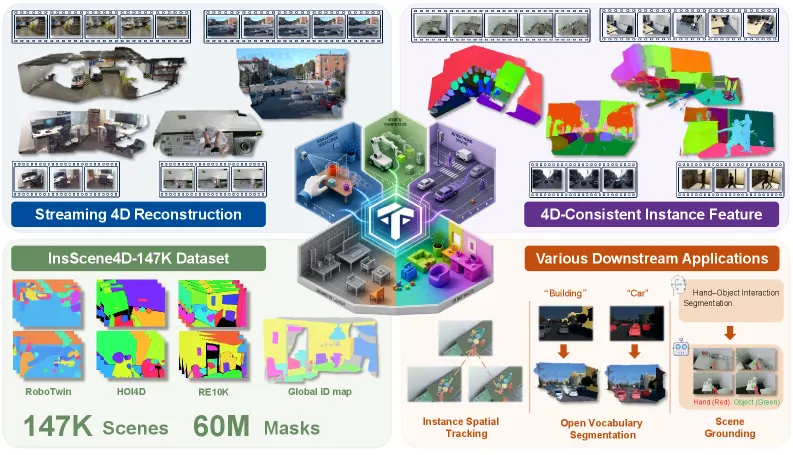
Real-world spatial intelligence requires agents to understand scenes from continuous video streams, where objects move, persist, disappear, and reappear over time. While recent spatial foundation models have enabled generalizable feed-forward 3D reconstruction, most streaming methods remain geometry-centric and lack temporally consistent object-level understanding. Meanwhile, existing semantic reconstruction and 3D-aware vision-language methods largely rely on externally extracted 2D semantic cues or loosely coupled geometry inputs, limiting unified geometry-instance learning in long dynamic scenes. In this paper, we propose IGGT4D, a streaming instance-grounded geometry Transformer for online 4D scene understanding. IGGT4D processes video frames sequentially, reuses historical context through causal spatial-temporal modeling, and incrementally updates a unified representation of camera motion, geometry, and object identity. This enables long-sequence feed-forward reconstruction with geometry-instance consistency in dynamic environments. To address the lack of high-quality 4D supervision, we further construct InsScene4D-147K, a large-scale dataset spanning real/synthetic and static/dynamic scenes, with RGB images, depth, poses, and temporally consistent instance masks generated by an automated geometry-guided annotation pipeline. Experiments on 3D reconstruction, pose estimation, instance spatial tracking, and open-vocabulary segmentation demonstrate that IGGT4D outperforms existing streaming baselines while maintaining scalable online inference for long dynamic sequences.

Zhengyu Zou, Hao Li, Kuixuan JiaoJul 21, 2026
Spatial IntelligenceJul 21, 2026

Spatial-IQ: Deconstructing Spatial Intelligence via Hierarchical Capability Tests

Spatial-IQ: Deconstructing Spatial Intelligence via Hierarchical Capability Tests

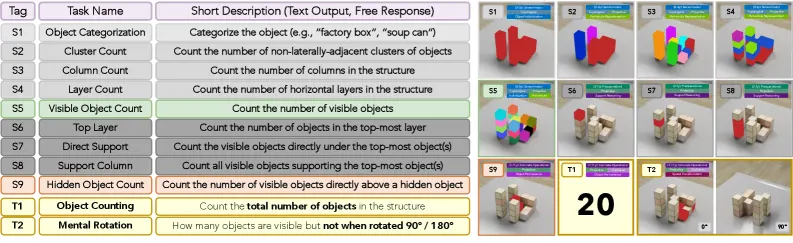
Multimodal large language models (MLLMs) excel at visual interpretation but fail on spatial reasoning tasks that humans solve reliably. Existing benchmarks evaluate these models as black boxes, limiting their ability to identify the underlying causes of lower performance: when a model fails a spatial reasoning task, it remains difficult to ascertain whether the hurdle is perceptual, such as recognizing object boundaries, or cognitive, such as reasoning about occlusion to infer hidden geometry. We introduce Spatial-IQ, a hierarchical diagnostic framework that decomposes object counting in stacked 3D structures into 9 perceptual and cognitive sub-tasks organized by the developmental stages of human spatial cognition, with mental rotation as an additional target probe. Using NVIDIA Isaac Sim, we procedurally generated a diverse dataset of roughly 80,000 stacked 3D structures with per-task ground truth. We evaluate models across three output formats (free-response text, multiple-choice images, and image editing) alongside a human baseline. The Spatial-IQ framework shows that top-performing models often succeed at the target task (object counting) without succeeding on the lower-level sub-tasks intended to support it, and that models differ in how much of these hierarchical chains they preserve, often revealing shortcut behavior that raw target-task accuracy alone would obscure. Finally, we demonstrate that training models with chain-of-thought (CoT) supervision over our hierarchical sub-tasks, combined with reinforcement learning with verifiable rewards, significantly improves both spatial consistency across sub-tasks and target-task accuracy, supporting the value of the proposed decomposition as both a diagnostic tool and a training signal.

Patrick Rim, Tom Long, Ekta PrashnaniJul 24, 2026
Spatial IntelligenceJul 24, 2026
PlanCraft: Sketch, Refine, and Furnish for Architect-Inspired Progressive 3D Residential Scene Generation

PlanCraft: Sketch, Refine, and Furnish for Architect-Inspired Progressive 3D Residential Scene Generation

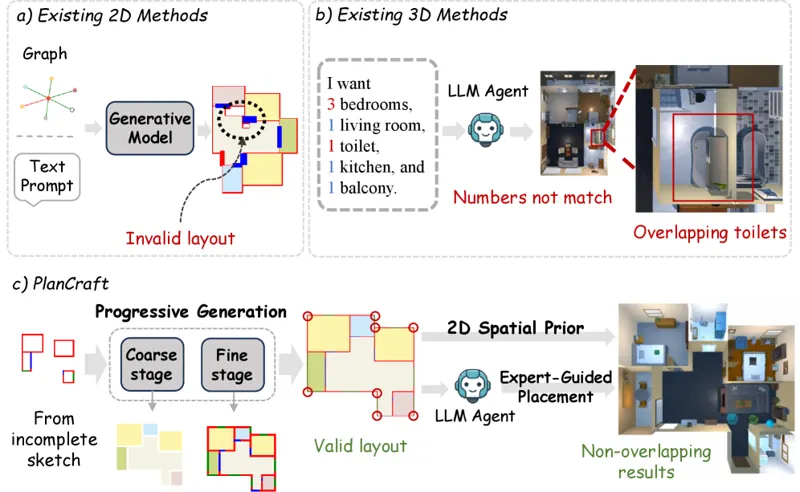
Two structural insights have been overlooked in automated residential floor plan generation. First, design is inherently progressive. Architects begin with rough strokes and refine them over time, whereas existing methods typically require their conditioning representation to be fully specified before generation, a fundamental mismatch with how design actually works. Second, the 2D floor plan is not an optional intermediate but an irreplaceable spatial contract. Once room boundaries, doors, and windows are fixed, furnishing reduces from open-ended spatial reasoning to bounded constraint satisfaction. Bypassing this contract, as existing 3D systems do by delegating layout to language models, yields overlapping rooms and implausible proportions; directly calling general-purpose language models likewise produces geometrically invalid layouts. Guided by these insights, we present PlanCraft. SketchPlan supplies the missing training signal by replaying the architect's drawing process on 80K real floor plans, producing partial sketches at every completeness level. PlanCraft-Diff progressively sharpens an incomplete sketch into a geometrically precise, vectorizable floor plan through a coarse-to-fine strategy. With the spatial contract established, PlanCraft-Agent then furnishes the scene within well-defined room boundaries. Experiments show that PlanCraft achieves a 61.1% lower FID than the best existing 2D method and surpasses existing 3D systems by 15 points in expert-rated spatial rationality, with a sketch at only 25% completion already outperforming all fully specified baselines.

Pengyu Zeng, Yuqin Dai, Jun YinJul 26, 2026
Spatial IntelligenceJul 26, 2026
FloAff-Kitchen: Bridging Navigation and Manipulation via Canonical and Progressive Floor Affordance Learning

FloAff-Kitchen: Bridging Navigation and Manipulation via Canonical and Progressive Floor Affordance Learning

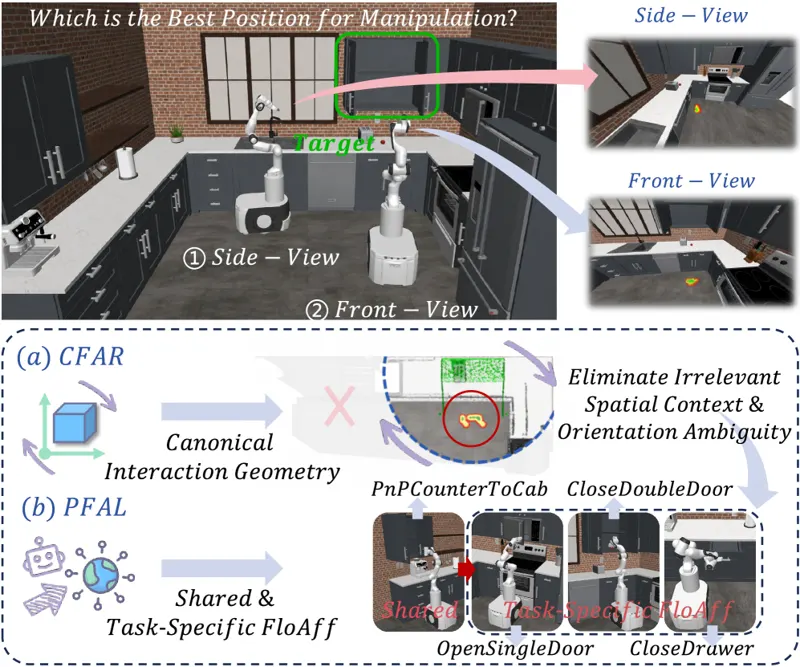
Mobile manipulation requires robots to identify Floor Affordance (FloAff) that maximizes downstream manipulation success rather than merely ensuring navigation feasibility. FloAff prediction is a target-conditioned local spatial reasoning problem, yet existing methods suffer from representation ambiguity caused by irrelevant spatial context and arbitrary object orientations, while entangling shared and task-specific knowledge across heterogeneous manipulation skills. To address these challenges, we propose a unified framework for FloAff prediction from egocentric multimodal perception, consisting of canonical representation learning and progressive affordance prior learning. Specifically, we introduce a Canonical Floor Affordance Representation (CFAR), which learns canonical interaction geometry by preserving affordance-relevant local structure while eliminating nuisance spatial variations unrelated to robot base placement. We further propose Progressive Floor Affordance Learning (PFAL), which learns transferable FloAff priors from a foundation manipulation task and progressively adapts them to heterogeneous downstream manipulation skills. To facilitate systematic evaluation, we establish the first cross-scene, multi-view FloAff-Kitchen benchmark covering diverse manipulation skills, scene layouts, furniture styles, and viewpoints. Extensive experiments on three benchmark settings demonstrate that our method consistently outperforms strong baselines, while ablation studies validate the contribution of each proposed component. Project page: https://csu-hero-lab.github.io/FloAff-Kitchen_Web/

Ping Zhong, Manling Teng, Tao WuJul 27, 2026
Spatial IntelligenceJul 27, 2026