BLOG
1X announces 25-DOF tendon-driven hands for NEO. Low gear ratios enable force transparency and backdrivability, combined with high-resolution tactile skin, turning every grasp into an experiment — a perception stack, not just an actuator.
1X introduces 1XWM, a video-pretrained world model integrated into NEO as a robot policy. Unlike VLAs, 1XWM derives robot actions from text-conditioned video generation, leveraging world dynamics from internet video for zero-shot generalization without large-scale teleoperation data.
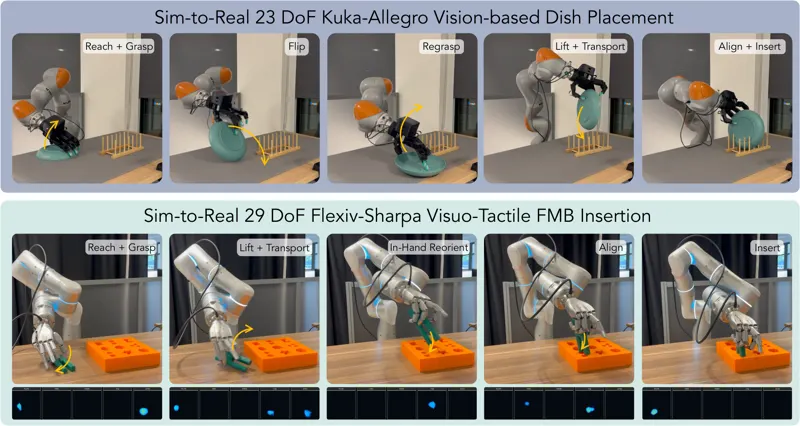
ADEPT pre-trains one dexterous policy on 16 primitives, post-trains specialists without forgetting, and deploys zero-shot on Kuka-Allegro and Flexiv-Sharpa, 2-14x faster than gripper pipelines.
GRASP proposes three innovations making long-horizon planning with world models practical: lifting states for parallel-in-time optimization, stopping brittle state gradients while keeping action gradients, and periodic sync refinement. Achieves leading success rates at long horizons on Push-T.
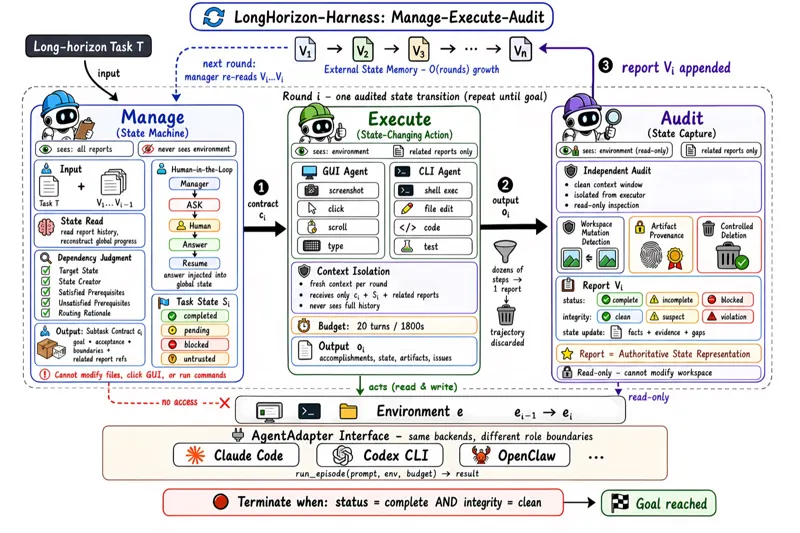
AMAP-ML's LongHorizon-Harness turns long-horizon execution into independently audited state transitions via a Manage-Execute-Audit loop, lifting WeaveBench PassRate 51.8→80.7 with the same backbone.
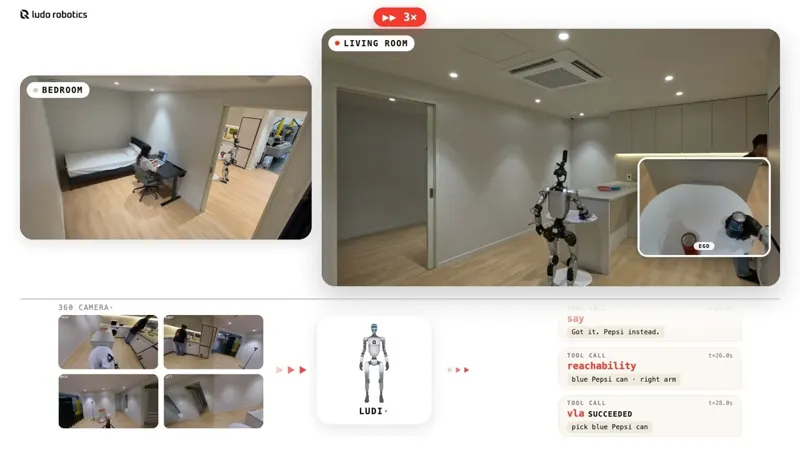
Ludo Robotics presents Ludi₀.₁, their first agentic system integrating perception, navigation, and manipulation with interactive speech, dialogue, memory, and social reasoning — powered by a fine-tuned Qwen3.5 VLM, GR00T VLA policies, and KISS-ICP navigation.
How to import 3DGS scans into Isaac Sim 6.0: the silent 2^24 point cap, USD conversion, orientation fixes, trajectory cameras — plus four industrial weaknesses and mesh-based workarounds.
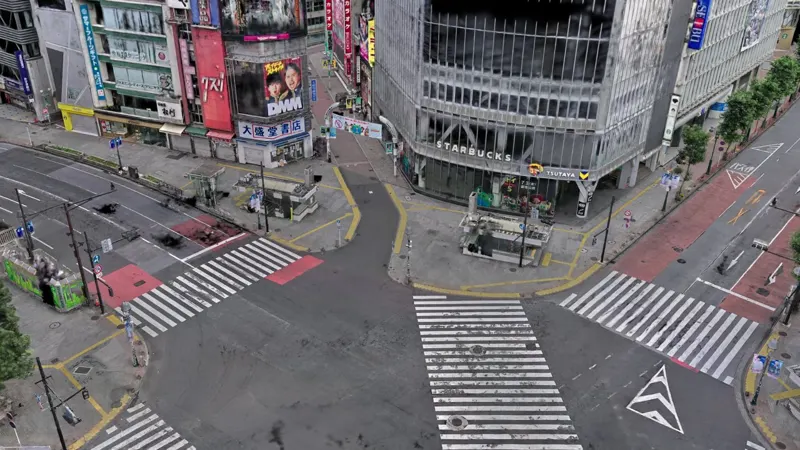
Using Shibuya's scramble crossing as a case study: keep the scanner's 3DGS and mesh untouched, patch only the ground holes from measured LiDAR, stack appearance and physics as two layers, and drive a PhysX Vehicle in Isaac Sim.
Across ICRA REAL-I and CRAIC 2026, 200+ student teams used Leju's open-source LeTools chain to go from algorithm to real-robot deployment in as little as one day. Hardware-free dry-run of a 37-node behavior tree, a 1,000-hour production-grade LET-Base dataset, a one-line simulation-to-real switch in deploy.yaml, and 10+ architectures behind a unified Adapter layer show embodied-AI competition shifting toward low-barrier dev environments covering data, models, and deployment.
DYNA Robotics introduces Dyna-2, a world-action model pre-trained on 1M+ hours of egocentric human video, demonstrating the first human-to-robot transfer scaling law. With just hours of fine-tuning, it performs tasks across embodiments, achieving 87% zero-shot pass rate at customer sites.
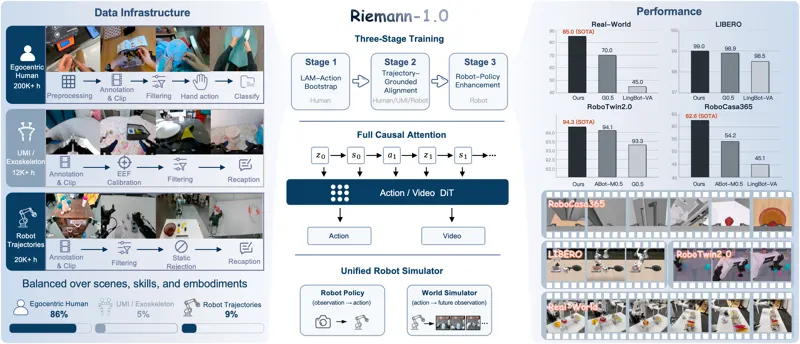
Riemann Dynamics releases Riemann-1.0: a fully causal autoregressive World Action Model that unifies executable robot policy and action-conditioned world simulation in one architecture. Through progressive pretraining on 232K+ hours of heterogeneous embodied experience, it achieves SOTA on LIBERO (99.0%), RoboTwin 2.0 (94.3%), RoboCasa365 (62.6%), and real-world manipulation (85.0% SR).
Official 6B base weights, RoboTwin post-training weights, training code, open-loop eval, simulation eval, and deployment entry are all public. Labs can run inference, RoboTwin closed-loop evaluation, or custom-data post-training, but the full 60K-hour raw corpus and training budget are missing, making equivalent base pre-training reproduction infeasible.