Skip to content
← Tags

#Voice Cloning (5)

Speech & AudioMediaTopC

Fun-CosyVoice3-0.5B: open TTS that turns controllability into an interface

The third generation LLM based speech synthesis system from the FunAudioLLM group at Alibaba, 0.5B parameters, released as Fun-CosyVoice3-0.5B-2512 with base and RL weight sets plus training and inference scripts; the code repository has moved to QwenAudio/CosyVoice (Apache-2.0, 23,794 stars, verified through the GitHub API on 2026-09-29). We list it as the open source top row for speech in the audio domain, and the reason is not that it sounds most human but that it gives each of the four failure modes of production TTS an explicit interface: misread polyphonic characters go through pronunciation correction with Chinese pinyin or English CMU phonemes written straight into the input, wrong readings of numbers and symbols go through the built in text normalisation, collapsed long sentences go through RAS repetition aware sampling, and low latency goes through bidirectional streaming with an official first packet at 150ms, which is the right order of magnitude to sit inside a realtime conversational agent. Three readings matter on the metric sheet. The test-zh speaker similarity of 78.0 is the highest among 0.5B open models and above the human baseline of 75.5, yet still below the closed source Seed-TTS at 79.6, so open source first holds while world first does not. The test-hard column is the real strength, base 6.71 and RL 5.44 being the lowest in the table and better than the closed source 7.59, and hard is exactly long sentences and tongue twisters, so that lead maps to usable real scripts. English needs a discount: base test-en similarity 71.8 sits below the human baseline 73.4 and only the RL tier WER of 1.68 recovers it. Base and RL are two post training weights of one architecture, with all three error rates falling (zh CER down 33 percent, hard CER down 19 percent) and all three similarities slipping slightly, which is a good trade for broadcast and support workloads where one misread character is an incident, while voice fidelity work for a specific IP should audition the RL tier first. The repository also ships GRPO training scripts and a triton plus TensorRT-LLM runtime claimed at four times the speed of HF transformers, so post training is a path others can continue rather than a one off delivery, and the language surface covers nine languages with more than eighteen Chinese dialect accents, a tier the closed APIs still barely offer. Boundaries: the licence is two layered, Apache-2.0 for code while the weight terms live on the model pages and must be checked separately before commercial use; every reading comes from the evaluation of the authors themselves with no third party blind listening table to cross check and we did not recompute; zero shot cloning similarity comes from standard sets while real deployments depend on the noise and style of the reference recording. Graded C (vendor claim).
78.0test-zh 说话人相似度(0.5B 开源档,人类基线 75.5)Vendor Claim · 2025-12
ProductAlibaba Tongyi FunAudioLLM (QwenAudio)SiteRepo
Fun-CosyVoice3-0.5B: open TTS that turns controllability into an interface
Speech & AudioMediaTopA

VoiceStudio: the commercial voice stack moved onto local hardware and opened to agents by default

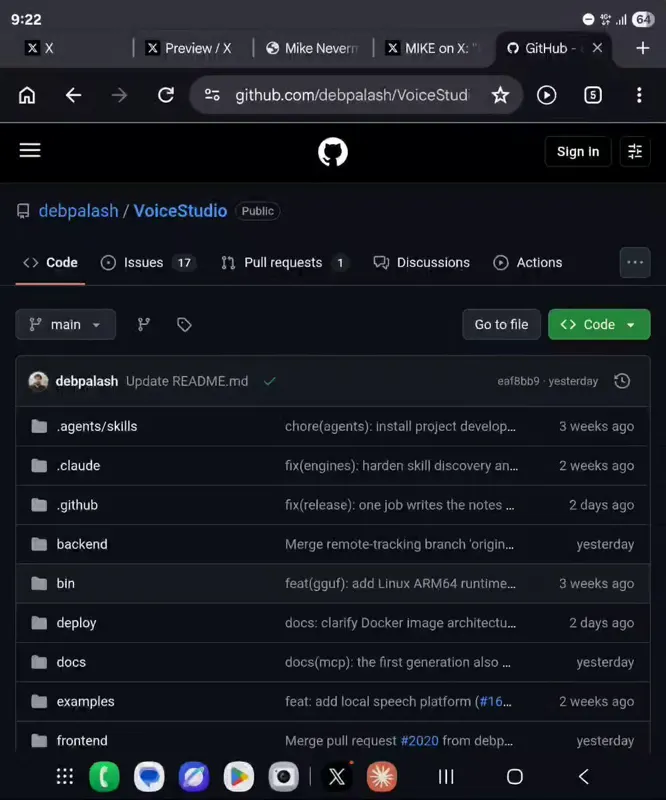
An open source, fully local voice workstation (debpalash/VoiceStudio, AGPL-3.0, Python plus Electron) positioned as the local alternative to ElevenLabs: voice cloning, voice design, video dubbing, dictation, transcription and audiobook creation, with a claimed 646 languages. Created on 2026-04-09 and at 42,831 stars and 5,005 forks on 2026-09-29. We list it as the top self-hosted row in the audio domain, not because any model behind it is stronger, but because the abstraction layer is useful. Open voice capability is scattered across a dozen repositories with their own weight formats, device requirements, cloning interfaces and licences, so assembling a pipeline of clone a voice, transcribe, align, dub and produce an audiobook spends most of its effort on glue. VoiceStudio collects 17 TTS and 11 ASR engines into one registry and reports per engine which devices it runs on (CUDA, MPS, CPU), whether it can clone, and its max_ref_seconds and ref_strategy, on top of a workflow that actually runs. The agent surface matters most for this site: a local API and an MCP server ship as first class product features, the README includes an installation prompt ready to paste into Claude Code, Codex or Cursor, and npx skills add installs it as a skill, which means coding agents can call dubbing and transcription as tools rather than needing a human at the interface. The reference audio policy is equally rigorous, with a 75 second ceiling while how much of a longer clip reaches the model depends on the engine and is reported per engine, an automatic or saved transcript ignored beyond the limit, and a hard [clone_ref_too_long] error when sending more than 20 seconds plus transcript text to the default OmniVoice. One measurement point needs stating plainly: the official docs/benchmarks.md contains a real harness with per stage profiling, refusal to start when memory is insufficient, and a rule that only RTF warm and peak memory on named hardware and versions are accepted with no estimated numbers allowed, but the results column reads No verified rows yet. We therefore attach no performance figure at all and the card carries only the star count we verified ourselves through the GitHub API, which is what earns the A grade. That A asserts the number is real and nothing about being better than ElevenLabs. Four boundaries: AGPL-3.0 is strong copyleft with a network clause, so embedding it in a service offered to outsiders obliges you to release your own server side source, and closed commercial use means either process isolation calling only the local API under your own legal review or assembling the pipeline from Apache-2.0 pieces such as CosyVoice 3 or Kokoro; per-model licences are not settled by the wrapper, since the Breeze-TTS-2 weights behind audio.cpp are research and non-commercial, Supertonic-3 and PocketTTS need extra permissions and GPT-SoVITS requires its own server, so check every model before commercial use; the 646 language figure is the repository own claim and real coverage depends on the engine chosen, from 25 European languages on Parakeet through 50 plus on FunASR to the wider Whisper family, unverified by us language by language; and desktop is Electron only now, with 0.5.3 the last Tauri release, so existing users must migrate. It sits alongside Eleven v4 on the ladder rather than replacing it, one representing the quality ceiling and convenience of a closed commercial stack and the other the data sovereignty and engine substitutability of local self-hosting.

42,831GitHub Stars(2026-09-29,本站经 GitHub API 核)Confirmed · 2026-09
Productdebpalash (open source)SiteRepo
VoiceStudio: the commercial voice stack moved onto local hardware and opened to agents by default
Speech & AudioMediaTopC

Eleven v4: the generation that pushes cloning fidelity far enough to reproduce bad training data

The new generation speech synthesis model from ElevenLabs, shipping in two variants: Eleven v4 for highest quality and Eleven v4 Turbo for real time use at a median inference latency of about 100 ms, with an official footnote stating that application and network latency are excluded. The vendor positions it above v3 on output quality, voice accuracy, consistency, emotion, delivery, audio tags and language coverage, and recommends migrating. We list it as the top closed source voice row in the audio domain because this generation changed the optimisation target from sounding better to sounding more like the source: timbre, cadence, delivery and other mannerisms are reproduced together, and the vendor concedes that accuracy and personal preference are not always the same thing and that you may still prefer how a voice sounded in v3. The engineering consequence is hard, since the burden of data cleaning moves back to the user. The showcase samples are explicitly labelled raw, with no EQ, compression, normalisation, de-essing or plosive removal, and the vendor says that if you hear clipping or plosives they are very likely in the training data and the model simply captured them accurately. What is deliverable comes down to three numbers: about 100 ms on Turbo; 10,000 characters per request, roughly ten minutes of audio, against 5,000 on v3 so long form text carries twice as many segment seams; and a coverage claim of 90 plus languages against a FAQ that enumerates 87, a gap we keep visible rather than smoothing away. Four boundaries matter. Cross language accent handling is a default behaviour change and not a toggle, so generating in a language that differs from the reference produces fluent native sounding speech in the target language, and the vendor calls a switchable version a research project with no timeline; any persona that depends on a native accent carried into a second language must be tested first. The control surface narrowed to Stability and Similarity, the Style and Speed sliders are gone, SSML is unsupported, and fine grained delivery moves to audio tags which the vendor admits are not perfect yet. Continuous model evolution is stated in writing, with training continuing after launch and behaviour possibly shifting over time, so teams treating a voice as a brand asset need periodic re-testing. Voice Design voices may also be less performative on v4. It is closed and not self-hostable, data must pass through ElevenLabs, and cloning compliance sits with the user; the self-hostable counterparts are CosyVoice 3, VibeVoice and Kokoro for speech and YuE2 for music under a non-commercial weight licence. This entry and the Eleven v3 already catalogued here are two generations of the same commercial stack rather than a replacement. Graded C (vendor claim): no verifiable third party benchmark, and no blind listening test by us.

~100msv4 Turbo 中位推理延迟(模型侧,不含应用与网络)Vendor Claim · 2026-09
ProductionElevenLabsSite
Eleven v4: the generation that pushes cloning fidelity far enough to reproduce bad training data
Speech & AudioMediaTopC

Gemini 3.8 Flash TTS: turning director-level voice direction into API parameters

Google's speech generation model (gemini-3.8-flash-tts), positioned for studio-grade voice fidelity, expressive acting and long-form stability, the most overlooked being the last: audiobook failure is not an ugly sentence but timbre drift by hour three. The design separates scopes: text is strictly a script while performance direction travels on another channel and is never read aloud, fixing "(sighs)" that used to be spoken; round style goes into speech_metadata.style, word-level emotion into pipe tags. Four voice sources: prebuilt, an extended library, voice design IDs (describe it, then reuse) and replication IDs; design and replication arrived only in 3.8. Specs: 130 languages with automatic language detection, WAV by default at 24 kHz, at most 2 speakers per request and only with prebuilt voices. Billing is per audio token at 25 tokens per second, $0.50 input and $9.00 output per million through 2026-12-31 then $1.00/$18.00. Limits: 24 kHz is not mastering grade; replication compliance rests with the user. No speech board among the 12 we sync, so listed alongside ElevenLabs v3 without ranking. Graded C (vendor-stated): no intelligibility or blind listening test by us.

全支持语音设计+克隆+多说话人Vendor Claim · 2026-09
ProductGoogleSite
Gemini 3.8 Flash TTS: turning director-level voice direction into API parameters