Tac4Loco: Learning Spatiotemporal Plantar Pressure Representations for Humanoid Locomotion
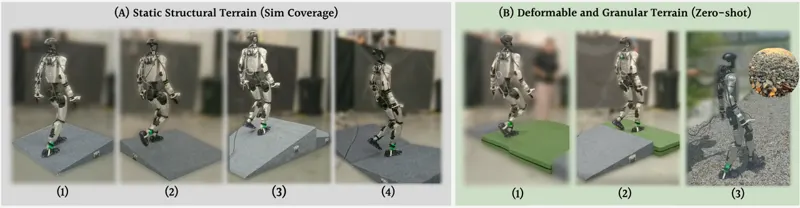
Humanoid robots are expected to traverse complex terrains, where the plantar support may vary dramatically due to foot placement errors, ground properties, and transient dynamics. To achieve robust locomotion, the robots are required to adapt to uneven terrain and uncertain foot–ground interactions. Existing locomotion policies rely primarily on proprioception or exteroceptive terrain perception, where the former provides only indirect evidence of plantar support, while the latter predicts contact conditions before touchdown but cannot observe the actual support in real-time. Although some studies incorporate plantar contacts as an auxiliary perception, they rely mainly on summary statistics, overlooking the spatial topology of plantar pressure, which provides a more direct characterization of the realized contact state. To bridge this gap, we present Tac4Loco, a tactile-perceptive framework that incorporates multi-array plantar pressure as direct feedback for humanoid locomotion. We formulate a topology-preserving ordinal representation to map simulated and physical sensor signals into a shared observation space, with a dual-branch encoder for extracting their spatial and temporal representations. Subsequently, the learned spatiotemporal features are integrated with augmented proprioception including terrain estimation cues, and provided to an asymmetric actor-critic architecture for policy learning. Extensive simulation and real-world experiments demonstrate improved tracking performance and support adaptation on terrains with inclined, partial, asymmetric, and changing support. We further demonstrate its zero-shot deployment on unseen compliant and unstructured terrains, including a foam platform and a gravel road. All code and experimental configurations will be released as open-source to facilitate reproducibility.
Ziyun Liu, Sikai Guo, Zheng Li·Aug 16, 2026
Tac4LocoLocomotionTactileAug 16, 2026
 0:20
0:20