
Skip to content
← Tags

#OpenCode (3)

Design & Frontendwheresryan22/anatomy

anatomy: turn a technical concept into a real machine, a zero-dependency isometric figure skill with a 12-check geometry audit

Editor's takeWhat is most worth stealing is that it ships its own falsification tooling: twelve checks in kit/audit.mjs (clearances, solid clearances, terminals, loose ends, supports, folds, self-overlaps, crowding, stand-in shapes, wobble, seats, depth order) plus scripts/lines.mjs demanding 'line ends: 0', which turns 'looks fine' into countable failures. It also states outright that a stand-in shape that quiets the audit is itself a bug, and the coverage check exists to catch it. Aesthetics are numeric too: bevels 0.4-1.6, screw dots 0.4-0.55, the subject filling 55-65% of the card, a device ratio cap of 1.5, and a 3D bend bound of R ≥ 2r / sin²(e − θmax). CI rebuilds every example in both themes and requires an empty git diff, so kit compatibility is a machine guarantee. The limits are stated just as honestly: not a chart library (no axes or series), machines, instruments, tools and furniture only, 3D self-reported beta at roughly 20 fps for 380 parts, and one figure costs a long session.

A standard Agent Skill that makes Claude Code, OpenCode or Codex explain a technical idea by inventing a real machine (a pin-tumbler lock for a cache key, a gantry plotter for one shared GPU context) and drawing it as four-tone isometric SVG with a zero-dependency kit of about 16,200 lines, plus optional WebGL shaders and a beta 3D mode. Eight examples ship with their built pages committed, and CI on macOS with Node 22 rebuilds each one and requires byte-identical output.

Claude CodeOpenCodeCodex
npx skills add wheresryan22/anatomy -g -a claude-code
JavaScriptwheresryan224.7k
anatomy: turn a technical concept into a real machine, a zero-dependency isometric figure skill with a 12-check geometry audit
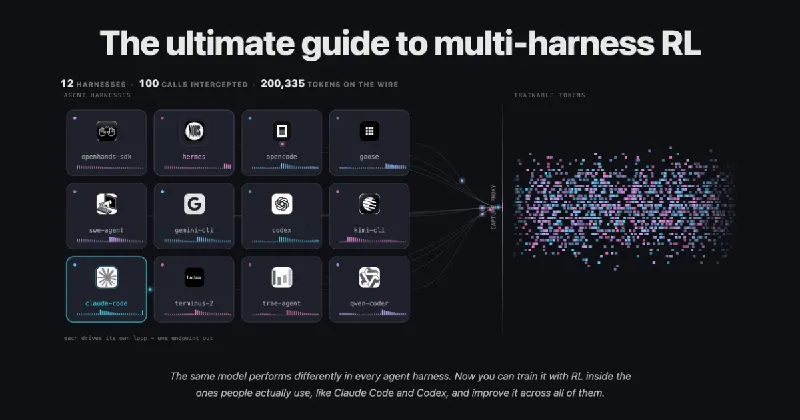
The ultimate guide to multi-harness RL: train models inside Claude Code and Codex — Hugging Face's four-harness experiment with a 2.6B model

The ultimate guide to multi-harness RL: train models inside Claude Code and Codex — Hugging Face's four-harness experiment with a 2.6B model

The same model behaves like two different models depending on the agent harness around it: GLM-5.2 scores 23% in one harness and 52% in another on SWE-bench Pro; in a controlled experiment swapping the harness moved scores 13 points while swapping the model moved only 2.5–5. A Hugging Face team (Adithya S Kolavi, Joel Niklaus, Lewis Tunstall, Leandro von Werra and colleagues, with Liquid AI) publishes an open fix: run agentic RL inside the real harnesses — Claude Code, Codex, OpenCode, Mini-SWE-Agent — with zero harness code changes. The stack: OpenEnv as the shared interface, a capture proxy that mints a session id per rollout and records exact token ids, per-token behavior logprobs and loss masks at the model endpoint (full-distribution sampling, top_p=1.0), Harbor for 40+ harness adapters and 26 sandbox backends, and TRL's Async GRPO consuming the masked training sequences. The numbers: LFM2.5-2.6B trained across four harnesses rises from 42.2% to 54.2% average pass@1 with gains under all four, and uses 31% fewer tool calls on tasks both it and the base model solved, while the OpenCode-only arm's gains stay mostly at home. The article also reports the SFT comparison (RL 54.6% vs SFT 47.5%), the full attribution of the earlier Qwen rise-and-decline (output-budget exhaustion, working without submitting, and a reward term that collapsed held-out accuracy from 0.740 to 0.178), and engineering boundaries like the proxy's concurrency ceiling.

BLOG

Reinforcement LearningRL

As an Amazon Associate, we earn from qualifying purchases.