Skip to content
← Tags

#Diffusion models (23)

OmniEgoCap: Device-Agnostic Sequence-Level Egocentric Motion Reconstruction

OmniEgoCap: Device-Agnostic Sequence-Level Egocentric Motion Reconstruction

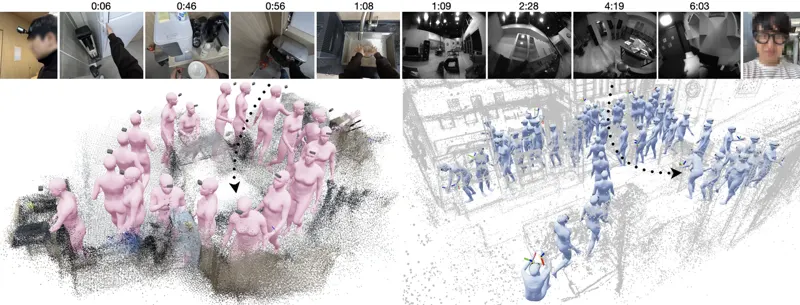
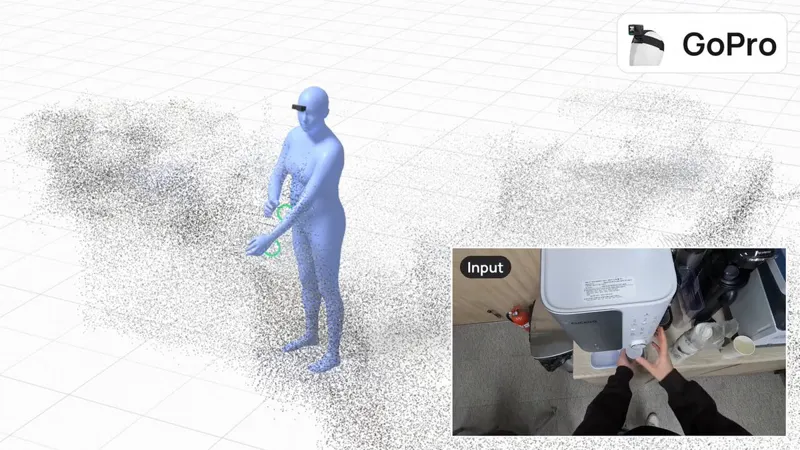
Commercial egocentric devices capture human behavior in everyday settings, yet full-body motion reconstruction must generalize across diverse cameras and mountings. This is challenging because head trajectories under-determine body motion, while hand observations are intermittent and camera-dependent: a hand may disappear simply because it has left the camera's field of view. Existing methods treat such absences as missing data, relying on fixed visibility regimes or post-hoc optimization, and fail to generalize across devices. We present OmniEgoCap, a sequence-level diffusion framework for device-agnostic egocentric full-body motion reconstruction. Our key insight is that egocentric videos contain sequence-level evidence about both the wearer and the camera-induced visibility structure, enabling OmniEgoCap to infer consistent body shape and coherent motion from sparse head and hand cues. To prevent overfitting to a single camera setup, we further introduce geometry-aware visibility augmentation, which synthesizes visibility patterns from realistic variations in camera geometry. We also present OmniEgoDB, the first mocap benchmark that pairs ground-truth motion with recordings from multiple consumer egocentric devices. Experiments on synthetic, real-device, and in-the-wild settings demonstrate superior motion reconstruction, robust cross-device generalization, and coherent in-the-wild results.

Kyungwon Cho, Jeonghyeon Na, Hanbyul Joo · 51 views · Dec 22, 2025
Egocentric VisionMotion Capture
Dec 22, 2025
RoboGesture: Real-Time Semantic-aligned Co-Speech Gestures Generation for Humanoid Interaction

RoboGesture: Real-Time Semantic-aligned Co-Speech Gestures Generation for Humanoid Interaction

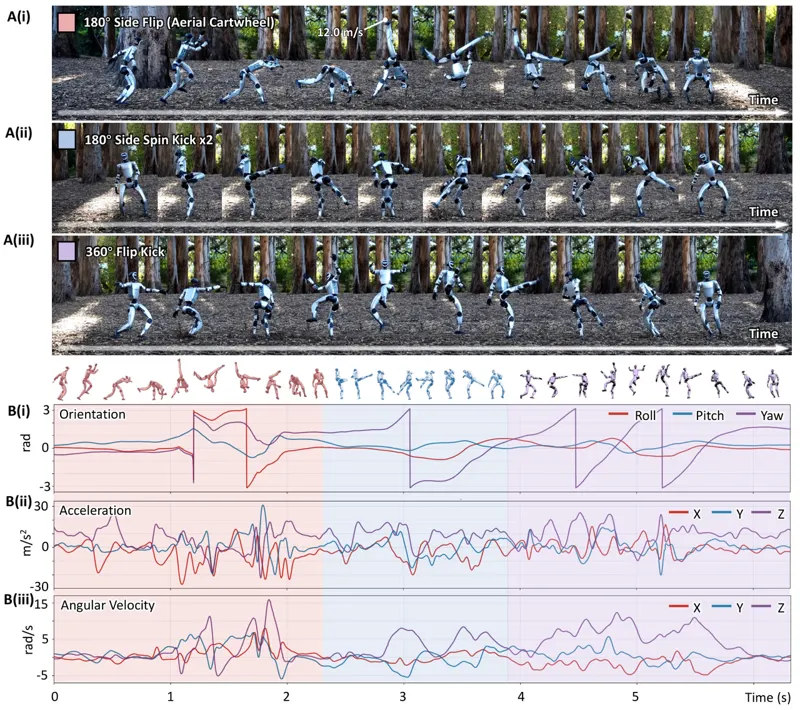
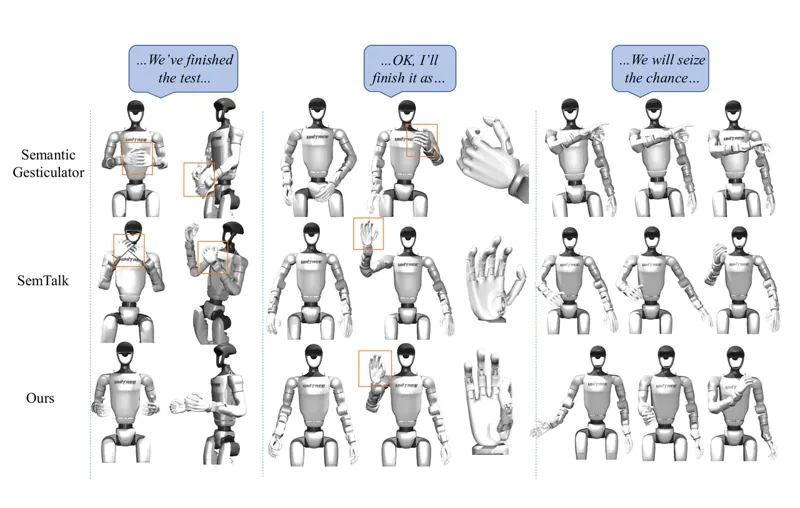
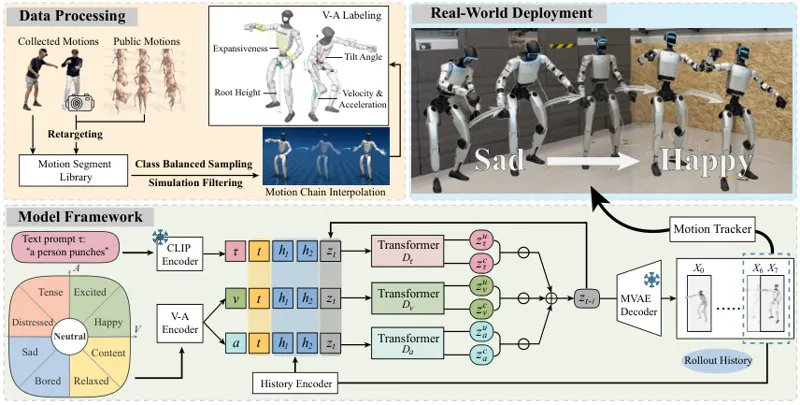
Enabling humanoid robots to respond to human speech with synchronized and semantically meaningful gestures is fundamental to natural human-robot interaction. However, this task faces three critical barriers: the scarcity of semantically rich datasets, the "modality eclipse" where models ignore audio cues in favor of kinematic inertia, and the sim-to-real gap regarding physical safety. We propose RoboGesture, a robot-centric framework that co-designs data, modeling, and control to power a complete interactive human-humanoid system in which the robot listens, responds, and gestures in real time. We first establish the RoboGesture dataset featuring over 300 gesture categories and develop an automated pipeline to synthesize large-scale collision-free, robot-specific audio-motion pairs. Our architecture features a Hierarchical Semantic-Acoustic Aligner that extracts multi-granular prosodic and semantic cues directly from raw audio tokens. These cues drive a Streaming Conditional Motion Generator based on a diffusion transformer with conditional flow matching. To ensure high responsiveness, we introduce Anti-Inertia CFG Masking, which prevents the model from collapsing into repetitive historical patterns by compelling it to proactively mine control signals from the audio modality. Finally, an MPC-based safety filter ensures real-time, collision-free execution on physical hardware. Experiments on a Unitree G1 humanoid demonstrate that RoboGesture generates safer, more rhythmic, and more semantically appropriate responses compared to state-of-the-art baselines.

Wang, Zifan, Ren, Ziang, Shi, Pengyang · 1.5k views · Aug 27, 2026
MPCSim-to-Real
Aug 27, 2026


Learning Adaptive Safety Margins for Visual Navigation

Learning Adaptive Safety Margins for Visual Navigation

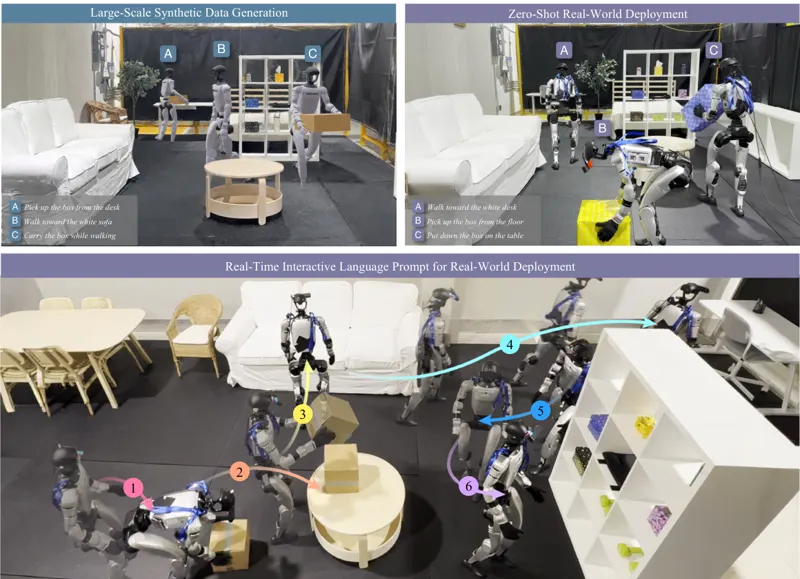
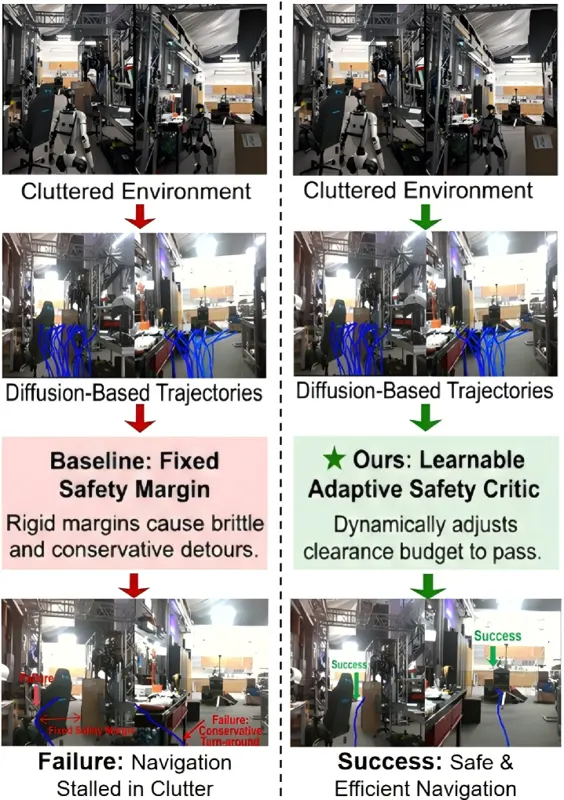
Robots in cluttered indoor spaces often fail not because they cannot generate collision-free paths, but because a fixed safety margin is mis-calibrated: conservative margins cause detours and timeouts, while permissive margins lead to near-boundary shortcuts under perception bias. Diffusion-based planners propose diverse trajectory candidates from egocentric RGB-D, yet reliable selection remains the bottleneck. We propose a context-conditioned safety critic that learns an adaptive clearance preference for ranking diffusion proposals, decomposed into three complementary terms: (i) a safety term with a clearance-budget penalty and a control-barrier-function residual for waypoint- and transition-wise safety, (ii) an efficiency term combining a smoothness penalty with a safety-gated detour-ratio penalty that avoids detours without incentivizing risky shortcuts, and (iii) a distance-constraint matching term that anchors the learned budget to realized ESDF clearances to prevent margin collapse. We train the critic with privileged ESDF geometry in simulation and distill it into a perception-only selector via a two-stage teacher-student procedure. On PointGoal navigation in HM3D and MP3D, including cross-dataset transfer, our method achieves the highest success rate (SR) and success weighted by path length (SPL) among strong diffusion, optimization, and RL baselines. Trained purely in simulation, it transfers to a Unitree G1 humanoid and navigates cluttered indoor scenes without task-specific tuning.

Junyi Hu, Shuaihang Yuan, Geeta Chandra Raju Bethala · 413 views · Jul 20, 2026
Visual navigationSafety Margin
Jul 20, 2026

As an Amazon Associate, we earn from qualifying purchases.