Skip to content
Tags
GigaBrain-0.7: Scaling Embodied Foundation Models to Emergent Capabilities with a Three-System Architecture

GigaBrain-0.7: Scaling Embodied Foundation Models to Emergent Capabilities with a Three-System Architecture

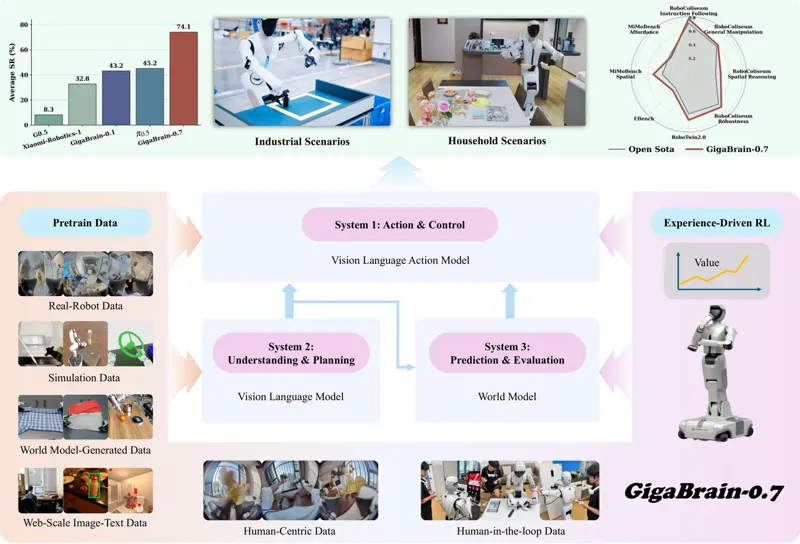
Vision-language-action (VLA) models have become a dominant paradigm for generalist embodied agents, demonstrating strong complex and long-horizon task completion in structured settings. Yet it remains an open question whether current VLA systems can benefit from more effective architectural design, scale to substantially larger and more heterogeneous data regimes, and achieve broader generalization across tasks and embodiments. To this end, we present GigaBrain-0.7, an embodied foundation model with substantially improved generalization across diverse robot embodiments. Specifically, GigaBrain-0.7 unifies understanding, prediction, and action through a three-system architecture, scales pretraining to over 37,000 hours of heterogeneous embodied data, and introduces one-stage alignment training that jointly optimizes vision-language understanding and multi-embodiment action generation. Compared with the preceding GigaBrain-0 series and prior state-of-the-art models including π_0.5, GigaBrain-0.7 achieves substantial improvements in foundation zero-shot capabilities, language-conditioned instruction following, and post-training task success rates. In particular, on our in-house Maker H01 platform and mainstream robot embodiments, GigaBrain-0.7 demonstrates strong task adaptability and completion ability across both home and industrial scenarios. All training code and pretrained model weights will be released.

GigaBrain Team, Angen Ye, Axiang SunAug 16, 2026
VLAGigaBrainFlow MatchingAug 16, 2026
TemporalFlow-VLA: Learning Physically Grounded Execution History for Long-Horizon Robot Manipulation

TemporalFlow-VLA: Learning Physically Grounded Execution History for Long-Horizon Robot Manipulation

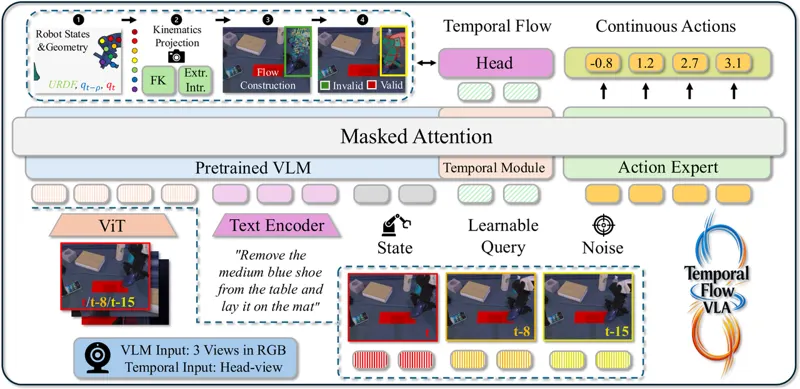
Vision-language-action (VLA) models leverage pretrained vision-language representations for robot control, yet simply adding historical frames does not reliably capture recent physical change. This is especially problematic in multi-stage manipulation, where visually similar states may require different actions depending on prior execution. To address this challenge, we present TemporalFlow-VLA, which learns compact execution history through physically grounded temporal supervision. Using recorded robot states, robot geometry, and calibrated cameras, we construct robot-surface temporal flow as a training-only target and supervise two execution-aligned temporal queries that provide structured history to the action expert. The geometric supervision path is not evaluated at deployment. TemporalFlow-VLA achieves 97.63 +/- 0.26% average success on LIBERO, including 96.60 +/- 0.87% on LIBERO Long, and 85.5%/84.2% Clean/Randomized success across 12 RoboTwin tasks. It shows its clearest advantage over prior methods on longer-horizon, multi-stage manipulation. Controlled history interventions show that action prediction depends on both historical content and temporal order. With asynchronous feature caching, temporal conditioning maintains single-frame-level server-side sampling latency without additional historical-encoding overhead. Overall, TemporalFlow-VLA provides a compact, physically grounded interface for exploiting ordered execution history without explicit motion estimation or geometric processing at deployment.

Jiarui Yang, Yehao Lu, Yuning SuAug 27, 2026
VLATemporal FlowLong-Horizon ManipulationAug 27, 2026