Skip to content
← Tags

#Agent Memory (10)

Large Language Models Do Not Always Need Readable Language

Large Language Models Do Not Always Need Readable Language

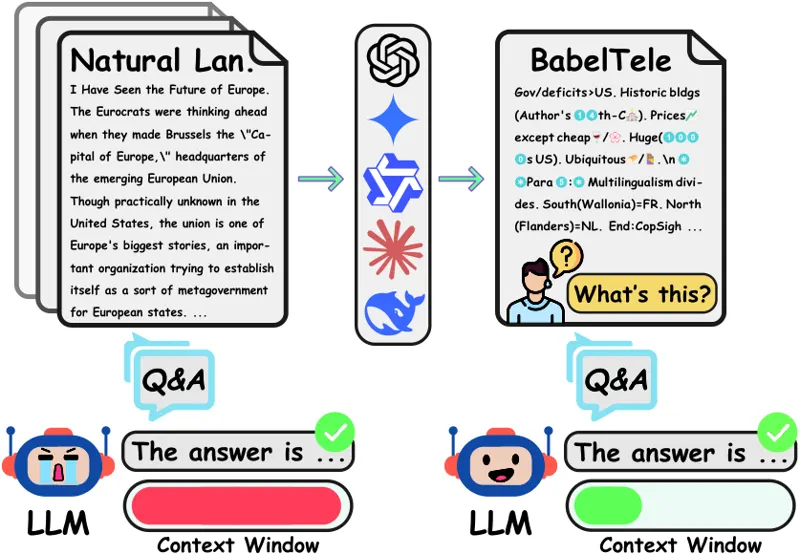
Large language models (LLMs) are commonly prompted and interfaced with human-readable natural language, even when the intended reader is another model. This paper investigates whether semantic information can be encoded in compact, non-standard textual forms that sacrifice human readability while remaining recoverable by LLMs. We refer to this class of model-centric textual representations as BabelTele, approached here not as a fixed protocol but as an empirical probe into LLMs' capacity to generate and interpret such representations. Through readability diagnostics, model likelihood measures, human questionnaires, and downstream task evaluations, we find that BabelTele can substantially depart from ordinary natural language while preserving core semantics for instruction-tuned LLMs. As a task-agnostic representational paradigm, BabelTele demonstrates high information density, maintaining 99.5% semantic fidelity even when the text volume is condensed to 27.9% of its original length. We further evaluate its semantic robustness in cross-model transfer, agent memory, and multi-agent communication. Results suggest that BabelTele can reduce context overhead while generally maintaining reliable downstream performance, although its effectiveness depends on the compressor-reader pair and task setting. These findings indicate that human readability, natural-language typicality, and model-side semantic recoverability can be partially decoupled, opening a path toward model-native representations in future exploration of LLM systems.

Jiayi Zhu, Haoxuan Peng, Junxi Wang · 15 views · Jun 18, 2026
LLMContext Compression
Jun 18, 2026
Memory Tax: Dissecting the Net Value of Agent Memory

Memory Tax: Dissecting the Net Value of Agent Memory

Memory is increasingly used in long-horizon agents, yet the net value of building memory over direct retrieval from raw history remains largely unclear. Through a large-scale evaluation across multiple benchmarks and model backbones, we find many dedicated memory systems underperform naive RAG in many cases, indicating a negative net value. Taking RAG as a reference, we dissect the net value of memory into the gains and losses over direct retrieval, termed memory benefit and memory tax. These gains and losses arise because memory process changes how the raw information is organized and accessed. We view such changes as the double-edged deviations from the raw history. They are originally designed and introduced to benefit the task, for example by reorganizing facts or distilling preferences, but some may also remove or obscure evidence, giving rise to memory tax. Since memory benefit reflects the expected gains of its design, we then focus more on the overlooked memory tax, study how it arises from the system and evaluation side, and generalize the concept to more application scenarios of memory. We hope the notion of memory tax can provide a new lens and shift more attention from standalone performance to the net value of memory, informing more reliable memory designs and evaluations. We will open-source the code and results to the community. Project Page: https://hexuan21.github.io/MemoryTax/

Xuan He, Sining Zhoubian, Ruozhen Yang · 524 views · Oct 25, 2026
Agent MemoryLong-Term Memory
Oct 25, 2026

As an Amazon Associate, we earn from qualifying purchases.