
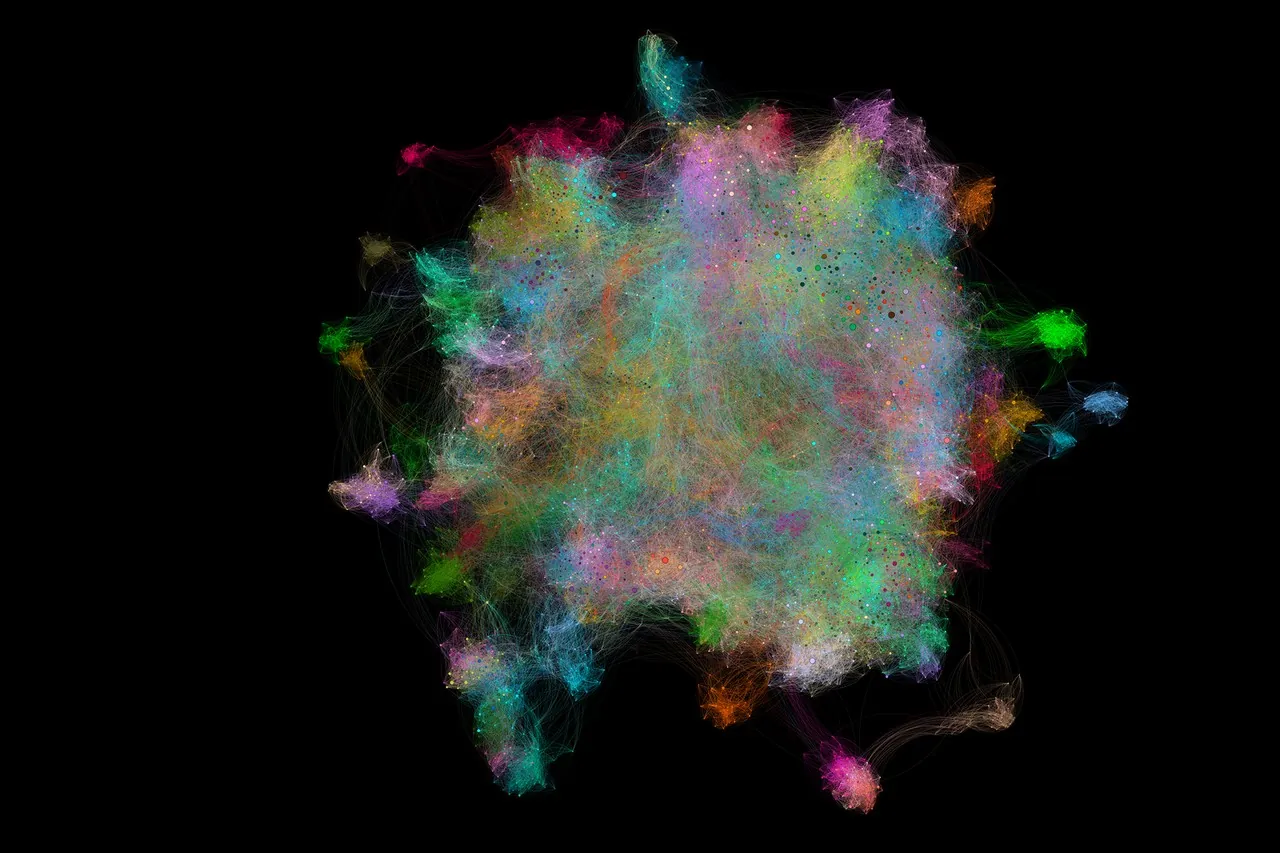
The evolution of GraphRAG: Advancing systems and evaluation together
Microsoft Research traces GraphRAG from dataset-wide sensemaking to sub-second GraphRAG Zero, pairing every system advance with evidence-focused evaluation in BenchmarkQED.
AI agents do not fail only because their models are weak. They also fail because the information they receive is fragmentary. A conventional retrieval system can find passages that resemble the wording of a question, but an agent often needs something more demanding: the relationships among people, events, claims, documents, and prior decisions, assembled quickly enough to support the next action.
This is the problem addressed by GraphRAG Zero. It is the latest stage in a research line that began with whole-dataset sensemaking and moved through cheaper local and global search toward representative context prepared at interactive speed. Its development has advanced alongside a second line of work, BenchmarkQED, because every efficiency gain raised the same question: once retrieval becomes cheaper and faster, how do we know that it still preserves the evidence that matters?
GraphRAG Zero and the context problem facing agents
At a glance
- GraphRAG Zero supplies connected context that agents can build and refresh continuously at interactive speed.
- The system is the result of years of research that turned graph-based retrieval from an experimental technique into deployable infrastructure for applications and agents.
- GraphRAG Zero is available as an option in Foundry IQ, built on Azure AI Search, allowing developers and customers to use graph-guided retrieval at scale.
- Microsoft Discovery has committed to adopting GraphRAG Zero through Foundry IQ for scientific research. GitHub Next's Repo Mind Light uses it to connect issues and pull requests with live code and documentation.
- The progression from dataset-wide sensemaking to interactive retrieval has lowered cost and latency while retaining access to relevant, representative evidence.
- The original GraphRAG paper has 3.9 thousand citations since April 2024, and the open-source repository has more than 36 thousand GitHub stars.
AI agents need more than text excerpts that happen to match a prompt. Complex questions require retrieval that preserves structure: which facts belong together, which claims support one another, where evidence came from, and what remains unresolved. The need grows as AI systems generate more material than people can inspect directly.
GraphRAG represents that structure. Its earlier versions made whole-corpus questions practical but required substantial language-model processing. GraphRAG Zero changes the operating point. It removes language-model calls from indexing and can also be configured to retrieve context without them at query time. Retrieval is driven by the geometry of text embeddings, yielding sub-second context preparation for the final response model.
From a research library to a systems-and-evaluation programme
Microsoft Research shared the first GraphRAG research and open-source library in 2024. It introduced a way to ask questions that conventional retrieval-augmented generation handled poorly. Instead of returning isolated facts or passages, GraphRAG could support questions about themes, patterns, and implications across an entire document collection.
Its influence went beyond adoption of the library. GraphRAG helped move the field's attention from finding relevant passages toward organizing connected evidence for reasoning over a corpus. New research methods, open-source implementations, and industry tools now explore this design space. The method was also included in Gartner's Hype Cycle for Generative AI.
Inside Microsoft, the public release was a starting point rather than an endpoint. Collaborations pushed the work toward lower construction cost, faster responses, and new ways to use organizational knowledge. Each change created an evaluation problem: a cheaper system might still look good on answer preferences while quietly losing breadth, provenance, or representativeness.
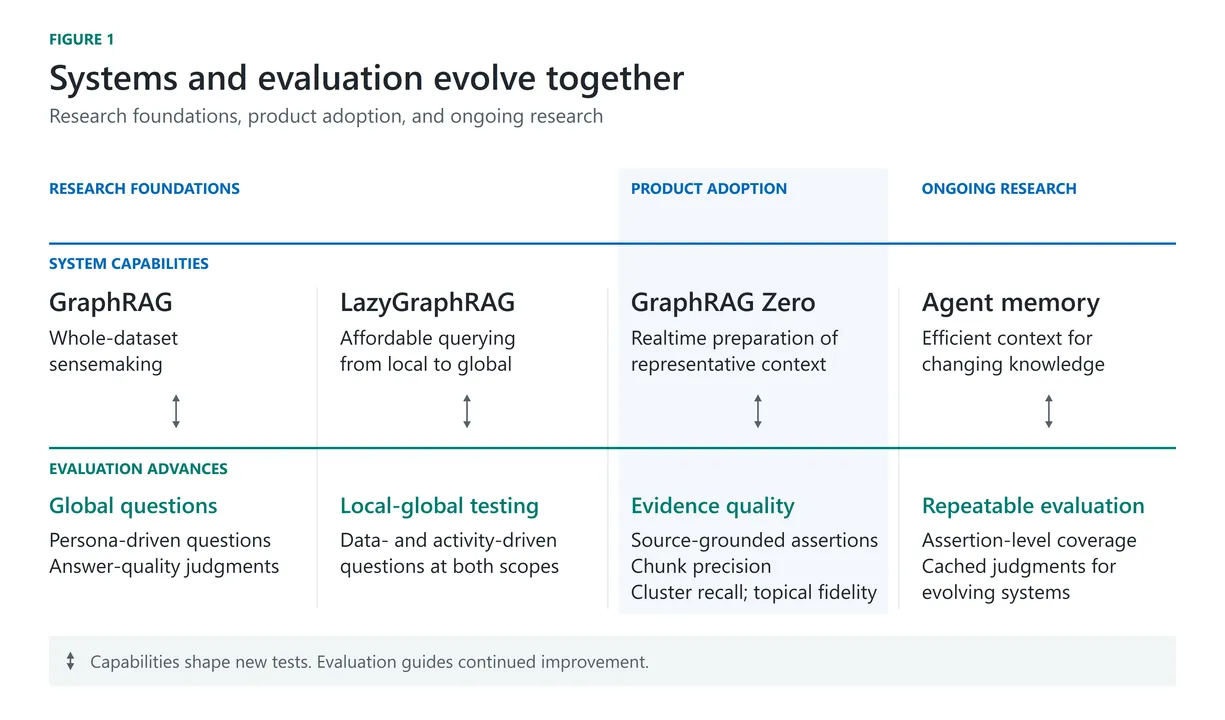
The response was to develop systems and evaluation together. Successive GraphRAG generations were paired with BenchmarkQED, an open-source framework for automated query synthesis, evaluation, and dataset curation. The pair eventually brought GraphRAG Zero into production systems.
GraphRAG Zero is now an option within Foundry IQ. Microsoft Discovery plans to use it through Foundry IQ to support scientific research. Repo Mind Light, a GitHub Next tool for repository understanding, ships with GraphRAG Zero and is available as a public container integrated with GitHub Agentic Workflows. It combines graph retrieval over issues and pull requests with live retrieval of code and documentation, giving people and coding agents context for questions about architecture, ownership, and the reasoning behind earlier decisions.
The source article includes an overview video, The evolution of GraphRAG, and a separate first-generation GraphRAG demonstration.
Cheap and current context also makes it easier to verify what an agent produces. VeriTrail works across RAG systems that have source data and context-driven outputs. It detects hallucinations and traces where unsupported content entered the pipeline, as well as how faithful generated material remains to its source.
The story of these systems and their evaluation began before the team thought of the problem as retrieval-augmented generation at all.
The research behind GraphRAG Zero
From intelligence analysis to global sensemaking
In 2023, the team did not set out to build a RAG system. The goal was to explore how generative AI could help people make sense of large bodies of data. Earlier research had applied intelligence-analysis methods to business intelligence, search recommendation, cybercrime investigation, and news provenance. A broader human-rights technology programme addressed related problems: connecting evidence to action, exposing corruption risk, and helping organizations counter human trafficking.
Graphs appeared in all of these settings. They connected search queries through navigation paths, linked fraudulent operations through shared signals, and revealed reused text across news stories. Language models suggested a more general approach: extract entities and relationships directly from unstructured text.
The first concrete use case came from an internal threat-analysis partnership. Analysts needed to integrate, navigate, and interrogate years of reports as one body of knowledge. They wanted collection-wide patterns without losing the ability to trace every claim back to its source.
The team followed Ben Shneiderman's information-seeking principle, "Overview first, zoom and filter, then details on demand." Analysts first needed to understand the shape of their data before they could formulate precise questions. The system identified communities of closely related entities and used language models to summarize the associated evidence. Those community reports supplied collection-level overviews from which users could explore further.
The same structure supported questions at multiple scales. Local questions could draw on detailed entity and relationship descriptions. Global questions could be answered by synthesizing across community reports. This movement between specific evidence and dataset-wide understanding became the foundation of GraphRAG.
The first generation of GraphRAG
The first-generation index supported both direct exploration and question answering. Entity descriptions, relationship descriptions, and community reports were valuable analytical artifacts in their own right. Building them, however, required substantial language-model work, even for applications that mainly wanted to answer questions.
This cost created a design tension. The graph representation was useful precisely because it organized evidence beyond raw passages, but producing a rich semantic graph for every dataset could be expensive. The next system needed to preserve the useful structure while reducing the model effort required to build and refresh it.
Evaluating a new class of questions
Global sensemaking also required a new kind of benchmark. A question such as "What are the main risks discussed across these reports?" has many reasonable answers. A benchmark that checks retrieval of individual facts cannot establish whether a system represented the breadth of relevant evidence.
The initial evaluation therefore defined three answer qualities:
- Comprehensiveness: the extent to which an answer covers relevant aspects and details.
- Diversity: the range of perspectives and insights the answer provides.
- Empowerment: how much the answer helps a reader understand the material and make an informed judgment.
Using an LLM-as-a-Judge approach, the researchers compared pairs of answers on each quality. They also developed activity-based query synthesis for arbitrary datasets. Given a collection description, a language model identified representative users and activities, then generated questions that required understanding the collection as a whole. Evaluation was tied to realistic activity rather than to facts selected in advance by a benchmark author.
These methods became the basis of BenchmarkQED. Its AutoQ component synthesizes activity-based queries steered by personas and their tasks. Its evaluation tools compare RAG capabilities, answer quality, and cost.
Reducing the cost of global understanding
The first extension of GraphRAG reduced indexing cost by building a concept co-occurrence graph with conventional natural-language processing, then generating community reports from the associated source text. This capability is available as the fast indexing option in the Microsoft GraphRAG library.
The second-generation system, LazyGraphRAG, went further by deferring all generative-model use until query time. A lightweight graph organized the data, while language-model reasoning concentrated on evidence needed for the current question. In the reported evaluation, indexing cost fell to 0.1 percent of full GraphRAG. Keeping source text intact until query time also preserved details that repeated summarization might erase.
The next goal was one approach for questions anywhere on the local-to-global spectrum. AutoQ extended activity-based global questions along two dimensions: source, meaning whether a question came from the data or a representative activity; and scope, meaning local or global. The resulting four classes were data-local, activity-local, data-global, and activity-global.
The team generated 200 questions across those classes for a collection of nearly 1,400 news articles. LazyGraphRAG achieved higher aggregate answer-quality win rates across all four classes than comparison methods using the same generative model. The evaluation also revealed the relative strengths of specialized techniques: vector retrieval performed well on local questions, GraphRAG Global Search performed well on global questions, and combinations covered the full spectrum more effectively.
These methods reached several deployment settings. Microsoft Discovery's use of GraphRAG and LazyGraphRAG for scientific research established the background for its commitment to GraphRAG Zero through Foundry IQ. Across Microsoft, work in threat intelligence, incident investigation, engineering, science, and organizational knowledge continued to define requirements for cost, latency, and evidence quality.
| Generation | Main advance | Evaluation response |
|---|---|---|
| GraphRAG | Whole-dataset sensemaking through entities, relationships, and community reports | Persona-driven global questions and pairwise answer-quality judgments |
| LazyGraphRAG | Deferred language-model work until query time, reducing indexing cost | Data and activity questions tested at both local and global scope |
| GraphRAG Zero | Embedding-derived graph for sub-second representative context | Source-grounded assertions plus chunk precision, cluster recall, and topical fidelity |
| Agent memory research | Efficient context for knowledge that changes during agent activity | Graded assertion coverage and reusable assertion-chunk judgments |
Evaluating GraphRAG Zero: from answers to evidence
LazyGraphRAG lowered preparation cost by moving model work to query time. The resulting delay before answer generation still limited interactive use. GraphRAG Zero addresses that delay with an embedding-derived graph that assembles relevant, representative context. In its real-time configuration, generative-model processing is reserved for the final response. The research results reported below explain the approach behind the product release; Microsoft Research explicitly notes that they are not measurements of the Foundry IQ service.
Answer preferences alone cannot separate better retrieved evidence from better organization or writing. The team therefore wanted to measure both relevant diversity, meaning varied query-relevant content, and representative diversity, meaning coverage that reflects the topical structure of the relevant data. They also needed to measure whether the answer model could use that evidence.
AutoQ's data-driven query synthesis generated source-grounded assertions together with questions. The same source material established what a correct answer should contain. For local, linked multi-hop, and global queries, those assertions became testable requirements. Thematic assertions for global questions could also be linked to supporting facts.
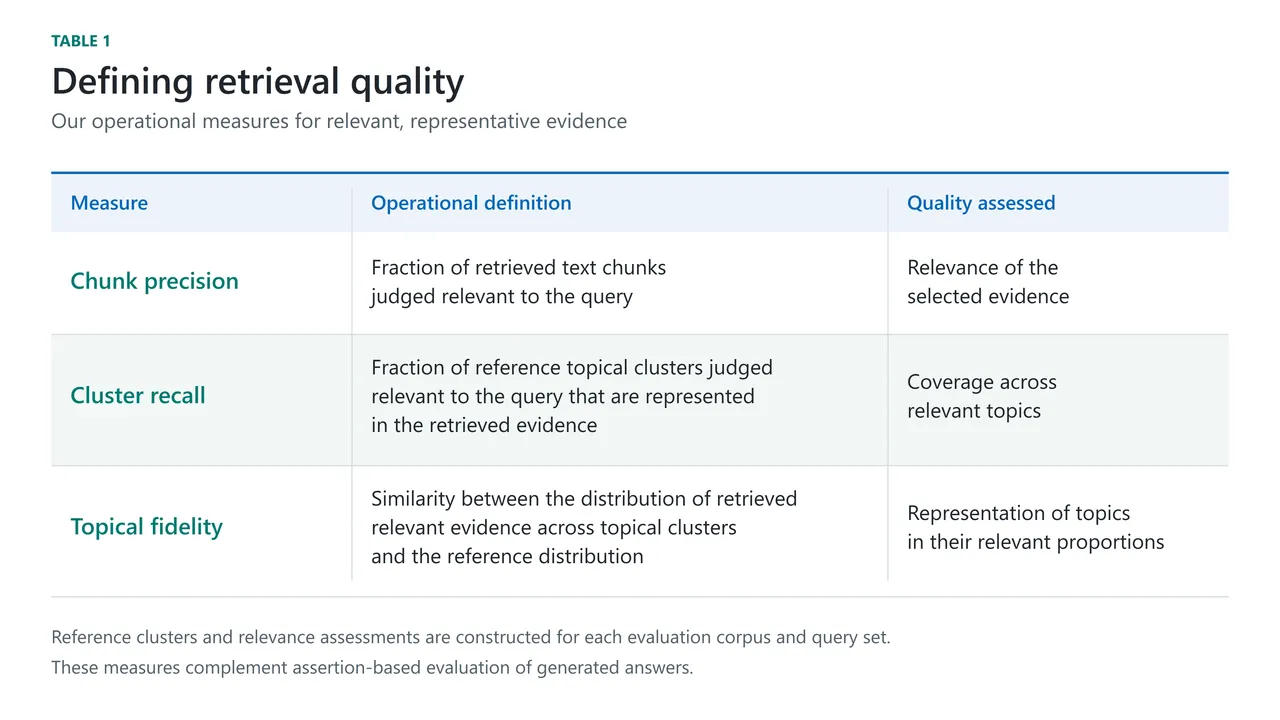
Answer-level checks were complemented by relevance-based retrieval measures. An LLM judged source chunks, allowing the context to be assessed independently of the generated answer. Table 1 below summarizes the three operational definitions. Precision uses judged chunks as its unit. Cluster recall uses relevant topical clusters, so it measures breadth rather than conventional document-level recall. Topical fidelity compares the distribution of retrieved relevant evidence across clusters with the reference distribution.
The GraphRAG Zero study applied these measures to podcast transcripts and news articles using 200 synthetic questions, split equally between multi-hop and global queries. At a retrieval budget of 50 chunks, global answer assertion coverage increased from 53.4 percent with vector RAG to 57.4 percent with GraphRAG Zero. Both systems used the same embedding model and answer generator and produced one response per query.
GraphRAG Zero prepared answer context in an average of 0.93 seconds, including query embedding but excluding answer generation.
Sub-second retrieval changes the experience of asking a question. LazyGraphRAG and deep-research-style workflows can spend a minute or more gathering and analyzing evidence. GraphRAG Zero allows answer generation to begin almost immediately. That is the practical meaning of "Zero": retrieval moves at the pace of an interactive conversation, with no mandatory model call required for the retrieval stage.
The study also exposed a tradeoff that a single relevance score would hide. GraphRAG Zero achieved higher cluster recall and topical fidelity, while vector RAG retained higher chunk precision. In other words, more representative evidence supported more complete global answers even when a smaller fraction of individual chunks looked directly relevant. The result helps explain why chunk precision alone is insufficient to guide retrieval design.
Optional reasoning extensions can improve global answer coverage with additional model processing. GraphRAG Zero is already used widely across Microsoft, and its release through Foundry IQ and Repo Mind Light brings the research direction to more application and agent workflows, where retrieval quality must be balanced against latency, cost, and ease of use.
What comes next for GraphRAG Zero
GraphRAG Zero is a foundation for the next phase rather than the end of the programme. Its adoption creates opportunities to learn from real application requirements and to evaluate improvements in context. The team is also investigating complementary methods for changing agent knowledge, broadening the choices available to workloads with different retrieval needs.
Context for changing agent knowledge
For an agent, retrieved context may support an intermediate interpretation, a planning step, or a decision about what to investigate next. The underlying data also changes through the agent's activity: documents and code are updated, observations accumulate, and earlier conclusions become inputs to later work.
The ongoing research studies how to prepare useful context efficiently as knowledge changes. It must support both ordinary question answering and the repeated retrieval agents perform. The design space includes configurations that work with or without embeddings, so applications can choose methods suited to different workloads.
To evaluate this work, the team uses BenchmarkQED's data-driven questions and assertions to measure graded evidence coverage. An LLM judges each chunk's support for an assertion as full, partial, or absent, represented by scores of 1, 0.5, or 0. The system takes the best support across retrieved chunks, then averages across assertions within each query and across queries.
Repeating the same evidence earns no extra credit. Supplying support for a fact that was missing does. The measure therefore focuses on whether the retrieved context contains the required content, rather than giving the answer generator credit for making the best of incomplete evidence.
WikiKB from GitHub Next already applies this direction to a repository-native knowledge base for people and agents. Knowledge is stored as reviewable Markdown with provenance and Git history, while indexing and retrieval run locally. People and agents can inspect, maintain, and reuse project knowledge in the same working environment.
Reusing evidence in loop engineering
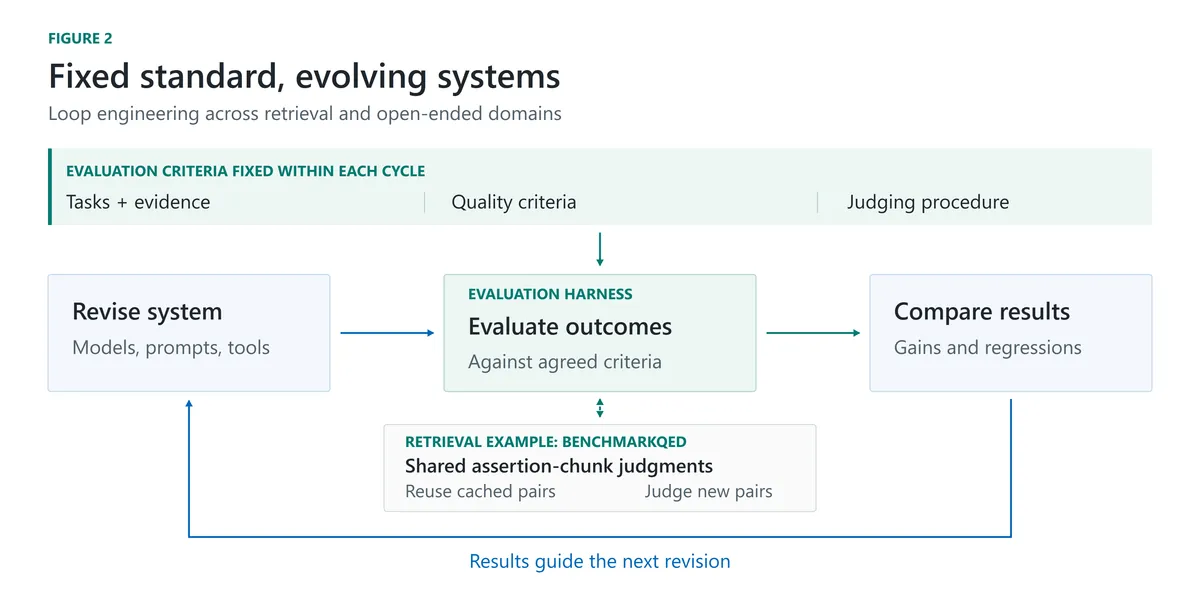
Loop engineering turns evaluation into a repeated cycle: revise a system, test it against a fixed standard, and use the result to guide the next revision. BenchmarkQED's chunk-level assertion evaluation is designed for this pattern. Datasets, questions, assertions, and judging procedures remain fixed within a cycle. Cached assertion-chunk results can then be reused across system versions, with new judgments required only for evidence that was not assessed before.
This makes repeated retrieval testing more economical while preserving a common basis for measuring progress and detecting regressions. The figure below shows the cycle from system revision to evaluation to comparison, with evidence judgments reused where they remain valid.
Early results from loop engineering are also appearing in open-ended domains as different as game development and graph layout. Evaluating qualities such as novelty and depth requires more than predefined correctness tests. Deciding how to recognize meaningful progress is part of designing the loop itself.
Looking back, each GraphRAG advance followed the same pattern. A new capability exposed a gap in the way quality was measured, and closing that gap shaped the next system. GraphRAG Zero is a product of that loop. Current research makes the loop itself an object of study, asking how methods and evaluation metrics can co-evolve while preserving comparability within each development cycle.
With GraphRAG Zero deployed in Foundry IQ and Repo Mind Light, the loop widens again. Real applications will expose requirements that no current benchmark captures. BenchmarkQED is open source so teams can apply the same discipline to their own systems when measuring holistic reasoning over entire corpora. As retrieval becomes a foundation for agent reasoning and memory, progress cannot be assumed. It has to be measured at every iteration.
Source: "The evolution of GraphRAG: Advancing systems and evaluation together" by Darren Edge, Jonathan Larson, Cencheng Shen, and Ha Trinh, Microsoft Research, November 17, 2026. Figures and tables reproduced from the original article.