Skip to content
Tags

#Action chunking (6)

IMLE-VLA: Fast Single-Step Action Generation for Vision-Language-Action Policies

IMLE-VLA: Fast Single-Step Action Generation for Vision-Language-Action Policies

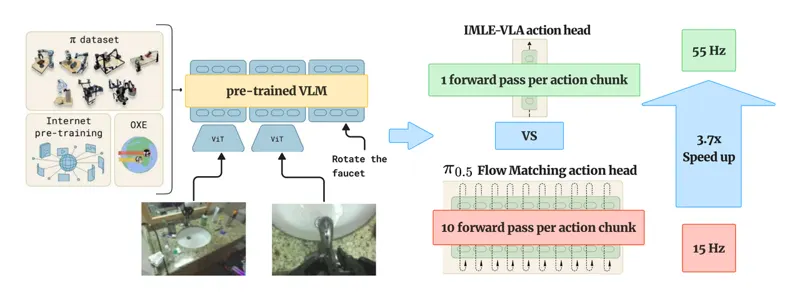
Vision-language-action (VLA) policies leverage pretrained vision-language backbones to achieve strong cross-task generalization. A leading design couples this backbone with a dedicated continuous action head trained via diffusion or flow matching. However, such heads rely on iterative multi-step sampling, for example 10 Euler steps in π_0.5. This creates an inference bottleneck that produces stop-and-go movement in the robot and slower task completion. We introduce IMLE-VLA, which replaces the iterative action head with a single-step conditional generator trained via conditional Implicit Maximum Likelihood Estimation (cIMLE). The cIMLE objective promotes multimodal action coverage, avoiding the mode collapse of naive regression heads while eliminating multi-step sampling entirely. When IMLE-VLA is applied to π_0.5, it increases inference frequency 3.67x (55 Hz vs. 15 Hz), enabling up to 11x higher action throughput. On the 40-task LIBERO benchmark, IMLE-VLA achieves the highest average success rate (98.0%) among all baselines while leading in inference frequency. Under the test-time perturbations of LIBERO-plus, IMLE-VLA retains π_0.5's robustness while other baselines degrade sharply, confirming that the cIMLE head preserves generalization. Real-world experiments on a Franka Emika Panda across four tasks demonstrate smoother motion (2.2x to 3.0x lower jerk) and faster task completion, with IMLE-VLA outperforming π_0.5 on every task and reducing average VLA inference time per episode by 3.9x to 6.6x. Videos and code are available at https://kianhk6.github.io/IMLE-VLA/
Hosseinkhani, Kian, Peng, Qinhe, Shramko, GeorgeSep 10, 2026
VLAEfficient InferenceSingle-Step Action GenerationSep 10, 2026
VLA-Corrector: Lightweight Detect-and-Correct Inference for Adaptive Action Horizon

VLA-Corrector: Lightweight Detect-and-Correct Inference for Adaptive Action Horizon

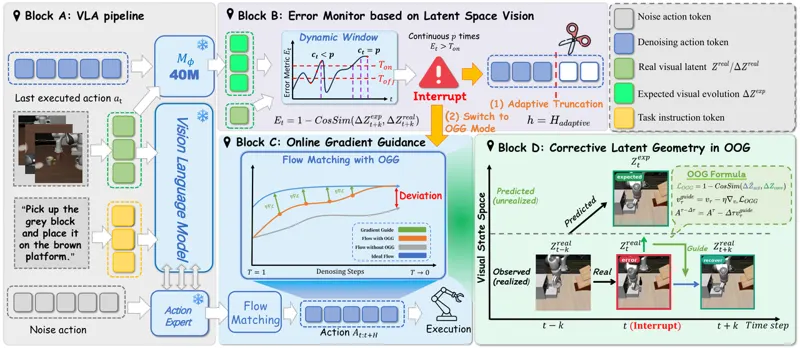
Vision-Language-Action (VLA) foundation models have recently achieved strong progress in embodied intelligence. To reduce policy-call frequency while preserving temporal coherence, most generative policies adopt an action chunk mechanism, executing multiple future actions in an open-loop manner under a fixed action horizon. However, this "predict-then-blindly-execute" paradigm sacrifices closed-loop reactivity: in contact-rich physical interactions, even small local perturbations can rapidly amplify within the open-loop blind spot, leading to compounding errors and ultimately task failure. To address this limitation, we propose VLA-Corrector, a lightweight corrective inference framework for action-chunked VLA policies. Without modifying the backbone policy weights, VLA-Corrector introduces a lightweight Latent-space Vision Monitor (LVM) that continuously compares predicted and actual visual feature evolution, enabling online detection of visual dynamics deviations. Once persistent deviation is detected, the system triggers a truncation event, discards the remaining stale actions, and invokes corrective replanning via Online Gradient Guidance (OGG). The detect-and-correct mechanism of VLA-Corrector naturally induces an event-triggered adaptive action horizon: it preserves long-horizon execution when the current chunk remains reliable, and invokes short-horizon corrective replanning when execution begins to drift. In doing so, VLA-Corrector mitigates the trade-off imposed by static horizons between execution robustness and policy-call frequency. It can be integrated into different VLA models without further retraining the VLA backbone, interrupting compounding errors while preserving much of the efficiency benefit of action chunking and substantially improving robustness in long-horizon, contact-rich robotic manipulation tasks.

Yi Pan, Miao Pan, Qi LuJul 2, 2026
VLARobotic ManipulationAction chunkingJul 2, 2026
Why Does Action Chunking Improve Behavioral Cloning Performance in Robotic Control?

Why Does Action Chunking Improve Behavioral Cloning Performance in Robotic Control?

Action chunking—predicting and executing multiple actions instead of a single action—has proven to be a critical component for learning effective robotic control policies. However, our precise understanding of why action chunking improves performance has remained limited. In this work we seek to close this gap. Through rigorous experimental evaluations in both simulated and real-world settings, we show that existing hypotheses for the success of action chunking—temporal consistency, horizon reduction, and representation learning—fail to explain the success of action chunking. Instead, we find that action chunking benefits from greater non-Markovian expressivity and reduced compounding error compared to Markovian policies, but, in many settings of interest, these effects can be fully captured by delayed policies, which at each step predict a single action based on the observation k steps in the past. We then show that there exists an additional benefit of action chunking that we refer to as implicit ensembling. In particular, by learning a diversity of temporal relationships (that is, aₜ | oₜ, aₜ | o_t-1, …), action-chunked policies exhibit behavior matching that of a model ensemble, increasing their robustness and generalization ability over policies that only learn a single temporal relationship. Building on these insights, we show that in simulated and real-world robotic control settings, we can match the performance of action chunking without action chunking—by deploying an action chunking policy as an ensemble of policies with randomized delays. Furthermore, we propose a policy class that amplifies the benefits of action chunking by explicitly instantiating an ensemble, and which we show significantly improves over the performance of action chunking in many domains.

Filippo Lazzati, Kyle Stachowicz, William ChenAug 3, 2026
FrankaAction chunkingBehavioral cloningAug 3, 2026