Skip to content
← Tags

#Navigation (38)

NavJev: Efficient Vision-Language Navigation via Action-Centric Visual Compression and Discriminative Action-Semantic Memory

NavJev: Efficient Vision-Language Navigation via Action-Centric Visual Compression and Discriminative Action-Semantic Memory

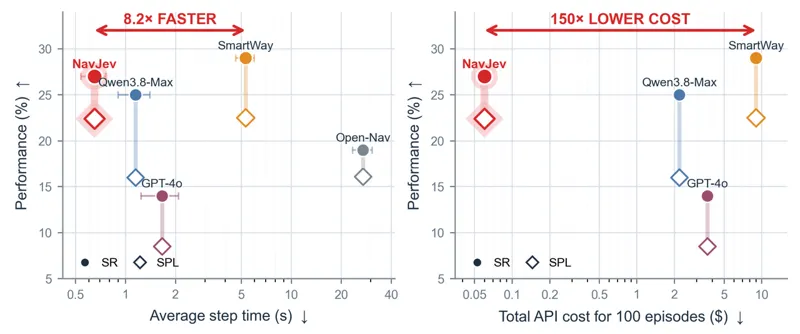
Recent zero-shot Vision-and-Language Navigation (VLN) methods increasingly rely on multimodal large language models (MLLMs) to reason over visual observations, navigation instructions, and candidate actions. Although effective, repeatedly invoking autoregressive multimodal reasoning at every navigation step introduces substantial inference latency, limiting the responsiveness of embodied agents. We propose NavJev, an efficient VLN framework that reformulates online navigation from repeated multimodal generation into compact visual compression followed by lightweight typed action selection. Specifically, Action-Centric Visual Compression (ACVC) integrates waypoint geometry, BLIP captions, and RAM semantic tags into compact representations of candidate actions, while Discriminative Action-Semantic Memory (DASM) filters shared semantics and maintains discriminative action-specific evidence across navigation steps. Based on these representations, Jev directly performs structured probabilistic decisions over the available action set. Experiments on R2R-CE show that NavJev achieves 27.0% SR and 22.4% SPL with only 0.65 s per navigation step, while substantially reducing inference latency and cost compared with MLLM-based VLN methods. The project page is available at https://kai-sheng-caesar.github.io/NavJev/.

Kai Sheng, Liuyi Wang, Jinlong Li · 278 views · Sep 28, 2026
Vision-language navigationZero-Shot
Sep 28, 2026
TANGO: Humanoid Navigation in Cluttered Environments with a Whole-Body Vision-Language-Action Model

TANGO: Humanoid Navigation in Cluttered Environments with a Whole-Body Vision-Language-Action Model

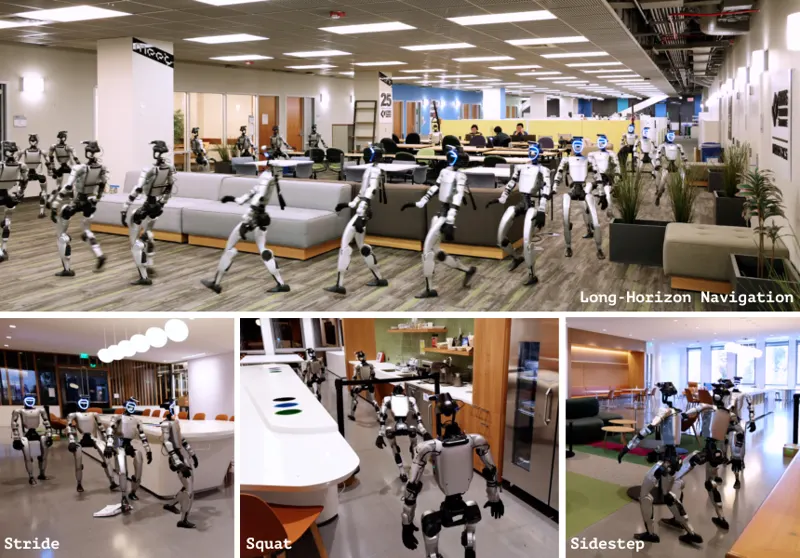
We study the problem of navigating cluttered indoor environments with a humanoid robot. Unlike conventional methods that model navigation as a 2D path planning problem, humanoid traversal in cluttered environments requires continuous geometry-aware whole-body adaptation, including coordinated arm placement, torso adjustment, and gait modulation for collision-free movement through complex 3D spaces. We introduce TANGO, the first whole-body vision-language navigation framework for language-conditioned humanoid traversal in cluttered environments. Given a natural-language instruction and egocentric RGB observations, TANGO directly predicts 29-DoF joint-space actions for downstream whole-body control. We train TANGO entirely in simulation by synthesizing diverse collision-free traversal behaviors via global path planning, kinematic whole-body motion generation, obstacle-aware motion editing, and RL-based tracking. This pipeline provides dynamically feasible action supervision for learning language-conditioned whole-body policies. In extensive simulation experiments, TANGO demonstrates state-of-the-art performance in vision-language navigation, while outperforming strong modular baselines in navigating challenging scenes requiring obstacle negotiation. Lastly, we deploy TANGO zero-shot on a Unitree G1 humanoid robot, and observe robust language-guided traversal in cluttered real-world scenes without training on any real-world navigation data.

Anqi Li, Yuxin Chen, Zhaobo Li · 1.2k views · Sep 8, 2026
HumanoidVLA
Sep 8, 2026

As an Amazon Associate, we earn from qualifying purchases.