
AGENT SKILL
DevelopmentLieflat Less AI Tone: evidence-led cleanup for Chinese drafts
larashero3-dotcom/lieflat-less-ai-tone
A report-first Chinese editing skill grounded in 629 comparison articles and 270 matched pairs, with an approval gate and information-preserving rechecks.
Editor's takeIts strongest feature is the editing brake: evidence first, explicit approval, minimal changes, then a recheck that protects facts and structure.
npx skills add larashero3-dotcom/lieflat-less-ai-toneMost cleanup prompts begin with a list of supposedly robotic words. That approach has a predictable failure mode: the writer removes a few phrases, the prose still feels mechanically assembled, and the model may damage perfectly good questions, headings, qualifiers, or sentence rhythm in the name of sounding human. Lieflat Less AI Tone takes the opposite route. It treats style cleanup as an evidence-led editing task with a mandatory approval gate, rather than an invitation for a model to rewrite the whole draft.
The important feature is the brake
This skill works on finished Chinese prose. It first runs a deterministic detector, then asks the current model to classify a bounded set of semantic candidates, and finally produces a diagnostic report with measured signals, research context, locatable examples, and proposed edits. The workflow stops there. The draft is not changed until the author replies that the proposed scope is accepted or supplies a different scope.
That pause is more than interface etiquette. Ordinary editing prompts combine diagnosis and rewriting in one generation, so a questionable detection can immediately become a destructive edit. This skill separates the recommendation from permission to act. It also prevents “make it sound human” from becoming a license to add opinions, remove qualifications, or manufacture sentence-length variation.
Once approved, each edit must map back to a named rule and an accepted recommendation. Facts, figures, names, dates, quotations, causal claims, and hedging language must remain traceable to the source. Headings, section order, paragraph order, lists, tables, quotations, and code blocks stay in place. Information preservation takes priority over style: a smoother paragraph that changes the evidence is not a successful edit.
Two research rounds instead of one intuition
The public research record contains two distinct studies. The first compared 629 articles: 300 generated by five models and 329 written by people, totaling about 2.83 million Chinese characters. It measured punctuation, vocabulary, syntax, and document geometry, then retained only rules that were frequent enough, stable across human comparison groups, and specific enough to produce an actionable edit.
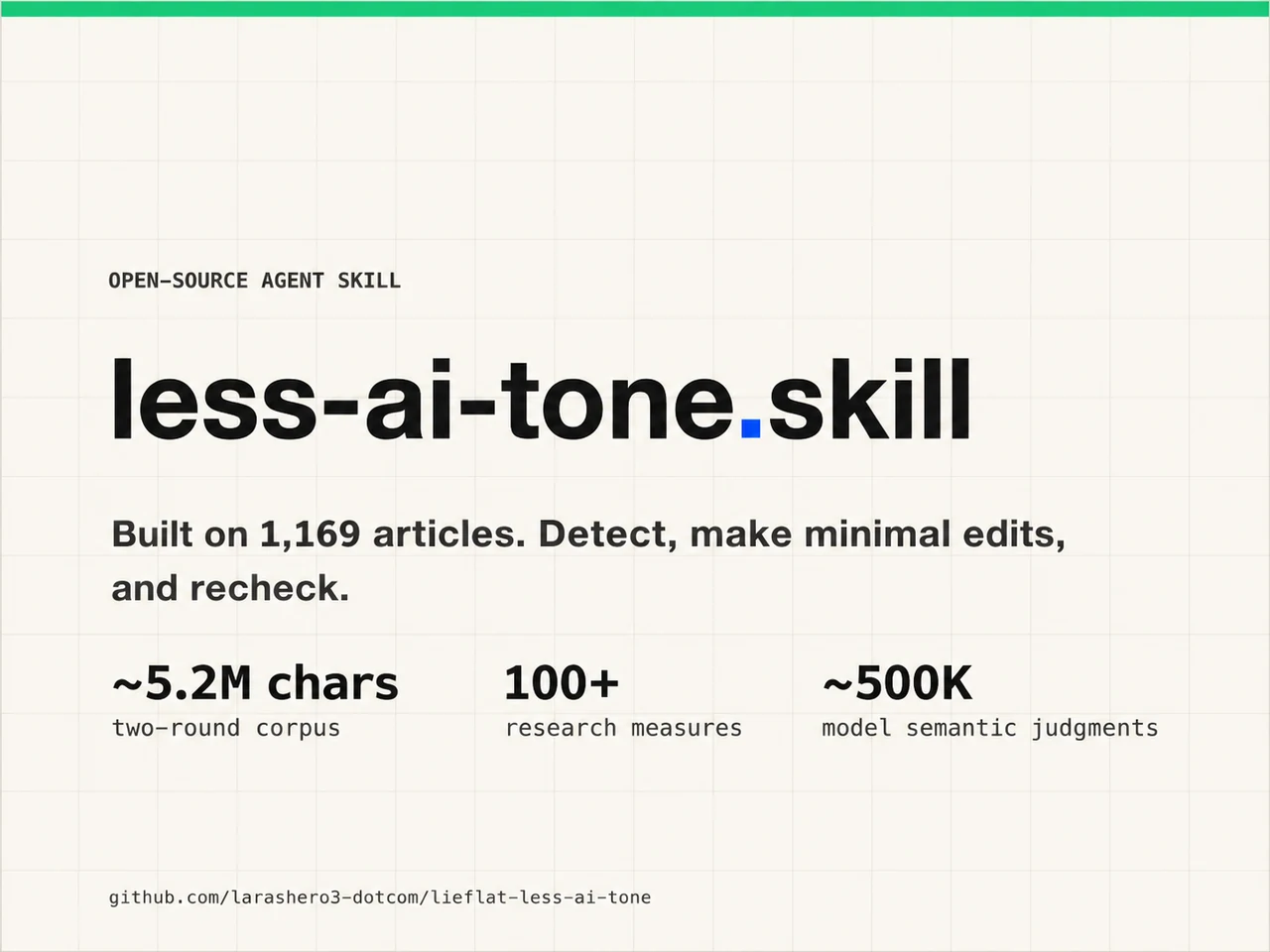
That design had a major weakness: topic and factual constraints differed between the two sides. The second round therefore converted facts from human articles into matched writing tasks and asked models to write under the same constraints. It produced 270 matched pairs, or 540 articles. The script layer evaluated 90 computable measures with paired tests and used an absolute Cliff's delta of at least 0.33 as the significance threshold. The semantic layer extracted candidates that regexes could not judge and accumulated roughly 500,000 model judgments. Across both rounds, the project reports 1,169 articles and about 5.2 million Chinese characters.
These figures support a useful distinction. Research-level significance can tell an editor which patterns deserve attention; it cannot establish that a particular draft was written by a model. The skill does not ask which system produced the text, does not infer authorship from punctuation, and labels a single local hit as a local hit rather than as statistical proof about the whole document.
The findings that survived replication
The strongest cross-model signal is a reversal construction that first denies one framing and then supplies another. In the matched round, the effect size was +0.88 for GPT and +0.72 for Opus. The lexical content can vary, but the underlying move remains recognizable: establish a misconception, then reveal the real claim. The recommended edit states the positive judgment directly while preserving the information carried by the rejected side.
| Measured pattern | Published result | Editing boundary |
|---|---|---|
| Deny-then-reframe syntax | GPT +0.88, Opus +0.72 | State the judgment; retain both sides of the information. |
| Dense enumeration | About 1.45 times the human rate | Do not compress rules, configurations, or complete inventories. |
| Adjacent and three-sentence isomorphism | About 1.6 times; highly isomorphic triples about 2.75 times | Break only a confirmed mechanical frame, without deleting content. |
| Conclusion-cue colon | About 2.1 times the human rate | Target explicit conclusion prompts; keep quotation and definition colons. |
| Over-smooth linkage and long premodifiers | Explicit linkage 98.9% vs. 95.2%; long modifiers GPT +0.48, Opus +0.54 | Allow natural topic jumps and split overloaded modifier chains. |
Even these replicated findings are not universal editing orders. A dense list can be the correct form for a policy clause, a product configuration, or a complete inventory. A repeated sentence frame can carry deliberate rhetoric or narrative progression. The skill asks the model to justify retention as well as action, which is important because silence is otherwise indistinguishable from an unreviewed false negative.
Model fingerprints are not universal defects
The study also found surface preferences that split sharply by model. Opus used em dashes at a much higher rate than the human comparison, with an effect size of +0.95; GPT moved in the opposite direction at -0.54. Semicolons showed the reverse split: +0.80 for GPT and -0.11 for Opus. Opus also used quotation marks less often, with a -0.67 effect size.
Those findings are fingerprints, not a collective definition of machine writing, and the skill explicitly forbids using them to identify an author or a model. They can still inform a local edit. A decorative dash may be removed if it only suspends a conclusion that could be stated directly, but the report must explain that specific function. A low quotation-mark count never justifies inserting quotes; quotation marks serve attribution, titles, and source marking, not a density target.
Script, semantics, and human review
The script layer counts punctuation, sentence-length distributions, lexical diversity, Europeanized constructions, section geometry, paragraph bridging, and other repeatable properties. The semantic layer handles four tasks that require context: synonymous renaming within a paragraph, overly continuous paragraph linkage, conclusion-cue colons, and highly isomorphic three-sentence groups. Human review is reserved for questions the models cannot settle reliably, especially whether a metaphor is apt. Because inter-model agreement on metaphorical fit ranged only from 0 to 40 percent, the default is to preserve metaphors rather than automate a judgment the evidence cannot support.
Reports use seven levels. Level A covers mechanical changes with no semantic risk, such as deleting a pure framing phrase or changing punctuation. Level B contains suggestions that require restructuring. Level C reports document-level distributions without pretending that a sentence is defective. Level H is the human-review zone. Level X records rules that later evidence rejected, so they are shown but never applied. Level F identifies model-specific fingerprints. The taxonomy keeps a detector hit from becoming an automatic edit and gives the recheck stage a way to explain remaining signals.
The rejected rules matter most
The most interesting part of the project is not its new list of rules but the rules it withdrew. In the matched study, 8.6 percent of human articles used ordinal subheadings, compared with 4.9 percent of generated articles. Human text used the local equivalent of “this means” at 0.027 occurrences per thousand characters, while generated text used it at 0.016. Empty list-introducing sentences were also more common in human writing. Treating any of those as an AI tell would push an editor in the wrong direction.
A proposed rule against replacing concrete detail with vague summary was also retired after a symmetric recount. The side that became more vague measured 24.7 percent, while the side that became more specific measured 26.0 percent, and precise-number density showed no matched difference. The rule therefore moved to Level X. Exact-number stacking, fashionable business jargon, nominalization, rhetorical questions, and common sequence markers also failed to produce stable general signals.
The study likewise rejects the familiar instruction to make sentence lengths uneven. It reports sentence-length variation but does not set a target value or reward mechanical alternation. That restraint is central to the skill: removing one template by introducing another is not an improvement.
Report, approve, edit minimally, recheck
The workflow starts with a re-computable script report. The detector can print the diagnostic and save JSON for later comparison. Semantic candidates are stored separately and classified with a closed label set, so the model cannot invent a new category when a case is inconvenient. After the before-report is delivered, the process stops.
When approval arrives, the model edits only the accepted scope and records the source text, the replacement, and the governing rule for each change. It then reruns the same detector and generates a before-and-after report with metric changes, remaining findings, semantic labels, and a full comparison. The goal is not to force every metric to zero. It is to verify that accepted findings were addressed, retained items have reasons, and the document-level structure did not drift.
The bundled agent-memory case shows the approach on a roughly 2,620-character draft. The first report found two reversal constructions, six dense enumerations in body prose, four conclusion-cue colons, and one three-sentence isomorphic group. The revision addressed those locations while preserving quotations, inventories, metaphors, heading numbers, and key figures. In the recheck, the reversal pattern fell from two to zero, the six body enumerations were handled, and sentence-length variation moved only from 0.559 to 0.545 rather than being inflated to imitate human rhythm.
Scope and limits
The skill fits authors who already have a complete Chinese draft and want to inspect a diagnosis before changing it. It is particularly suitable for long-form research writing, explanatory articles, and client documents where factual conservation matters. It can also be called by an agent, but the caller must implement the pause for approval. A wrapper that accepts its own recommendations in the same turn defeats the central safeguard.
It is not an AI-authorship detector and should not be used as an academic-integrity test. The semantic judgments came from a single model, with a sampled error rate of 15 to 30 percent; direction is more reliable than the exact percentage. Human comparison groups varied widely, and model behavior changes over time, so every frequency is a snapshot rather than a permanent law. The original corpus is not redistributed because of copyright and privacy, which means outside researchers cannot directly reproduce the sample. The scripts, thresholds, and semantic criteria are public and can be run on another corpus.
Install it with npx skills add larashero3-dotcom/lieflat-less-ai-tone. The repository uses the CC BY-NC 4.0 license: non-commercial use is permitted with attribution, while commercial writing, client delivery, or product integration requires a license from the author’s pricing page. GitHub reports NOASSERTION because it does not recognize the license file automatically; that metadata should not be read as permission for commercial use.
Primary sources: the project overview, the operating instructions, and the full research record.