
Why is AI-generated language so hard to understand?
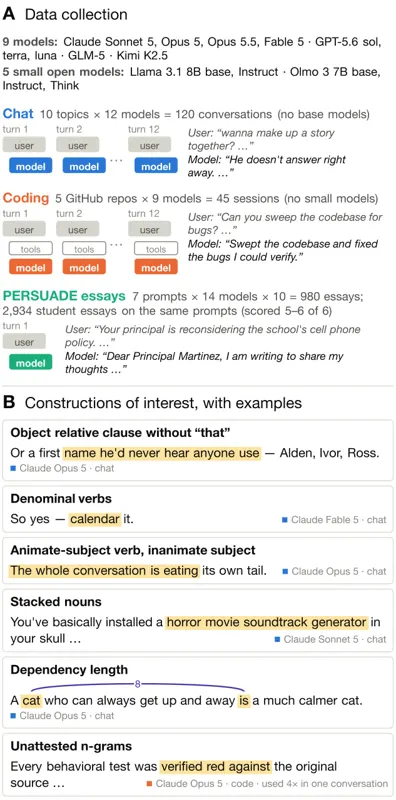
The authors compare psycholinguistic processing-cost features across 14 language models in chat, coding, and essay settings. Relative to round-trip paraphrases, frontier models overuse low-frequency n-grams, long dependencies, stacked noun compounds, denominal verbs, reduced object relatives, and atypical animacy patterns. They hypothesize that post-training for math, code, and verifiable rewards rewards information density rather than human communication. A Qwen2.5-1.5B Instruct experiment with GRPO shows that a simple length penalty can create a near-categorical preference for shorter variants and transfer to some untrained constructions. Task success therefore does not guarantee human-comprehensible language.
Thomas Hikaru Clark, Matias B. Martin, Kyle Mahowald · 54 views · Oct 21, 2026
Large Language ModelsPsycholinguistics
Oct 21, 2026