Skip to content
OmniBrain-0: A Unified Agentic Model for Embodied Intelligence

OmniBrain-0: A Unified Agentic Model for Embodied Intelligence

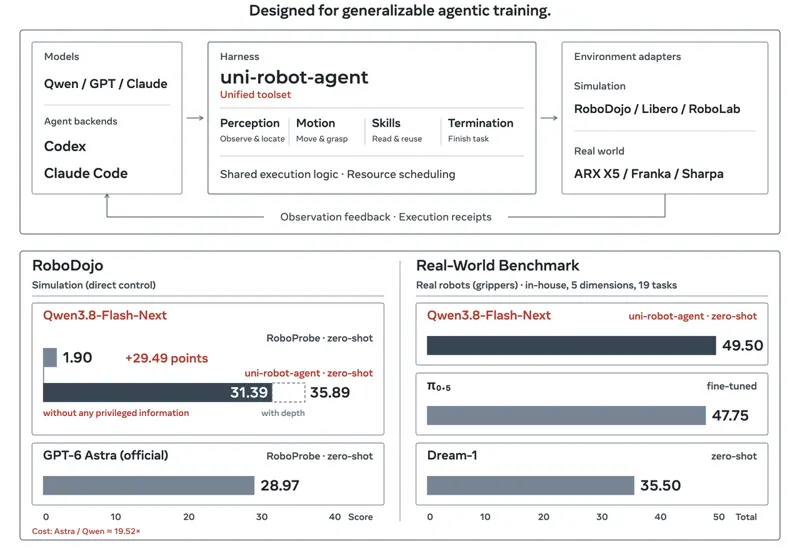
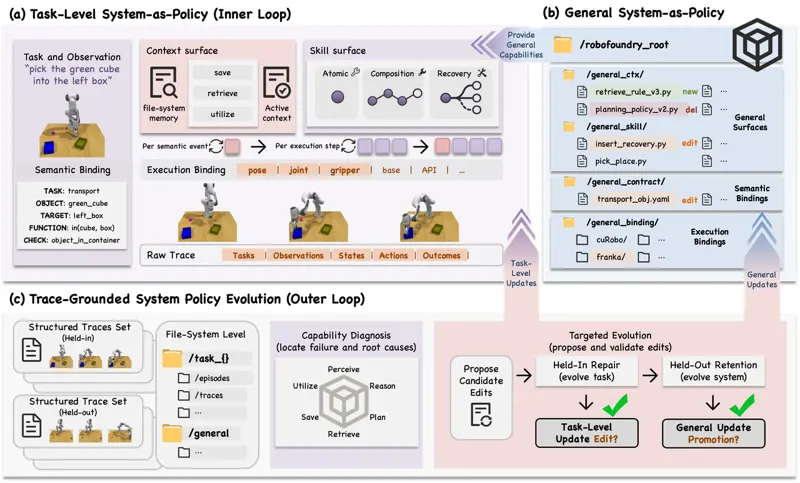
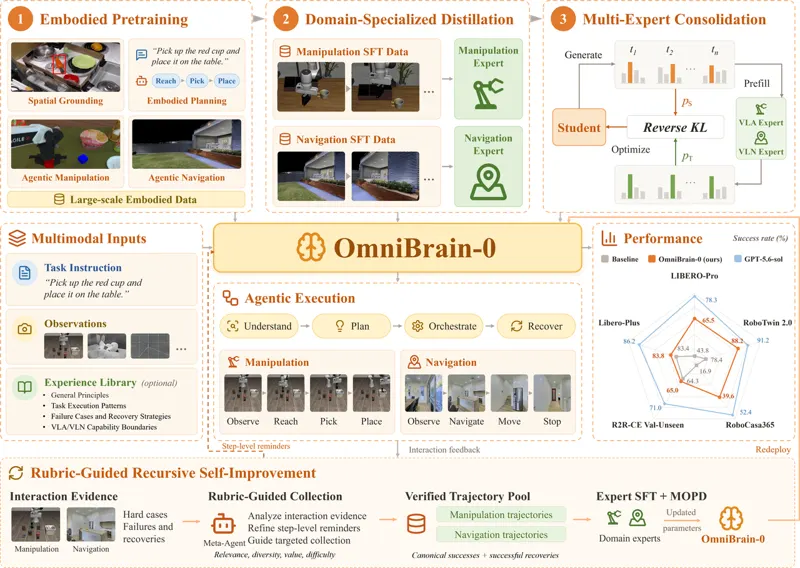
General-purpose embodied intelligence requires robots to coordinate diverse skills over long horizons, track task progress, and recover from failures. Specialist policies alone do not ensure task-level reliability, while powerful multimodal agents rely on costly reasoning and external experience that compact models struggle to reproduce. We introduce OmniBrain-0, a lightweight unified embodied agent that coordinates manipulation and navigation through a shared high-level decision model, integrating task understanding, planning, progress tracking, and feedback-driven recovery. Our progressive training framework combines embodied pretraining, domain-specialized agent distillation, and multi-teacher on-policy distillation (MOPD). It distills powerful teachers' interaction experience into manipulation and navigation experts, then consolidates their decision capabilities into OmniBrain-0. Unification therefore occurs within the learned decision model rather than only at the tool interface. We further introduce Rubric-Guided Recursive Self-Improvement (RSI), a data flywheel in which a Meta-Agent turns execution evidence into refined rubrics, step-level reminders, and verified trajectories for domain-expert updates before their reconsolidation into OmniBrain-0 through MOPD. We evaluate OmniBrain-0 on LIBERO-Pro, LIBERO-Plus, RoboCasa365, RoboTwin 2.0, and R2R-CE Val-Unseen, as well as multiple real-world manipulation tasks. OmniBrain-0 combines strong cross-domain task performance with substantially lower inference and execution overhead than its closed-source teacher, demonstrating efficient transfer and consolidation of embodied capabilities into a compact unified agent.

Embodied AIVLA
Xiaomi Embodied Intelligence Team, Yuechen Luo, Chong He · 81 views · Oct 26, 2026
RoboColosseum: Evaluating Physical Intelligence at Scale In-The-Wild

RoboColosseum: Evaluating Physical Intelligence at Scale In-The-Wild

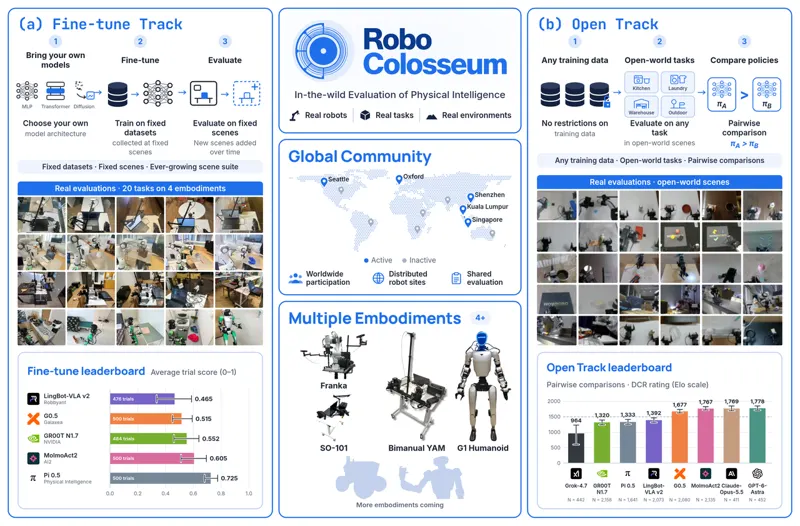
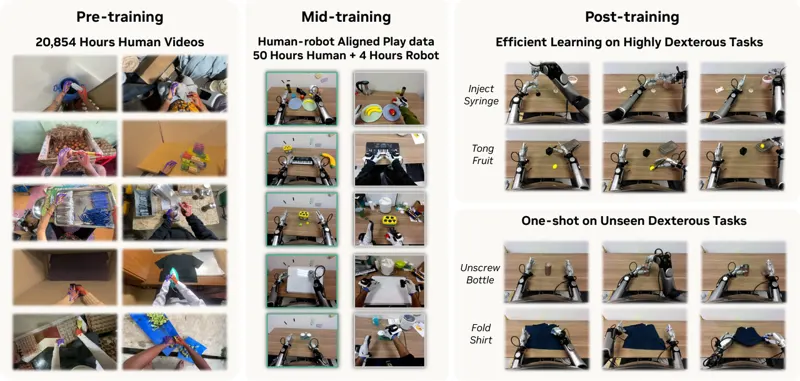
General-purpose robot policies must work across robots, tasks, and environments, yet the variation that makes physical trials informative also makes them difficult to reproduce. We introduce RoboColosseum, a distributed evaluation framework that combines unified policy serving and standardized protocols across a network of locally operated robots in diverse environments. Our initial study evaluates five vision-language-action (VLA) policies and three frontier AI agents across four embodiments (SO-101, Franka, Bimanual-YAM, and G1 Humanoid). The Open Track compares models without task-specific adaptation in blinded, pairwise trials under matched local conditions. The Fine-tune Track measures how well VLA policies adapt to 20 tasks across all four embodiments when each policy receives the same 100 demonstrations per task. Across 5,699 pairwise Open Track comparisons at 124 sites, frontier agents rival specialized VLA policies, while all systems struggle to complete open-world tasks reliably. After fine-tuning, GR00T N1.7 leads on SO-101 and pi0.5 leads on Franka and Bimanual-YAM. Policy rankings show weak agreement across embodiment-specific task suites (Kendall W = 0.24). Open Track rankings poorly predict relative performance after fine-tuning, with substantial rank reversals on all three embodiments shared between tracks. Measuring partial progress reveals differences that task success alone misses. On the G1 Humanoid, no policy completes any of the five tasks, yet average progress ranges from 13.3% to 23.2% across policies. Open Track rankings stabilize as trials accumulate, and active matchmaking achieves comparable ranking agreement with substantially fewer physical trials than uniform sampling. These results show how distributed physical evaluation can reveal where robot policies generalize, how well they adapt to new tasks, and how far they progress on tasks they fail to complete.

Physical AIVLA
Tan Sang Nguyen, Yi Ru Wang, Shailesh Shailesh · 140 views · Nov 2, 2026
Real2Sem2Real: 3D Semantic Augmentations for Robot Learning from a Single Human RGB Demonstration

Real2Sem2Real: 3D Semantic Augmentations for Robot Learning from a Single Human RGB Demonstration

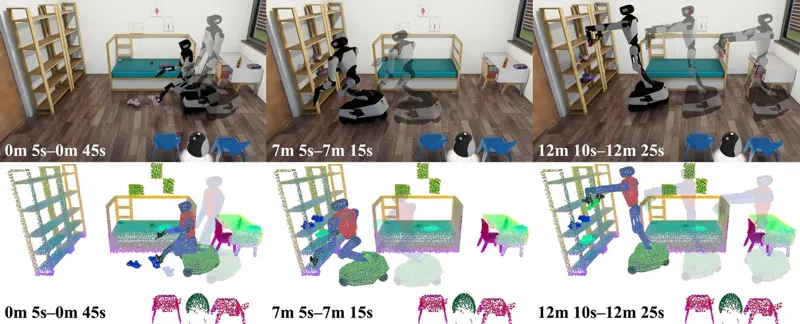
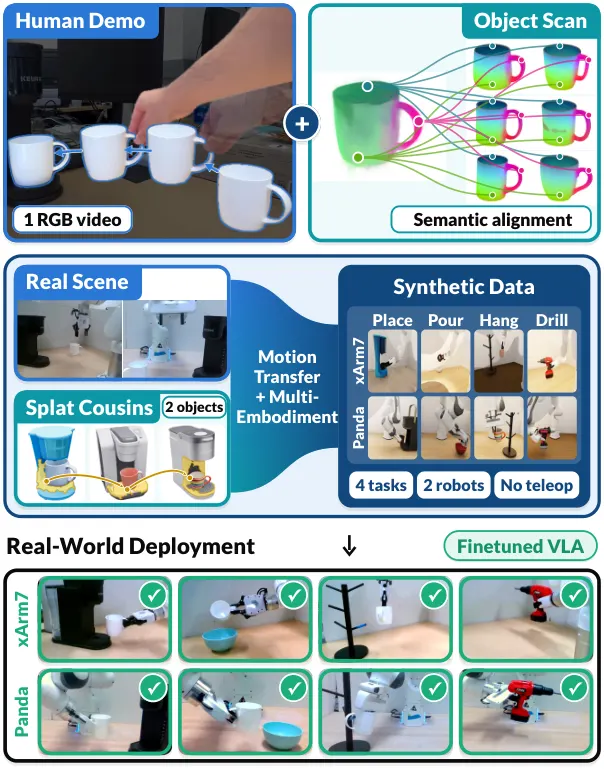
Human video scales easily and does not need robot hardware, but existing methods require depth sensing, overlay the robot onto 2D video, or generate data only for the demonstrated objects. We present Real2Sem2Real (R2Sem2R), a real-to-semantic-to-real pipeline that turns one monocular RGB video of a human demonstration into thousands of robot demonstrations across the semantic object instances of a category. R2Sem2R tracks the SE(3) pose of each object with DINOv3-distilled Gaussian splats, outperforming existing methods and FoundationPose with estimated metric depth. R2Sem2R then aligns digital cousins, each generated from one or a few photographs, to the demonstrated objects with a semantic alignment. This alignment matches whole objects and the functional regions of target objects, such as a coffee machine's tray. R2Sem2R maps the human hand to a feasible robot grasp that extends to the cousins. Robot demonstrations are generated either in IsaacSim, for photorealistic rendering, or MuJoCo, for contact physics, and R2Sem2R can generate over 2,000 episodes in about two hours. On two real robots and four tasks, we train a vision-language-action policy on data from one human video per task, and policies trained on our data match or exceed policies trained on teleoperation across diverse object instances. The project page is available at https://real2sem2real.github.io/.

Robot LearningHuman demonstrations
Matthew Strong, Ankush K. Dhawan, Julien Poffet · 180 views · Oct 20, 2026
PACE: Temporal-Role Tactile Conditioning for Chunk-Based Insertion Policies

PACE: Temporal-Role Tactile Conditioning for Chunk-Based Insertion Policies

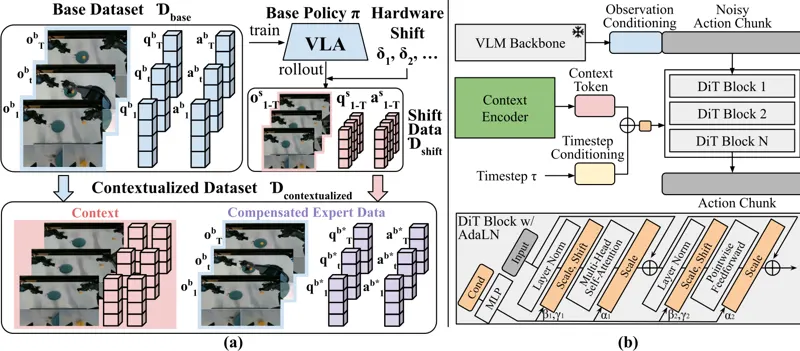
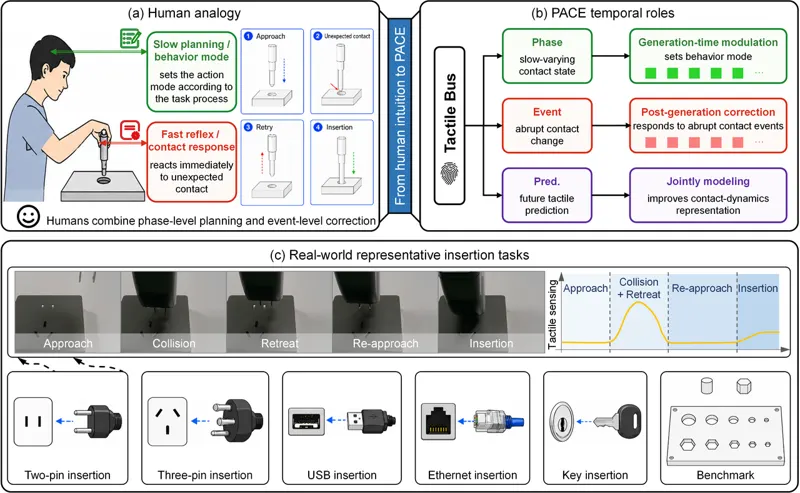
Contact-rich insertion requires a robot to combine visual alignment with tactile adjustment. Existing visuotactile chunk-based policies often collapse tactile feedback into one generation-time pathway, so persistent contact state, abrupt contact events, and the future contact consequences of an action are modeled implicitly in a single representation. PACE assigns one tactile stream three temporal roles. An exponential-smoothed contact state modulates action-chunk generation through layer-wise feature conditioning. A short-window tactile difference forms an event cue and drives a gated residual correction over only the first steps of the chunk. A training-only head predicts future tactile increments from decoder states as an auxiliary representation-learning objective. This preserves chunk-level action continuity while giving slowly varying contact phases and fast collision or jamming events separate pathways. Across five real insertion tasks, PACE reaches 90.7 percent average success, more than 44 percentage points above vision-only and single-path tactile-fusion baselines. It also averages 88.7 percent on six ManipulationNet geometry and clearance settings, including 0.1 mm clearance. Ablations show complementary contributions from Phase, Event, and Pred., while cross-signal and cross-architecture tests extend the principle to force/torque, joint current, and diffusion-policy backbones.

Tactile SensingRobot Manipulation
Zhiyuan Chen, Shixiong Xu, Shuai Chen · 286 views · Oct 12, 2026

As an Amazon Associate, we earn from qualifying purchases.