Skip to content
GUARD: Stabilizing Recursive Self-Improvement with Regret Guidance

GUARD: Stabilizing Recursive Self-Improvement with Regret Guidance

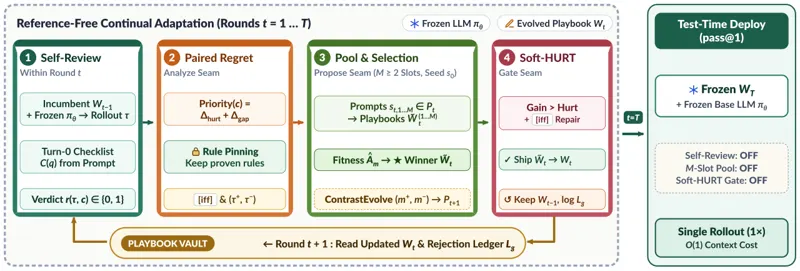
Autonomous AI agents pair a frozen base model with an editable harness of prompts, skills, tool rules, and memory. Recursive self-improvement (RSI) adapts this harness from experience without weight updates, yet self-editing without external graders often backfires: reflection and scalar scores conflate what an edit newly broke with what remains unsolved, causing local regressions, skill forgetting, and memory bloat. We introduce GUARD (Grader-free Unsupervised Environment Design [UED] with Adaptive Rule Distillation), a closed-loop framework for reference-free continual harness evolution. Our key insight is to decompose each task into pre-execution self-checks and guide harness updates via directional regret. Each round grades trajectories against these checks, pinning mastered rules while prioritizing newly broken behaviors, and selects among parallel candidate edits by critic-free group-relative fitness. A Soft-HURT gate then promotes an edit only when gains outweigh regressions, scoping specialized fixes to prevent over-triggering and guaranteeing non-regression on its gated buffer. At test time, one frozen harness runs in a single pass. Across benchmarks on memory, skill evolution, continual task streams, and domain reasoning, GUARD consistently improves performance without catastrophic forgetting or memory pollution while substantially cutting deployment token usage.

LLMAgent Harness
Minghe Zhang, Xuetao Kang, Yifei Ming · 290 views · Nov 17, 2026
OmniBrain-0: A Unified Agentic Model for Embodied Intelligence

OmniBrain-0: A Unified Agentic Model for Embodied Intelligence

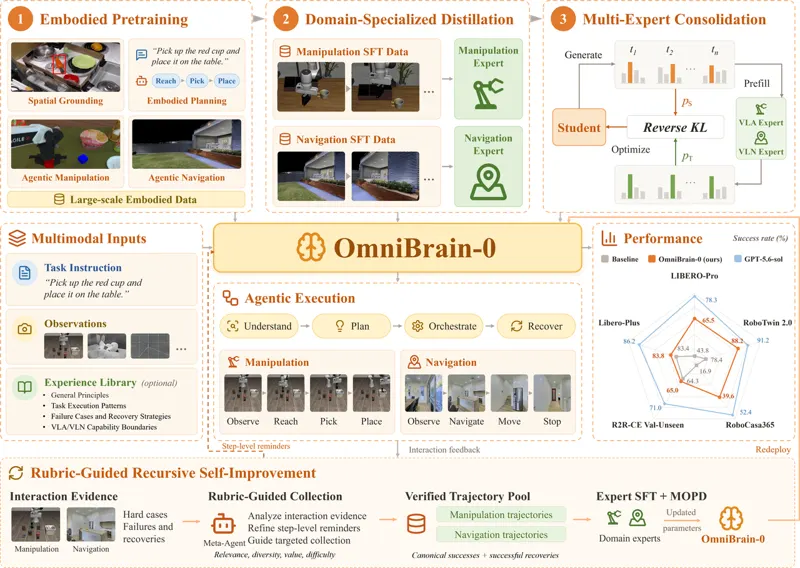
General-purpose embodied intelligence requires robots to coordinate diverse skills over long horizons, track task progress, and recover from failures. Specialist policies alone do not ensure task-level reliability, while powerful multimodal agents rely on costly reasoning and external experience that compact models struggle to reproduce. We introduce OmniBrain-0, a lightweight unified embodied agent that coordinates manipulation and navigation through a shared high-level decision model, integrating task understanding, planning, progress tracking, and feedback-driven recovery. Our progressive training framework combines embodied pretraining, domain-specialized agent distillation, and multi-teacher on-policy distillation (MOPD). It distills powerful teachers' interaction experience into manipulation and navigation experts, then consolidates their decision capabilities into OmniBrain-0. Unification therefore occurs within the learned decision model rather than only at the tool interface. We further introduce Rubric-Guided Recursive Self-Improvement (RSI), a data flywheel in which a Meta-Agent turns execution evidence into refined rubrics, step-level reminders, and verified trajectories for domain-expert updates before their reconsolidation into OmniBrain-0 through MOPD. We evaluate OmniBrain-0 on LIBERO-Pro, LIBERO-Plus, RoboCasa365, RoboTwin 2.0, and R2R-CE Val-Unseen, as well as multiple real-world manipulation tasks. OmniBrain-0 combines strong cross-domain task performance with substantially lower inference and execution overhead than its closed-source teacher, demonstrating efficient transfer and consolidation of embodied capabilities into a compact unified agent.

Embodied AIVLA
Xiaomi Embodied Intelligence Team, Yuechen Luo, Chong He · 510 views · Oct 26, 2026
Terminal-RSI: Recursive Self-Improving Terminal Agents via Recursive Self-Rewrite and Policy-Refine

Terminal-RSI: Recursive Self-Improving Terminal Agents via Recursive Self-Rewrite and Policy-Refine

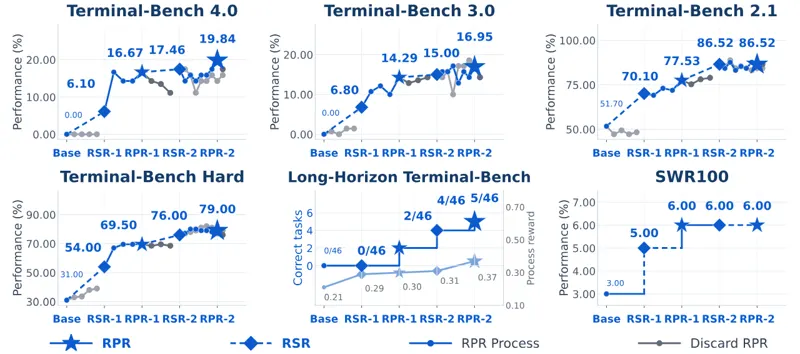
Converting verifier outcomes into useful policy updates and partial progress into complete task resolution is crucial for terminal agents. We present Terminal-RSI, which alternates Recursive Self-Rewrite (RSR) of verified trajectories with critic-inheriting Recursive Policy-Refine (RPR). We formulate Turn-Boundary Skip-Observation GAE (TB-GAE) to retain token-specific baselines while applying decay across interaction turns. Family Dense Reward (FDR) calibrates semantic progress across task families; Success-Prioritized Reward (SPR) separates strict success from bounded partial credit. A Warm-up Critic Model, recursive critic handoff, and stage-specific learning rates coordinate the two refinement phases. The five-stage sequence from Qwen3.8-27B base model through RSR-1, RPR-1, RSR-2, and RPR-2 yields Terminal-RSI-27B: 19.84% on Terminal-Bench 4.0, 86.52% on Terminal-Bench 2.1, 16.95% on Terminal-Bench 3.0, and 79.00% on Terminal-Bench Hard. On LHTB, process reward rises from 0.21 to 0.37 and strict completion from 0/46 to 5/46; SWR100 success doubles from 3.00% to 6.00%. By recursively coupling verified trajectory rewriting with critic-inheriting policy refinement, each retained stage consolidates discovered behaviors and progressively advances the agent from partial local repairs to strict terminal verification.

Terminal AgentReinforcement Learning
Junyao Yang, Zongxia Li, Yucheng Shi · 629 views · Oct 15, 2026
Recursive Game Creator: An Agentic Product-Level Experience-Oriented Game Harness

Recursive Game Creator: An Agentic Product-Level Experience-Oriented Game Harness

Recent game design agents have made substantial progress in generating playable games. However, program correctness does not ensure an enjoyable experience for players. We present Recursive Game Creator, an experience-oriented harness to advance agentic game development from rough game prototypes into entertaining games. Recursive Game Creator organizes recursive development around four components: Designer, Builder, Player, and Reviewer. The Designer translates user instructions and Reviewer's feedback into detailed plans. The Builder turns these plans into candidate games. The coding-native Player creates and executes reusable policies through programmatic interfaces to efficiently collect diverse gameplay trajectories, mitigating evaluation bias caused by slow GUI-based collection. The Reviewer uses carefully designed trajectory-based metrics to induce player preferences, integrating with visual evidence and explicit textual preferences to evaluate games against game-specific criteria. Finally, the Reviewer accepts the better version and provides improvement reviews for the next round, closing the recursive loop. Our method achieves state-of-the-art overall performance of 77.89 on GameCraft-Bench. On GameASG-Bench, it achieves a strict task success rate of 53.2%, a 34.1% improvement over the same-model baseline, and the highest mean runtime-check pass rate at 93.4% among compared methods. A user study shows longer playtime and higher ratings. Code is coming soon.

Agentic Game DevelopmentRecursive self-improvement
Jiajun Chen, Haoyu Wu, Mingda Jia · 578 views · Oct 6, 2026

As an Amazon Associate, we earn from qualifying purchases.