Skip to content
LabRobFail: A Benchmark for Robotic Failure Analysis in Chemical Self-driving Laboratories

LabRobFail: A Benchmark for Robotic Failure Analysis in Chemical Self-driving Laboratories

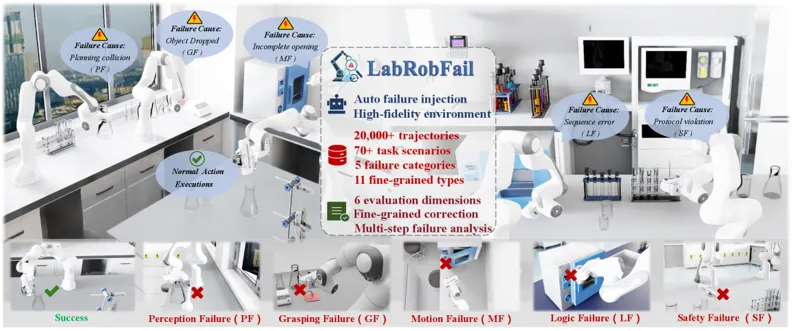
The deployment of embodied agents in self-driving laboratories could accelerate scientific discovery, yet their reliability is constrained by the irreversible and safety-critical nature of chemical experiments. Progress is further hindered by scarce failure data and the lack of fine-grained evaluation protocols. To address these challenges, we introduce LabRobFail, a failure-centric framework for learning and evaluating robotic failure analysis in chemical laboratories. LabRobFail-Sim injects controllable failures at the control, physics, and semantic levels, enabling the construction of LabRobFail-Data, which contains over 20,000 trajectories across 70+ task scenarios, five failure categories, and 11 fine-grained failure types. LabRobFail-Bench evaluates six capabilities spanning task understanding, failure detection, temporal localization, severity assessment, failure classification, and actionable correction. We further develop LabRobFail-VLM, a domain-specialized vision-language model that generates structured failure diagnoses and recovery instructions. On seen environments, it achieves 92.58% failure-detection accuracy and 85.58% temporal-localization accuracy, substantially outperforming general-purpose VLMs. When integrated as a real-time supervisor, it improves downstream VLA task success rates by 10-20 percentage points, demonstrating the value of fine-grained failure understanding for closed-loop recovery and reliable laboratory autonomy. Our code and data are available at https://github.com/Su-ISE-2001/SciRobo

Embodied AIHaobo Wang, Baoli Sun, Anqi Zou·Jul 26, 2026
N₀-TWAM: Scaling Tactile-Native World-Action Model for Contact-Rich Manipulation

N₀-TWAM: Scaling Tactile-Native World-Action Model for Contact-Rich Manipulation

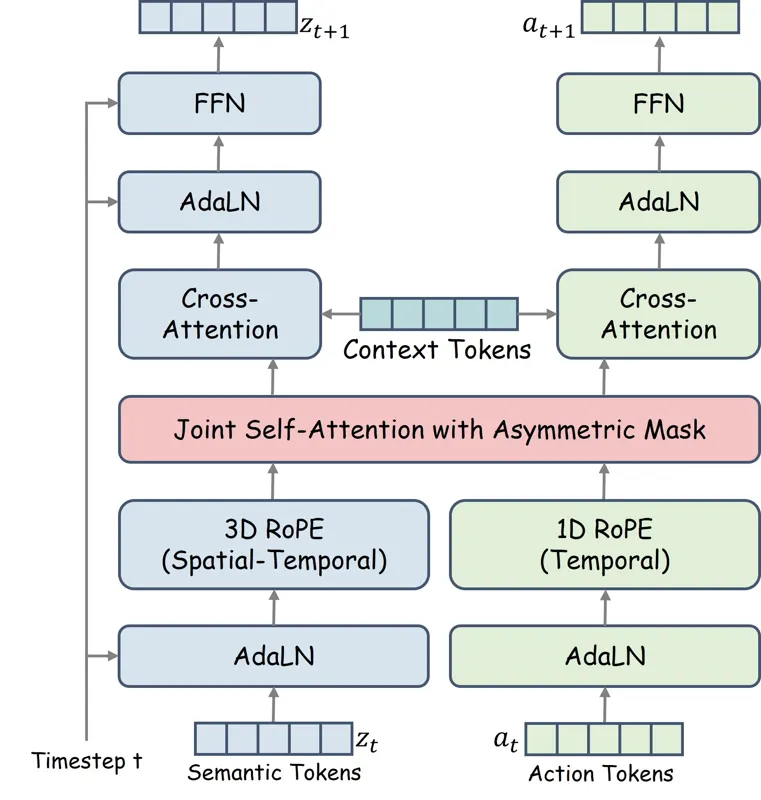
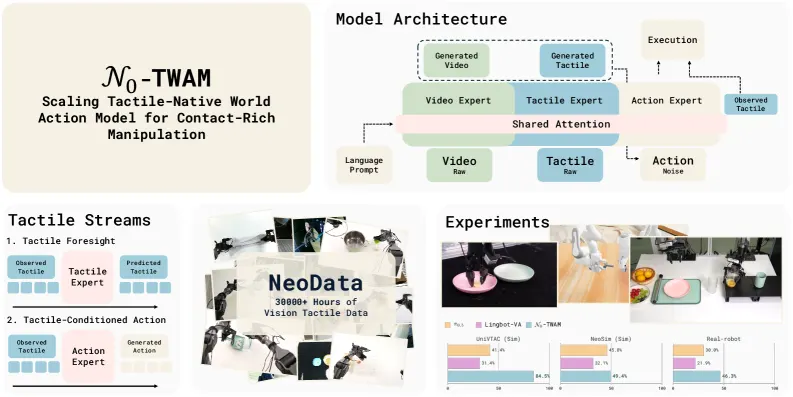
We present N₀-TWAM, a tactile-native world-action model for contact-rich manipulation that predicts both future vision and future contact. To our knowledge, it is the first tactile world-action model trained at large scale, and it shows strong capability on contact-rich tasks. We pre-train N₀-TWAM at large scale with visuo-tactile joint training over tactile-rich demonstrations spanning six embodiments and 450 tasks. We use NeoForce, a unified force-based tactile representation, to form a physically grounded contact signal that conditions action generation. To improve long-horizon and multi-stage manipulation, we introduce tactile contact events for task staging and advance through them during execution. For real-time efficiency, we adopt an asymmetric Mixture-of-Transformers architecture that pairs a full-width expert for video prediction with slim experts for downstream action and tactile prediction. Evaluations on both real and simulated benchmarks justify the capabilities of N₀-TWAM across a range of contact-rich tasks, and demonstrate the benefit of data scaling for precise tactile and action prediction. In summary, N₀-TWAM endows a world-action model with predictive capabilities to foresee vision, touch and action, building a solid foundation for fine-grained manipulation on open contact-rich tasks. The codebase and model checkpoints will be made publicly available to foster further research and development in tactile-enabled robotic manipulation.

Embodied AI NeoteAI Team, Fudan TEAI Team·Jul 26, 2026
Embodied GPT-5.1: Evidence of a World Model?

Embodied GPT-5.1: Evidence of a World Model?

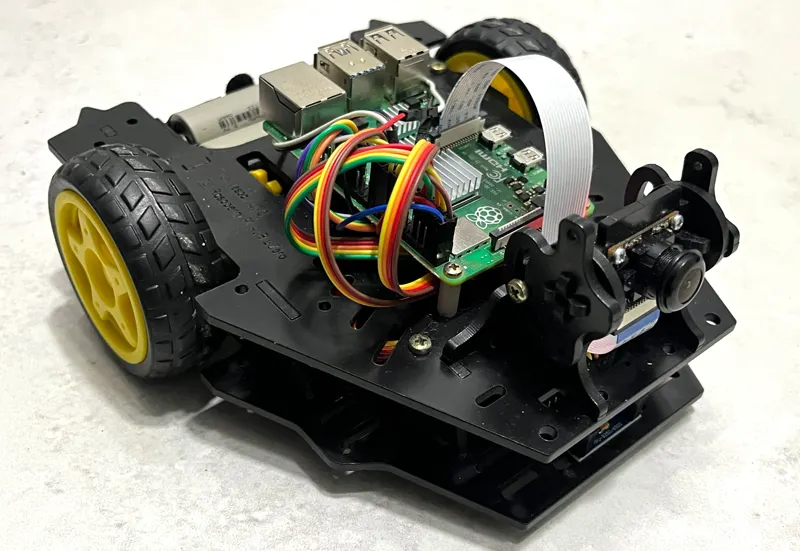
This exploratory study examines whether a large multimodal language model, GPT-5.1, can serve as the high-level controller of a physical mobile robot despite having no prior embodiment, no training in simulated environments, and no exposure to sensorimotor experience. Using only low-resolution first-person images and a discrete action set, the model was tasked with navigation and object-directed behaviors such as locating and contacting a target toy. Across multiple trials, GPT-5.1 demonstrated emergent capabilities that suggest elements of spatial reasoning and physical understanding. These included maintaining short-term memory of object locations after they left the camera frame, inferring the physical consequences of its own movements, and executing coherent action sequences such as colliding with an object and reversing to visually verify the outcome. At the same time, the model displayed inefficiencies and perceptual limitations, including imprecise alignment strategies and occasional misidentification of distant distractors. Overall, the results indicate that GPT-5.1 exhibits signs of world-model-like behavior in an embodied setting, despite the absence of any embodiment-related training, a finding that challenges long-standing views in cognitive science and robotics which hold that a physical body is a necessary prerequisite for developing such forms of intelligence. The findings motivate deeper investigation into the emergence, limits, and robustness of physical understanding in large language models.

Embodied AIRoberto Spinelli, Thiago C. Martins·Jul 27, 2026
LeapBot-WA: World-Anchor Action Models via Predictive Latent Alignments

LeapBot-WA: World-Anchor Action Models via Predictive Latent Alignments

World Action Models (WAMs) have emerged as a powerful paradigm for embodied intelligence, yet the prevailing reliance on pixel-level video generation creates a fundamental bottleneck. Forcing models to reconstruct task-irrelevant visual details dissipates representational capacity and renders policies vulnerable to visual distractors. In this paper, we propose LeapBot-WA, which establishes a novel Predictive-Latent paradigm for WAMs by operationalizing the Joint-Embedding Predictive Architecture (JEPA) as a World-Anchor. Departing from the traditional reliance on visual synthesis, LeapBot-WA shifts the core of world modeling to Predictive Semantic Alignment, extracting abstract physical dynamics directly within a latent foundation space. To bridge the modality gap between non-Gaussian predictive features and diffusion priors, we introduce the Isotropic Semantic Autoencoder (ISAE), which reshapes the anchor's latent space into a diffusion-friendly manifold to prevent off-manifold drift. Furthermore, we design an Asymmetric Mixture-of-Transformers (MoT) architecture. During training, an Anchor Diffusion Transformer acts as a privileged dynamics expert to guide the Action Diffusion Transformer; at inference, this heavy dynamics branch is pruned, enabling zero-overhead execution. LeapBot-WA achieves state-of-the-art performance among predictive models on LIBERO and matches top-tier generative WAMs on RoboTwin 2.0 without requiring large-scale trajectory pre-training. It further demonstrates superior zero-shot robustness to unseen environments and successful real-world transfer, establishing a highly efficient and robust latent-centric paradigm for scalable robotic control. Code: https://github.com/LeapWM/leapbot-wa.

Embodied AIPei Liu, Nan Zheng, Lang Zhang·Jul 27, 2026
Data Pyramid for Embodied Manipulation: A Survey

Data Pyramid for Embodied Manipulation: A Survey

Multimodal foundation models learned to see and to speak by consuming the whole internet. Embodied agents admit no such shortcut, since they require data that couple observations with physical states and actions. These signals can be provided, to varying degrees, by multiple data sources. In this work, we organize the embodied data ecosystem as a "pyramid" spanning five complementary sources: real-robot data, UMI-style data, egocentric and exocentric data, simulation data, and general vision-language data. We organize the pyramid around the tension between scalability and robot alignment, and further characterize each source in terms of data quality, diversity, reusability, and physical fidelity. We then analyze recent embodied foundation models through the lens of their data recipes, examining how different sources are selected, aligned, and mixed during pretraining. For embodied brain models, vision-language-action models, and world-action models alike, we relate data composition to capabilities in perception, reasoning, planning, action generation, and world prediction. We close by discussing six open challenges: building large-scale tactile datasets, collecting failure and recovery data, developing scalable data-collection pipelines, aligning actions across embodiments, leveraging egocentric data for dexterous manipulation, and designing principled data recipes for robot learning. We hope this work paves the foundation for the design of next-generation embodied systems.
Embodied AIYifan Ye, Yankai Fu, Yaoxu Lv·Jul 27, 2026
Addressing the Orchestration Gap in Generalist Robots via Physical Agency

Addressing the Orchestration Gap in Generalist Robots via Physical Agency

General-purpose robots need to reason about their actions, combining perception, world knowledge, planning, success detection, recovery, and low-level control. Today's state-of-the-art models attempt to combine all these capabilities into the learned policy via large-scale pre-training. Instead, we show that these capabilities can be decomposed into a general language-conditioned policy/control agent and a high-level agent manager/orchestrator. Rather than training policies to reason via pre-training, we build a closed-loop physical agent orchestrator that can do high-level planning, decompose the goal into achievable subgoals, command low-level motor commands, track and verify the outcome from low-level observations, and recover from failures. Our Physical Agency orchestrator (Pigey) can control existing vision-language-action (VLA) policies as well as parametrized skills to solve complex reasoning tasks in the real world, without any additional data collection or post-training. We evaluate Pigey extensively across simulation benchmarks and challenging real-world robotic manipulation tasks, and demonstrate significant performance improvements over existing generalist policies. On LIBERO-PRO, Pigey advances the state-of-the-art by over 4x (12.8% -> 53.3%) with no task-specific fine-tuning. On a real robot, Pigey lifts the frozen policy from near-zero to over 90% on reasoning-limited tasks. We call the difference between what frozen motor skills achieve alone and inside the agentic loop the orchestration gap.

VLAOrchestrationPrincetonLiane Galanti, Dhruv Shah, Tri Dao·Jul 23, 2026
PAVXploreRL: Physical-Action-Visual World Model Reinforcement Learning with Action Exploration

PAVXploreRL: Physical-Action-Visual World Model Reinforcement Learning with Action Exploration

Action-conditioned world models are a key component of embodied AI, serving as scalable policy evaluators that reduce reliance on expensive real-world rollouts. To accurately capture diverse action-induced dynamics, such models should satisfy three key objectives-Physical Plausibility (P), Action Adherence (A), and Visual Fidelity (V), collectively referred to as PAV-while remaining robust to both in-distribution (ID) expert demonstrations and out-of-distribution (OOD) actions. However, existing methods primarily rely on ID action-video pairs and pixel-level reconstruction losses, which do not explicitly optimize PAV objectives and generalize poorly beyond expert data. To address this, we propose PAVXploreRL, a reinforcement learning framework built on a pretrained latent world model that explicitly optimizes PAV objectives through reward-driven training. To improve action generalization, our method jointly leverages ID trajectories and noise-driven OOD action exploration, without paired video supervision. Experiments show that PAVXploreRL consistently outperforms pretrained baselines, achieving a 5.6% average gain across benchmarks and producing higher-quality PAV properties. As a policy evaluator, it also yields more reliable performance estimates and reduces the overestimation bias of prior expert-only world models such as Ctrl-World. Code: https://github.com/Social-AI-Studio/PAVXploreRL

World ModelsReinforcement LearningAction ExplorationHan Wang, Zijun Wang, Shuoshuo Xue·Jul 18, 2026
Athena-Brain Technical Report: An Efficient Robot Brain for General Intelligence and Embodied Interaction

Athena-Brain Technical Report: An Efficient Robot Brain for General Intelligence and Embodied Interaction

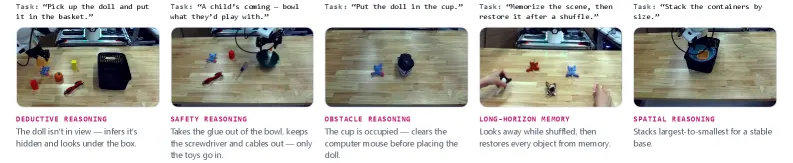
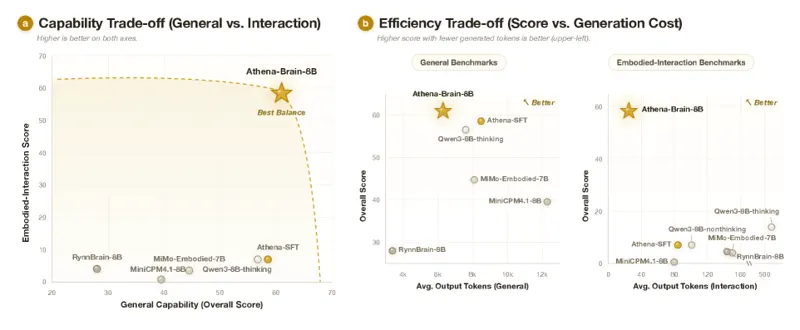
Large language models (LLMs) have demonstrated remarkable capabilities in language understanding, reasoning, and world knowledge. As embodied agents become increasingly capable, there is a growing demand for compact models that can serve as an on-device brain, preserving the broad general intelligence of LLMs while enabling effective high-level interaction with embodied environments. Existing approaches, however, often prioritize either general-purpose intelligence or specialized embodied capabilities, making it challenging to satisfy both requirements within a single model. We present Athena-Brain-8B, an 8B LLM designed to serve as an on-device brain for embodied intelligence for embodied intelligence. Through a multi-stage post-training pipeline consisting of General Supervised Fine-Tuning, General Reinforcement Learning, Embodied Expert training, and Model Merge, Athena-Brain-8B maintains strong general capabilities while acquiring strong high-level embodied interaction capabilities and generating concise responses for efficient embodied interaction. Experimental results demonstrate the effectiveness of Athena across both general and embodied evaluations. Compared with the corresponding Qwen3-8B thinking model, Athena-Brain-8B achieves comparable performance on general language and reasoning benchmarks while generating substantially shorter responses. On in-domain embodied benchmarks, Athena-Brain-8B consistently outperforms models of similar scale and surpasses several substantially larger frontier models evaluated zero-shot, demonstrating that compact language models can effectively integrate strong general intelligence with embodied capabilities.

Embodied AIRobot BrainGeneral Purpose IntelligenceJialian Li, Junhong Liu, Yuchen Cao·Jul 21, 2026
EA-Nav: Learning Safe Visual Navigation Policies with Embodiment Awareness

EA-Nav: Learning Safe Visual Navigation Policies with Embodiment Awareness

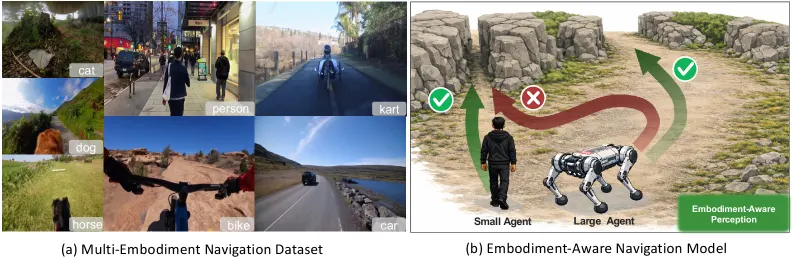
Cross-embodiment navigation is a key challenge in embodied intelligence. Due to differences in embodiment, the same visual observation may imply different actions for different agents, making prediction ambiguous when relying solely on vision. Existing studies mainly rely on reinforcement learning, which requires large-scale interaction and careful reward design, making it difficult to support scalable pretraining and real-world adaptation. In contrast, imitation-learning-based approaches remain limited. To address these challenges, we propose an imitation-learning-based embodiment-aware navigation framework with a modular multi-stage design. In pretraining, we construct a cross-embodiment navigation dataset from Internet videos and introduce embodiment geometry as conditional tokens to reduce action ambiguity under the same observation. In fine-tuning, we design a multimodal information injection mechanism based on a decoupled architecture. Specifically, we design a trajectory augmentation strategy to generate high-risk samples, which are used to train spatial perception and risk-aware correction separately, thereby explicitly incorporating embodiment geometry for safe navigation. Experimental results show that the proposed method effectively improves navigation performance across different embodiment settings, demonstrating the effectiveness of incorporating embodiment geometry into embodied navigation.

Visual navigationBody-AwarenessSafetyJialu Zhang, Yong Du, Xianda Guo·Jul 22, 2026
ReferTrack: Referring Then Tracking for Embodied Visual Tracking

ReferTrack: Referring Then Tracking for Embodied Visual Tracking

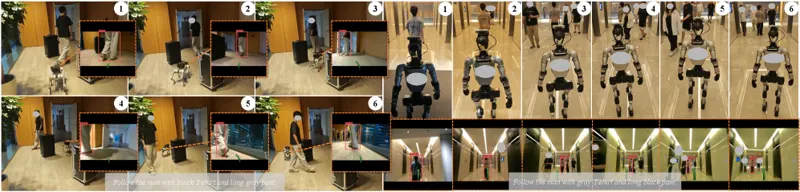
Embodied visual tracking (EVT) requires a mobile agent to continuously follow a specific target described in natural language using only onboard vision. While recent vision-language-action (VLA) policies unify target identification and trajectory planning, their chain-of-thought (CoT) reasoning often operates in abstract spatial latents that are difficult to supervise and weakly aligned with explicit image-space detections. To address this, we introduce ReferTrack, a referring-then-tracking paradigm that grounds EVT using a single forward-facing camera. Our model first selects the target from an indexed set of bounding boxes, then decodes tracking waypoints conditioned on this image-grounded decision. To preserve target motion cues over time, ReferTrack maintains a sliding-window queue of previously selected bounding boxes, injecting their geometric features into the visual history via temporal-viewpoint-bbox indicator (TVBI) tokens. We further enhance target identification by co-training on a custom Refer-QA dataset. On EVT-Bench, ReferTrack achieves state-of-the-art single-view performance with success rates of 89.4%, 73.3%, and 74.1% on the single-target, distracted, and ambiguity tracking splits, respectively – matching or even surpassing several multi-camera baselines on identification-heavy tasks. Finally, real-world deployments on legged and humanoid robots validate its robust sim-to-real transfer capabilities. Code is available at https://github.com/MedlarTea/referTrack.

VLAObject trackingReferenceHanjing Ye, Tianle Zeng, Jiazhao Zhang·Jul 22, 2026