Skip to content
Real2Sem2Real: 3D Semantic Augmentations for Robot Learning from a Single Human RGB Demonstration

Real2Sem2Real: 3D Semantic Augmentations for Robot Learning from a Single Human RGB Demonstration

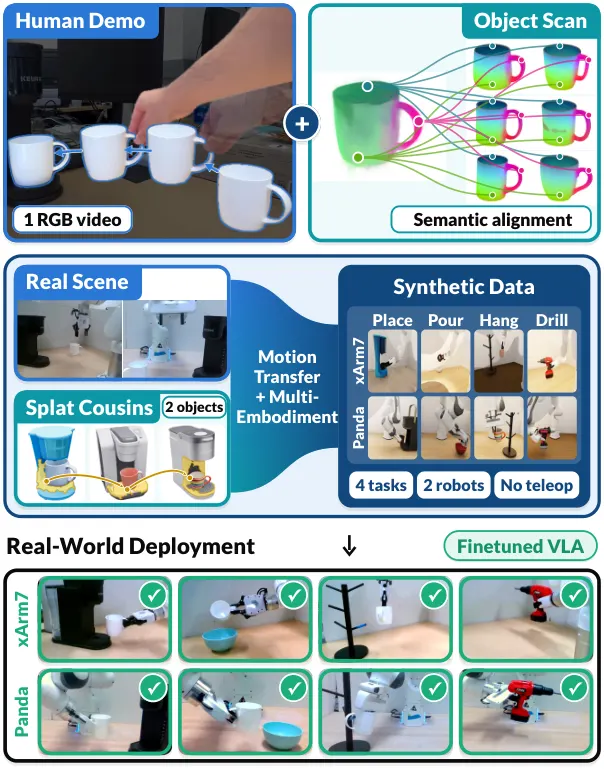
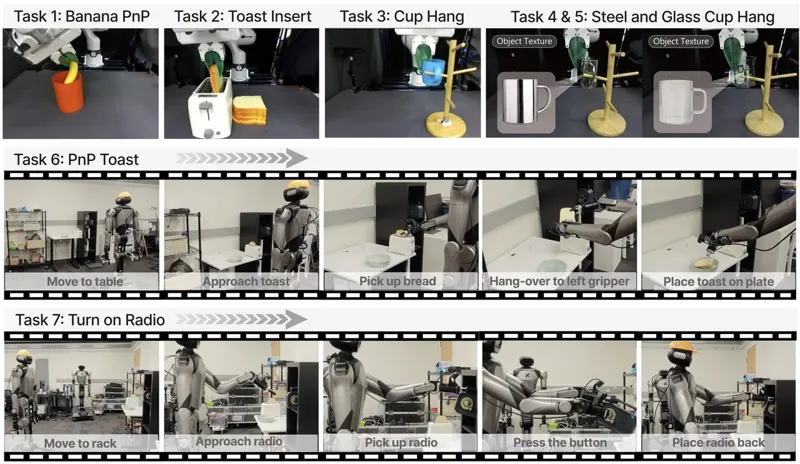
Human video scales easily and does not need robot hardware, but existing methods require depth sensing, overlay the robot onto 2D video, or generate data only for the demonstrated objects. We present Real2Sem2Real (R2Sem2R), a real-to-semantic-to-real pipeline that turns one monocular RGB video of a human demonstration into thousands of robot demonstrations across the semantic object instances of a category. R2Sem2R tracks the SE(3) pose of each object with DINOv3-distilled Gaussian splats, outperforming existing methods and FoundationPose with estimated metric depth. R2Sem2R then aligns digital cousins, each generated from one or a few photographs, to the demonstrated objects with a semantic alignment. This alignment matches whole objects and the functional regions of target objects, such as a coffee machine's tray. R2Sem2R maps the human hand to a feasible robot grasp that extends to the cousins. Robot demonstrations are generated either in IsaacSim, for photorealistic rendering, or MuJoCo, for contact physics, and R2Sem2R can generate over 2,000 episodes in about two hours. On two real robots and four tasks, we train a vision-language-action policy on data from one human video per task, and policies trained on our data match or exceed policies trained on teleoperation across diverse object instances. The project page is available at https://real2sem2real.github.io/.

Robot LearningHuman demonstrations
Matthew Strong, Ankush K. Dhawan, Julien Poffet · 180 views · Oct 20, 2026
T2-z: Test-Time Optimization of Environment Latents for Robotic World Models

T2-z: Test-Time Optimization of Environment Latents for Robotic World Models

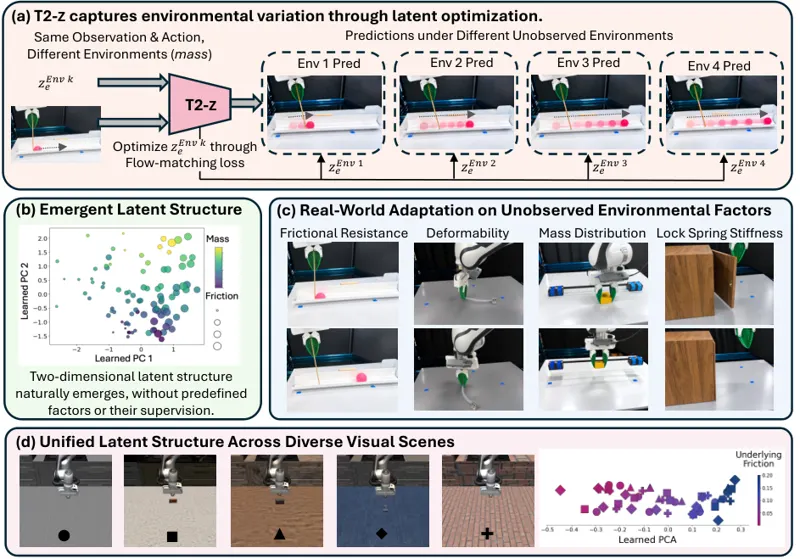
Predicting how the world responds to an action requires more than what can be seen: robots must account for environmental factors that are neither directly observable nor explicitly specified, from physical properties such as friction and mass to human-defined environmental rules. We introduce T2-Z for test-time optimization of environment latents, which augments a robotic world model with a learnable environment latent to condition world predictions. This compact latent captures underlying environmental variation without supervision of what environmental factors exist or what values they take. During training, T2-Z alternates between two stages: a world-model optimization stage that fixes the latents and learns general action-conditioned dynamics across environments; and an environment-latent optimization stage that freezes the world model and optimizes the conditioning latents, allowing latent structure to emerge purely through world prediction. At test time, the world model remains frozen and a newly initialized environment latent is optimized from one or more test-time interactions, adapting the model to previously unseen environmental configurations. Across 7 simulated settings and 4 real-world robotic tasks, T2-Z reduces object prediction error metric from 15.20 to 7.00 and raises action success from 33.73% to 72.96%. Its emergent latents capture structured representations of individual and compounded factors across diverse visual scenes. Ablations further show that T2-Z can efficiently infer environment latents from as little as a single test-time interaction trajectory.

Robotic World ModelsTest-Time Optimization
Chenyuan Zhou, Yining Hong, Huang Huang · 137 views · Oct 15, 2026
OmniEgoCap: Device-Agnostic Sequence-Level Egocentric Motion Reconstruction

OmniEgoCap: Device-Agnostic Sequence-Level Egocentric Motion Reconstruction

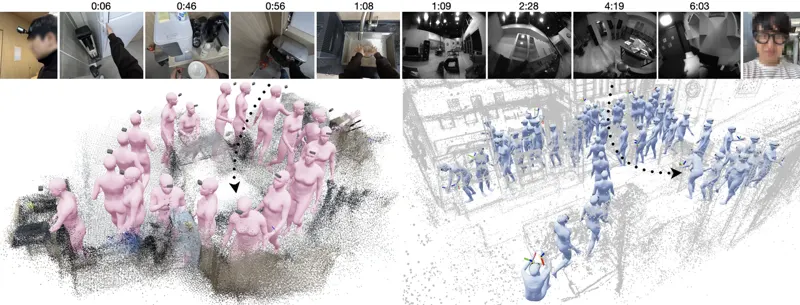
Commercial egocentric devices capture human behavior in everyday settings, yet full-body motion reconstruction must generalize across diverse cameras and mountings. This is challenging because head trajectories under-determine body motion, while hand observations are intermittent and camera-dependent: a hand may disappear simply because it has left the camera's field of view. Existing methods treat such absences as missing data, relying on fixed visibility regimes or post-hoc optimization, and fail to generalize across devices. We present OmniEgoCap, a sequence-level diffusion framework for device-agnostic egocentric full-body motion reconstruction. Our key insight is that egocentric videos contain sequence-level evidence about both the wearer and the camera-induced visibility structure, enabling OmniEgoCap to infer consistent body shape and coherent motion from sparse head and hand cues. To prevent overfitting to a single camera setup, we further introduce geometry-aware visibility augmentation, which synthesizes visibility patterns from realistic variations in camera geometry. We also present OmniEgoDB, the first mocap benchmark that pairs ground-truth motion with recordings from multiple consumer egocentric devices. Experiments on synthetic, real-device, and in-the-wild settings demonstrate superior motion reconstruction, robust cross-device generalization, and coherent in-the-wild results.

Egocentric VisionMotion Capture
Kyungwon Cho, Jeonghyeon Na, Hanbyul Joo · 111 views · Dec 22, 2025

As an Amazon Associate, we earn from qualifying purchases.