Skip to content
Scalable Causal Imitation Learning

Scalable Causal Imitation Learning

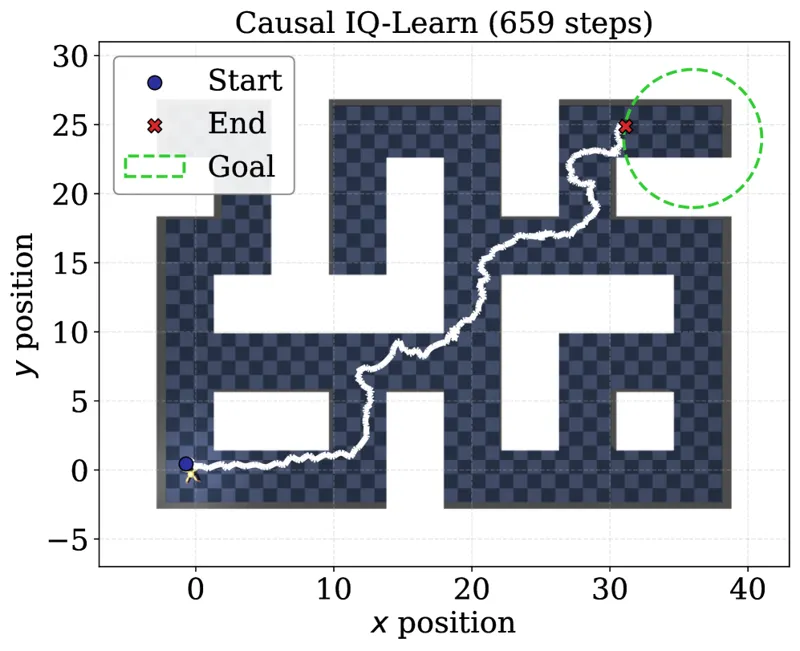
Imitation learning enables learning a policy in an unknown environment with a latent reward signal using expert demonstrations, but it struggles when the imitator's and expert's observations are mismatched and unobserved confounders are present in expert demonstrations. By identifying appropriate adjustment sets via the sequential π-backdoor criterion, causal imitation learning (CIL) provides a framework for approximating the expert's policy from confounded data. However, existing CIL methods, Causal Behavioral Cloning (Causal BC) and Causal Generative Adversarial Imitation Learning (Causal GAIL), are designed for short-horizon, low-dimensional settings. When applied to continuous control tasks with long horizons and high-dimensional state-action spaces, these methods exhibit poor performance: Causal BC suffers from compounding errors, Causal GAIL is unstable and sample-inefficient, and sequential π-backdoor adjustment becomes impractical. We introduce Causal Soft Q Imitation Learning (SQIL) and Causal Inverse soft-Q Learning (IQ-Learn), two off-policy causal imitation learning algorithms that combine the causal adjustment framework with state-of-the-art inverse reinforcement learning objectives. Both algorithms operate on causally-adjusted state representations produced by an efficient approximation of the sequential π-backdoor criterion, exploiting the causal structure of continuous control environments to reduce the full-horizon adjustment to a fixed-size sliding window. We evaluate all methods in a suite of confounded environments and find that Causal SQIL and Causal IQ-Learn substantially outperform prior CIL algorithms on long-horizon tasks, sometimes surpassing the expert, whereas all causally unaware imitation methods fail to learn meaningful behavior.

Imitation LearningCausal Inference
Eylam Tagor, Mingxuan Li, Elias Bareinboim · 390 views · Jul 18, 2026
MEVION: Low-Cost Open-Source Data Collection System for Powerful and High-Speed Dual-Arm Manipulation

MEVION: Low-Cost Open-Source Data Collection System for Powerful and High-Speed Dual-Arm Manipulation

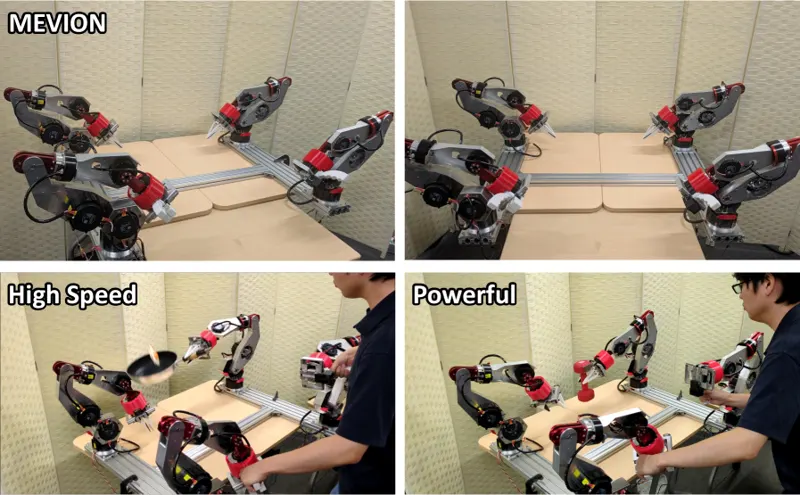
The global competition for developing robotic foundation models is intensifying. Among the data collection systems used for dual-arm robots, ALOHA is representative of being low-cost and open-source, and is widely adopted by researchers as a de facto standard. However, due to its limited ability to generate high forces and speeds, it is difficult to handle heavy objects or perform fast manipulations. To address this, we developed MEVION, a low-cost and open-source dual-arm robot data collection system capable of generating greater force and speed. All parts of this robot can be sourced through e-commerce, and by extensively utilizing sheet metal welding, its large body structure is constructed with a small number of components at low cost, while also simplifying assembly. MEVION is equipped with four 6-DoF arms with parallel grippers. Each arm weighs 7.0 kg and has a maximum torque of 60 Nm, and the entire system can be constructed for about USD 14,000. The elbow joint adopts a closed-link mechanism similar to those used in quadruped robots, which reduces the distal mass and enables higher force and speed output at the end-effector. We demonstrate that MEVION enables data collection for object manipulation tasks not previously possible and supports imitation learning-based motion generation. All hardware and software of this work are included in the Supplementary Materials or https://github.com/haraduka/mevion.

Data CollectionDual-Arm
Kento Kawaharazuka, Yoshiki Obinata, Hirokazu Ishida · 476 views · Jul 20, 2026

As an Amazon Associate, we earn from qualifying purchases.