Skip to content
Gait-Adaptive Perceptive Humanoid Locomotion with Real-Time Under-Base Terrain Reconstruction

Gait-Adaptive Perceptive Humanoid Locomotion with Real-Time Under-Base Terrain Reconstruction

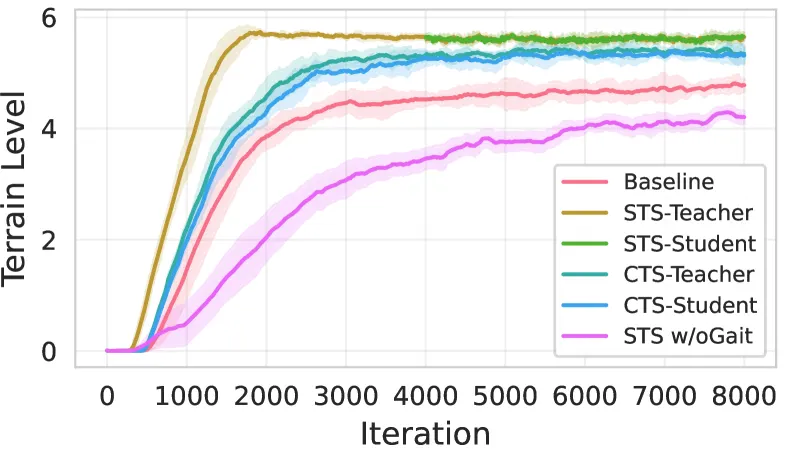
For full-size humanoid robots, even with recent advances in reinforcement learning-based control, achieving reliable locomotion on complex terrains, such as long staircases, remains challenging. In such settings, limited perception, ambiguous terrain cues, and insufficient adaptation of gait timing can cause even a single misplaced or mistimed step to result in rapid loss of balance. We introduce a perceptive locomotion framework that merges terrain sensing, gait regulation, and whole-body control into a single reinforcement learning policy. A downward-facing depth camera mounted under the base observes the support region around the feet, and a compact U-Net reconstructs a dense egocentric height map from each frame in real time, operating at the same frequency as the control loop. The perceptual height map, together with proprioceptive observations, is processed by a unified policy that produces joint commands and a global stepping-phase signal, allowing gait timing and whole-body posture to be adapted jointly to the commanded motion and local terrain geometry. We further adopt a single-stage successive teacher-student training scheme for efficient policy learning and knowledge transfer. Experiments conducted on a 31-DoF, 1.65 m humanoid robot demonstrate robust locomotion in both simulation and real-world settings, including forward and backward stair ascent and descent, as well as crossing a 46 cm gap. Project Page:https://ga-phl.github.io/

HumanoidGait Adaptation
Haolin Song, Hongbo Zhu, Tao Yu · 501 views · Dec 8, 2025
Explicit Stair Geometry Conditioning for Robust Humanoid Locomotion

Explicit Stair Geometry Conditioning for Robust Humanoid Locomotion

Robust humanoid stair climbing remains challenging due to geometric discontinuities, sensitivity to step height variations, and perception uncertainty in real-world environments. Existing learning-based locomotion policies often rely on implicit terrain representations or blind proprioceptive feedback, limiting their ability to generalize across varying stair geometries and to anticipate required gait adjustments. This paper proposes an explicit stair geometry conditioning framework for robust humanoid stair climbing. Instead of encoding terrain as high-dimensional latent features, we extract a compact set of interpretable geometric parameters, including step height, step depth, and current yaw angle relative to the robot heading. These explicit stair parameters directly condition a Proximal Policy Optimization (PPO)-based locomotion policy, enabling proactive modulation of swing-foot clearance and stride characteristics according to stair structure. Simulation experiments demonstrate improved generalization across unseen stair heights beyond the training distribution. Real-world experiments on the Unitree G1 humanoid validate reliable indoor and outdoor stair traversal. In challenging outdoor scenarios, the robot successfully ascends 33 consecutive steps without failure, demonstrating robustness and practical deployability.

HumanoidStair Climbing
Jianguo Zhang, Wentai Xu, Shusheng Ye · 452 views · May 11, 2026
NSL-SLAM: High-Fidelity Neural Structured-Light Depth for Practical SLAM and Reconstruction

NSL-SLAM: High-Fidelity Neural Structured-Light Depth for Practical SLAM and Reconstruction

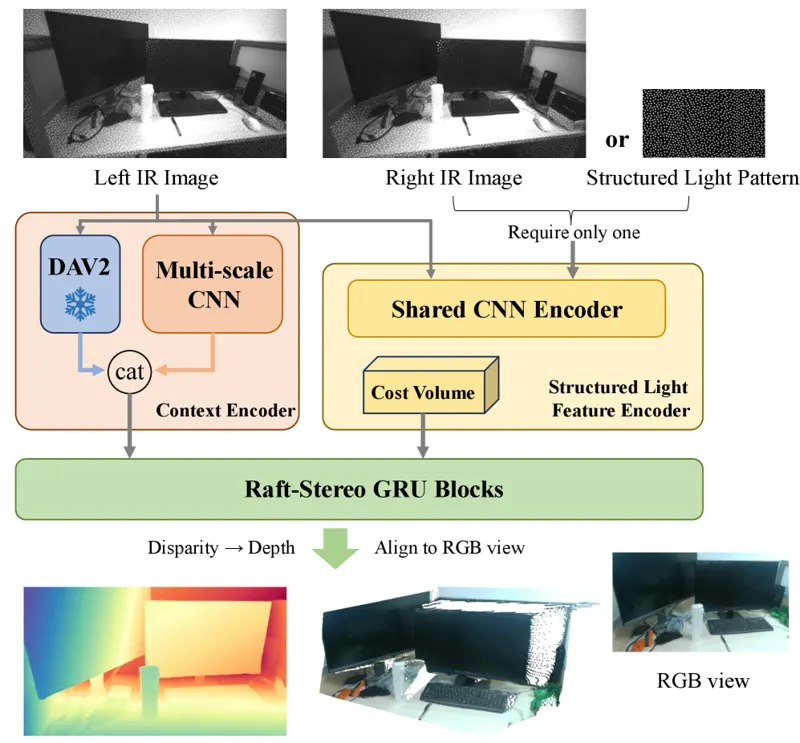
Structured-light (SL) cameras power depth sensing in millions of devices, and recent neural SL decoding methods have substantially improved their depth quality. SLAM systems can benefit greatly from such strong depth sensing, where reliable geometry enables stable tracking and faithful reconstruction. In this work, we present NSL-SLAM, a practical SLAM system tailored for high-fidelity structured-light depth. We first strengthen SL depth sensing: inspired by the neural structured-light (NSL) method, we further incorporate strong monocular depth priors into the SL stereo decoding, reducing depth RMSE by 35% on Replica-SL compared to NSL. We then build a depth-centric SLAM pipeline with this stronger depth: because structured-light geometry is dense and metrically accurate, we keep it as the primary tracking signal, and add only sparse visual correspondences for geometrically degenerate cases and lightweight bundle adjustment for long-range drift. Our depth estimator and SLAM design reinforce each other: stronger depth makes a simple SLAM pipeline effective, and the depth-centric pipeline ensures this advantage transfers to downstream reconstruction. Experimentally, on the synthetic Replica-SL benchmark, NSL-SLAM achieves the best tracking accuracy and improves reconstruction F-score by 1.6 points over the SOTA baseline under a shared-depth protocol. On a real benchmark of 8 challenging scenes, it is the only method that avoids catastrophic failure on all sequences while achieving 43.3% lower trajectory deviation than selected baselines. The SLAM system runs online at 20.9 FPS, demonstrating that stronger structured-light depth and depth-centric system design together enable practical, robust SLAM.

SLAMStructured Light Depth
Jiaheng Li, Binsheng Zhang, Xinhai Chang · 444 views · Jul 27, 2026
Heavy lifting tasks via haptic teleoperation of a wheeled humanoid

Heavy lifting tasks via haptic teleoperation of a wheeled humanoid

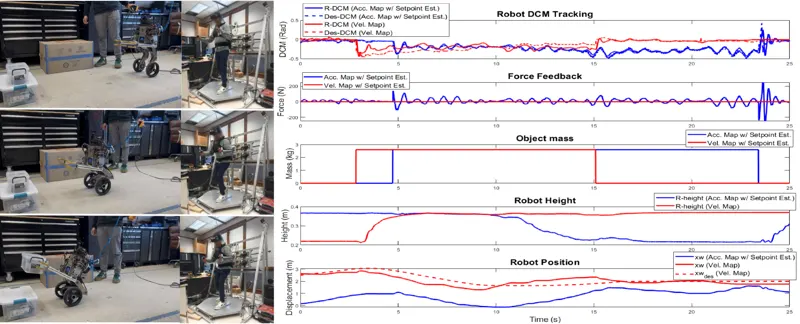
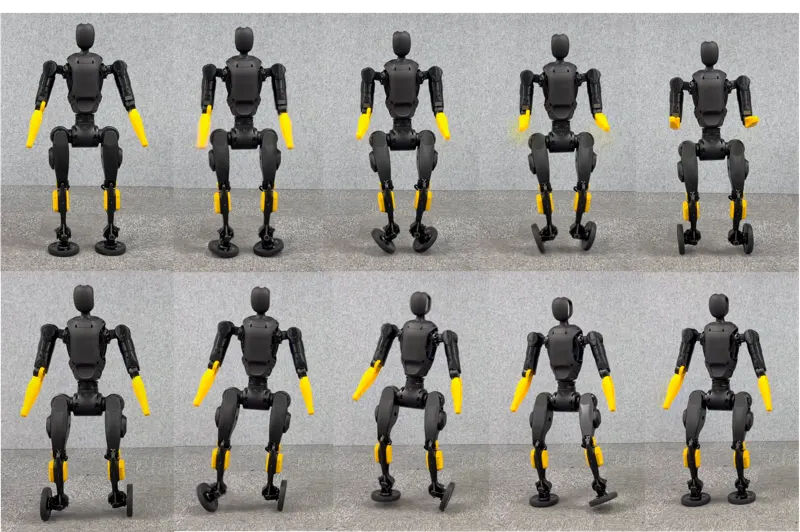
Humanoid robots can support human workers in physically demanding environments by performing tasks that require whole-body coordination, such as lifting and transporting heavy objects.These tasks, which we refer to as Dynamic Mobile Manipulation (DMM), require the simultaneous control of locomotion, manipulation, and posture under dynamic interaction forces. This paper presents a teleoperation framework for DMM on a height-adjustable wheeled humanoid robot for carrying heavy payloads. A Human-Machine Interface (HMI) enables whole-body motion retargeting from the human pilot to the robot by capturing the motion of the human and applying haptic feedback. The pilot uses body motion to regulate robot posture and locomotion, while arm movements guide manipulation.Real time haptic feedback delivers end effector wrenches and balance related cues, closing the loop between human perception and robot environment interaction. We evaluate the different telelocomotion mappings that offer varying levels of balance assistance, allowing the pilot to either manually or automatically regulate the robot's lean in response to payload-induced disturbances. The system is validated in experiments involving dynamic lifting of barbells and boxes up to 2.5 kg (21% of robot mass), demonstrating coordinated whole-body control, height variation, and disturbance handling under pilot guidance. Video demo can be found at: https://youtu.be/jF270_bG1h8?feature=shared

TeleoperationTactile Feedback
Amartya Purushottam, Jack Yan, Christopher Yu · 454 views · May 26, 2025
Per-Group Error, Not Total MSE: Fine-Tuning Vision-Language-Action Models for 11-DoF Mobile Manipulation

Per-Group Error, Not Total MSE: Fine-Tuning Vision-Language-Action Models for 11-DoF Mobile Manipulation

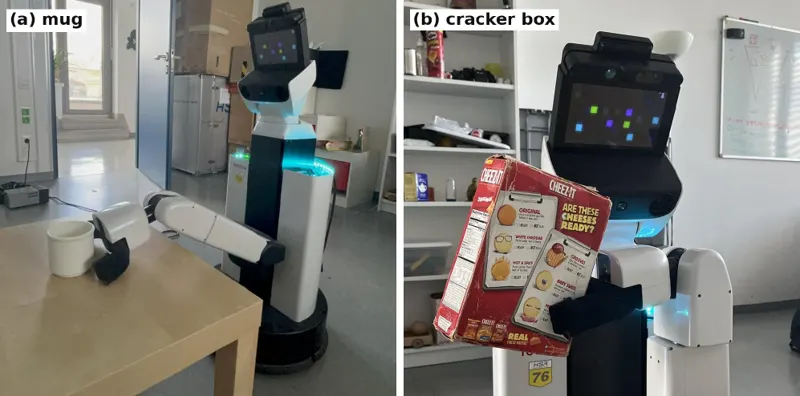
Fine-tuning Vision-Language-Action (VLA) models for mobile manipulators with heterogeneous joint spaces can produce a counterintuitive result: the checkpoint with the lowest aggregate MSE is not the one that performs best on the real robot. We argue this is a predictable consequence of collapsing heterogeneous joint groups (arm, gripper, head, wheeled base) into a single metric, where easy-to-predict joints can mask joints that still fail. We fine-tune SmolVLA (450M, action-expert only) on the 11-DoF Toyota HSR and compare it against π_0.5 (3.3B), a stronger pretrained baseline. Per-group analysis exposes two patterns: in SmolVLA, the mobile base converges slowest and limits overall performance. In expert-only fine-tuning of π_0.5 (training only the action head, backbone frozen), total MSE drops below the baseline but arm accuracy degrades. On 60 real-robot trials (20 per model), π_0.5 80k (4.0/4) significantly outperforms both fine-tuned variants (expert-only 3k: 3.75/4; HSR-SmolVLA: 3.5/4; Mann-Whitney p ≤ 0.010), despite expert-only 3k having the lowest total MSE. This separation is most consistent with the offline arm-group error, not total MSE or base-group error. We conclude that per-group error is a more reliable signal than total MSE for checkpoint selection on robots with heterogeneous action spaces. Code: https://github.com/paumontagut/per-group-mse-vla

VLA ModelMobile Manipulation
Pau Montagut Bofi, Mario García Blasco, Tessa Pulli · 440 views · May 29, 2026
Whole-body Motion Control of an Omnidirectional Wheel-Legged Mobile Manipulator via Contact-Aware Dynamic Optimization

Whole-body Motion Control of an Omnidirectional Wheel-Legged Mobile Manipulator via Contact-Aware Dynamic Optimization

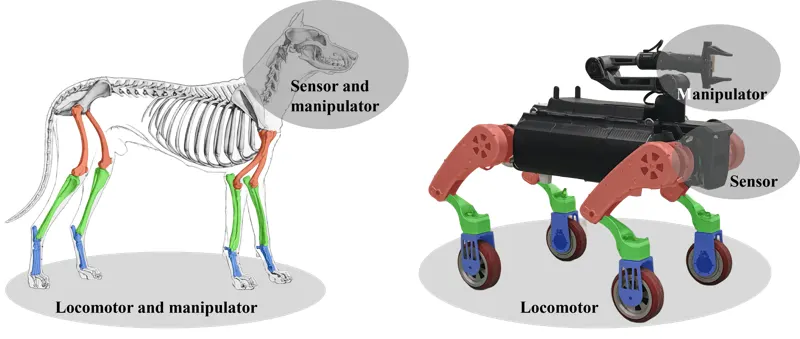
Wheel-legged robots with integrated manipulators hold great promise for mobile manipulation in logistics, industrial automation, and human-robot collaboration. However, unified control of such systems remains challenging due to the redundancy in degrees of freedom, complex wheel-ground contact dynamics, and the need for seamless coordination between locomotion and manipulation. In this work, we present the design and whole-body motion control of an omnidirectional wheel-legged quadrupedal robot equipped with a dexterous manipulator. The proposed platform incorporates independently actuated steering modules and hub-driven wheels, enabling agile omnidirectional locomotion with high maneuverability in structured environments. To address the challenges of contact-rich interaction, we develop a contact-aware whole-body dynamic optimization framework that integrates point-contact modeling for manipulation with line-contact modeling for wheel-ground interactions. A warm-start strategy is introduced to accelerate online optimization, ensuring real-time feasibility for high-dimensional control. Furthermore, a unified kinematic model tailored for the robot's 4WIS-4WID actuation scheme eliminates the need for mode switching across different locomotion strategies, improving control consistency and robustness. Simulation and experimental results validate the effectiveness of the proposed framework, demonstrating agile terrain traversal, high-speed omnidirectional mobility, and precise manipulation under diverse scenarios, underscoring the system's potential for factory automation, urban logistics, and service robotics in semi-structured environments.

Wheel-legged robotsWhole-Body Control
Zong Chen, Shaoyang Li, Ben Liu · 442 views · Sep 17, 2025
Multi-critic Learning for Whole-body End-effector Twist Tracking

Multi-critic Learning for Whole-body End-effector Twist Tracking

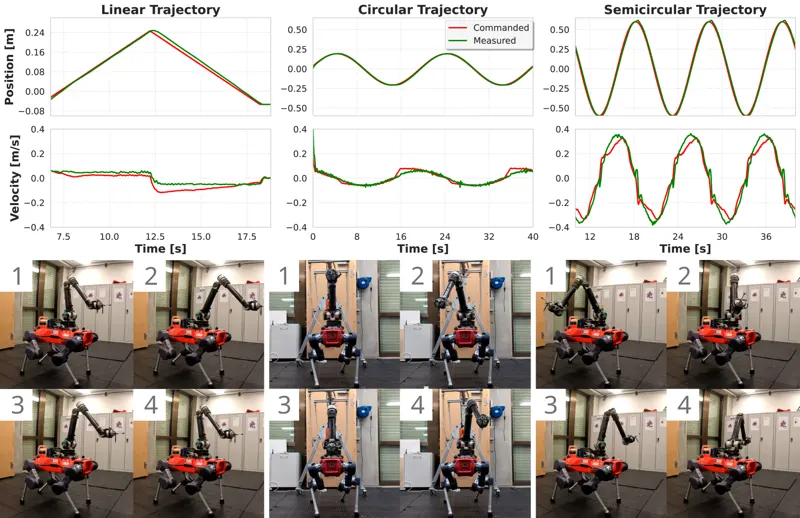
Learning whole-body control for locomotion and arm motions in a single policy has challenges, as the two tasks have conflicting goals. For instance, efficient locomotion typically favors a horizontal base orientation, while end-effector tracking may benefit from base tilting to extend reachability. Additionally, current Reinforcement Learning (RL) approaches using a pose-based task specification lack the ability to directly control the end-effector velocity, making smoothly executing trajectories very challenging. To address these limitations, we propose an RL-based framework that allows for dynamic, velocity-aware whole-body end-effector control. Our method introduces a multi-critic actor architecture that decouples the reward signals for locomotion and manipulation, simplifying reward tuning and allowing the policy to resolve task conflicts more effectively. Furthermore, we design a twist-based end-effector task formulation that can track both discrete poses and motion trajectories. We validate our approach through a set of simulation and hardware experiments using a quadruped robot equipped with a robotic arm. The resulting controller can simultaneously walk and move its end-effector and shows emergent whole-body behaviors, where the base assists the arm in extending the workspace, despite a lack of explicit formulations. Videos and supplementary material can be found at multi-critic-locomanipulation.github.io.

Reinforcement LearningWhole-Body Control
Aravind Elanjimattathil Vijayan, Andrei Cramariuc, Mattia Risiglione · 403 views · Jul 11, 2025

As an Amazon Associate, we earn from qualifying purchases.