PAPER DEEP DIVE
MoE-Loco: Mixture of Experts for Multitask Locomotion
We present MoE-Loco, a Mixture of Experts (MoE) framework for multitask locomotion for legged robots. Our method enables a single policy to handle diverse terrains, including bars, pits, stairs, slopes, and baffles, while supporting quadrupedal and bipedal gaits. Using MoE, we mitigate the gradient conflicts that typically arise in multitask reinforcement learning, improving both training efficiency and performance. Our experiments demonstrate that different experts naturally specialize in distinct locomotion behaviors, which can be leveraged for task migration and skill composition. We further validate our approach in both simulation and real-world deployment, showcasing its robustness and adaptability.
MoE-Loco: Mixture of Experts for Multitask Locomotion
Paper: MoE-Loco: Mixture of Experts for Multitask Locomotion
Authors: Runhan Huang, Shaoting Zhu, Yilun Du, Hang Zhao (Tsinghua IIIS / Shanghai Qi Zhi Institute / MIT)
Link: arXiv:2503.08564 | Project: moe-loco.github.io | Platform: Unitree Go2
One-line summary: Replacing a single MLP policy with a Mixture of Experts architecture lets one policy handle bars, pits, stairs, slopes, and baffles across quadrupedal and bipedal gaits, boosting mixed-task success from 57.1% to 87.9%, with naturally specialized experts recomposable into new skills.
Background and Motivation
Reinforcement learning has become the dominant paradigm for training robot locomotion policies, but single-task RL success has not naturally extended to multitask settings. Learning a unified policy across multiple terrains and gait modes remains challenging. The core problem is gradient conflict in multitask reinforcement learning (MTRL): when gradient directions from different tasks diverge, simple neural network architectures lead to poor training efficiency and even model divergence. This is especially severe when spanning quadrupedal and bipedal gaits—fundamentally different kinematics, dynamics, and reward structures.
Existing work attempts diverse terrains in parallel simulation training, but gradient conflicts in MTRL remain unresolved. ManyQuadrupeds focuses on unified policies across quadruped categories. MELA uses pretrained expert models but only addresses basic skills with heavy reward engineering. MTAC attempts hierarchical RL across terrains but handles only one gait with three simple terrains, without real-world deployment.
MoE-Loco's core idea: introduce the Mixture of Experts architecture into locomotion policy training, letting gradients naturally flow to specialized expert modules, structurally mitigating gradient conflicts. Different experts naturally specialize in distinct locomotion behaviors, which can be leveraged for task migration and skill composition—manually adjusting expert weight ratios to synthesize new skills.
Method
1. Task Definition
This work focuses on 9 challenging locomotion tasks spanning quadrupedal gaits (bar crossing, pit crossing, baffle crawling, stair climbing, slope walking) and bipedal gaits (standing, plane walking, slope walking, stair descending). The robot is controlled via joystick velocity commands, with a one-hot vector $g$ indicating quadrupedal ($g=0$) or bipedal ($g=1$) gait. Multitask locomotion is defined as an MDP $\langle S_{\tau},A_{\tau},T_{\tau},R_{\tau},\gamma_{\tau}\rangle$, where different terrains correspond to different state subspaces $S_{\tau}\subseteq S$, reward $R$ varies by gait, and termination conditions depend on gait type. The goal is a single universal policy maximizing cumulative reward across tasks:
$$J(\pi)=\mathbb{E}\left[\sum_{\tau}\sum_{t=0}^{\infty}\gamma^{t}R_{\tau}(s_{t},a_{t},s_{t+1})\right]$$
2. MoE-Based Multitask Locomotion Learning
Uses a two-stage teacher-student framework with PPO. State space includes four observation types: proprioception $\boldsymbol{p}_t$ (projected gravity, base angular velocity, joint positions/velocities, last action), explicit privileged state $\boldsymbol{e}_t$ (base linear/angular velocity), implicit privileged state $\boldsymbol{i}_t$ (per-link contact forces, encoded to low-dimensional latent to reduce sim-to-real gap), and command $\boldsymbol{c}_t$ (velocity command $V=(v_x,v_y,v_{\text{yaw}})$ and gait one-hot $g$). Action space $\boldsymbol{a}_t\in\mathbb{R}^{12}$ is desired joint positions for 12 joints.
Reward: quadrupedal $r^{\text{quad}}=r^{\text{quad}}_{\text{track}}+r^{\text{quad}}_{\text{reg}}$; bipedal $r^{\text{bip}}=r^{\text{bip}}_{\text{track}}+r^{\text{bip}}_{\text{stand}}+r^{\text{bip}}_{\text{reg}}$. Termination: quadrupedal terminates when $\theta_{\text{roll}}>1.0$ or $\theta_{\text{pitch}}>1.6$; bipedal terminates when any link except rear feet and calf contacts ground after 1 second.
MoE module is the core innovation. In stage 1 (Oracle policy), all observations $[\boldsymbol{p}_t,\boldsymbol{e}_t,\boldsymbol{i}_t,\boldsymbol{c}_t]$ are available. The implicit state is encoded and concatenated with explicit privileged and proprioception to form dual-state representation $\boldsymbol{l}_t=[\text{Enc}(\boldsymbol{i}_t),\boldsymbol{e}_t,\boldsymbol{p}_t]$, which an LSTM processes into $\boldsymbol{h}_t$. The MoE module is introduced into both actor and critic:
$$\hat{g}_{i}=\text{softmax}(g(\boldsymbol{h}_{t}))[i]$$
$$\boldsymbol{a}_{t}=\sum_{i=1}^{N}\hat{g}_{i}\cdot f_{i}(\boldsymbol{h}_{t})$$
where $g$ is the gating network and $f_i$ is expert $i$. Actor and critic MoE share the same gating network, ensuring consistency between policy evaluation and action generation. MoE dynamically routes tasks to appropriate experts, promoting coordination of similar skills while minimizing conflicts between heterogeneous tasks. Total optimization: $L_{\text{surro}}+L_{\text{value}}+L_{\text{recon}}$.
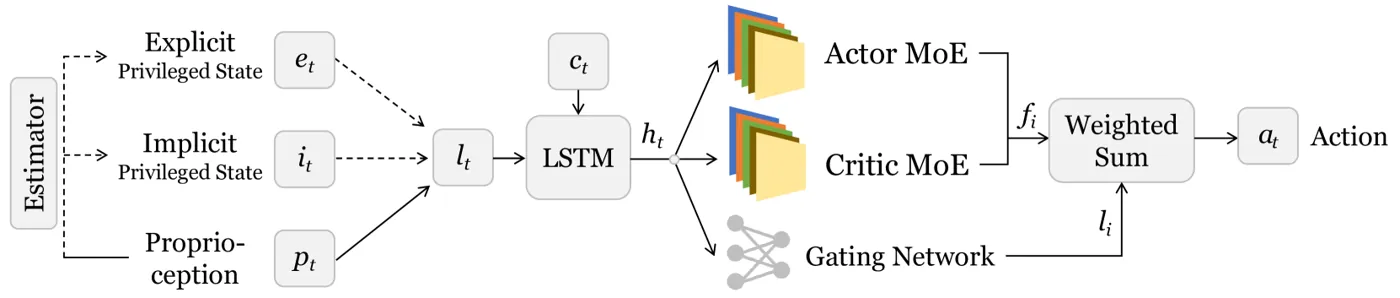
Figure 3: MoE-Loco pipeline overview. The MoE architecture enables robust multitask locomotion across challenging terrains and multiple gaits.
3. Skill Decomposition and Composition
The MoE framework provides a natural solution for skill composition by dynamically decomposing tasks into different skill experts. Using pretrained experts with modified gating weights:
$$\hat{g}_{i}=w[i]\cdot\text{softmax}(g(\boldsymbol{h}_{t}))[i]$$
where $w[i]$ can be manually defined or dynamically adjusted by a neural network. This enables constructing new locomotion strategies without additional training—each expert naturally specializes in different movement aspects (balancing, crawling, obstacle crossing), and selective weight adjustment synthesizes new gait patterns.
graph TD
  A[Obs: p_t + e_t + i_t + c_t] --> B[Encoder Enc]
  B --> C[Dual-state l_t]
  C --> D[LSTM]
  D --> E[Hidden state h_t]
  E --> F[Gating Network g]
  F --> G[Gate Scores softmax]
  E --> H[Expert 1 f_1]
  E --> I[Expert 2 f_2]
  E --> J[Expert N f_N]
  G --> K[Weighted Sum]
  H --> K
  I --> K
  J --> K
  K --> L[Action a_t]
  style F fill:#f5a623,stroke:#b97316,color:#fff
  style K fill:#4a90d9,stroke:#2c5f8a,color:#fff
  style L fill:#7ed321,stroke:#4a8a14,color:#fff
4. Two-Stage Training
Stage 1 trains the Oracle policy (with privileged info) and pretrains the estimator. Stage 2 accesses only $[\boldsymbol{p}_t,\boldsymbol{c}_t]$; estimator/LSTM/MoE weights are copied from stage 1, and Probability Annealing Selection (PAS) gradually adapts to imprecise estimates. Simulation in IsaacGym with 4096 parallel robots on RTX 3090: 40,000 iterations plane walking, 80,000 challenging terrain, 10,000 PAS adaptation. 50Hz control, deployed on Unitree Go2 (Jetson Orin), PD control $K_p=40.0, K_d=0.5$, $N_{\text{exp}}=6$.
Experimental Results
Simulation Comparison
Baselines: Ours w/o MoE (same framework, MoE replaced by equal-parameter MLP) and RMA (1D-CNN adaptation module). The mixed-task runway contains bars, pits, baffles, up/down stairs, up/down slopes.
| Method | Mix SR | Bar(q) | Baffle(q) | Stair(q) | Pit(q) | Slope(q) | Walk(b) | Slope(b) | Stair(b) |
|---|---|---|---|---|---|---|---|---|---|
| MoE-Loco | 0.879 | 0.886 | 0.924 | 0.684 | 0.902 | 0.956 | 0.932 | 0.961 | 0.964 |
| w/o MoE | 0.571 | 0.848 | 0.264 | 0.568 | 0.698 | 0.988 | 0.826 | 0.504 | 0.453 |
| RMA | 0.000 | 0.871 | 0.058 | 0.017 | 0.017 | 0.437 | 0.000 | 0.000 | 0.000 |
MoE policy achieves the best across all three metrics. Mixed-task success rate rises from 57.1% (w/o MoE) to 87.9%. Except quadrupedal slope walking (relatively simple), MoE outperforms baselines on all single tasks. RMA completely fails in mixed scenarios (0% success) due to its MLP+CNN architecture's inability to handle multi-gait multi-terrain.

Figure 2: Terrain settings. Left to right: bar, pit, baffle, slope, stairs.
| Training Stage | Iterations | Objective |
|---|---|---|
| Plane walking | 40,000 | Basic quadrupedal + bipedal gaits |
| Challenging terrain | 80,000 | Bars/pits/baffles/stairs/slopes |
| PAS adaptation | 10,000 | Pure proprioception adaptation |
Real-World Experiments
Zero-shot deployment on real Go2. Mixed terrain: 20cm bar, 22cm baffle, 15cm stairs, 20cm pit, 30° slope (quadrupedal), then bipedal command to stand, walk 30° slope, turn and descend. 20 trials per test for average success rate.
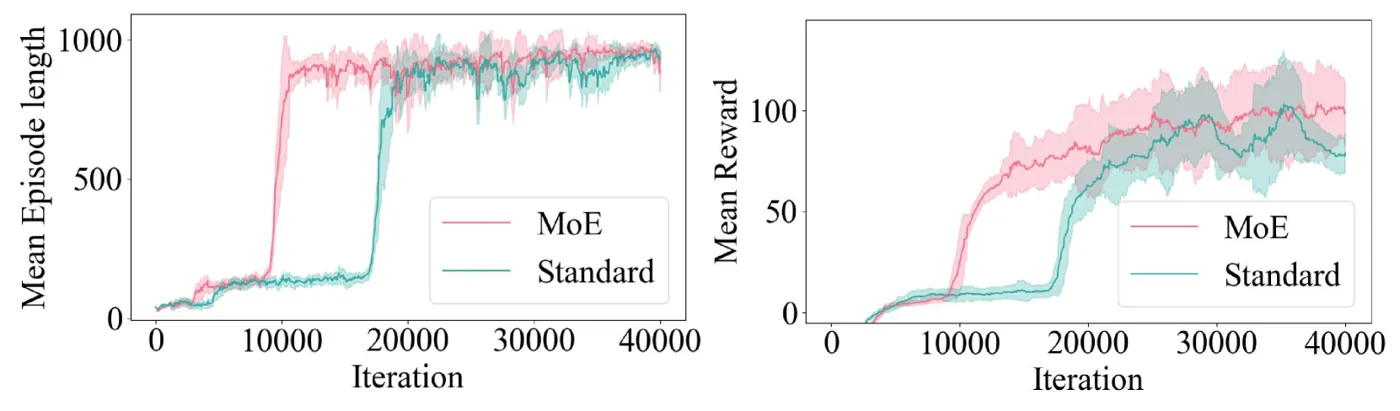
Figure 4: Real-world success rate across multiple terrains and gaits.
Expert Specialization and Skill Composition
Quantitative analysis shows different experts naturally specialize in distinct locomotion behaviors. By adjusting gating weights $w[i]$, new skills can be composed without additional training—e.g., blending balancing and obstacle-crossing experts generates gait patterns adapted to specific new terrains.
Multi-robot objective
$$ J(\pi)=\mathbb{E}\left[\sum_{\tau}\sum_{t=0}^{\infty}\gamma^{t}R_{\tau}(s_{t},a_{t},s_{t+1})\right] $$
LimitationsAuthor-stated: On quadrupedal slope walking, MoE slightly underperforms the w/o MoE variant, likely because this task is relatively simple and MoE routing overhead introduces a minor negative effect.
Analysis: Expert count is fixed at 6; how to optimally choose expert count for different task complexities is not discussed. Skill composition relies on manual weight adjustment $w[i]$, lacking automated new-skill discovery. Only proprioception is used (blind locomotion); no visual perception integration, limiting scenarios requiring distant terrain sensing. Bipedal gaits only cover standing, plane, slope, and stair descending—not more challenging bipedal stair climbing or obstacle crossing. Real-world mixed-terrain success rates are not fully reported in the main text.
Conclusion and Future Work
MoE-Loco demonstrates the effectiveness of the Mixture of Experts architecture in structurally resolving gradient conflicts in multitask locomotion. Six experts naturally specialize into different locomotion behaviors within a single policy, handling 9 tasks across 5 terrains × 2 gaits. The shared gating network ensures actor-critic routing consistency. The skill composition formula $\hat{g}_i=w[i]\cdot\text{softmax}(g(\boldsymbol{h}_t))[i]$ provides a no-retraining interface for new skill synthesis. Two-stage teacher-student training with PAS enables zero-shot sim-to-real transfer.
The key to one policy managing nine tasks isn't making the network bigger—it's letting different experts handle their own specialties while the gating network learns who to listen to and when.
SOURCE LINKS