Skip to content
ABot-AgentOS: A General Robotic Agent OS with Lifelong Multi-modal Memory

ABot-AgentOS: A General Robotic Agent OS with Lifelong Multi-modal Memory

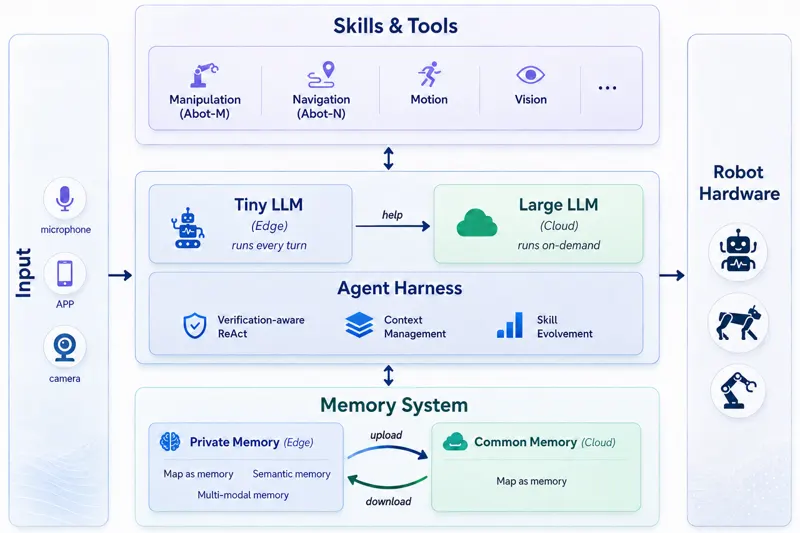
Recent VLM and VLA systems have improved robotic perception and action prediction, yet long-horizon embodied agents still require a general runtime layer for reasoning, memory, tool use, verification, and cross-embodiment execution. We present ABot-AgentOS, a general robotic Agent Operating System that sits above low-level controllers and provides a deliberative agent layer for scene-conditioned planning, context-isolated skill execution, multi-stage verification, multi-modal memory, and edge-cloud collaboration. To evaluate such systems, we introduce EmbodiedWorldBench, an executable benchmark with 16 indoor, outdoor, and hybrid scenes, four difficulty levels, and over 200 tasks involving navigation, object search, NPC dialogue, dynamic events, and trace-grounded scoring. ABot-AgentOS further introduces Universal Multi-modal Graph Memory, a persistent source-grounded substrate that converts dialogue, visual observations, spatial context, temporal relations, and task traces into typed nodes and edges. A failure-driven self-evolution loop converts diagnosed memory failures into gated runtime evo-assets that are promoted only to later evaluation splits, preventing current-split ground-truth leakage while enabling continual improvement. On an initial EmbodiedWorldBench subset, ABot-AgentOS improves over a single-controller baseline in both task success and goal completion. Across memory benchmarks, ABot-AgentOS Static achieves 87.5 on LoCoMo, 59.9 on OpenEQA EM-EQA, 88.6 on Mem-Gallery, and 76.5 Acc@All on NExT-QA; self-evolution further improves LoCoMo to 88.7, OpenEQA to 60.4, and Mem-Gallery to 89.0. These results suggest that a general Agent OS layer can improve long-horizon embodied execution while providing persistent, auditable memory for continual interaction.

AgentOSEmbodiedWorldBench
Jiayi Tian, Shiao Liu, Yuting Xu · 771 views · Jul 11, 2026
Learning Athletic Humanoid Tennis Skills from Imperfect Human Motion Data

Learning Athletic Humanoid Tennis Skills from Imperfect Human Motion Data

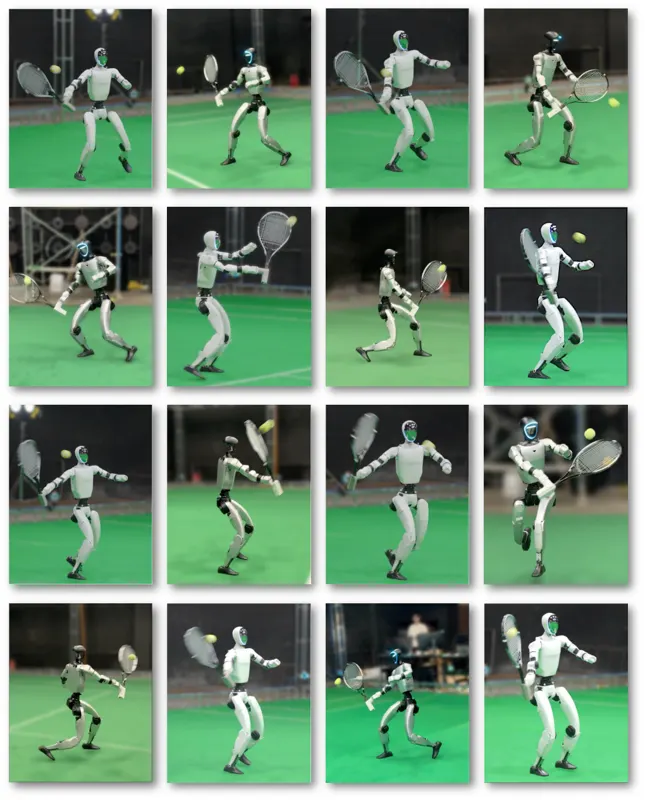
Human athletes demonstrate versatile and highly-dynamic tennis skills to successfully conduct competitive rallies with a high-speed tennis ball. However, reproducing such behaviors on humanoid robots is difficult, partially due to the lack of perfect humanoid action data or human kinematic motion data in tennis scenarios as reference. In this work, we propose LATENT, a system that Learns Athletic humanoid TEnnis skills from imperfect human motioN daTa. The imperfect human motion data consist only of motion fragments that capture the primitive skills used when playing tennis rather than precise and complete human-tennis motion sequences from real-world tennis matches, thereby significantly reducing the difficulty of data collection. Our key insight is that, despite being imperfect, such quasi-realistic data still provide priors about human primitive skills in tennis scenarios. With further correction and composition, we learn a humanoid policy that can consistently strike incoming balls under a wide range of conditions and return them to target locations, while preserving natural motion styles. We also propose a series of designs for robust sim-to-real transfer and deploy our policy on the Unitree G1 humanoid robot. Our method achieves surprising results in the real world and can stably sustain multi-shot rallies with human players. Project page: https://zzk273.github.io/LATENT/

LATENTSim-to-Real
Zhikai Zhang, Haofei Lu, Yunrui Lian · 688 views · Mar 13, 2026
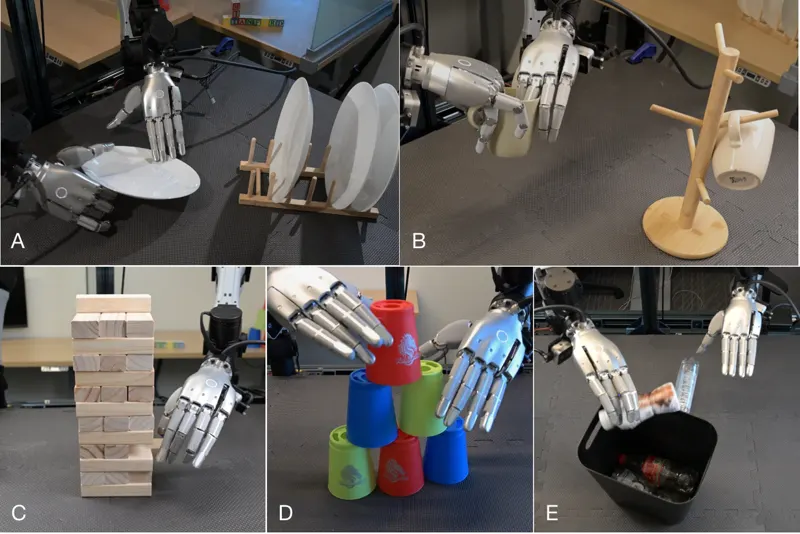
Pre-training Visual Dexterity in Simulation

Pre-training Visual Dexterity in Simulation

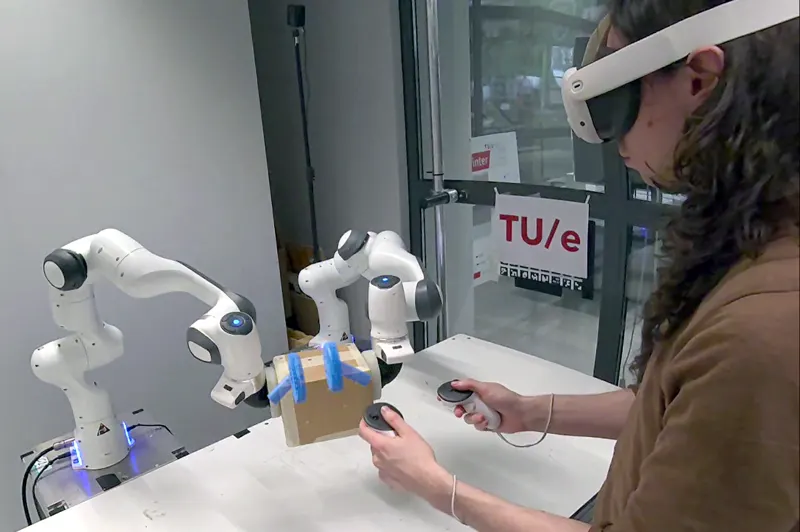
Large-scale pre-training has made robot policy fine-tuning increasingly data-efficient, but this progress has largely been driven by datasets and embodiments built around simple parallel-jaw grippers. Dexterous, multi-fingered hands remain comparatively data-starved because real teleoperation is costly to scale, while human hand video is off-embodiment and requires lossy pose estimation and retargeting. We introduce Simulation Pre-training for Dexterity (SPD), a pre-training framework for dexterous manipulation that uses data entirely collected in simulation. In SPD, humans manipulate virtual objects inside a VR headset, enabling on-embodiment trajectories and robot-free collection. With the help of five operators, we collect 75 hours of multi-task dexterous manipulation over one week, and use it to pre-train a causal transformer on a sequence modeling objective. We study the benefits of simulation pre-training on real-world tasks by fine-tuning on 1-2 hours of physical demonstrations on a 56-DoF bimanual dexterous setup. We find that our approach outperforms training behavior cloning policies from scratch, showing that simulation teleoperation is a viable pre-training source for real-world dexterous manipulation. We perform ablation studies, measuring the benefits of history conditioning and short action chunks for reactive control.

Sim-to-RealDexterous Manipulation
Sarthak Kamat, Adam Rashid, Satvik Sharma · 837 views · Aug 16, 2026
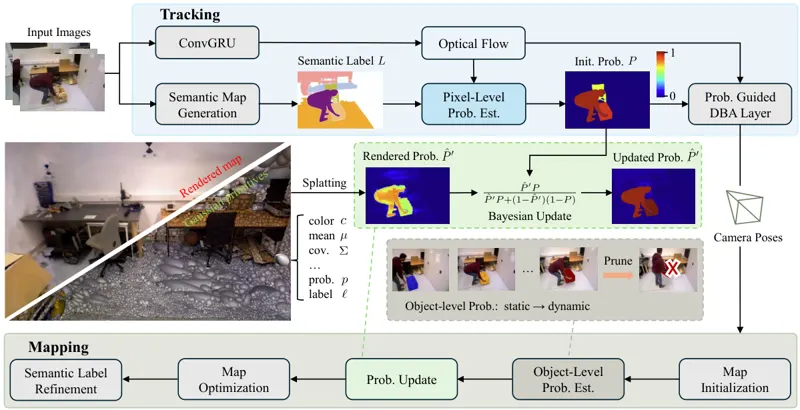
DL-SLAM: Enabling High-Fidelity Gaussian Splatting SLAM in Dynamic Environments based on Dual-Level Probability

DL-SLAM: Enabling High-Fidelity Gaussian Splatting SLAM in Dynamic Environments based on Dual-Level Probability

Recent advances in 3D Gaussian Splatting (3DGS) have enabled significant progress in dense dynamic Simultaneous Localization And Mapping (SLAM). Prevailing methods typically discard predefined dynamic objects, ignoring that transiently static objects offer valuable geometric constraints for pose estimation. A recent work attempts to leverage this potential by employing per-pixel uncertainty maps to quantify the magnitude of motion. While this approach enables transiently static objects to enhance pose estimation, it erroneously integrates these objects into the static map, resulting in persistent artifacts. Moreover, its reliance on purely geometric information leads to ambiguous object boundaries in the uncertainty maps. To overcome these limitations, we present DL-SLAM, a monocular Gaussian Splatting SLAM system built upon a novel dual-level probabilistic framework. Our method computes dynamic probability maps by combining semantic and geometric information. These pixel-level probabilities are lifted to 3D and aggregated to derive an object-level dynamic probability for each instance. Object-level probability enables the categorical pruning of dynamic Gaussians, resulting in an artifact-free static map. The static map, in turn, provides a geometrically consistent guidance to refine the pixel-wise probabilities, enhancing their reliability. Experimental results demonstrate that DL-SLAM outperforms existing approaches, improving tracking accuracy by up to 13% while generating high-fidelity semantic maps.

Dynamic EnvironmentSLAM
Ziheng Xu, Qingfeng Li, Xuefeng Liu · 802 views · Jul 2, 2026
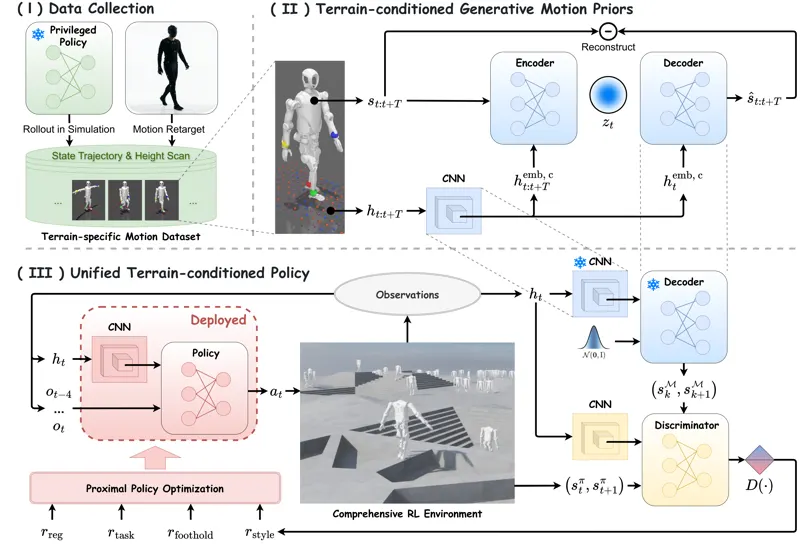
Tac4Loco: Learning Spatiotemporal Plantar Pressure Representations for Humanoid Locomotion

Tac4Loco: Learning Spatiotemporal Plantar Pressure Representations for Humanoid Locomotion

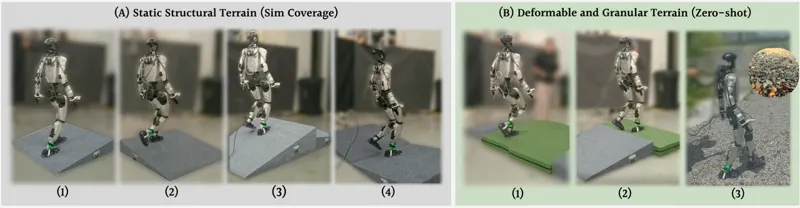
Humanoid robots are expected to traverse complex terrains, where the plantar support may vary dramatically due to foot placement errors, ground properties, and transient dynamics. To achieve robust locomotion, the robots are required to adapt to uneven terrain and uncertain foot–ground interactions. Existing locomotion policies rely primarily on proprioception or exteroceptive terrain perception, where the former provides only indirect evidence of plantar support, while the latter predicts contact conditions before touchdown but cannot observe the actual support in real-time. Although some studies incorporate plantar contacts as an auxiliary perception, they rely mainly on summary statistics, overlooking the spatial topology of plantar pressure, which provides a more direct characterization of the realized contact state. To bridge this gap, we present Tac4Loco, a tactile-perceptive framework that incorporates multi-array plantar pressure as direct feedback for humanoid locomotion. We formulate a topology-preserving ordinal representation to map simulated and physical sensor signals into a shared observation space, with a dual-branch encoder for extracting their spatial and temporal representations. Subsequently, the learned spatiotemporal features are integrated with augmented proprioception including terrain estimation cues, and provided to an asymmetric actor-critic architecture for policy learning. Extensive simulation and real-world experiments demonstrate improved tracking performance and support adaptation on terrains with inclined, partial, asymmetric, and changing support. We further demonstrate its zero-shot deployment on unseen compliant and unstructured terrains, including a foam platform and a gravel road. All code and experimental configurations will be released as open-source to facilitate reproducibility.

Tac4LocoLocomotion
Ziyun Liu, Sikai Guo, Zheng Li · 620 views · Aug 16, 2026
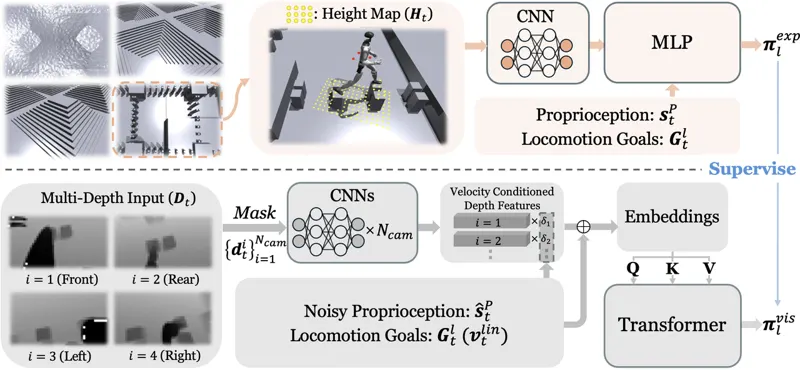
Learning Agile Navigation in Crowded Environments for Quadruped Robots

Learning Agile Navigation in Crowded Environments for Quadruped Robots

Navigating dynamic and crowded environments presents significant challenges for quadruped robots due to severe sensor occlusion and unpredictable human motion. Existing approaches face a trade-off: model-based methods, such as Velocity Obstacles (VO), theoretically guarantee safety but rely on accurate obstacle motion estimates that often fail in dense crowds, while end-to-end learning methods offer robustness but lack motion prediction capability of obstacles, leading to collisions or conservative behaviors. To solve this, we propose VOP-Nav, a novel navigation system that combines the geometric safety of VO with the agile adaptability of end-to-end learning. Using only local onboard observations, our system avoids explicit obstacle detection and tracking pipelines. The VOP-Net processes multi-frame LiDAR data to implicitly encode dynamic constraints and predict a safe velocity region derived from Velocity Obstacle theory. Importantly, the VO predictions serve a dual role: they are used as input to the navigation policy during inference and as a reward signal during training to encourage safe motion. Evaluations in Isaac Gym demonstrate that VOP-Nav achieves higher success rates than all baselines while balancing locomotion speed and collision avoidance. Real-world deployment on a Unitree Go2 quadruped robot further validates the system's robustness and efficiency in complex indoor and outdoor dynamic environments.

Quadruped robotsNavigation
Shuyu Wu, Zeyu Liu, Tianbao Zhang · 687 views · Jul 16, 2026

As an Amazon Associate, we earn from qualifying purchases.