Skip to content
TemporalFlow-VLA: Learning Physically Grounded Execution History for Long-Horizon Robot Manipulation

TemporalFlow-VLA: Learning Physically Grounded Execution History for Long-Horizon Robot Manipulation

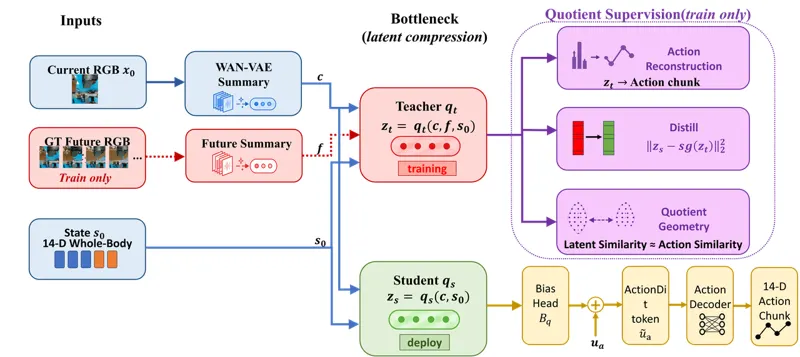
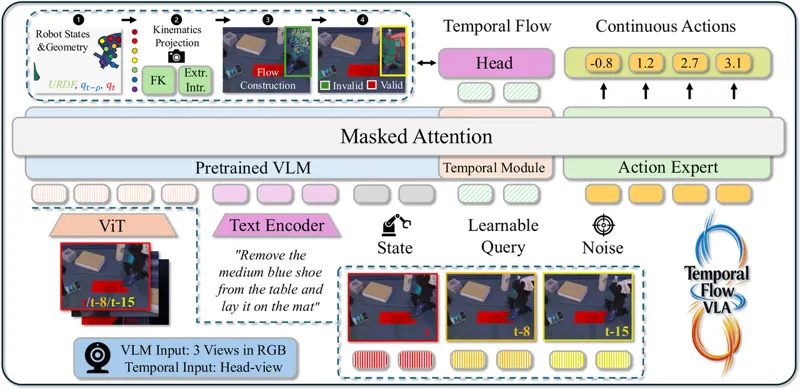
Vision-language-action (VLA) models leverage pretrained vision-language representations for robot control, yet simply adding historical frames does not reliably capture recent physical change. This is especially problematic in multi-stage manipulation, where visually similar states may require different actions depending on prior execution. To address this challenge, we present TemporalFlow-VLA, which learns compact execution history through physically grounded temporal supervision. Using recorded robot states, robot geometry, and calibrated cameras, we construct robot-surface temporal flow as a training-only target and supervise two execution-aligned temporal queries that provide structured history to the action expert. The geometric supervision path is not evaluated at deployment. TemporalFlow-VLA achieves 97.63 +/- 0.26% average success on LIBERO, including 96.60 +/- 0.87% on LIBERO Long, and 85.5%/84.2% Clean/Randomized success across 12 RoboTwin tasks. It shows its clearest advantage over prior methods on longer-horizon, multi-stage manipulation. Controlled history interventions show that action prediction depends on both historical content and temporal order. With asynchronous feature caching, temporal conditioning maintains single-frame-level server-side sampling latency without additional historical-encoding overhead. Overall, TemporalFlow-VLA provides a compact, physically grounded interface for exploiting ordered execution history without explicit motion estimation or geometric processing at deployment.

VLATemporal Flow
Jiarui Yang, Yehao Lu, Yuning Su · 658 views · Aug 27, 2026
Zero-WAM: In-Context World-Action Modeling from Human Videos for Open-Ended Task Generalization

Zero-WAM: In-Context World-Action Modeling from Human Videos for Open-Ended Task Generalization

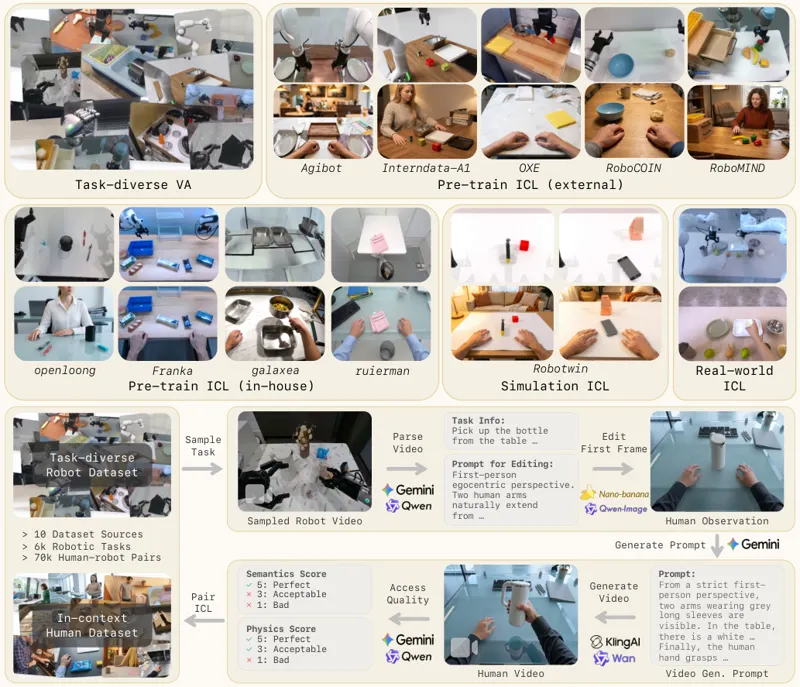
Zero-shot cross-task generalization, where a policy must execute manipulation tasks never seen during training, remains a central challenge in robot learning. In large language models, a novel task can be performed simply by specifying it in the context, without any parameter update. This form of in-context learning (ICL) turns generalization into a problem of task specification. To achieve cross-task generalization, we bring this paradigm to robotic manipulation, and argue that the natural task specification for manipulation is a human video: unlike language, it provides rich visual cues about the intended task evolution. We present Zero-WAM, a causal video-action model that executes unseen tasks by following in-context human video guidance. To address the scarcity of task-rich paired human-robot data, we propose an automatic pipeline that converts task-sampled robot trajectories into semantically matched human videos, yielding HumanGen, a dataset of 74.2K human-robot ICL pairs across 8.6K tasks. For model training, we further introduce an in-context future chunk prediction (IFP) objective that suppresses shortcuts learned from seen tasks and forces the policy to draw task information from the video prompt. On seven unseen tasks in RoboTwin 2.0 simulation, Zero-WAM achieves a 47.0% average success rate, an absolute improvement of 29.5 percentage points over the strongest video-action baseline. In real-world evaluations, it follows human video guidance to generalize to unseen task configurations involving multi-object scenes, long-horizon manipulation, and fine-grained insertion.

Zero-WAMHumanGen
Jiaming Zhou, Qihang Zhang, Gangwei Xu · 710 views · Aug 26, 2026
Navigating the Crowd: Non-linear MPC with Social Forces Dynamics for Human-Aware Robot Navigation

Navigating the Crowd: Non-linear MPC with Social Forces Dynamics for Human-Aware Robot Navigation

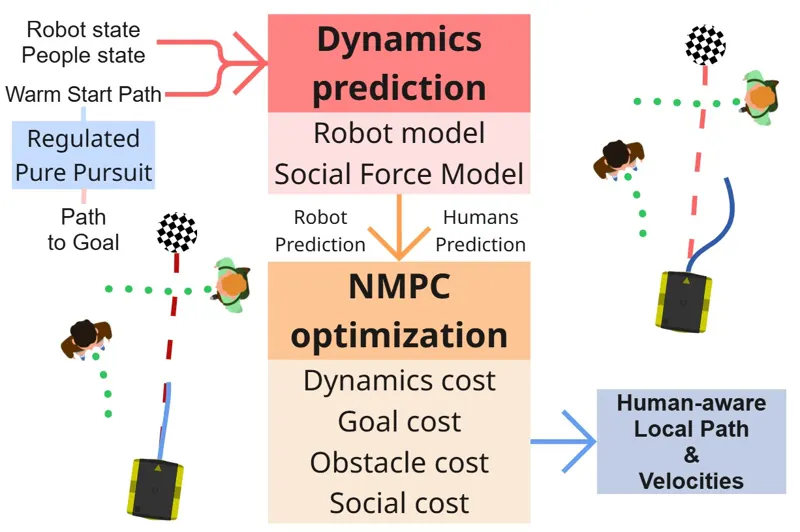
Safe and socially compliant navigation remains a fundamental challenge for autonomous robots operating in human-populated environments. Beyond collision avoidance, robots must anticipate human motion and respect personal space to ensure human comfort. Model Predictive Control (MPC) offers a robust alternative to classical and data-driven methods, although its effectiveness strongly depends on accurate human motion prediction and efficient computation. This paper introduces SFM-NMPC, a Social Force Model-based Non-linear Model Predictive Control framework that embeds human motion prediction directly within the optimization loop. By incorporating the Social Force Model into the dynamic model of surrounding agents, the controller jointly predicts the trajectories of humans and robots over the prediction horizon, thereby enabling socially-aware planning. A tailored set of social cost functions guides the optimization toward human-compliant behaviors. Despite the increased model complexity, the proposed formulation runs in real time at 20 Hz. Extensive simulated testing in crowded environments demonstrates that SFM-NMPC outperforms state-of-the-art baselines in social compliance metrics while maintaining efficient and smooth navigation. Visual trajectory analysis and an ablation study further highlight the contribution of the embedded SFM dynamics and social cost terms, confirming the effectiveness of the proposed approach for real-world social navigation.

Robot navigationSocial Navigation
Stefano Trepella, Andrea Ostuni, Mauro Martini · 742 views · Jul 11, 2026
EATR-Stereo: Embodiment-Aware Token Routing of Paired Stereo Evidence for Humanoid Vision-Language-Action Control

EATR-Stereo: Embodiment-Aware Token Routing of Paired Stereo Evidence for Humanoid Vision-Language-Action Control

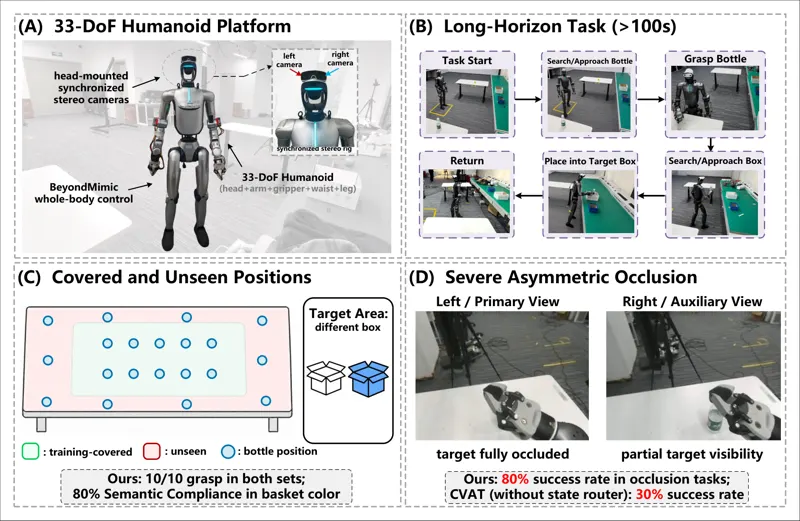
Long-horizon humanoid vision–language–action (VLA) control with head-mounted stereo cameras requires visual interfaces that can exploit complementary views while maintaining compatibility with pretrained representations. Existing interfaces often discard complementary stereo evidence or fuse additional observations without preserving the native primary-view pathway and adapting auxiliary information to robot embodiment. We present EATR-Stereo, an embodiment-aware token-routing framework that retains primary-view tokens and constructs primary-aligned Cross-View Auxiliary Tokens (CVATs) by querying the synchronized auxiliary-view token sequence. A body-segmented proprioceptive encoder further conditions token-wise auxiliary usage on robot configuration history, enabling selective incorporation of stereo evidence during action generation. The routed auxiliary stream augments the language and primary-visual context of a pretrained VLA while keeping its vision–language model frozen. On a 33-DoF physical humanoid with a 37-D proprioceptive state, we evaluate nine configurations in over-100-s search–approach–grasp–place–return tasks. EATR-Stereo achieves 60.0% full-task success, 100.0% grasp success, and 80.0% stage success. Under severe asymmetric occlusion, it improves recovery to 80% compared with 30% for CVAT alone. Ablation studies further show the importance of preserving primary tokens and combining cross-view auxiliary features with structured proprioceptive routing. These results demonstrate that selectively routed paired stereo evidence improves spatial grounding for reliable long-horizon humanoid VLA control.

VLAStereo vision
Songwei Wu, Rui Zhao, Fan Yang · 503 views · Aug 18, 2026
DELTA: Deformable Elevation-Based Local Terrain Attention Encoder for Sparse-Terrain Quadrupedal Locomotion

DELTA: Deformable Elevation-Based Local Terrain Attention Encoder for Sparse-Terrain Quadrupedal Locomotion

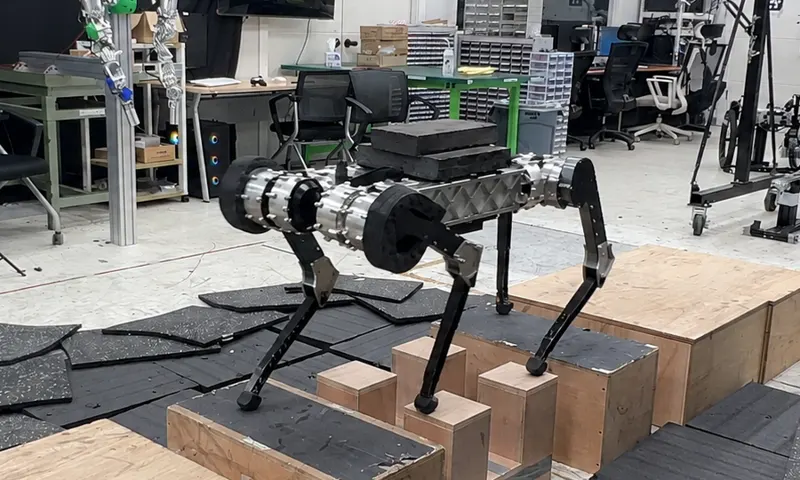
Stable quadrupedal locomotion on sparse terrain requires selecting state-relevant terrain evidence for precise foot placement. Model-based foothold planners provide precise foothold selection but rely heavily on explicit model assumptions. Recent attention-based map encoding (AME) studies show that end-to-end reinforcement learning (RL) can learn implicit foothold guidance. However, the computational cost of dense AME encoding grows with map resolution, limiting its scalability to fine-grained sparse terrain. We propose DELTA, a Deformable Elevation-Based Local Terrain Attention encoder. DELTA predicts state-conditioned sampling locations, forms terrain evidence tokens from adaptive local elevation patches, and attends only to a fixed-size token set. With fixed sampling and patch settings, DELTA's encoder cost is independent of map resolution. Experiments show that DELTA achieves final traversal performance comparable to AME at the standard resolution while improving learning efficiency. This fixed encoder cost enables the use of higher-resolution terrain maps, improving traversal on fine-grained sparse terrain. DELTA also demonstrates strong generalization to unseen mixed evaluation courses composed of continuous and discrete terrain elements. Beyond simulation, DELTA demonstrates successful sim-to-real transfer on RAIBO2. Analysis of the learned sampling offsets and attention weights shows that DELTA samples steppable regions and attends to terrain evidence relevant to future touchdowns without foothold labels or attention supervision.

Sim-to-RealQuadruped robots
Sanghyun Park, Moonkyu Jung, Jemin Hwangbo · 612 views · Aug 22, 2026

As an Amazon Associate, we earn from qualifying purchases.