PAPER DEEP DIVE
Motion Priors Reimagined: Adapting Flat-Terrain Skills for Complex Quadruped Mobility
Reinforcement learning (RL)-based motion imitation methods trained on demonstration data can effectively learn natural and expressive motions with minimal reward engineering but often struggle to generalize to novel environments. We address this by proposing a hierarchical RL framework in which a low-level policy is first pre-trained to imitate animal motions on flat ground, thereby establishing motion priors. A subsequent high-level, goal-conditioned policy then builds on these priors, learning residual corrections that enable perceptive locomotion, local obstacle avoidance, and goal-directed navigation across diverse and rugged terrains. Simulation experiments illustrate the effectiveness of learned residuals in adapting to progressively challenging uneven terrains while still preserving the locomotion characteristics provided by the motion priors. Furthermore, our results demonstrate improvements in motion regularization over baseline models trained without motion priors under similar reward setups. Real-world experiments with an ANYmal-D quadruped robot confirm our policy's capability to generalize animal-like locomotion skills to complex terrains, demonstrating smooth and efficient locomotion and local navigation performance amidst challenging terrains with obstacles.
Paper information: Zewei Zhang, Chenhao Li, Takahiro Miki, and Marco Hutter. arXiv:2505.16084, May 2025. Project page: anymalprior.github.io. The paper does not provide a public code repository. The experimental platform is ANYmal-D.
One-sentence summary: The authors freeze flat-ground animal-motion priors into a low-level skill policy, then train a high-level policy to output latent gait commands and constrained joint residuals, enabling ANYmal-D to preserve natural motion while navigating stairs, rugged slopes, boxes, and obstacles.
1. Background and Motivation
Legged-robot control has long faced two competing demands. A controller must move reliably over difficult terrain, and it must do so with motion that is smooth, efficient, and mechanically sensible. Reinforcement learning can already track commanded velocities or reach goal positions with impressive robustness, but high-quality motion usually requires extensive reward engineering. Typical pipelines penalize base acceleration, vertical velocity, joint torques, contact forces, action rates, and other quantities, then adjust their weights until task performance and motion quality reach an acceptable compromise. This approach works, but the resulting reward configuration is often task- and platform-specific.
Motion imitation offers an alternative. Instead of describing good motion through many penalty terms, a policy can imitate trajectories produced by teleoperation, motion capture, or trajectory optimization. Animal motion capture is especially attractive because it naturally encodes periodic gaits, phase relationships, and whole-body coordination. Canine walking, pacing, and cantering contain a style of movement that is difficult to design from scratch. The limitation is equally clear: animal data are usually collected on flat ground, and the reference trajectories become physically infeasible on stairs, rugged slopes, high obstacles, and random boxes.
This paper does not discard motion priors when the environment becomes difficult. Instead, it changes their role. The low-level policy first learns to execute several canine gaits in a latent space. During task training, that policy is frozen and treated as a motion prior. A high-level policy selects a latent gait command and adds small, penalized corrections to the low-level action. The prior contributes rhythm, style, and coordination; the residual contributes foot clearance, attitude adaptation, and obstacle avoidance. Complexity is decomposed rather than handed to a single policy trained from scratch.
The second motivation is local navigation. Conventional systems often separate navigation from locomotion: a planner generates waypoints or velocity commands, and a low-level controller tracks them. This interface is convenient, but it may not exploit the robot’s full motion capability. The paper integrates perceptive locomotion, local obstacle avoidance, and goal-directed navigation in one hierarchical policy, allowing the robot to choose actions directly from terrain observations.
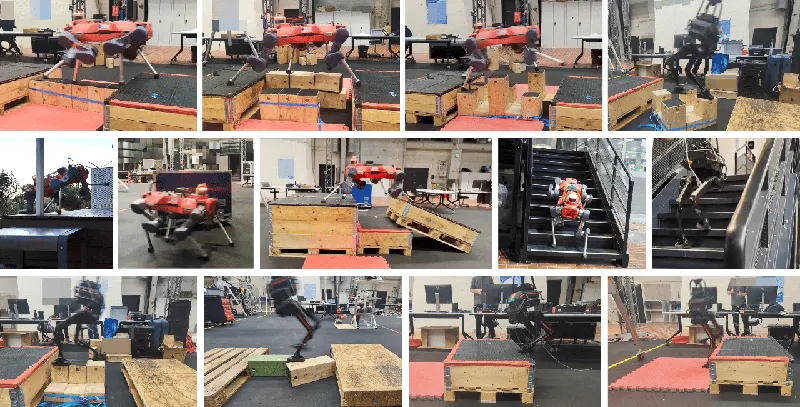
The design goal is therefore threefold: reduce reward tuning by using real animal motions, extend flat-terrain skills through residual learning, and combine locomotion and local navigation in a single framework. Figure 1 shows ANYmal-D deployments across indoor and outdoor stairs, random blocks, and high obstacles.
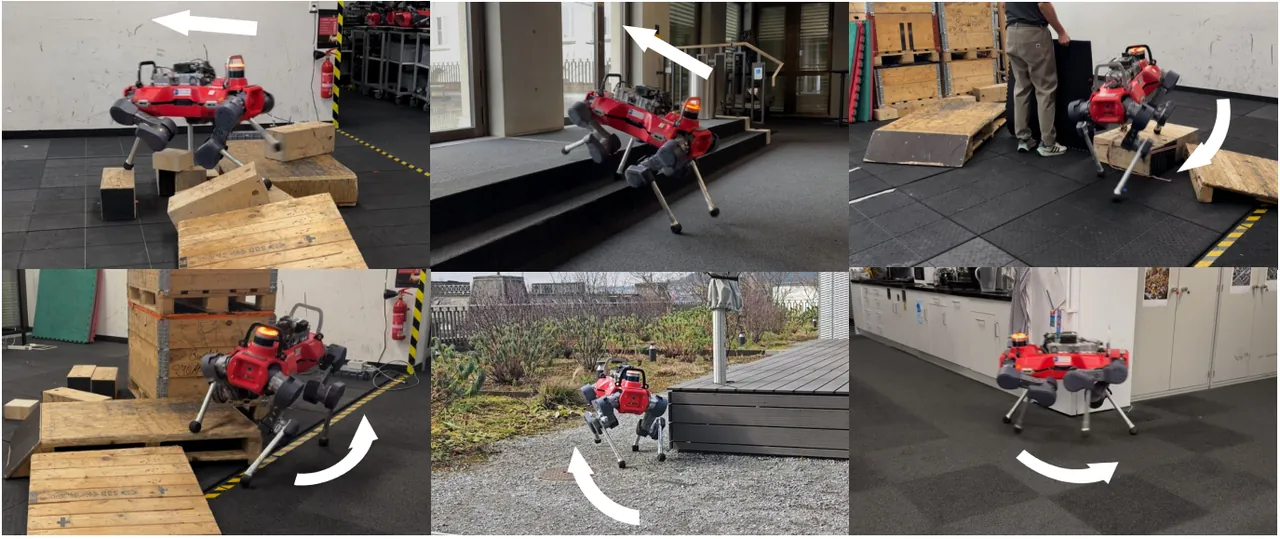
Figure 1: ANYmal-D uses an animal-like gait to traverse uneven ground and reach goal positions in challenging environments.
2. Preliminaries
Hierarchical reinforcement learning. The low-level policy receives proprioceptive signals and a motion latent encoding, then outputs twelve joint actions. The high-level policy receives goals, perception scans, and privileged state, then outputs a sixteen-dimensional latent command and twelve joint residuals. Once task training begins, the low-level policy is frozen. It functions as an action grammar; the high-level policy chooses and modifies actions within that grammar.
Fourier Latent Dynamics. The paper uses an FLD representation for motion. An encoder compresses motion sequences into latent variables containing global periodic parameters and local phase states. A decoder reconstructs future motion, while a fixed-frequency propagation rule predicts how the latent state evolves. This creates a compact, structured space in which different canine gaits can be reused by a downstream policy.
Teacher-student distillation. The simulation teacher observes noiseless proprioception, exteroception, and privileged information such as contact states, friction, and disturbances. Real hardware does not provide those signals. A student policy with a GRU-based belief encoder is therefore distilled from the teacher using noisy observations, allowing the robust behavior learned in simulation to survive deployment.
3. Method
3.1 Motion retargeting. Raw canine motion-capture data cannot be mapped directly onto ANYmal-D. The authors use inverse kinematics based on neck, pelvis, and foot positions to convert animal motions into robot joint trajectories. The dataset includes walking, pacing, and cantering at different speeds, preserving animal timing while satisfying the robot’s kinematic configuration.
3.2 Low-level motion representation. The FLD model is first trained offline. Its encoder compresses motion segments, its decoder reconstructs future states, and its latent representation combines periodic parameters with phase. The propagation equation is:
$$z_t=(\theta_t,\phi_t)=\mathrm{enc}(s_t),\quad \hat z_{t+i}=(\theta_t,\phi_t+if_t\Delta t),$$where $s_t$ is the original motion state, $z_t$ is the latent representation, $\theta_t=(f_t,a_t,b_t)$ contains frequency, amplitude, and offset, $\phi_t$ is phase, and $\Delta t$ is the discrete time step. Intuitively, the encoder compresses when limbs should move and how the motion repeats, while the propagation rule advances that periodic state through time.
Decoding and training use:
$$\hat s_{t+i}=\mathrm{dec}(\hat z_{t+i}),\quad L^{FLD}=\sum_i^N \mathrm{MSE}(s_{t+i},\hat s_{t+i}).$$The reconstruction loss over consecutive segments forces the latent dynamics to preserve global periodic structure. The encoded state includes base linear and angular velocity, projected gravity, and joint positions, so the representation captures body attitude as well as joint configuration.
3.3 Modified low-level imitation. The authors do not simply run the original FLD pipeline during policy training. They remove the decoder, replace reconstructed trajectories with ground-truth references, bypass phase propagation, randomly sample motion clips, and let the encoder compute latent embeddings dynamically. This avoids accumulating decoder reconstruction errors while retaining the structured latent space. The low-level action $a_t^l$ is twelve-dimensional, and its observation combines proprioception with latent motion encoding.
3.4 High-level task policy. During task training, the low-level policy is frozen as a prior. The high-level teacher outputs latent commands $z_t$ and joint residuals $a_t^{res}$. Exteroception combines elevation scans around each foot with a downsampled sparse conical LiDAR scan. Privileged state includes leg contact, friction, and external disturbances. Task inputs are the goal position in the base frame and a forward velocity command.
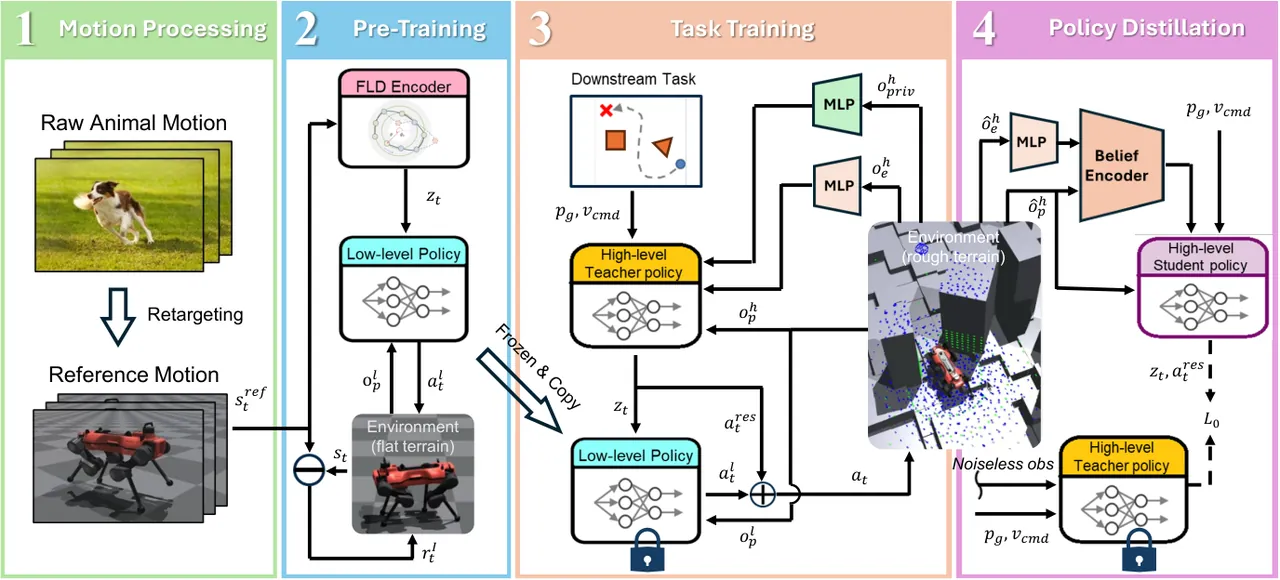
Figure 2: The four stages are motion retargeting, low-level pre-training, high-level residual learning, and student-policy distillation.
3.5 Goal rewards. The task objective combines a sparse reaching reward with a denser velocity reward. The reaching reward is active only near the end of an episode when the robot is sufficiently close:
$$r_{reach}=\frac{1}{T_r}\left(1-\frac{\|\mathbf d\|_2}{2}\right),$$where $\mathbf d$ is the displacement from the robot base to the target and $T_r$ is the threshold time for reward computation. When the target is farther away, the velocity reward provides a denser signal:
$$r_{vel}=\min(v_{cmd},\langle\mathbf v,\mathbf d\rangle),$$where $v_{cmd}$ is the velocity command and $\mathbf v$ is base linear velocity. Together, they reward both reaching the goal and making progress toward it through cluttered terrain.
3.6 Residual constraint. The residual penalty is the central mechanism for balancing style and adaptability. Without it, the high-level policy can drift away from canine motion; with too strong a penalty, the robot cannot lift its joints enough for stairs and slopes. The penalty is:
$$r_{res}=w_{res}\sum_{i=1}^{12}(a_{t,i}^{res})^2.$$Here $w_{res}$ is a negative weight and $a_{t,i}^{res}$ is the residual for joint $i$. This single term replaces many manual motion-regularization terms because the low-level prior already supplies natural movement; the high level pays only for deviating from it.
3.7 Reward structure. The low-level reward includes linear and angular velocity tracking, joint-position tracking, projected-gravity tracking, action-rate penalties, collision penalties, torque limits, joint accelerations, foot accelerations, and contact forces. For example, joint tracking is:
$$1.4\exp\left(-2\sum_{i=1}^{12}(q_{t,i}-q_{t,i}^{ref})^2\right).$$The high-level reward retains regularization terms but removes motion tracking and adds goal rewards plus the residual penalty. Compared with training from scratch, this reduces the need to repeatedly tune weights solely to make motion look natural.
3.8 Perception and belief encoding. The teacher sees ideal exteroception and privileged state. The student sees noisy proprioception and exteroception. A recurrent GRU belief encoder reconstructs a useful internal state from history, and behavior cloning matches the student’s actions to the teacher’s. This narrows the sim-to-real gap in perceptive locomotion.
flowchart TD
  A[Canine motion capture] --> B[Inverse-kinematics retargeting]
  B --> C[FLD encoder]
  C --> D[Low-level flat-terrain policy]
  D --> E[Frozen motion prior]
  F[Elevation and LiDAR scans] --> G[High-level teacher]
  H[Goal position and velocity command] --> G
  I[Privileged state] --> G
  G --> J[Latent gait command]
  G --> K[Joint residual]
  E --> L[Low-level action]
  J --> L
  K --> L
  L --> M[Complex-terrain navigation]
  G --> N[Distillation with noisy observations]
  N --> O[Student policy]
  O --> M
4. Experimental Analysis
Training is performed in Isaac Gym on ANYmal-D. The low-level policy is trained exclusively on flat ground, while the high-level policy trains across boxes, stairs, rugged slopes, and high obstacles. PPO uses 4096 parallel environments on one NVIDIA RTX 4090. The method therefore does not rely on an unusually large compute budget; its advantage comes from the decomposition.
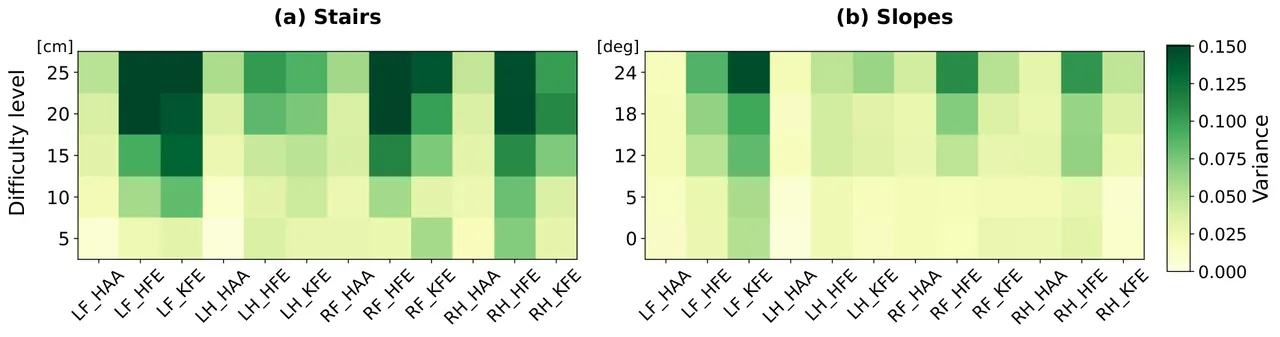
Figure 3: The low-level policy closely follows reference joint trajectories and transitions between canter, walk, and pace.
The first experiment validates the prior itself. Dashed reference trajectories and solid actual trajectories align closely across joints. The policy can execute multiple animal-like gaits and switch smoothly between them when the latent command changes. This matters because the high-level policy needs a stable action interface, not merely a classifier over gait labels.
The high-level evaluation uses the student policy under noisy observations. Goals are placed five meters from the start in random directions, and each terrain type is evaluated over 100 trials. The policy reaches high success rates on 0.25-meter stairs, 24-degree slopes, random boxes, and high obstacles. The hardest combination—random boxes with high obstacles—still reaches 75%, indicating that residual corrections can handle combined terrain and perception uncertainty.
| Terrain | Success rate |
|---|---|
| 0.25 m stairs, ascending | 84 / 100 |
| 0.25 m stairs, descending | 85 / 100 |
| 24-degree slope, ascending | 90 / 100 |
| 24-degree slope, descending | 95 / 100 |
| Random boxes | 81 / 100 |
| Random boxes with high obstacles | 75 / 100 |
| Flat ground with high obstacles | 90 / 100 |
The residual analysis explains how adaptation works. The authors compare hip-flexion-extension residuals for the left and right front legs on stairs and rugged slopes. Residual peaks and variance increase with terrain difficulty. On flat ground, the canine prior is often sufficient; as terrain becomes harder, the high-level policy must adjust joints to avoid collisions and maintain body attitude. Figures 4 and 5 show this trend.
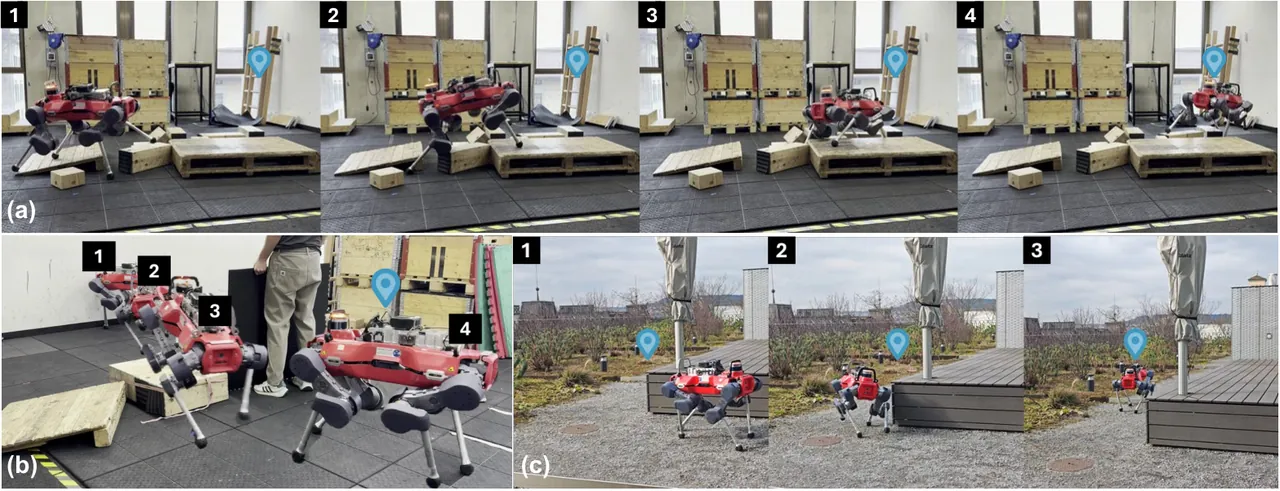
Figure 4: Joint residual peaks continue to change as stairs and slopes become more difficult.
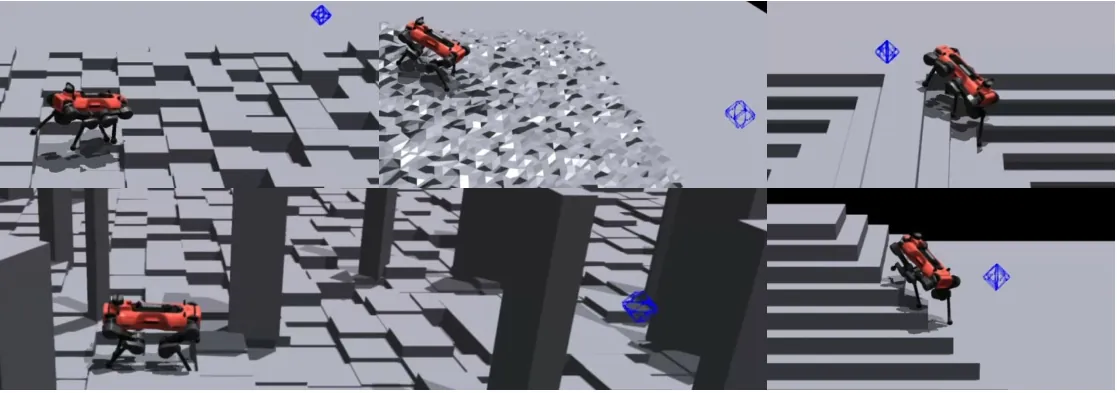
Figure 5: Residual variance grows with terrain difficulty, showing increased high-level correction.
The residual-penalty ablation exposes the core trade-off. A very strong penalty suppresses corrections and reduces efficiency on higher steps and steeper slopes. A very weak penalty preserves success but allows residuals to grow without bound, causing the robot to abandon regularized motion even on near-flat terrain. The authors vary the weight from -100 to 0 and use $w_{res}=-0.1$ in the main model.
Compared with a baseline trained from scratch under the same reward setup, the proposed policy produces a more natural animal-like gait. The baseline can navigate difficult terrain but tends to jump. Making the baseline natural would require additional regularization on quantities such as base acceleration or vertical velocity. In this framework, the motion prior plus residual penalty achieves that effect without extra reward tuning.
Energetic efficiency provides an additional comparison. The paper measures Cost of Transport during forward walking:
$$CoT=\frac{\sum_i^{12}|\tau_{t,i}\dot q_{t,i}|}{mgv_b},$$where $m$ is robot mass, $g$ is gravity, $v_b$ is forward velocity, and $\tau_{t,i}$ and $\dot q_{t,i}$ are joint torque and velocity. Although energy is not explicitly optimized, models with motion priors achieve lower CoT. The authors attribute this to reduced vertical motion in animal-like gaits. Removing residual regularization slightly increases CoT, suggesting that unconstrained residuals also introduce energetic cost.
| Training configuration | Interpretation |
|---|---|
| FLD latent channels: 4 | A compact representation of periodic canine motion |
| Propagation horizon: 30; segment length: 31 | Learns periodic propagation across time |
| PPO parallel environments: 4096 | Trains on one RTX 4090 |
| Residual penalty $w_{res}=-0.1$ | Balances adaptability and gait style in the main model |
| Student truncation steps: 15 | Used for truncated backpropagation through the GRU |
5. Code and Reproducibility
No public code repository is available. The project page contains a “Code” button, but its target is still the page template’s placeholder GitHub URL and cannot be treated as a released implementation. The page provides the paper, abstract, and supplementary videos, but not training scripts, network code, or simulation configuration.
Reproducing the system therefore requires reconstructing the Isaac Gym environment, retargeting the motion data, implementing the FLD encoder, low-level policy, residual action head, teacher-student distillation loop, and perception preprocessing. The appendix supplies detailed rewards and hyperparameters, which is helpful, while the most uncertain components are the exact LiDAR scan representation and noise augmentation.
6. Limitations and Discussion
The authors state that the high-level policy can suffer from mode collapse: it may rely habitually on one low-level gait and use residuals only for adaptation instead of exploiting the full range of motion skills. Exploration strategies or diversity-driving rewards may alleviate this issue.
Training scenarios remain somewhat constrained. The paper evaluates stairs, slopes, random boxes, and high obstacles, but not gaps, stepping stones, overhanging obstacles, severe low-friction surfaces, strong external disturbances, or dynamic obstacles. Such environments may require larger corrections or fundamentally different motion modes.
A further methodological limitation is that a residual penalty prices deviation from the prior. When the task genuinely requires a motion pattern unlike flat-ground canine movement—large jumps or crawling under low ceilings, for example—a single residual mechanism may be insufficient. The low-level skill library itself must expand.
Animal motion is also not automatically optimal for a robot. A dog and ANYmal-D differ in mass distribution, actuator power, and foot geometry. The reported natural gaits and lower transport cost are encouraging, but they should not be generalized to every platform and speed without revalidation.
7. Conclusion
This paper separates imitation from adaptation. A low-level policy learns motion priors from canine data on flat ground; a high-level policy chooses latent skills and adds constrained residuals for rough terrain; teacher-student distillation handles noisy perception for hardware deployment. Motion quality comes from demonstrated animal dynamics, while terrain adaptation comes from a penalized correction mechanism.
ANYmal-D reaches goals on stairs, slopes, boxes, and obstacle fields while preserving animal-like motion. Residual variance increases with terrain difficulty, confirming that the correction mechanism is actively used. The main remaining gaps are limited motion diversity, possible mode collapse, and absent public code. Future work should expand the skill library and investigate more automatic or adaptive residual constraints.
Golden sentence:A motion prior should not dictate every step; it should provide a good enough movement grammar so the robot knows when to stay faithful and when to deviate.