Skip to content
Design and Human Evaluation of Tactile Withdrawal Reflexes for a Skin-Covered Robot Arm

Design and Human Evaluation of Tactile Withdrawal Reflexes for a Skin-Covered Robot Arm

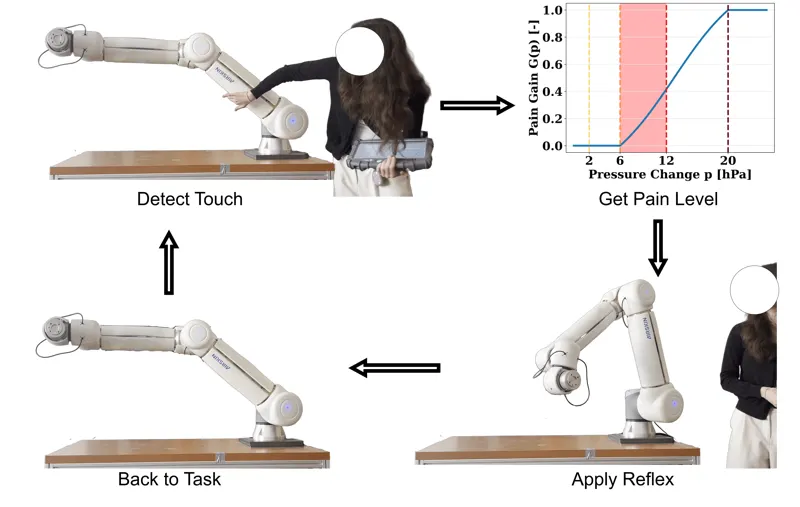
Nociception is a protective biological mechanism that links harmful stimulation to a reaction. This paper investigates artificial nociception for a robotic arm with whole-body tactile sensing. We present a complete pipeline that maps pressure changes from sensitive skin on a robot manipulator to bio-inspired withdrawal motions. The system first converts skin pressure into a scalar pain gain using a nonlinear continuous model. We compare three reflexes: (i) uniform reflex moves four robot joints by a fixed amount, whereby the withdrawal is approximated by a movement of the arm "toward the base", independent of where the robot was touched; (ii) biologically motivated location-dependent joint-space withdrawal derived from human withdrawal reflex characteristics; (iii) Cartesian space withdrawal along the surface normal of the contacted skin pad. All behaviors are integrated in a reflex controller that interrupts the task, executes the withdrawal, and returns to a pre-contact pose. A user study with 15 participants compared the strategies using Godspeed questionnaire subscales, custom perceived-naturalness and safety items, forced-choice comparisons, and qualitative feedback. Interestingly, participants rated more highly the uniform reflex behavior over one or both competitors on the anthropomorphism, animacy, and likeability Godspeed subscales and on the Naturalness and Realism custom scale. When asked to compare the conditions, the uniform reflex was scored best in "felt safest", "most human-like", and "most natural". This suggests that predictability of the robot behavior is key for user acceptance. The Cartesian reflex was judged the most appropriate reaction to touch. The bio-inspired reflex did not lead any evaluated measure. This may be partly attributed to the embodiment gap between the robot arm and human arm and participants having different expectations from a robot manipulator.

Embodied AILaura Babayeva, Lukas Rustler, Matej Hoffmann·Jul 24, 2026
MEMENTO: Memory-Guided Memetic Code-as-Policy Evolution

MEMENTO: Memory-Guided Memetic Code-as-Policy Evolution

Long-horizon embodied tasks require policies that execute many dependent actions before task success can be observed. Representing policies as executable control pro- grams (code-as-policy) enables their decision logic to be inspected and revised after rollout evaluation. Revised programs can then be executed and compared by rollout performance, framing policy improvement as execution-guided program search. Evo- lutionary methods driven by large language models (LLMs) provide a natural mecha- nism for this search by generating variants and selecting high-performing candidates. However, existing approaches primarily select among independently generated vari- ants and lack a sequential local improvement phase. We introduce MEMENTO, a memory-guided single-elite memetic framework for code-as-policy evolution. ME- MENTO first evolves a rollout evaluator that maps policy rollouts to scalar fitness and structured feedback metrics. Fitness selects accepted candidates and the next elite, while feedback metrics condition policy proposals generated by memory-guided hill-climbing, macro-mutation, and crossover. We evaluate MEMENTO on two long- horizon embodied domains: Robosuite Franka Tower-of-Hanoi manipulation and AI2- THOR household interaction. MEMENTO outperforms Eureka and REvolve, adapted as code-as-policy evolutionary baselines, in task success and generalization to held- out Robosuite object configurations and unseen AI2-THOR scenes. Ablations show that zero-shot generation and unevolved evaluators fail to solve either domain, and that removing policy-search branches reduces performance. Finally, we deploy the best-evolved Robosuite policy on a physical Franka robot, demonstrating the feasibil- ity of sim-to-real transfer of the evolved code-as-policy. Code, prompts, and videos are available at: https://github.com/sygkounas/MEMENTO.

Embodied AIAlkis Sygkounas, Victor Aregbede, Amy Loutfi·Jul 24, 2026
Real2Sim2Real for Vision-Language-Action Manipulation: An AMD ROCm-Based Pipeline

Real2Sim2Real for Vision-Language-Action Manipulation: An AMD ROCm-Based Pipeline

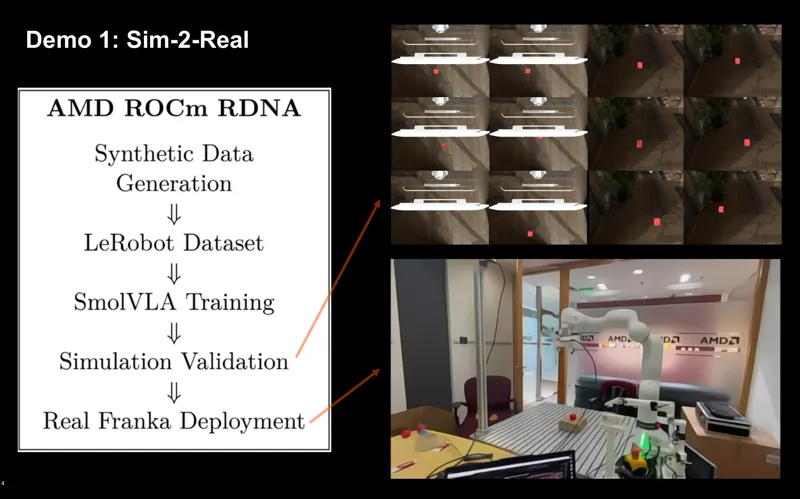
Physical AI – the integration of large vision-language-action (VLA) models with embodied agents that act in the real world – has emerged as the next major frontier for AI, echoed by industry leaders such as Jensen Huang (``the next big thing is Physical AI, AI with a body,'' GTC Paris, June 2025) and Dr. Lisa Su (`we're entering the world of Physical AI... this is where AI enters the real world,' CES 2026). This paper presents an end-to-end, fully AMD-accelerated technology stack for embodied manipulation, spanning data-center training silicon, Radeon PRO simulation/rendering GPUs, and Ryzen AI edge compute, unified by the open ROCm software stack. We demonstrate that training and deploying VLA-based manipulation policies does not require a CUDA-locked ecosystem. Four progressive demonstrations are presented: (1) a Sim-to-Real manipulation pipeline trained with SmolVLA and deployed on a physical Franka arm; (2) a semantic, language-grounded object-selection task (`one-of-three'); (3) a Real2Sim synthetic-data generation pipeline that fuses 3D Gaussian Splatting (3DGS) reconstructions of real scenes with the Genesis physics engine; and (4) large-scale reinforcement learning for quadruped and humanoid locomotion benchmarked across multiple hardware platforms. All pipelines run natively on ROCm + PyTorch on RDNA4 (Radeon AI PRO R9700) and RDNA3.5 (Radeon PRO W7900) hardware and are reproducible on the free Radeon Cloud Platform.

Embodied AIQing Yang, Xun Wang, Ziguan Wang·Jul 25, 2026
PRISM: Polynomial Representations for Interaction-Structured Motor Control

PRISM: Polynomial Representations for Interaction-Structured Motor Control

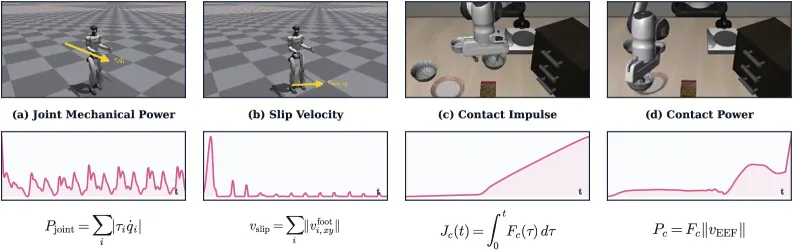
Robot policies are typically MLPs mapping observations to actions. Yet robot observations are physical variables, and many action-relevant cues arise not from individual variables but from their interactions; power, inertial effects, contact, slip, and compliance depend on products among observable signals. We introduce PRISM, a policy representation that makes polynomial interactions among observable physical variables explicit, learnable, and compact. Rather than listing all polynomial terms, PRISM uses a factorized polynomial module to expose higher-order interaction features efficiently. In reinforcement learning, it keeps the standard MLP backbone but applies a gradually activated element-wise polynomial function after it. In imitation learning, it replaces linear proprioceptive conditioning in Diffusion Policy with a polynomial layer trained end-to-end. Across humanoid locomotion and contact-rich manipulation, PRISM improves performance over standard MLP policies and larger MLPs with matched capacity, showing that interaction structure cannot be replaced by capacity alone. It also yields sensorless compliant behavior without force, wrench, tactile input, contact labels, or admittance control. These results suggest that polynomial representations should become a standard architectural choice for embodied motor control. The project page is available at https://lsh3163.github.io/prism/

PRISMMotion ControlPolynomial NetworkSeung Hyun Lee, Stella X. Yu·Jul 26, 2026
LabRobFail: A Benchmark for Robotic Failure Analysis in Chemical Self-driving Laboratories

LabRobFail: A Benchmark for Robotic Failure Analysis in Chemical Self-driving Laboratories

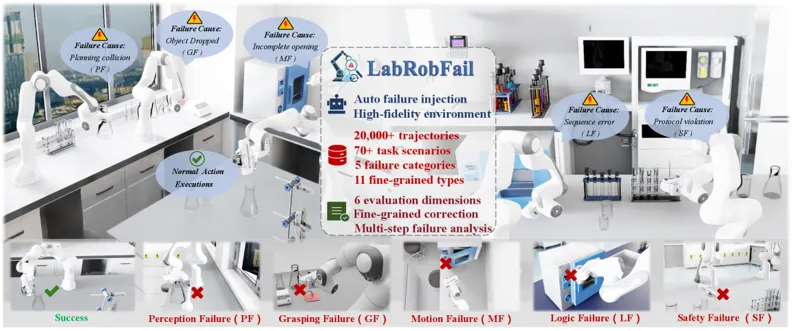
The deployment of embodied agents in self-driving laboratories could accelerate scientific discovery, yet their reliability is constrained by the irreversible and safety-critical nature of chemical experiments. Progress is further hindered by scarce failure data and the lack of fine-grained evaluation protocols. To address these challenges, we introduce LabRobFail, a failure-centric framework for learning and evaluating robotic failure analysis in chemical laboratories. LabRobFail-Sim injects controllable failures at the control, physics, and semantic levels, enabling the construction of LabRobFail-Data, which contains over 20,000 trajectories across 70+ task scenarios, five failure categories, and 11 fine-grained failure types. LabRobFail-Bench evaluates six capabilities spanning task understanding, failure detection, temporal localization, severity assessment, failure classification, and actionable correction. We further develop LabRobFail-VLM, a domain-specialized vision-language model that generates structured failure diagnoses and recovery instructions. On seen environments, it achieves 92.58% failure-detection accuracy and 85.58% temporal-localization accuracy, substantially outperforming general-purpose VLMs. When integrated as a real-time supervisor, it improves downstream VLA task success rates by 10-20 percentage points, demonstrating the value of fine-grained failure understanding for closed-loop recovery and reliable laboratory autonomy. Our code and data are available at https://github.com/Su-ISE-2001/SciRobo
Embodied AIHaobo Wang, Baoli Sun, Anqi Zou·Jul 26, 2026
N₀-TWAM: Scaling Tactile-Native World-Action Model for Contact-Rich Manipulation

N₀-TWAM: Scaling Tactile-Native World-Action Model for Contact-Rich Manipulation

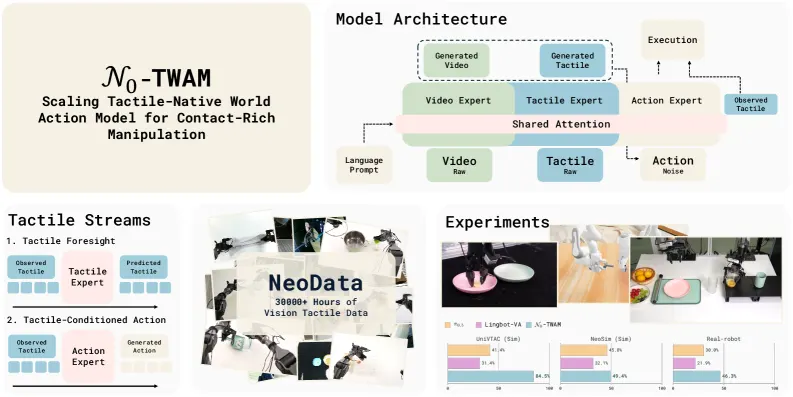
We present N₀-TWAM, a tactile-native world-action model for contact-rich manipulation that predicts both future vision and future contact. To our knowledge, it is the first tactile world-action model trained at large scale, and it shows strong capability on contact-rich tasks. We pre-train N₀-TWAM at large scale with visuo-tactile joint training over tactile-rich demonstrations spanning six embodiments and 450 tasks. We use NeoForce, a unified force-based tactile representation, to form a physically grounded contact signal that conditions action generation. To improve long-horizon and multi-stage manipulation, we introduce tactile contact events for task staging and advance through them during execution. For real-time efficiency, we adopt an asymmetric Mixture-of-Transformers architecture that pairs a full-width expert for video prediction with slim experts for downstream action and tactile prediction. Evaluations on both real and simulated benchmarks justify the capabilities of N₀-TWAM across a range of contact-rich tasks, and demonstrate the benefit of data scaling for precise tactile and action prediction. In summary, N₀-TWAM endows a world-action model with predictive capabilities to foresee vision, touch and action, building a solid foundation for fine-grained manipulation on open contact-rich tasks. The codebase and model checkpoints will be made publicly available to foster further research and development in tactile-enabled robotic manipulation.

Embodied AI NeoteAI Team, Fudan TEAI Team·Jul 26, 2026
Embodied GPT-5.1: Evidence of a World Model?

Embodied GPT-5.1: Evidence of a World Model?

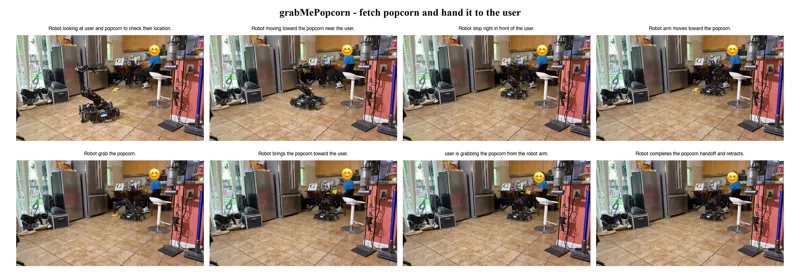
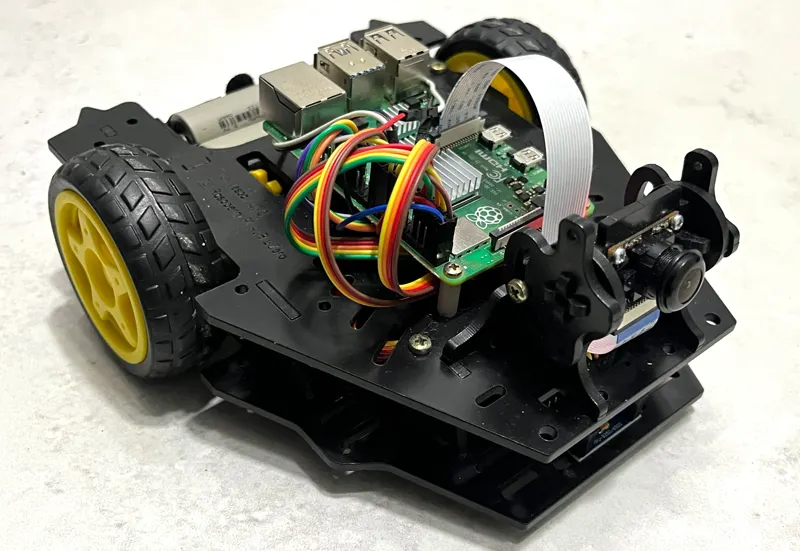
This exploratory study examines whether a large multimodal language model, GPT-5.1, can serve as the high-level controller of a physical mobile robot despite having no prior embodiment, no training in simulated environments, and no exposure to sensorimotor experience. Using only low-resolution first-person images and a discrete action set, the model was tasked with navigation and object-directed behaviors such as locating and contacting a target toy. Across multiple trials, GPT-5.1 demonstrated emergent capabilities that suggest elements of spatial reasoning and physical understanding. These included maintaining short-term memory of object locations after they left the camera frame, inferring the physical consequences of its own movements, and executing coherent action sequences such as colliding with an object and reversing to visually verify the outcome. At the same time, the model displayed inefficiencies and perceptual limitations, including imprecise alignment strategies and occasional misidentification of distant distractors. Overall, the results indicate that GPT-5.1 exhibits signs of world-model-like behavior in an embodied setting, despite the absence of any embodiment-related training, a finding that challenges long-standing views in cognitive science and robotics which hold that a physical body is a necessary prerequisite for developing such forms of intelligence. The findings motivate deeper investigation into the emergence, limits, and robustness of physical understanding in large language models.

Embodied AIRoberto Spinelli, Thiago C. Martins·Jul 27, 2026
LeapBot-WA: World-Anchor Action Models via Predictive Latent Alignments

LeapBot-WA: World-Anchor Action Models via Predictive Latent Alignments

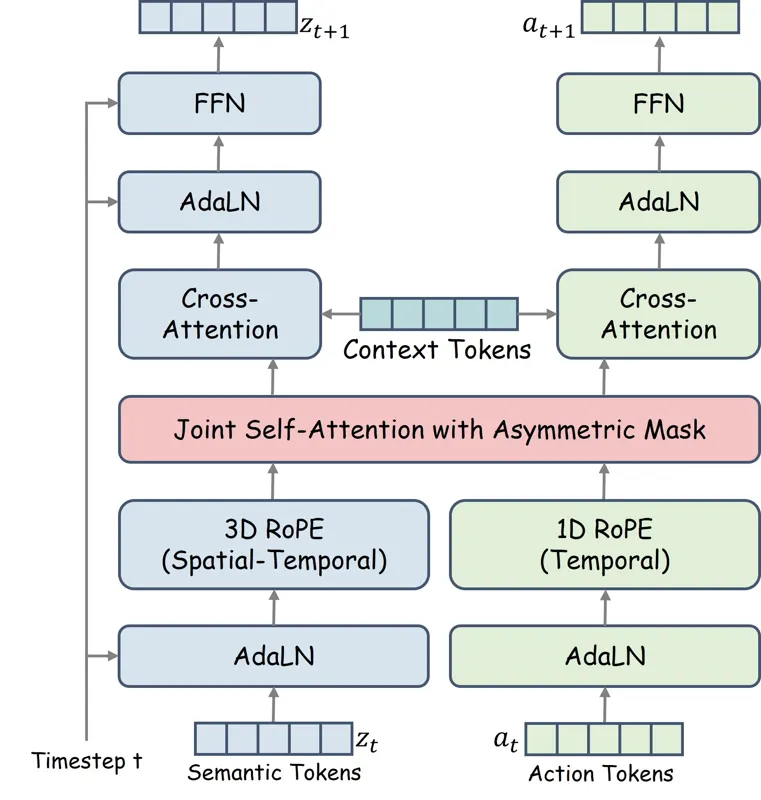
World Action Models (WAMs) have emerged as a powerful paradigm for embodied intelligence, yet the prevailing reliance on pixel-level video generation creates a fundamental bottleneck. Forcing models to reconstruct task-irrelevant visual details dissipates representational capacity and renders policies vulnerable to visual distractors. In this paper, we propose LeapBot-WA, which establishes a novel Predictive-Latent paradigm for WAMs by operationalizing the Joint-Embedding Predictive Architecture (JEPA) as a World-Anchor. Departing from the traditional reliance on visual synthesis, LeapBot-WA shifts the core of world modeling to Predictive Semantic Alignment, extracting abstract physical dynamics directly within a latent foundation space. To bridge the modality gap between non-Gaussian predictive features and diffusion priors, we introduce the Isotropic Semantic Autoencoder (ISAE), which reshapes the anchor's latent space into a diffusion-friendly manifold to prevent off-manifold drift. Furthermore, we design an Asymmetric Mixture-of-Transformers (MoT) architecture. During training, an Anchor Diffusion Transformer acts as a privileged dynamics expert to guide the Action Diffusion Transformer; at inference, this heavy dynamics branch is pruned, enabling zero-overhead execution. LeapBot-WA achieves state-of-the-art performance among predictive models on LIBERO and matches top-tier generative WAMs on RoboTwin 2.0 without requiring large-scale trajectory pre-training. It further demonstrates superior zero-shot robustness to unseen environments and successful real-world transfer, establishing a highly efficient and robust latent-centric paradigm for scalable robotic control. Code: https://github.com/LeapWM/leapbot-wa.

Embodied AIPei Liu, Nan Zheng, Lang Zhang·Jul 27, 2026