PAPER DEEP DIVE
ZEST: Zero-shot Embodied Skill Transfer for Athletic Robot Control
Achieving robust, human-like whole-body control on humanoid robots for agile, contact-rich behaviors remains a central challenge, demanding heavy per-skill engineering and a brittle process of tuning controllers. We introduce ZEST (Zero-shot Embodied Skill Transfer), a streamlined motion-imitation framework that trains policies via reinforcement learning from diverse sources – high-fidelity motion capture, noisy monocular video, and non-physics-constrained animation – and deploys them to hardware zero-shot. ZEST generalizes across behaviors and platforms while avoiding contact labels, reference or observation windows, state estimators, and extensive reward shaping. Its training pipeline combines adaptive sampling, which focuses training on difficult motion segments, and an automatic curriculum using a model-based assistive wrench, together enabling dynamic, long-horizon maneuvers. We further provide a procedure for selecting joint-level gains from approximate analytical armature values for closed-chain actuators, along with a refined model of actuators. Trained entirely in simulation with moderate domain randomization, ZEST demonstrates remarkable generality. On Boston Dynamics' Atlas humanoid, ZEST learns dynamic, multi-contact skills (e.g., army crawl, breakdancing) from motion capture. It transfers expressive dance and scene-interaction skills, such as box-climbing, directly from videos to Atlas and the Unitree G1. Furthermore, it extends across morphologies to the Spot quadruped, enabling acrobatics, such as a continuous backflip, through animation. Together, these results demonstrate robust zero-shot deployment across heterogeneous data sources and embodiments, establishing ZEST as a scalable interface between biological movements and their robotic counterparts.
Paper Metadata
Title: ZEST: Zero-shot Embodied Skill Transfer for Athletic Robot Control
Authors: Jean Pierre Sleiman, He Li, Alphonsus Adu-Bredu, Robin Deits, Arun Kumar, Kevin Bergamin, Mohak Bhardwaj, Scott Biddlestone, Nicola Burger, Matthew A. Estrada, Francesco Iacobelli, Twan Koolen, Alexander Lambert, Erica Lin, M. Eva Mungai, et al.
Affiliations: Boston Dynamics AI Institute; RAI Institute
arXiv: arXiv:2602.00401 (submitted 2026-02)
Code: No public code release (proprietary Boston Dynamics stack; Isaac Lab-based training)
One-line Summary
ZEST is a single-stage motion-imitation recipe: RL policies trained in simulation on retargeted motions from three heterogeneous sources (MoCap, monocular video, keyframe animation) deploy zero-shot to Atlas, Unitree G1, and Spot, achieving the first dynamic multi-contact behaviors on a full-size humanoid — without contact labels, state estimators, reference windows, or per-skill reward shaping.
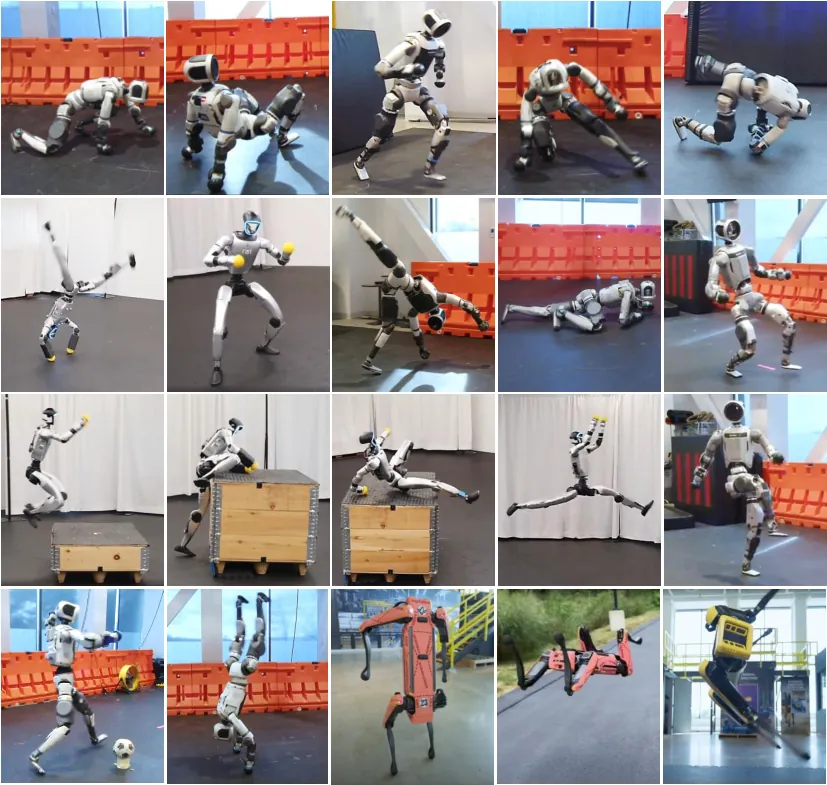
Figure 1: Hardware deployment of ZEST across diverse data sources and robot morphologies.
Background and Motivation
Humanoid robots are humanoid for a reason: our built environment is scaled to the human body, so a robot with comparable form can in principle operate in it without retrofitting. But operating requires executing the same broad repertoire of whole-body skills humans use — not just one tuned behavior, but walking, crawling, climbing, and recovering with human-like fluidity. High DoF counts, intermittent multi-contact interaction, and unavoidable model mismatch make this a hard control problem.
The dominant industrial approach over the past decade has been model-based: generate whole-body trajectories offline with trajectory optimization, then track them online with a controller such as a Model Predictive Control (MPC) planner plus an optimization-based whole-body controller. Boston Dynamics' Atlas has produced impressive parkour and dance this way, and the research community has adopted the same offline-plan/online-track paradigm for stair climbing with handrails, quadruped acrobatics, and animal-to-robot motion retargeting.
The model-based paradigm has real virtues — interpretability and versatility — but it pays for them in three currencies that limit scaling. First, contact schedules: MPC needs explicit contact labels, which are easy to extract for clean animation but error-prone for noisy video-reconstructed motion, and the controllers typically only support contacts at predefined end-effectors (feet and hands), excluding knee/torso/forearm interaction. Second, per-skill engineering: each behavior demands careful tuning of motion-specific costs and contact annotations. Third, modeling mismatch: online optimization is brittle when contact timing labels are wrong.
Learning-based motion imitation offers the alternative: train a tracking policy with reinforcement learning so that contact emerges rather than being prescribed. Prior work has shown sim-to-real motion imitation on quadrupeds and humanoids, but typically for locomotion-style skills, single data sources, or single platforms. Video-to-skill transfer such as VideoMimic focused on locomotion rather than contact-rich dynamic skills.
ZEST's bet is that a single, low-tuning training recipe can absorb heterogeneous, imperfect data — high-fidelity MoCap, noisy monocular-video reconstruction, and physically infeasible animation — and produce robust zero-shot hardware behavior across embodiments. The paper validates this on the electric Atlas (30 DoF, 1.8 m, 100 kg), Unitree G1 (29 DoF, 1.2 m, 35 kg), and Spot quadruped (12 DoF, 33 kg).
Preliminaries: Motion Data and Retargeting
ZEST consumes three reference sources. MoCap from Xsens and Vicon systems is the highest-fidelity source, requiring minimal post-processing. ViCap reconstructs 3D human motion from a single handheld-phone video by combining MegaSaM for camera/scene estimation with TRAM for human pose estimation — a pairing the authors found significantly reduces jitter and foot-skidding artifacts. Keyframe animation covers motions that are physically aggressive or non-human (e.g., Spot acrobatics).
All human-centric data is mapped to the robot skeleton via kinematic retargeting formulated as a spacetime optimization: weighted costs track the source root position/orientation and align corresponding bones via alignment frames, with joint-velocity regularization. The optimization jointly estimates a uniform scale and time resampling so ballistic motions stay consistent with real gravity, subject to forward-kinematics and self/ground non-penetration constraints. Crucially, no contact labels are produced or consumed anywhere in this pipeline.
Method
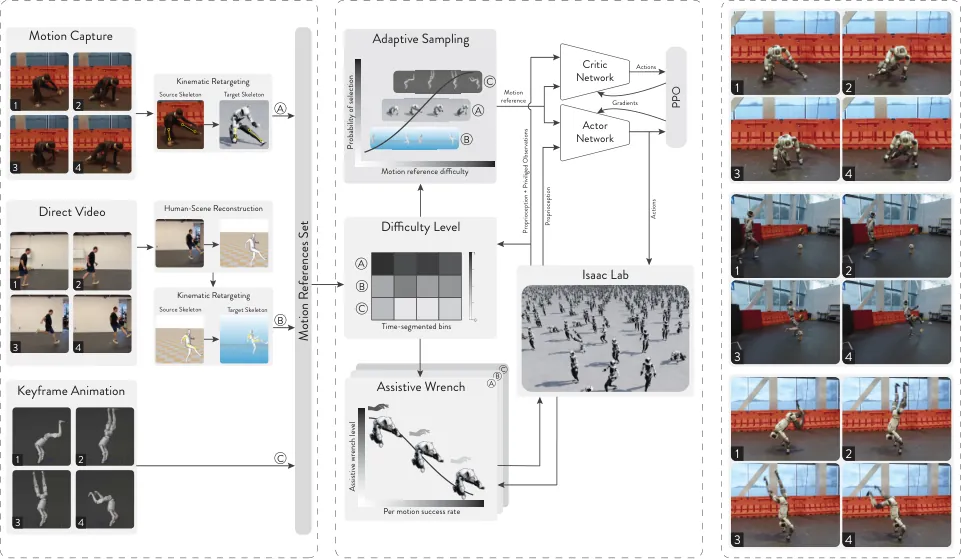
Figure 4: ZEST architecture — reference data, goal-conditioned MDP training with adaptive curriculum, and zero-shot deployment.
Goal-conditioned MDP. ZEST is formulated as $\mathcal{M}=(\mathcal{S},\mathcal{A},\mathcal{G},P,r,\gamma)$, where the goal $g_t$ encodes the reference target to track. The observation is $o_t=\psi(s_t,g_t)$, the policy samples $a_t\sim\pi_\theta(\cdot\,|\,o_t,g_t)$, and the objective is the expected discounted return
$$J(\theta)\;=\;\mathbb{E}\!\left[\sum_{t=0}^{T-1}\gamma^{t}\,r(s_{t},a_{t},g_{t})\right].$$
The paper notes $g_t$ can be instantiated as (i) a time-indexed reference snippet $\hat{s}_{t:t+H}$, (ii) a latent embedding of such a snippet, or (iii) a phase variable plus trajectory identifier. The deployed configuration deliberately uses the minimal one: only the next-step reference, plus current proprioception and the previous action as the sole history.
Proprioception-only actor, privileged critic. The actor observation is $\mathbf{o}_{t}=(\mathbf{o}_{\text{prop}},\ \mathbf{o}_{\text{ref}})$, where $\mathbf{o}_{\text{prop}}$ contains IMU angular velocity and gravity direction, joint positions and velocities, and the previous action. Quantities requiring a state estimator — global base pose or linear velocity — are intentionally excluded. The critic receives privileged simulation-only signals (true root state, contact forces, key body positions, assistive-wrench signal) via an asymmetric actor-critic design. This removes estimator lag and bias from the deployment path and avoids the fragile contact/terrain assumptions estimators typically require.
Residual actions and armature-based PD gains. The policy outputs residual actions $\bm{a}_t$ that are added to reference joint positions before being sent to joint-level PD controllers:
$$\bm{q}^{\mathrm{cmd}}_{j}=\hat{\bm{q}}_{j}+\bm{\Sigma}\,\bm{a}_{t},$$
where $\bm{\Sigma}$ is a positive-definite diagonal matrix of per-DoF action scales: joints needing feedforward torque assistance (hips, knees) get larger scales, while joints the PD loop alone handles well (head, wrists) get smaller ones. PD gains are chosen by modeling each joint as an independent second-order system $I\,\theta^{\prime\prime}(t)+K_{d}\,\theta^{\prime}(t)+K_{p}\,\theta(t)=0$, where $I$ is the nominal armature value about that axis, tuned for critical damping at a chosen natural frequency $\omega_n$:
$$K_{p}=I\,\omega_{n}^{2},\qquad K_{d}=2\,I\,\omega_{n}.$$
The same gains run in simulation and on hardware, minimizing sim-to-real mismatch. This is where the paper's actuator modeling pays off: Atlas uses Parallel-Linkage Actuators (closed-chain mechanisms at ankles, knees, waist) whose stiff dynamics are expensive to simulate exactly. ZEST introduces three progressive approximations: a locally projected model (massless support links, configuration-dependent effective armature), a dynamic armature model using a Jacobi approximation to handle non-diagonal armature matrices at coupled PLAs, and finally a nominal armature model that fixes armature at one configuration — eliminating ~20% per-step overhead and providing the principled basis for the PD gains. For Spot, an even more detailed actuator model adds power-limiting, magnet saturation, and transmission friction/losses, with efficiency parameters identified against logged real-robot data.
Reward. The total reward combines three deliberately generic components:
$$r_{\text{total}}\;=\;r_{\text{track}}+r_{\text{reg}}+r_{\text{survival}}.$$
The tracking reward uses a decaying exponential kernel — dense, bounded, emphasizing accuracy near the reference:
$$r_{\text{track}}\;=\;\sum_{i}c_{t_{i}}\exp\!\Bigl(-\,\kappa\frac{\|\mathbf{e}_{i}\|^{2}}{\sigma_{i}^{2}}\Bigr),$$
where $\mathbf{e}_i$ are errors for base linear/angular velocity, base pose, joint positions, and keybody poses. Regularization penalizes rapid action changes, large joint accelerations, and joint-position/torque limit violations; the survival reward is a constant per-step bonus. Nothing here is task- or motion-specific, and nothing requires contact labels.
Adaptive reference state initialization. Naive RSI samples phases blindly, oversampling mastered regions. ZEST partitions each reference trajectory into fixed $N$-step bins; each bin $b$ maintains a failure level $f_b$ derived from recent tracking performance, updated with an exponential moving average. At reset, a bin index is drawn from a categorical distribution with logits proportional to $\{f_b\}$, then a phase is sampled uniformly inside that bin. A floor probability on every bin prevents forgetting previously acquired skills.
Assistive-wrench automatic curriculum. Highly dynamic skills with large base rotations (handstands, cartwheels, backflips) terminate immediately under RSI alone. ZEST applies a virtual spatial wrench at the base — computed model-based as a PD term on base-pose tracking error plus a feedforward torso-dynamics compensation — scaled by a gain $\beta\in(0,\beta_{\text{max}})$ with $\beta_{\text{max}}<1.0$ so the agent must still learn the skill itself. The annealing schedule is driven automatically by the same per-bin failure levels: harder bins receive stronger assistance initially and are relaxed faster as tracking improves, until assistance vanishes. This replaces handcrafted curricula with a self-paced one.
flowchart LR
    A["MoCap
Xsens / Vicon"] --> R["Kinematic retargeting
spacetime optimization"]
    B["Monocular video
MegaSaM + TRAM"] --> R
    C["Keyframe animation"] --> T["Reference library
binned into N-step segments"]
    R --> T
    T --> S["Adaptive sampling
EMA failure level per bin"]
    S --> W["Assistive wrench curriculum
model-based, annealed to zero"]
    W --> P["PPO in Isaac Lab
residual actions, asymmetric actor-critic"]
    P --> D["Zero-shot deployment
Atlas / G1 / Spot"]
Training setup. PPO in Isaac Lab, all observations normalized with running averages, actor and critic as three-hidden-layer MLPs with ELU activations. Each hardware policy is a single-skill specialist trained ~10 hours (≈7k iterations) on one NVIDIA L4 GPU; domain randomization includes impulsive pushes, sensor noise, friction and mass variations. Deployment uses an automated ONNX-export/registry pipeline shared between simulation and hardware.
Experiments
Results are organized by reference source, with tracking metrics computed over successful trials: MAE$(\bm{q})$ for joint positions, MAD$(R)$ for base orientation, ML2$(\bm{\omega})$ for base angular velocity, plus maxima.
| Motion | Robot | Source | Multi-contact | Duration (s) | MAE(q) (rad) | MAD(R) (rad) |
|---|---|---|---|---|---|---|
| Walk | Atlas | MoCap | ✗ | 8.47 | 0.0568 | 0.0300 |
| Army crawl | Atlas | MoCap | ✓ | 16.66 | 0.1033 | 0.0754 |
| Breakdance | Atlas | MoCap | ✓ | 6.56 | 0.0790 | 0.1334 |
| Cartwheel | G1 | MoCap | ✓ | 8.0 | 0.078 | 0.331 |
| Soccer kick | Atlas | ViCap | ✗ | 6.00 | 0.0493 | 0.0504 |
| Cartwheel | Atlas | Animation | ✓ | — | 0.0882 (RL) | 0.0628 (RL) |
| Continuous backflip | Spot | Animation | ✓ | — | Robust even after IMU saturation | |
Selected rows from Table 1 of the paper (full table covers all motions across the three platforms).
MoCap skills. On Atlas, ZEST deploys walk, jog, forward roll, roll on all fours, crawl on all fours, army crawl, cartwheel, and breakdance — plus MoCap table-tennis and cartwheel on G1. The gait behaviors show heel-toe rollover, near-full knee extension, and quiet deceleration transitions that the authors note would be extremely hard to induce through reward shaping alone. The multi-contact skills proceed without prescribed contact schedules: army crawl maintains near-continuous arm-leg-torso contact with deliberate sliding, and the breakdance includes a segment where one fully extended leg threads under the other — unavoidable self-contact handled without special treatment.
ViCap skills. From handheld-phone videos, ZEST runs a soccer kick and three dance snippets on Atlas, and ballet plus box-climbing skills (jump onto box, climb up, climb down) on G1. Despite visible jitter and foot-skidding in the references, tracking errors stay near 0.05 rad in MAE$(\bm{q})$ and MAD$(R)$. The box skills run with a proprioception-only interface — no perception of the box — relying on randomization of the initial robot-box pose at training time. Robustness testing: 5/5 consecutive successes at nominal setup; all trials within the training distribution ($\pm10$ cm in $x$, $\pm0.3$ rad in yaw) succeed; a 2 kg torso payload still succeeds; and box heights outside the trained range [0.70, 0.80] m work at 0.55 m (climb up) and both 0.55 m and 0.95 m (climb down).
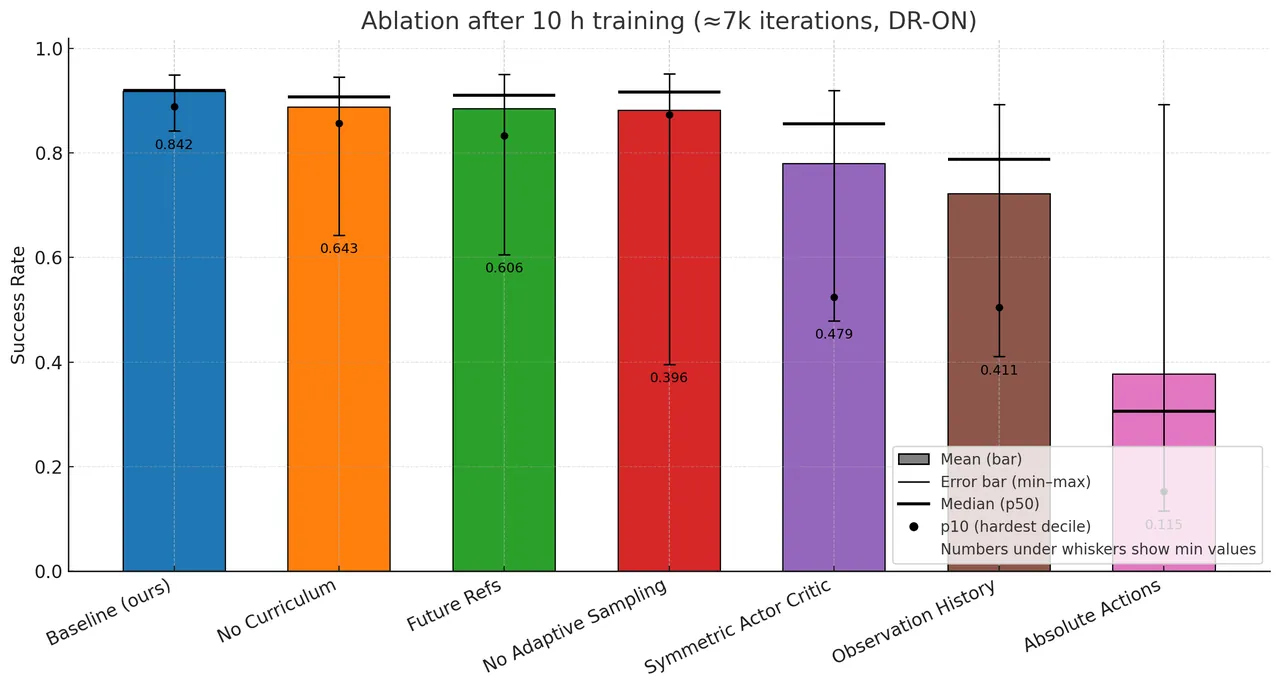
Ablations after 10 hours of training (~7k iterations) under full domain randomization.
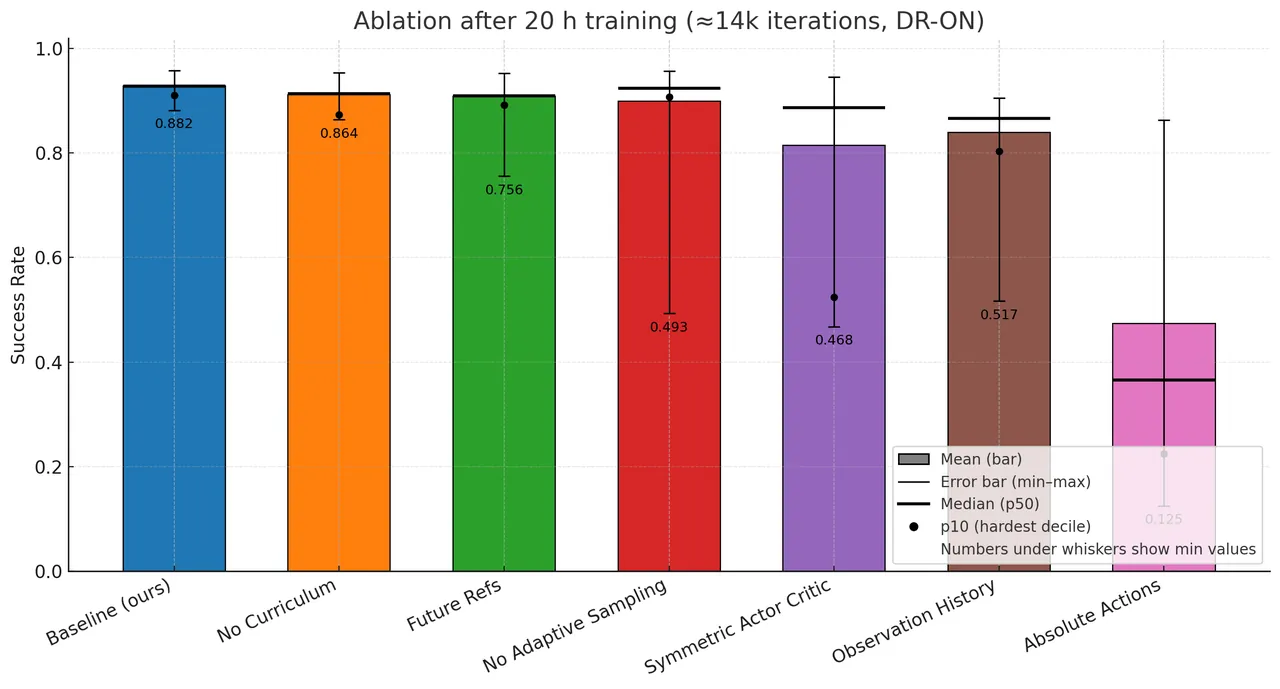
Ablations after 20 hours of training (~14k iterations).
| Motion | MPC MAE(q) | RL MAE(q) | MPC MAD(R) | RL MAD(R) |
|---|---|---|---|---|
| Walk | 0.0467 | 0.0554 | 0.0202 | 0.0280 |
| Jog | 0.1172 | 0.0757 | 0.1099 | 0.0621 |
| Handstand invert | — (fail) | 0.1466 | — (fail) | 0.1250 |
| Cartwheel | 0.2371 | 0.0882 | 0.0597 | 0.0628 |
| Roll on all fours | — (fail) | 0.0862 | — (fail) | 0.0914 |
| Dance snippet B | — (fail) | 0.0964 | — (fail) | 0.1503 |
Table 2: Simulation-based comparison of the Boston Dynamics whole-body MPC baseline vs. the multi-skill RL policy. A dash means MPC failed to execute the behavior. All values in radians; lower is better.
Ablations and MPC comparison. A multi-skill Atlas policy over 15 motions serves as the analysis vehicle: 10,000 rollouts per reference under full domain randomization. Removing the curriculum roughly matches full ZEST's 10 h performance at 20 h — feasible but less sample-efficient, especially on motions with large base-orientation variability. Removing adaptive sampling undersamples hard bins and degrades lower-tail performance. Adding 20-step history or future reference windows increases dimensionality, complicates credit assignment, and slows or prevents convergence; a sweep over window lengths 5–20 shows gradual degradation. Stripping privileged information from the critic degrades value estimation, and absolute actions (instead of residual) give the worst performance. Against a Boston Dynamics whole-body MPC baseline, RL matches MPC on walk (MAE$(\bm{q})$ 0.0554 vs 0.0467) but clearly wins on jog (0.0757 vs 0.1172) and cartwheel (0.0882 vs 0.2371), while MPC fails entirely on dance B, handstand invert, and roll on all fours — behaviors involving noisy contact labels, arm-torque saturation under point contact, or extended toe-contact phases.
Limitations
The authors are explicit about three gaps. First, no generalization study: the multi-skill policy is never tested on motions outside the training set, so it remains open whether ZEST learns transferable control primitives or overfits to specific references. Second, the formulation is proprioception-only and assumes flat, non-slippery terrain — explicit perception of uneven or compliant environments is future work. Third, sim-to-real still hinges on reasonable modeling; the paper provides a practical PLA modeling and armature-based gain-selection procedure, but fully automated system identification remains open, and complex phenomena will likely need data-driven methods. Beyond the authors' list, the per-skill specialist policy design means hardware results rely on one dedicated ~10 h training run per behavior rather than one general policy — practical today, but a scaling cost worth noting.
Summary and Outlook
ZEST shows that motion imitation can be simplified rather than engineered: no contact labels, no state estimator, no reference windows, no motion-specific rewards, no multi-stage training — yet it produces the first dynamic multi-contact behaviors on a full-size humanoid and the first video-to-behavior transfer of athletic skills to a physical G1. The same recipe crosses embodiments (Atlas, G1, Spot) and data sources (MoCap, video, animation), tolerating noise and even physically infeasible references. Stated next steps include general tracking of unseen motions via compact motion embeddings, partially conditioned interfaces (keyframes, pose snippets, language), and high-level generative planners closing the loop between behavior synthesis and control.
Golden Quote
"Together, these results demonstrate robust zero-shot deployment across heterogeneous data sources and embodiments, establishing ZEST as a scalable interface between biological movements and their robotic counterparts."
SOURCE LINKS