[●●●]ASSEMBLING INDUSTRY MAP
Industry Chain
The humanoid robot industry chain — from a market cognition map to upstream components, OEMs, capital and applications.
Industry Knowledge Graph
Key facts from all eight chapters in one graph · click nodes to expand, scroll/pinch to zoom101 Nodes · 122 Edges
Star-map lights up once the page settles…
6%Lighting up the industry star-map…
Drag to orbit the star-map · scroll/pinch to zoom · click a node for facts · legend focuses a chapter
Companies
230
Key segments
16
OEMs
141
T-chain names
8
00
Industry Panorama · Cognition Layer
Set the coordinates before diving into the chain — market pulse / capital markets / shipment landscape / development stages / structural calls / segment map
Data as of Aug 31, 2026 · Quotes as of Aug 28, 2026 close
Jan–Jul 2026 funding
¥164.1B¥39.8B full-year 2025
Unitree market cap
¥236.6BListed 2026-08-19
2025 global shipments
~13,000Chinese vendors 84.7%
2026 China output target
100kMIIT basis
00-A
Market Pulse · Funding
2026 monthly financing vs. annual base
Jan–Jul 2026 funding (¥100M) & deal count
156Jan23
215Feb31
310Mar53
208Apr47
86May52
350Jun64
316Jul52
Jan–Jul 2026 humanoid financing reached ~¥164.1B (GG basis), far above the ¥39.8B full-year 2025 total; H1 alone was ¥104.1B (Yuanda), nearly double 2025, with June's ¥31.5B a record. August's monthly tally is pending; disclosed deals already include XPENG Robotics' $900M+ debut round (post-money $6.3B+) and LingChu's $100M+ round.
Annual funding base (¥100M / deals)
2023
¥10.3B
2024
¥10.6B
2025
¥39.8B
2023 Active firms738 (OEMs 40-60)
2024 Active firms807 (OEMs 80-100)
2025 Active firms868 (OEMs 140+)
By 2025, China had 868 active humanoid-robot-related companies, including 140+ whole-machine OEMs and 330+ released products (MIIT, Qichacha; compiled by Analysys).
00-B
Capital Markets · Caps & Valuations
Listed caps (Aug 28, 2026 close) & latest primary valuations
Listed market caps (as of Aug 28, 2026 close)
Unitree688836.SHSTAR Market¥236.6B
Listed 2026-08-19, the first humanoid IPO; priced at ¥150.80, opened +629%, first-day close cap ~¥341.8B; latest close ¥585.00 (-4.88%).
UBTECH09880.HKHKEXHK$42.0B
Listed Dec 2023; latest close HK$83.50 (+0.66%); ~¥1.4B orders in 2025, targeting 10k-unit capacity in 2026.
Latest valuations / capital moves of leading private firms (2026)
AgiBotHK$40–50B
Pursuing HK listing (Aug 2026); 15,000th Genie G2 rolled off in June.
XPENG Robotics$6.3B+ post-money
Debut round $900M+ on 2026-08-24, a record for China's embodied AI.
Dexmal~¥20B (in talks)
Prior rounds led by Alibaba and NIO (2026-08-21).
LimX Dynamics¥15B post-money
Per GG July report; humanoid maker.
Galaxea AI¥10B+
¥1B Series B in Feb 2026; ~¥3B raised in total.
Spirit AI¥10B+
~¥2B across two rounds in Feb 2026; ¥10B+ just 26 months after founding.
Yimu Tech¥10B+
Tactile sensors; crossed ¥10B in July 2026.
Qiuzhi / XinuoUnicorn
Home robot / dexterous hand; new unicorns as of July 2026.
Global capital moves (2026)
Skild AI$2.2B raisedHumanoid$1.35B post-moneyWalden Robotics$1.1B post-money
Capital-market channels are now open: Unitree became the first listed humanoid maker, AgiBot is pursuing a HK listing, RobotEra is reportedly prepping an IPO; Central Huijin holds stakes in 8 core humanoid-chain firms. Primary-market valuations concentrate on shipping leaders — six Chinese firms entered the ¥10B club in early 2026.
00-C
Shipment Landscape · Actuals & Forecasts
Omdia 2025 actuals + 2026 output forecasts
~13,000 units shipped globally in 2025 · Omdia 'General Embodied Robot Market Radar'
AgiBot5,16839%
Unitree4,20032%
UBTECH1,0008%
Leju, EngineAI and Fourier rank 4th–6th; Chinese vendors lead overall, shipping 84.7% of the global total.
From hundreds to 100k: global shipments grew from a few hundred (2023) to 3,000 (2024) to ~13,000 (2025); China's 2026 output is expected to pass 100k. Foshan runs China's first 10k-unit annual line (one robot every 30 minutes); AgiBot went from its 10,000th to 15,000th unit in just over two months.
2026 output / shipment forecasts
MIIT
China output to pass 100k units in 2026
GGII
62.5k domestic shipments
Morgan Stanley
50k China shipments (raised twice this year, from 14k)
Deutsche Bank
~50k globally (raised from 17.5k)
Omdia
2.6M global units by 2035
00-D
Industry Coordinates · Stages
Five-stage evolution of China's embodied-AI industry (Analysys)
- 2026 is 'year one' of both mass production and capital markets: Unitree listed on the STAR Market, more IPOs in the pipeline
- MIIT & SASAC launched a live-scenario deployment action: 10k-unit scale and 100+ high-value scenarios by end-2026
- Humanoids now work routinely at BYD, Zeekr and Foton Cummins plants; Q1 exports hit ¥11.3B (+210%), sold in 148 countries
- Morgan Stanley, Goldman and Deutsche Bank all raised shipment forecasts; MIIT expects 100k+ units built this year
00-E
Structural Calls
Trend judgments from research reports and latest market moves
00-E1
Year one of mass production: from hundreds to 100k
Global shipments: a few hundred (2023) → 3,000 (2024) → ~13,000 (2025); China's 2026 output may pass 100k. Foshan's 10k-unit line ships one robot every 30 minutes; Unitree's humanoid price fell from ¥593k (2023) to ¥29.9k — the cost curve is clearing the path to scale.
00-E2
Capital markets open; concentration intensifies
Unitree's first-day cap hit ~¥341.8B as the first listed humanoid maker; AgiBot is pursuing a HK listing, RobotEra is reportedly prepping one, and Central Huijin holds 8 chain names. Capital now follows firms that actually ship — fundraising heat is coupling with delivery.
00-E3
Made in China leads: 84.7% of global shipments
Chinese vendors shipped 84.7% of the world's humanoids in 2025; Q1 2026 exports reached ¥11.3B (+210%) across 148 countries; Shanghai ports handled ¥8.6B of robot exports in the first five months — 42.5% of China's total.
00-E4
Policy tone: anchor on real scenarios, avoid a blind rush
MIIT and SASAC launched a 10k-unit live-deployment action targeting 100+ high-value manufacturing and livelihood scenarios, while NDRC warns against a blind rush. The commercial battleground has shifted from shows to 3C inspection, logistics sorting and auto manufacturing.
00-F
Chain Map · Segment Navigator
ZoSi Research directory basis: companies covered per segment, tap to jump
23 segments · 506+ company entries
Quadrupeds20Swarm intelligence21Industrial robots10Special-duty robots7Embodied data22
Sources: market caps from Tencent/Eastmoney (Aug 28, 2026 close); shipments from Omdia 'General Embodied Robot Market Radar' (Jan 2026); funding from GG Humanoid monthly reports (Jan–Jul 2026) and Yuanda H1-2026 statistics; output and forecasts from MIIT (WAIC 2026), Morgan Stanley, GGII and Deutsche Bank; company counts and 2025 baselines from Analysys and ZoSi Research '2026 Embodied-AI Robot Industry Chain Panorama'. Public information, for reference only.
01
Humanoid Anatomy
10 core segments mapped onto the robot body · tap a number to jump
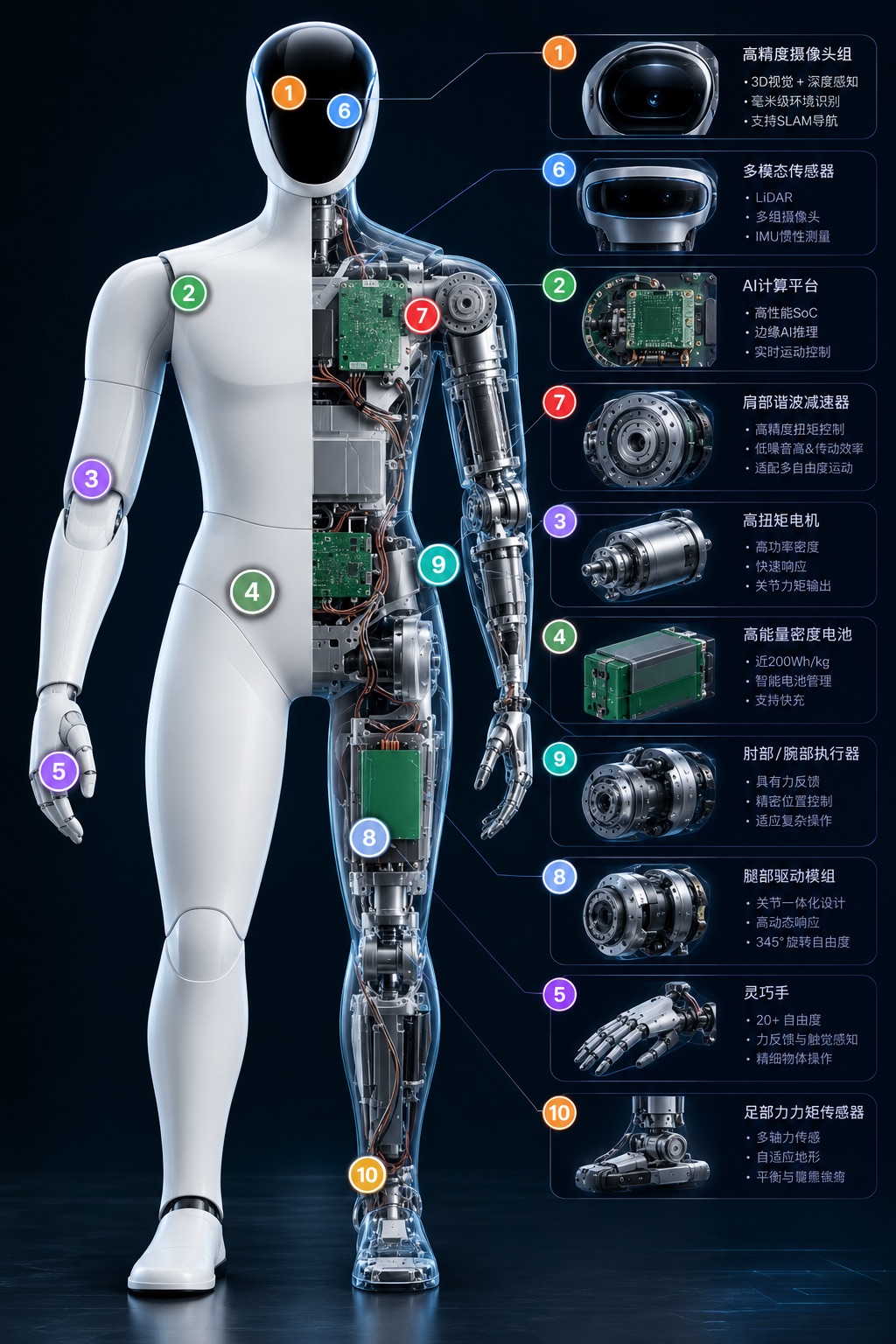
Tap a numbered hotspot to jump to its segment
02
Upstream Core Components
16 key segments · highest cost share & tech moats
1
LiDAR
3Head-mounted LiDAR adds mapping and navigation redundancy for mobile scenarios.
2
Vision & 3D Sensing
4Stereo, structured-light and ToF depth cameras are the robot's eyes.
3
Precision Reducers
6Harmonic/RV reducers set joint precision and life; the biggest rotary-joint cost.
4
Encoders
4High-precision encoders close the loop on joint-angle control.
5
Frameless Torque Motors
4High torque-density frameless motors directly drive rotary joints.
6
Coreless Motors
3Coreless motors are small and fast, the mainstream finger-drive choice.
7
6-Axis Force/Torque Sensors
7Wrist/ankle 6-axis F/T sensors give contact-force awareness for force control.
8
Tactile Sensing & E-Skin
8Fingertip tactile arrays and e-skin detect slip for dexterous manipulation.
9
Dexterous Hands
11Multi-DoF dexterous hands are the end-effector of general manipulation.
10
Battery
4High C-rate packs set runtime and peak power; humanoids carry 1-2 kWh.
11
Controllers & Motion Control
5Real-time controllers and servo drives handle balance and tracking.
12
IMU
3High-performance MEMS IMUs feed attitude data to balance algorithms.
13
Bearings
3Cross-roller and thin-section bearings carry joint and screw loads.
14
Actuators & Joint Modules
11Rotary/linear actuators integrate motor, reducer, screw and sensing.
15
Planetary Roller Screws
7Planetary roller screws convert rotation into linear force.
16
Structure & Lightweight Materials
5PEEK, carbon fiber and die-casting cut weight, boosting runtime.
03
Embodied AI & Foundation Models
VLA, world models and sim data form the embodied-AI software stack.
AI2 RoboticsLeaderAgibotLeaderDexForceLeaderGalbotLeaderRoboteraLeaderSpirit AILeaderX Square RobotLeaderX-HumanoidLeader1RobotAIO IntelligenceAheadFormAscapeAstroDroidDaxiao RobotDeltat AIDexTeleopDexterityDianshu TechFieldAIFiveAgesFoxgloveGalaxea AIGeneralistKinetix AILivsynMecka AIMotionPalatialPsiBotQianjie TechnologyRobbyantSkild AISynphonyTARSThinkWheelTowards AGITsing StandardXDOFYuandian Tech
04
Humanoid OEM Directory
115 companies · Beijing / Shanghai / Shenzhen / Hangzhou + 20 cities
Beijing
33GalbotLeader
Galbot· 2023
Founded by Dr. Wang He, assistant professor at Peking Un
Noetix RoboticsLeader
Noetix Robotics· 2023
Founded by Jiang Zheyuan, a 1998-born Tsinghua PhD stude
RoboteraLeader
Robotera· 2023
Founded by Professor Chen Jianyu, doctoral supervisor at
X-HumanoidLeader
X-Humanoid· 2023
Jointly established in November 2023 by UBTECH, Jingchen
Agile Robots
Agile Robots· 2018
Founded by researchers from the German Aerospace Center,
Amigos
Amigos· 2024
Founded by Liu Fang (SJTU CS master's, among Google's ea
Anyverse Dynamics
Anyverse Dynamics· 2025
Led by CEO Zhang Yufeng, former Horizon Robotics VP and
ART Robot
ART Robot· 2023
Founded by Zhang Rui, who previously worked at Beihang U
Booster Robotics
Booster Robotics· 2023
Founded by Cheng Hao, Tsinghua bachelor's and master's g
BXI
BXI· 2022
Co-founded by CEO Chen Yan (Southeast University CS grad
CASBOT
CASBOT· 2023
Founded by Dr. Zhang Zhengtao, researcher and PhD adviso
Corenetic
Corenetic· 2023
Co-founded by Dr. Lian Wenzhao (CAS researcher, former F
CX Robotics
CX Robotics· 2023
A wholly-owned subsidiary of listed company XinXing Equi
DAX Robotics
DAX Robotics· 2025
Co-founded by Wang Kun, former founding member of JD's u
Dexmal
Dexmal
A humanoid robotics company founded and led by CEO Tang
DexTeleop
DexTeleop· 2025
Founded by Tsinghua University's top motion control team
FiveAges
FiveAges· 2024
Founded by Dr. Liu Nianfeng (CAS Institute of Automation
Galaxea AI
Galaxea AI· 2023
Founded by Gao Jiyang, Tsinghua Electronics Department u
Haribit
Haribit· 2016
JD Robotics
JD Robotics09618.HK· 2025
JD.com's smart robotics division, established in March 2
Li Auto
Li Auto2015.HK· 2015
Founded by Li Xiang, founder of Autohome. In May 2026, L
Livsyn
Livsyn· 2023
Founded by Yang Hongbing (Tsinghua graduate, former Tenc
Matrix
Matrix· 2023
Founded by Zhang Haixing, former founding leader of Tesl
PhyBot
PhyBot· 2024
Founded by Ren Xiaoyu and co-founder Mao Shuhan (both Ts
RealMan
RealMan· 2018
Founded by Zheng Suibing, RealMan's core team comprises
RoboScience
RoboScience· 2024
Co-founded in December 2024 (operations began March 2025
Robot++
Robot++· 2015
Founded in Beijing in Sep 2015 by Xu Huayang, Tsinghua m
Tiangong Robot
Tiangong Robot· 2022
Beijing Tianxia Xianzhichuang Robot Technology Co., Ltd.
Vizum
Vizum· 2017
Founded by Dong Xiaojian, with core R&D from leading sem
Xiaomi Robotics
Xiaomi Robotics1810.HK· 2023
Operated independently as Beijing Xiaomi Robotics Techno
Yingzhi Technology
Yingzhi Technology· 2022
Yuequan Bionic
Yuequan Bionic· 2022
Co-founded by Academician Ren Luquan (Jilin University)
Zinovate
Zinovate· 2023
Incubated by the Chinese Academy of Sciences, with CEO S
Shanghai
22AgibotLeader
Agibot· 2023
FourierLeader
Fourier· 2015
Founded by Gu Jie, a Shanghai Jiao Tong University mecha
3S Robotics
3S Robotics· 2020
Founded in Shanghai in Nov 2020 by Wang Dezhao, former t
CloudMinds
CloudMinds· 2015
Founded by Bill Huang, former CTO of UTStarcom and head
CYAN
CYAN· 2023
Founded by Cambridge PhD Niu Tengfei, formerly an autono
DroidUp
DroidUp· 2021
Founded by Professor Li Qingdu, executive dean of the Ma
Futuring Robot
Futuring Robot· 2022
Founded by Zhang Yi, former founder of Zhangmen Educatio
HHS Robotics
HHS Robotics· 2025
Founded by CEO Qi Jianwei, the first Chinese employee at
Humanoid Robot (Shanghai)
Humanoid Robot (Shanghai)· 2023
A state-backed R&D institution co-founded by leading ent
JAKA
JAKA· 2014
China's leading collaborative robot maker, JAKA ranked f
Keenon
Keenon· 2010
The world's No.1 shipper of commercial service robots (I
KEPAI
KEPAI· 2024
Founded by Dr. Liang Conghui, formerly a T12 expert rese
Kepler
Kepler· 2023
Co-founded by Yang Hua, founder of Puremi Technology, an
QingBao
QingBao· 2021
Founded by Dr. Wang Lei, a Tsinghua electronic engineeri
Robo Party
Robo Party· 2025
Founded by Huang Yi (born 2004), who entered Harbin Inst
RobotGym
RobotGym· 2022
Founded by CEO Shi Yunlei, a student of German Academy o
SAIC Motor
SAIC Motor600104.SH· 1955
One of China's largest automotive groups, SAIC Motor beg
Siasun
Siasun· 2014
Founded in May 2014 with dual HQs in Shanghai and Shenya
Swancor
Swancor688585.SH· 2000
Originally an advanced materials company, Swancor entere
TARS
TARS· 2025
Founded by Dr. Chen Yilun, former Huawei Autonomous Driv
TIS Robot
TIS Robot· 2020
TIS Robot focuses on high-performance lightweight joint
WhalesBot
WhalesBot· 2018
An AI-robotics education company whose founding team has
Shenzhen
27AI2 RoboticsLeader
AI2 Robotics· 2023
Founded by Dr. Guo Yandong, formerly a researcher at Mic
DexForceLeader
DexForce· 2021
Founded by Dr. Jia Kui, tenured professor at CUHK-Shenzh
EngineAILeader
EngineAI· 2023
Founded by Zhao Tongyang, a humanoid-robotics veteran of
LimX DynamicsLeader
LimX Dynamics· 2022
Founded by Zhang Wei, tenured professor at SUSTech and f
PaXiniLeader
PaXini· 2021
Founded by Waseda University PhD Xu Jincheng, with found
UBTECHLeader
UBTECH9880.HK· 2012
Founded by Zhou Jian in 2012, who serves as Chairman and
X Square RobotLeader
X Square Robot· 2023
Led by CEO Wang Qian (Tsinghua, USC robotics PhD), CTO W
ARX
ARX· 2023
Founded by Zhang Xinliang, a Harbin University of Scienc
Astribot
Astribot· 2022
Founded by Lai Jie, first employee of Tencent Robotics X
Autolife Robotics
Autolife Robotics· 2024
Founded by Chen Siwei, a National University of Singapor
BYD
BYD002594.SZ· 1995
The world's largest NEV maker, founded by Wang Chuanfu.
Cyborg
Cyborg· 2024
Founded in July 2024, Cyborg focuses on all-terrain, all
Digit Robotics
Digit Robotics· 2024
Founded by Shen Jian, a veteran of 20+ years in top IT e
Digital Huaxia
Digital Huaxia· 2024
Shenzhen bionic-intelligence and humanoid company founde
Dobot
Dobot2432.HK· 2015
Co-founded by Liu Peichao (Shandong University mechanica
Elephant Robotics
Elephant Robotics· 2016
Co-founded in August 2016 by Wu Qilin and peers, with fo
HONOR
HONOR· 2013
The global smart-device giant spun off from Huawei in 20
Kinetix AI
Kinetix AI· 2025
Co-founded by CEO Yu Jie (YU JIE), former general manage
Leju Robot
Leju Robot· 2016
Founded by a Harbin Institute of Technology PhD team — C
LINX AI
LINX AI· 2023
Founded by Xiao Kai, who was inspired by Musk's humanoid
Lumos
Lumos· 2024
Founded by Yu Chao, former head of Dreame's humanoid bus
LY iTECH
LY iTECH002600.SZ· 2006
A leading global precision functional-parts maker founde
Morphi Robot
Morphi Robot· 2025
Founded in Shenzhen in 2025 by CTO Huang Qingqiu (Tsingh
OneRobotics
OneRobotics· 2018
Founded by Li Zhichen, who graduated from Harbin Institu
Pudu Robotics
Pudu Robotics· 2016
Founded by Zhang Tao, an HKUST mechanical engineering gr
T-chef
T-chef· 2018
Founded in Shenzhen in Nov 2018 by Dr. Geng Kaiping. Com
XTRONROBOT
XTRONROBOT· 2022
A special-industry embodied-AI company founded in Shenzh
Hangzhou
11DEEP RoboticsLeader
DEEP Robotics· 2017
Co-founded by Zhu Qiuguo, a Zhejiang University PhD and
Spirit AILeader
Spirit AI· 2024
Led by CEO Han Fengtao, former co-founder and CTO of Rok
Unitree RoboticsLeader
Unitree Robotics· 2016
Founded by Wang Xingxing, a Zhejiang native with degrees
AstroDroid
AstroDroid· 2023
Founded by ex-Alibaba VP Bai Huiyuan as CEO, with chief
Lanxin Robotics
Lanxin Robotics· 2016
Founded and controlled by chairman and general manager G
Mirror Me
Mirror Me· 2024
Founded by CEO Wang Hongtao, a Tsinghua- and Harvard-edu
Robbyant
Robbyant· 2024
Wholly owned by Ant Group with RMB 100M registered capit
Towards AGI
Towards AGI· 2024
Founded by Hu Luhui, former Meta chief engineering lead
Turui
Turui· 2023
Incubated from Zhejiang University's academician team an
Westlake Robotics
Westlake Robotics· 2021
Co-founded by Dr. Wang Donglin, deputy director of Westl
WuBa Intelligent Tech
WuBa Intelligent Tech· 2022
Jointly established by the Automation Research Institute
Other cities
48Huilun TechnologyLeader
Huilun Technology· 2026
Incubated by GAC Group and founded in February 2026 as t
MagicLabLeader
MagicLab· 2023
Incubated by Dreame Technology and now led by CTO Chen C
Tianji RoboticsLeader
Tianji Robotics· 2015
Guangdong Tianji Intelligent Systems Co., Ltd. (Tianji R
AtomRobot
AtomRobot· 2018
Founded by CEO Song Tao (2026 Capek Award 'Entrepreneur
Avatar Robotics
Avatar Robotics
Uses teleoperated robots for warehouse sorting and packi
Changan Auto
Changan Auto000625.SZ· 1996
One of China's 'Big Four' automakers, Changan is shiftin
Chaoneng Robot
Chaoneng Robot· 2016
Led by founder-chairman Dr. Xiao Xiangjiang, former dire
Chery
Chery9973.HK· 1997
One of China's 'Big Four' automakers, Chery has explored
Cobot
Cobot
Makes the mobile robot Proxie for collaborative cart and
Dash Bio
Dash Bio
Automates lab assays in drug discovery, with robots and
Dongfeng Motor
Dongfeng Motor0489.HK· 1969
One of China's 'Big Four' automakers, Dongfeng designate
Efort
Efort688165.SH· 2007
Efort Intelligent Equipment is a leading Chinese industr
EIR Technology
EIR Technology· 2024
Founded by legal representative Feng Zhenyu, EIR Technol
Estun Codroid
Estun Codroid· 2022
Incubated by Estun Automation, one of China's 'four litt
FAW Group
FAW Group· 1953
China's first state-owned automaker, FAW debuted its sel
GAC Group
GAC Group601238.SH· 2005
One of China's major automakers, GAC began its humanoid
Gecko Robotics
Gecko Robotics
Makes climbing robots and AI software to inspect power p
GLRoad
GLRoad· 2018
Controlled by Dou Qiaoqi and co-developing the 'Laborer'
GrayMatter Robotics
GrayMatter Robotics
Makes AI-driven surface-processing robots for sanding, g
Guanggu Dongzhi
Guanggu Dongzhi· 2025
Jointly established by Dongyanggwang Group, AgiBot, Peki
Humanoid (UK)
Humanoid (UK)· 2022
UK general-purpose humanoid maker targeting industrial a
Joyln
Joyln· 2024
Founded in Suzhou in Dec 2024 by Guo Renjie (Xi'an Jiaot
Juxie Intelligent
Juxie Intelligent· 2019
Founded by Zhao Wei, a Southeast University PhD who bega
LG Electronics
LG Electronics066570.KS· 1958
Korean consumer-electronics giant formally entering phys
Li-Gong
Li-Gong· 2018
Led by CEO Li Weichong, Li-Gong is a national 'Little Gi
Machina Labs
Machina Labs
Develops robotic factories for complex metal-part manufa
Matter
Matter
Builds autonomous factories to assemble drones and robot
Noble Machines
Noble Machines· 2024
Builds general-purpose humanoids for hazardous and heavy
PNDbotics
PNDbotics· 2023
Founded by CEO Yan Xunge (David Yan) and CTO Cui Haotian
ROKAE
ROKAE3752.HK· 2015
Founded by Tuo Hua (born 1983, Peking University master'
Seres
Seres601127.SH· 2007
Seres Group is an automaker in deep partnership with Hua
Shenhai Zhiren
Shenhai Zhiren
A Harbin-Engineering-University-lineage deep-sea robotic
Sunday Robotics
Sunday Robotics
Makes the wheeled home robot Memo. Backed by Bain Capita
Tesla
TeslaTSLA· 2003
Maker of the Optimus humanoid. In August 2026 Elon Musk
TetraBOT
TetraBOT· 2011
Founded in 2011, Nanjing TetraBOT is an embodied-intelli
TianQing
TianQing· 2024
Established on December 31, 2024, with iSoftStone holdin
TLIBOT
TLIBOT· 2012
Incubated by founder Hu Tianlian from a 2009 Southwest U
ugo, Inc.
ugo, Inc.· 2018
UniX AI
UniX AI· 2024
Founded by Yang Fengyu, a Yale CS PhD born in 2000 with
Upside Robotics
Upside Robotics
Makes solar-powered miniature robots that deliver fertil
Walden Robotics
Walden Robotics· 2026
Spun out of the Toyota Research Institute, Walden Roboti
XPeng Robotics
XPeng Robotics· 2019
Originally PengXing Intelligence, acquired and integrate
Yobotics
Yobotics· 2014
Founded by Fan Yong, former researcher at CAS Institute
Youibot
Youibot· 2017
Founded by Zhang Zhaohui, a robotics PhD candidate at Xi
Yunmu
Yunmu· 2021
Founded by He Liang, former deputy director of the Shang
Zerith
Zerith· 2025
Founded by post-2000 members of Tsinghua University's AI
Zhejiang Humanoid Robot Innovation Center
Zhejiang Humanoid Robot Innovation Center· 2023
Co-founded by a research team led by Zhejiang University
Zipline
Zipline· 2016
Delivery-drone operator moving medical supplies, food an
05
Capital & Milestones
[●●●]LOADING CAPITAL DATA
06
Embodied Applications
[●●●]LOADING APPLICATION MAP
07
Workforce Structure
Team sizes and R&D mix disclosed by leading humanoid makers, China and abroad · undisclosed firms are not estimated
Firms disclosing headcount
21
Total disclosed headcount
11,615
R&D staff share range
36%–70%
Humanoid job postings YoY
+215.8%
07-A
Domestic OEMs
Unit: people · dark segment = R&D staff · bracket = as-of date
UBTECH
2024-12
2,191
Agibot
2026-08
1,570
Fourier
2025-05
500
Unitree Robotics
2025-09
480
DEEP Robotics
2025-12
427
LimX Dynamics
2026-08
213
X Square Robot
2026-05
204
Kinetix AI
2026-09 晚点Auto
200
Robotera
2025
171
Noetix Robotics
2025-09
170
Galbot
2025
166
EngineAI
2026-08
151
MagicLab
2025-03
100
DexForce
2026-08
57
07-B
International leaders
Unit: people · dark segment = R&D staff · bracket = as-of date
Neura Robotics
2026
1,400
Boston Dynamics
2026-03
1,265
1X Technologies
2026-03
776
Figure AI
2026
619
Agility Robotics
2026-03
400
Apptronik
2026-03
391
Sanctuary AI
2026
164
Structural observations
07-1
R&D density far above traditional manufacturing
R&D shares among disclosing firms span 36% to over 80%: Unitree 36.5% (175), DEEP Robotics ~40%, Fourier above 40% (200+), DexForce above 70%, RobotEra and MagicLab above 80%, Agibot over 70% (~1,100 working on embodied foundation models). Algorithm and model teams are the core asset of embodied AI.
07-2
Pay benchmarked to top tech employers
UBTECH's 2024 report shows RMB 941M total compensation, about RMB 430K per person; Liepin data puts the average new robot-industry posting at ¥328K/yr and humanoid roles at ¥406K, with bachelor-level salaries up 240% YoY.
07-3
Teams scaling faster than in any mature industry
Noetix grew from ~50 to ~170 people in four months, average age under 25; Agibot's parent already employs 1,570+ and expects to pass 2,000 by end-2026; Unitree grew from 480 at its prospectus date to 516 by end-2025. International leaders are scaling too: 1X Technologies added ~251 people in a year and Apptronik grew 21.3% YoY (Revelio Labs estimates).
07-4
A widening talent gap
Liepin's 2026 robotics talent report: humanoid job postings +215.8% YoY, the wider robot field +75.26%; master's-level postings grow fastest (+87.8%); 63.1% of robot-trainer demand sits in Beijing, Shenzhen, Shanghai and Hangzhou.
Sources: Unitree / DEEP Robotics STAR Market prospectuses, UBTECH 2024 annual report, Eastmoney (2026-08-20), iFeng Tech (2025-05-12), Baobian (2025-09-20), Liepin '2026 Robotics Talent Supply & Demand Trends'; international figures from Neura Robotics' website, PitchBook, Revelio Labs workforce estimates (2026-03) and media coverage. Only firms with credible public disclosures are shown; undisclosed firms are left blank rather than estimated.
Sources: MechAwakening '2026 China Humanoid Company List' (2026-08) and public industry research; A-share tickers limited to high-confidence names.