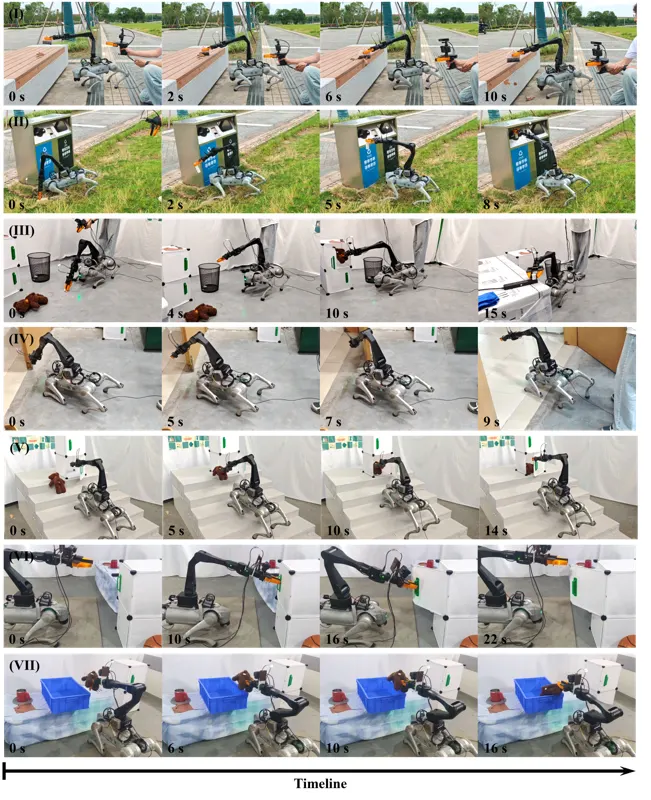
Whole-body loco-manipulation for quadruped robots with arms remains a challenging problem, particularly in achieving multi-task control. To address this, we propose MLM, a reinforcement learning framework driven by both real-world and simulation data. It enables a six-DoF robotic arm-equipped quadruped robot to perform whole-body loco-manipulation for multiple tasks autonomously or under human teleoperation. To address the problem of balancing multiple tasks during the learning of loco-manipulation, we introduce a trajectory library with an adaptive, curriculum-based sampling mechanism. This approach allows the policy to efficiently leverage real-world collected trajectories for learning multi-task loco-manipulation. To address deployment scenarios with only historical observations and to enhance the performance of policy execution across tasks with different spatial ranges, we propose a Trajectory-Velocity Prediction policy network. It predicts unobservable future trajectories and velocities. By leveraging extensive simulation data and curriculum-based rewards, our controller achieves whole-body behaviors in simulation and zero-shot transfer to real-world deployment. Ablation studies in simulation verify the necessity and effectiveness of our approach, while real-world experiments on a Go2 robot with an Airbot robotic arm demonstrate the policy's good performance in multi-task execution.
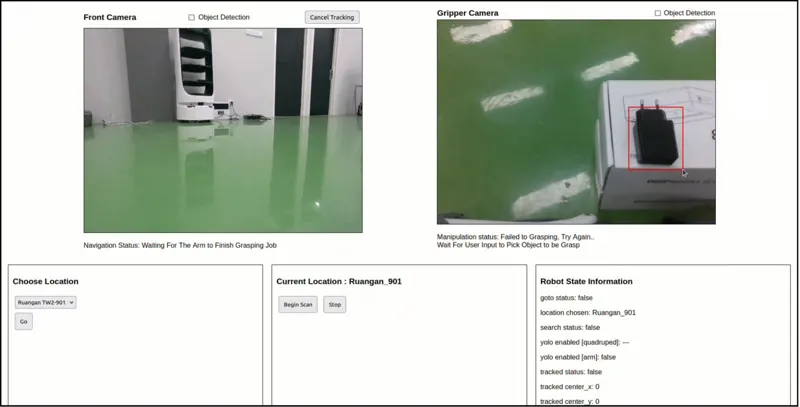
Quadruped robots are increasingly used in various applications due to their high mobility and ability to operate in diverse terrains. However, most available quadruped robots are primarily focused on mobility without object manipulation capabilities. Equipping a quadruped robot with a robotic arm and gripper introduces a challenge in manual control, especially in remote scenarios that require complex commands. This research aims to develop an autonomous grasping system on a quadruped robot using a task-level interaction approach. The system includes hardware integration of a robotic arm and gripper onto the quadruped robot's body, a layered control system designed using ROS, and a web-based interface for human-robot interaction. The robot is capable of autonomously performing tasks such as navigation, object detection, and grasping using GraspNet. Testing was conducted through real-world scenarios to evaluate navigation, object selection and grasping, and user experience. The results show that the robot can perform tasks accurately and consistently, achieving a grasping success rate of 75 % from 12 trials. Therefore, the system demonstrates significant potential in enhancing the capabilities of quadruped robots as service robots in real-world environments.
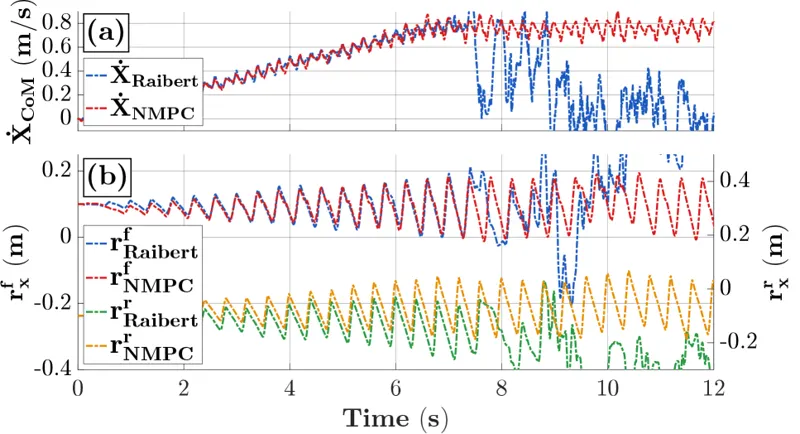
This paper presents a novel layered planning and control framework based on multi-rate nonlinear model predictive control (MR-NMPC) that enables quadrupedal robots to perform hybrid bipedal locomotion with wall-assisted support in constrained environments. Real-time trajectory optimization for this locomotion presents significant challenges, as the controller must simultaneously plan for both the contact points and the continuous trajectories of the robot's center of mass (CoM) and orientation within the robot's nonlinear dynamics while accounting for unilateral contact constraints, underactuation, and the switching nature of the robot's dynamics. At the high level of the control framework, an MR-NMPC is proposed, which dynamically plans both the discrete-time trajectories of the contact points and the continuous-time trajectories of the CoM and orientation, using a single rigid body (SRB) dynamics model. By incorporating contact-point planning within the multi-rate optimal control framework, this approach enhances dynamic stability compared to heuristic foot placement strategies. At the low level of the control framework, a nonlinear whole-body controller (WBC) based on virtual constraints and a quadratic program enforces full-order dynamics and tracks the MR-NMPC references. The proposed approach is validated through extensive numerical simulations demonstrating the robust wall-assisted bipedal locomotion of a Unitree A1 quadrupedal robot on rough terrains and under external disturbances in a constrained environment. Comparative analysis shows that the proposed MR-NMPC achieves a 2.9 times higher success rate compared to conventional MPC with heuristic-based foot placement strategies in negotiating irregular terrain at high speeds.