PAPER DEEP DIVE
ACAP: Asynchronous Coding Agents for Efficient Robot Control
ACAP organizes one robot as a team of persistent coding agents: each member owns a control group and reasons asynchronously, while a hyper-agent coordinates dependencies and dynamically transfers control, cutting task-balanced time cost by 28.2% across 25 real-world settings.
Paper: ACAP: Asynchronous Coding Agents for Efficient Robot Control (arXiv:2611.31205, v1 submitted 2026-11-23, cs.RO / cs.MA)
Authors: Zexin He, Rui Li, Chengkai Jin, Xingang Pan (S-Lab, Nanyang Technological University), Yushi Lan (University of Oxford), Zhi Hou (ACE Robotics); Xingang Pan is affiliated with both S-Lab and ACE Robotics
Links: arXiv:2611.31205 ·
Project page ·
Code status: ⏳ pending release (no public repository found at the time of writing; the project page is a placeholder shell, and the paper announces a release of the framework plus a 162-rollout real-world dataset)
One-Sentence Summary
ACAP organizes a single robot as a team of persistent coding agents: each member owns a configurable control group, such as an arm with its gripper or a body group comprising the torso and chassis, and reasons and executes at its own pace, while a hyper-agent assigns work, coordinates physical dependencies, and dynamically moves control between delegated members and the lead agent. Across 72 real-world rollouts covering 25 task/platform settings, ACAP reduces task-balanced time cost by 28.2% relative to a single-agent Direct policy, and it beats Fixed Delegation, where ownership never returns to the lead, in all eight Collaborative settings.
Background and Motivation
Coding-agent policies are a recent route to robot manipulation: an agent inspects the scene, constructs numerical models, and writes and revises robot-control programs during execution, extending the executable-policy interface of Code as Policies into sustained interaction with physical feedback. Unlike visuomotor policies learned from demonstrations, a coding agent can build task-specific procedures on the fly: fit a bottle axis, solve for the three-dimensional position of a flower tip, or track printed carton features to decide whether a grasp is slipping. That flexibility raises a practical organizational question: how should we arrange coding agents so that robotic manipulation becomes efficient?
Reasoning takes time. In a typical coding-agent policy, one agent is responsible for the entire robot. It can issue concurrent motion commands, but decisions about different robot components still pass through the same reasoning process. Diagnosing a failed grasp with one arm can delay an otherwise independent action with the other. Distributing reasoning across robot components therefore looks like a natural efficiency lever. The paper immediately identifies the tension at the heart of this idea: independent reasoning does not imply independent physical actions. The agents share one physical robot, and one group's actions can change another group's reach, support, or clearance. Tightly coupled manipulation, such as folding cloth or opening a bottle, demands close coordination; repeated communication and synchronization introduce substantial overhead, and one agent's recovery actions may change the object state and invalidate another agent's plan.
A straightforward organization is fixed delegation: each control group belongs permanently to a member agent, while a lead observes, assigns work, replans, and synchronizes. This works well for independent tasks, but the experiments in this paper show it can be slower than a single agent on collaborative work. ACAP's answer is a hyper-agent that decides not only what to delegate, but also when the lead should take direct control of multiple robot components. In four-flower insertion, the hyper-agent coordinates access to the shared vase while members prepare flowers independently. For a shared towel-folding action, the lead instead controls both arms directly while members continue their analysis. The division of control adapts to the physical dependencies of the task rather than being fixed in advance.
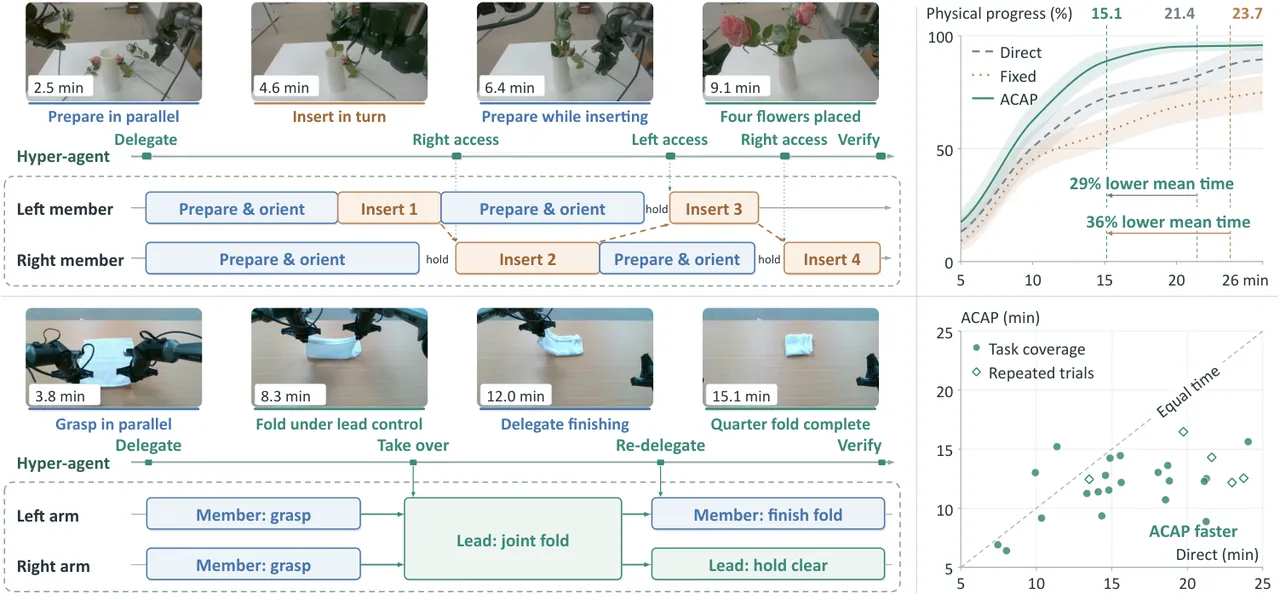
Figure 1 (paper Fig. 1): schematic timelines show parallel preparation with ordered vase access, and lead takeover followed by delegated finishing for towel folding; top right, mean physical progress and time cost across six tasks with five trials per policy; bottom right, task-level time comparisons between Direct and ACAP in the task-coverage and repeated-trial studies.
Preliminaries: Task Categories and Metrics
All experiments run on real robots. Following spatial and temporal distinctions in the bimanual manipulation literature, the paper groups tasks by the dependencies between control groups, so that the benefits of asynchrony and the benefits of coordination can be tested separately. (i) Fully Parallel tasks let control groups execute subtasks independently, as in collecting batteries into separate plates. (ii) Parallel-Sequential tasks make actions depend on another group's progress or on access to a shared workspace: flowers can be prepared independently but must be inserted into a shared vase in sequence. (iii) Collaborative tasks require control groups to jointly support, move, or deform one object, as in towel folding.
For time cost, let $T_i$ be the elapsed time of episode $i$ from the start of policy execution to the recorded outcome, or to the end of the episode when no outcome is declared. It includes reasoning, computation, waiting, movement, and recovery, but excludes task setup before policy execution. With recorded outcome $o_i$, the task-coverage study uses a penalty-floored cost:
$L_i=\begin{cases}T_i,&o_i=\mathrm{completed},\\ \max(T_i,\,30\text{ min}),&\text{otherwise}.\end{cases}$
An unsuccessful early stop therefore incurs at least 30 minutes, while completions longer than 30 minutes remain uncapped. Aggregation is task-balanced: repetitions are averaged within each setting first, and common settings are then weighted equally, so settings with more repetitions do not receive more weight. The repeated-trial study instead reports the mean and sample standard deviation of the 30-minute-capped cost $L_i^{30}=\min(L_i,\,30\text{ min})$: tasks completed within budget receive their elapsed time, and all other runs receive 30 minutes.
Physical progress is annotated by humans on a 0–100 scale. Annotators follow a shared task-specific rubric, marking when milestones are first reached and scoring completed work and partial achievement; the rubric defines milestone scores and allows intermediate scores based on the physical quality of the observed result. Each episode's progress curve records the highest score attained by each time. The normalized AUC integrates this curve over 30 minutes and divides by the window length, so earlier physical progress yields a higher score. The metric complements elapsed time: a policy may declare an outcome sooner, or it may achieve more physical progress within the same window.
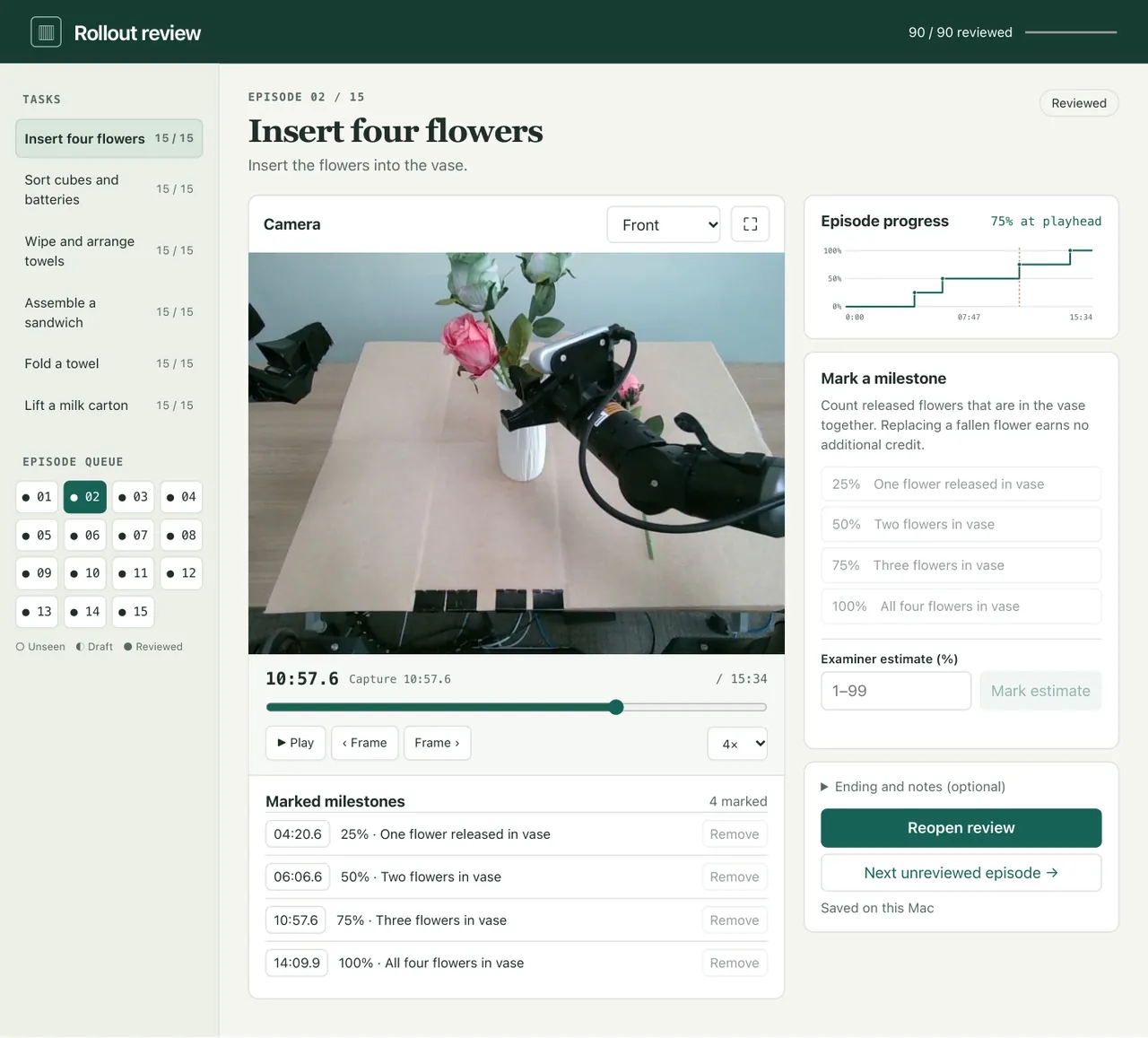
Figure 2 (paper Fig. 6): the annotation interface shows camera frames, task-specific scoring criteria, and timestamped marks together with the episode's progress curve; the selected frame shows three inserted flowers, corresponding to 75% progress.
Method in Detail
ACAP separates two questions: how can the agents progress independently, and how should their work be coordinated? An asynchronous framework answers the first; a hyper-agent answers the second.
Control groups and persistent members. Let $\mathcal{C}$ be the robot's configured control groups, each bundling actuators such as an arm and its gripper, or a torso and chassis. A persistent member $\mathrm{M}_c$ serves each $c\in\mathcal{C}$, while a lead $\mathrm{L}$ can directly control multiple groups; members are activated as needed. Each active agent repeatedly observes, reasons, and acts at its own pace: one member can diagnose a grasp while another plans a placement, without waiting for the other to finish a reasoning turn. Low-level controllers track the commanded motions, so reasoning and physical execution overlap. Members can also use lighter reasoning configurations for local subtasks while the coordinating agent considers the whole task, keeping reasoning within a manageable budget.
The hyper-agent policy. Handcrafted coordination rules encode human assumptions about how work should be organized, which can restrict a capable frontier coding agent's ability to adapt its coordination to the evolving physical situation. ACAP therefore lets the coding agent itself make task-dependent coordination decisions from observations, interaction history, and member feedback. At decision $k$, the hyper-agent policy $\pi_H$ selects an action $u_k$ from the interaction history $h_k$ and the current command owners $\omega_k$:
$u_k\sim\pi_H(\cdot\mid h_k,\omega_k),\qquad \omega_k(c)\in\{\mathrm{L},\mathrm{M}_c\},\quad c\in\mathcal{C}.$
The history includes observations, member reports, and computed results. An action can assign or revise work, request evidence, specify a dependency, authorize access to a shared workspace, or arrange direct lead execution. The index $k$ counts hyper-agent decisions while members follow their own loops, so the two rhythms are decoupled. Crucially, the hyper-agent makes these decisions from feedback rather than following a supplied task graph. Delegation gives a member an objective, an allowed scope of action, and control of its group; within that scope the member handles local planning and recovery. As dependencies change, the coordinator can keep work independent, sequence member actions at a shared workspace, return control of coupled groups to the lead for a joint action, or leave collaborative work with members whose roles complement one another.
Four scaffolding mechanisms. The framework provides mechanisms that support concurrent work and control transfers while leaving task-dependent coordination decisions to the hyper-agent. (1) Persistent contexts: each member keeps its observations, conversation history, and generated programs across assignments and control transfers within an episode, so it can continue from previous work without restarting its session or rebuilding its local context; members can even continue analysis while the lead controls their groups. (2) Message buffers: members report to the hyper-agent, which sends objectives, revisions, and relevant evidence; instructions and reports remain buffered until the receiving agent confirms receipt, so agents can work at different speeds without losing updates while a recipient is busy. (3) Event-based waits: a synchronization point specifies which actions must wait and what evidence permits them to continue; agents can wait for any or all specified events while other work proceeds. During flower insertion, for example, one member prepares and orients its flower while another inserts and withdraws from the vase, and a clearance report governs when the latter may act. (4) Exclusive ownership: a control group accepts commands only from its current owner, and ownership cannot change while a call to the robot controller is in progress. Initially the lead controls each available group; delegation transfers ownership to a member and takeover returns it to the lead. Transfers preserve controller targets, so responsibility can change without stopping motion or releasing held objects, and the new owner checks physical feedback before acting.
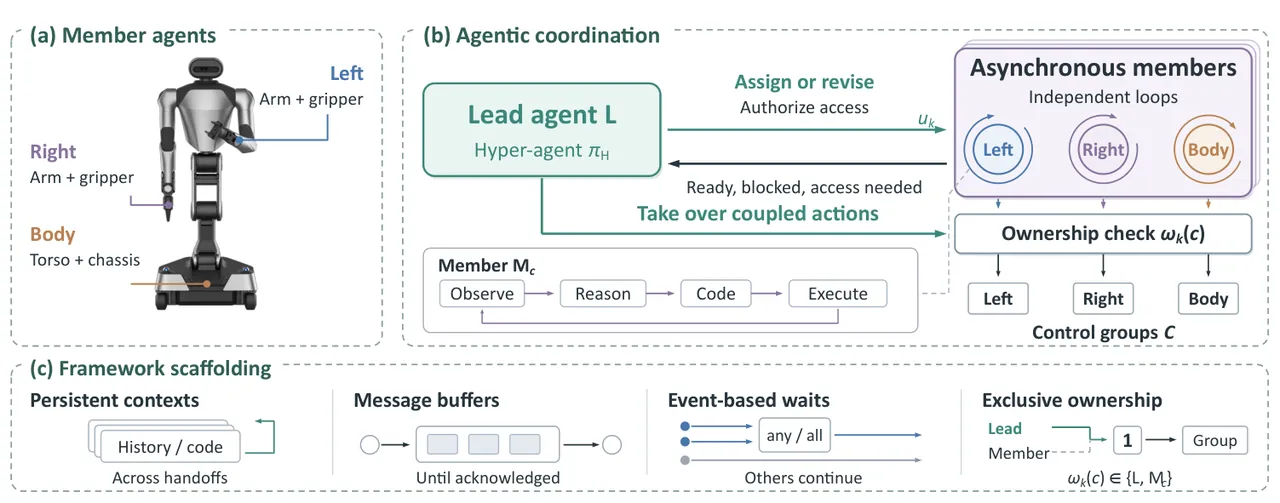
Figure 3 (paper Fig. 2): (a) members serve configurable control groups, illustrated by two arms with grippers and a body group comprising torso and chassis; (b) the hyper-agent uses history and member reports to assign or revise work, authorize access, or arrange direct lead execution of coupled actions, and the ownership check permits only the current owner to command a group; (c) persistent contexts, message buffers, event-based waits, and exclusive ownership support asynchronous progress and coordinated handoffs.
flowchart TB
  subgraph COORD["Lead L + hyper-agent pi_H (one session, Astra xhigh)"]
    PI["Decision k: u_k sampled from pi_H(h_k, omega_k)
h_k = observations + member reports + computed results"]
    PI --> ASSIGN["Assign / revise objectives and action scope"]
    PI --> SYNC["Specify dependencies and event-based waits
authorize shared-workspace access"]
    PI --> TAKE["Take over coupled groups for joint action"]
  end
  subgraph MEM["Persistent members M_c (Astra medium)"]
    MA["Left arm + gripper"]
    MB["Right arm + gripper"]
    MC["Torso + chassis (body member)"]
  end
  ASSIGN --> BUF["Message buffers
held until receiving agent acks"]
  BUF --> MA
  BUF --> MB
  BUF --> MC
  MA --> LA["Own loop: observe - reason - code - execute
context and programs persist across handoffs"]
  MB --> LB["Own loop: observe - reason - code - execute"]
  MC --> LC["Own loop: observe - reason - code - execute"]
  LA --> REP["Reports and physical evidence"]
  LB --> REP
  LC --> REP
  REP --> PI
  SYNC --> WAIT["Only dependent actions wait
independent work continues"]
  TAKE --> OWN["Ownership check: omega_k(c) is L or M_c
exclusive owner; transfer preserves controller targets"]
  LA --> OWN
  LB --> OWN
  LC --> OWN
  OWN --> ROBOT["Control groups C
only the current owner commands a group"]
Experimental Setup
The platforms are one Galaxea R1 Pro 2025 robot and four AgileX PiPER-family setups, including PiPER and PiPER-X. Three policy variants share the same observation modalities, numerical tools, and robot-control interface. Direct uses one coding agent to reason about and control the whole robot; it can issue concurrent robot commands, but planning and control share the same context. Fixed Delegation adds a lead that observes, assigns work, replans, and synchronizes member agents, but only members command their assigned groups, so assignments and timing can change while ownership can never return to the lead. ACAP is the full method: the coordinating agent chooses assignments and dependencies, retaining delegated execution or returning groups to the lead when direct coordination is appropriate.
For model configuration, the lead agent and the coordination hyper-agent share substantial context, and the frontier coding agent is capable of both coordination and direct robot control, so both roles are instantiated in a single session rather than two instances with largely overlapping context. Direct and the lead agents in Fixed and ACAP use Astra with xhigh reasoning; member agents use Astra with medium reasoning. Model and reasoning settings remain fixed within an episode. The Direct comparison therefore also includes lighter member reasoning, while the Fixed comparison holds these settings constant and changes only control permissions and role instructions. Every rollout starts with fresh agent sessions, without conversations or task-specific programs from earlier rollouts. Operators monitor safety without providing task guidance or manipulation assistance.
Two studies complement each other. The task-coverage study comprises 72 episodes across 25 task/platform settings: Direct versus ACAP spans all three dependency categories, while Fixed versus ACAP focuses on the eight Collaborative settings. The repeated-trial study comprises 90 episodes across six tasks, two per dependency category, with five trials per task and policy; objects are reset to corresponding initial arrangements across policy trials. A mobile-manipulation demonstration extends the member definition to chassis and torso control.
Experimental Results
Efficiency of the asynchronous framework (Table 1). ACAP has lower task-balanced time cost and higher physical-progress AUC than Direct in every dependency category: Fully Parallel 20.49 to 13.22 minutes (AUC 60.3 to 75.2), Parallel-Sequential 20.27 to 13.86 (67.4 to 73.1), and Collaborative 16.25 to 13.75 (56.9 to 70.8). Across all 25 settings the task-balanced mean falls from 19.04 to 13.67 minutes, a 28.2% reduction, with AUC rising from 62.3 to 72.9. The advantage extends from independent work to ordered access and coupled manipulation: even when some actions must be coordinated, members can prepare, perceive, and recover independently between those actions.
| Task dependency (settings) | Direct time (min) ↓ | ACAP time (min) ↓ | Direct AUC ↑ | ACAP AUC ↑ |
|---|---|---|---|---|
| Fully Parallel (6) | 20.49 | 13.22 | 60.3 | 75.2 |
| Parallel-Sequential (11) | 20.27 | 13.86 | 67.4 | 73.1 |
| Collaborative (8) | 16.25 | 13.75 | 56.9 | 70.8 |
| All settings (25) | 19.04 | 13.67 | 62.3 | 72.9 |
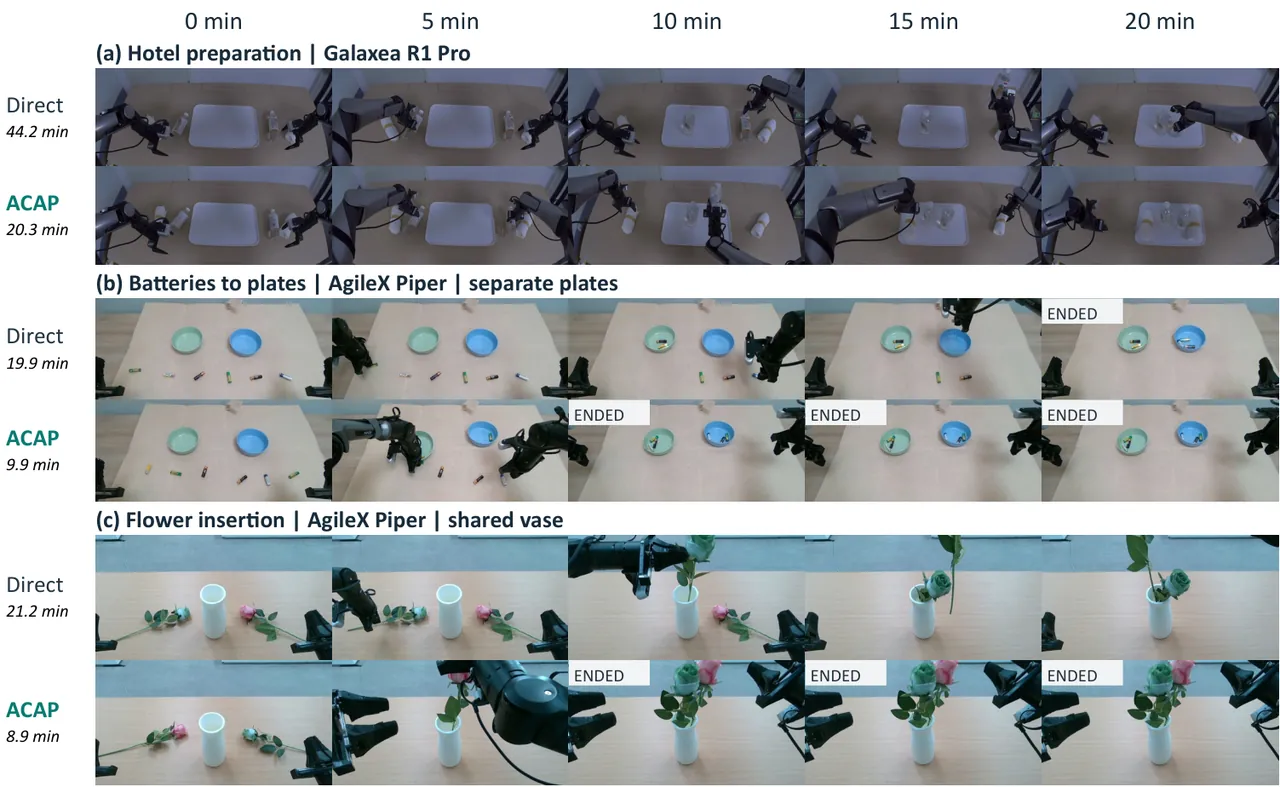
Figure 4 (paper Fig. 3): three Fully Parallel and Parallel-Sequential cases across Galaxea R1 Pro and two AgileX PiPER installations; columns share elapsed times within each task and row labels give observed episode durations. Battery collection: separate destinations allow independent pickups and placements (Direct 29.3 min vs ACAP 9.9 min). Hotel tray preparation: local pickup and reorientation run in parallel while the lead schedules tray access (44.2 vs 20.6). Flower insertion: vase entry must be ordered, but stem preparation proceeds alongside insertion (21.2 vs 8.9). In the two-flower trace, the finished member uses its wrist camera to reveal the other stem's occluded tip — parallel work remains useful even with shared resources and changing information needs.
The value of agentic coordination (Table 2). Across the eight Collaborative settings, Fixed Delegation averages 26.02 minutes with AUC 36.3 — worse than the single-agent Direct reference at 16.25 minutes and 56.9. ACAP reaches 13.75 minutes and 70.8, with lower mean time cost than Fixed in every Collaborative setting. Fixed already supports multiple agents, lead planning, and synchronization; what ACAP adds is the choice to execute coupled actions directly. The gains therefore come from flexibility in coordination, not from the number of agents.
| Policy | Mean elapsed time (min) ↓ | Progress AUC ↑ |
|---|---|---|
| Direct | 16.25 | 56.9 |
| Fixed Delegation | 26.02 | 36.3 |
| ACAP | 13.75 | 70.8 |
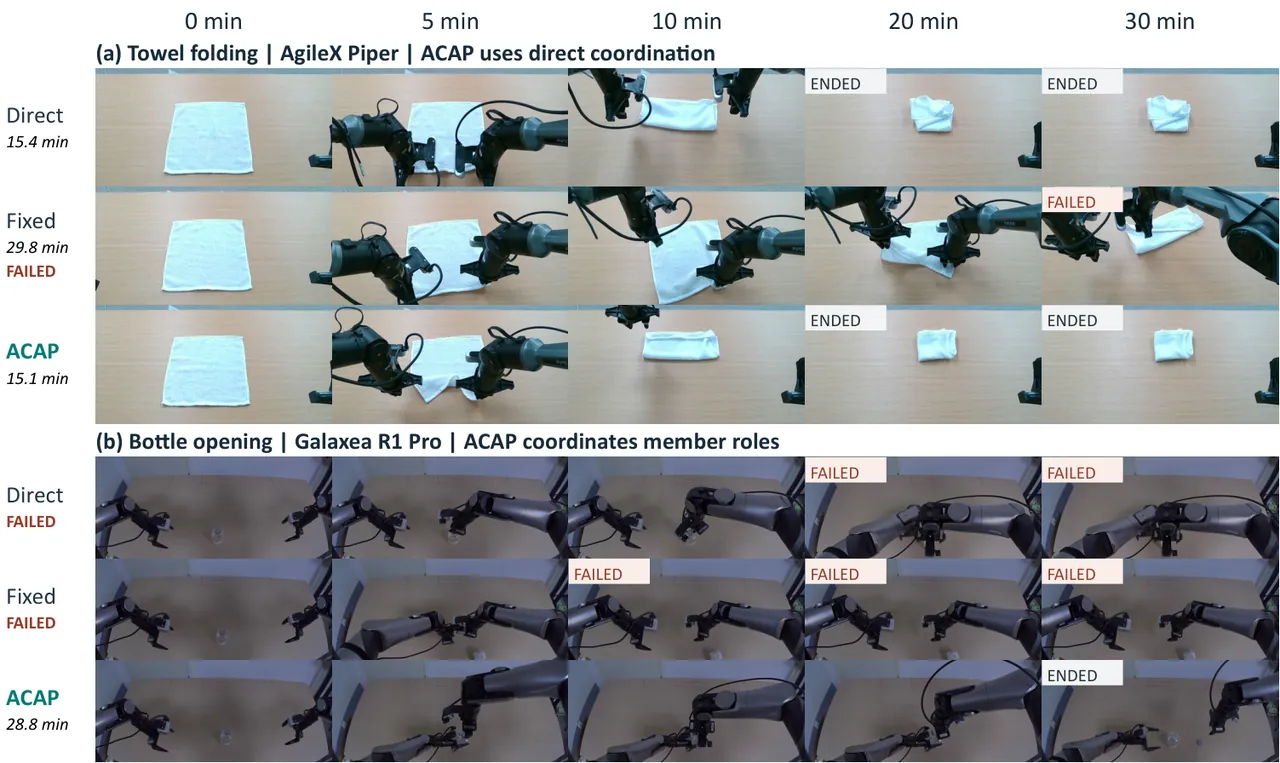
Figure 5 (paper Fig. 4): for towel folding, members establish grasps and the lead takes over both arms for the shared fold (shown episode: Direct 15.4 min, Fixed failed, ACAP 15.1 min); for bottle opening, ACAP keeps stabilization and twisting delegated and completes the task (28.8 min), while both baselines fail after arm crossing triggers hardware faults. Later Fixed columns repeat its last available image.
The Fixed traces explain why distributing a shared action can be costly even when it succeeds. In fruit-basket lifting, about 156 seconds elapse between the preparation instruction and the first motion command, filled with local computation and checks. In carton lifting, one member's wait condition does not recognize the shared start signal, requiring a later corrective command. Both episodes eventually complete, but converting readiness reports into a joint action takes further coordination. Appendix C adds the deeper reason: coupled manipulation makes the members' plans interdependent. One arm's grasp attempt moves the basket, shifting the handle the other arm is approaching, which prompts another round of communication and planning to update the grasp target and coordinate the next attempt. Overlapping reasoning rounds can coexist with delayed physical progress when members repeatedly revise and synchronize their actions.
Consistency across repeated executions (Table 3). With five fresh-session trials per task and policy on six tasks, ACAP has lower mean capped cost than Direct on all six tasks, a task-balanced reduction of 29.4%, and higher physical-progress AUC on five of the six. Wiping and towel arrangement gives the clearest separation: every ACAP trial finishes before every Direct trial, and both policies complete all five runs. On the Collaborative tasks, ACAP completes ten of ten runs, Direct eight of ten, and Fixed only three of ten. Fixed completes all wiping trials yet struggles when the arms must jointly fold or support an object: the ability to distribute independent work does not ensure effective collaboration.
| Task (30-min capped, min ± sample SD) | Direct time | Direct AUC | Fixed time | Fixed AUC | ACAP time | ACAP AUC |
|---|---|---|---|---|---|---|
| Wipe and arrange towels (Fully Parallel) | 23.73 ± 3.84 | 60.5 | 15.16 ± 2.98 | 72.0 | 12.54 ± 1.95 | 73.7 |
| Sort cubes and batteries (Fully Parallel) | 21.61 ± 3.07 | 62.5 | 17.44 ± 9.45 | 65.8 | 14.30 ± 5.87 | 75.2 |
| Insert four flowers (Parallel-Sequential) | 27.06 ± 3.79 | 46.7 | 25.59 ± 5.13 | 34.8 | 22.89 ± 6.78 | 56.6 |
| Assemble a sandwich (Parallel-Sequential) | 22.96 ± 9.06 | 40.3 | 26.50 ± 7.82 | 42.3 | 12.17 ± 4.70 | 69.2 |
| Fold a towel (Collaborative) | 19.74 ± 7.98 | 63.6 | 27.85 ± 4.10 | 40.9 | 16.47 ± 3.36 | 65.1 |
| Lift a milk carton (Collaborative) | 13.50 ± 9.34 | 75.2 | 29.82 ± 0.41 | 35.6 | 12.45 ± 2.37 | 70.1 |
| All six tasks (mean) | 21.43 | 58.1 | 23.73 | 48.6 | 15.14 | 68.3 |
Where the gains come from (Table 4). The trace analysis decomposes time into reasoning work (the summed duration of agents' active responses), overlaps between agents' reasoning, between reasoning and robot execution, and between control groups' execution, plus explicit coordination waiting. Relative to Direct, ACAP performs more summed reasoning work (+4.95 minutes in the coverage study, +6.29 in the repeated study) yet finishes sooner: reasoning overlap (−8.17 / −9.51) and reasoning-execution overlap (−1.35 / −1.44) dominate the gains, execution overlap contributes comparatively little (−0.18 / −0.14), and the net elapsed-time differences are −4.80 / −5.23 minutes. The efficiency gain primarily accompanies overlapping reasoning and execution, rather than more simultaneous robot motion alone. The Fixed-versus-ACAP comparison isolates coordination: with identical model configurations and both supporting asynchronous work, Fixed spends more time reasoning concurrently on the two repeated Collaborative tasks (14.78 vs 6.86 minutes), performs more total reasoning work (46.92 vs 23.29), waits longer for coordination (13.86 vs 2.85), and still takes nearly twice as long overall (28.83 vs 14.46). More concurrent reasoning need not translate into shorter elapsed time; adapting the division of control on coupled tasks matters beyond simply letting agents run asynchronously.
| (a) Asynchrony gains: ACAP relative to Direct (min) | Coverage | Repeated |
|---|---|---|
| Extra reasoning work | +4.95 | +6.29 |
| Reasoning overlap | −8.17 | −9.51 |
| Reasoning/execution overlap | −1.35 | −1.44 |
| Execution overlap | −0.18 | −0.14 |
| Elapsed-time difference | −4.80 | −5.23 |
| (b) Coordination gains: repeated Collaborative tasks (min) | Fixed | ACAP |
|---|---|---|
| Reasoning work | 46.92 | 23.29 |
| Concurrent reasoning | 14.78 | 6.86 |
| Coordination waiting | 13.86 | 2.85 |
| Elapsed time | 28.83 | 14.46 |
Mobile Manipulation: A Body Member
To test whether the member interface generalizes to other physical roles, the authors instantiate three members on the Galaxea R1 Pro: two arms with grippers, plus a body member responsible for the chassis and torso. The body member uses exactly the same assignment and reporting interface as the arm members, with responsibility for navigation and torso positioning. The task is to collect flowers from separate surfaces and place them in a floor-level basket: the robot travels to the flowers, grasps them, and adjusts its body to reach the basket.
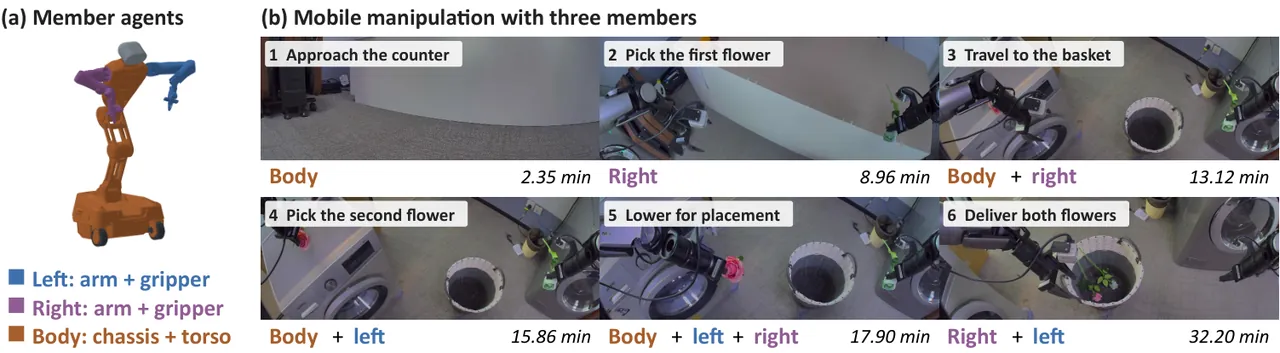
Figure 6 (paper Fig. 7): (a) an instantiation with three control groups colored by member — left arm and gripper, right arm and gripper, chassis and torso; (b) combined member labels indicate complementary roles: body navigation with a retained right-hand grasp (3), torso planning during left-member acquisition (4), and body lowering while both arm members maintain their grasps (5). Images come from chassis- and head-mounted cameras.
Body motion changes the workspace of both arms, introducing dependencies between navigation and manipulation. The timestamped trace (paper Table 10, mm:ss) shows how coordination unfolds. At 08:45–09:13 the body agent plans the navigation route while the right arm retracts with its flower during 08:49–08:58 and reports readiness for transport at 09:11. At 09:37–09:55 the left agent reassesses the destination basket from newly available views while the body executes a backward chassis movement at 09:48–09:51; the left agent's subsequent report informs the navigation direction. Before torso descent, the lead waits for carrying-pose reports: the right agent reports readiness at 15:39 and the left reports its flower retained after inward retraction at 16:48; after both reports, the lead authorizes the body agent to lower the torso at 17:05 with the arms holding their positions. At 20:46–21:02 all three members progress concurrently: the body plans chassis realignment, the right agent evaluates flower-placement poses, and the left arm physically retracts with its flower. The placement order is also revised: the right agent reports completed placement and a stable empty arm at 27:02, the lead authorizes chassis realignment at 27:10, and after the body reports completion at 28:36 the lead authorizes left-arm placement at 28:50, which the left agent reports completed at 32:02 — the revision was prompted by one arm being unable to reach the basket. Members retain control throughout while the lead adapts their objectives and dependencies. ACAP completes the task with both flowers visible in the basket, showing that asynchronous progress and agentic coordination carry over to the extended member definition.
The Rollout Dataset: Reasoning About Physics Through Code
The paper releases a dataset of 162 real-world rollouts from Direct, Fixed, and ACAP, linking observations, generated programs, and numerical results to agent communication, actions, feedback, and outcomes. It contains task instructions, timestamped observations, generated programs, numerical outputs, action requests, robot feedback, and task outcomes. Programs saved in development/ and agent workspaces preserve the computations performed during execution; available RGB and depth observations, calibration, and measured robot state provide their physical context. Observation identifiers and timestamps allow a computation to be traced from its input observations to the issued end-effector or joint targets, gripper commands, and subsequent feedback. Multi-agent rollouts also retain assignments, messages, and control transfers, showing how agents request, share, and use each other's analysis. An index supports retrieval by task, platform, policy, and task-dependency category, and the framework and role instructions accompany the dataset.
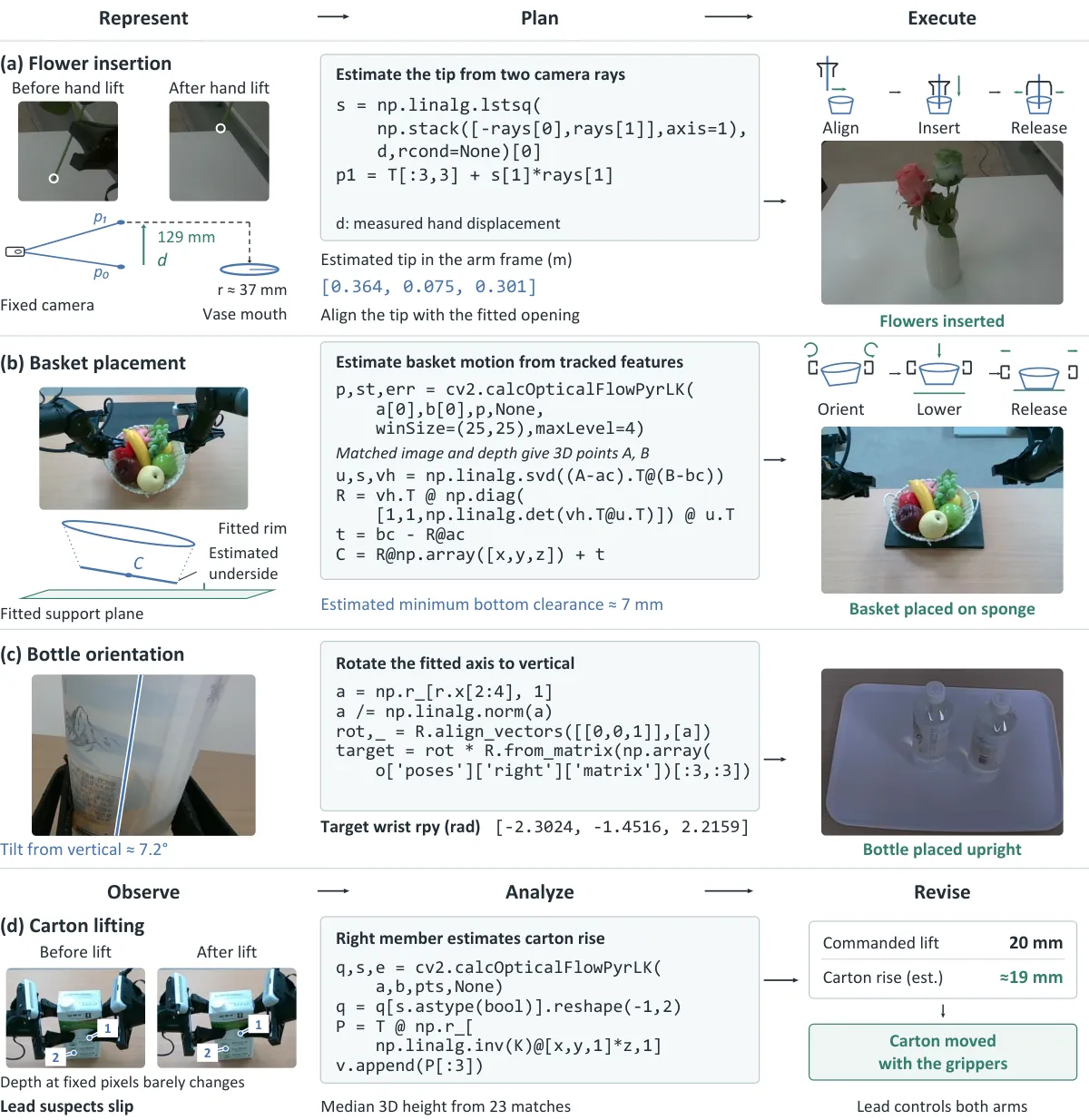
Figure 7 (paper Fig. 8): (a) the robot raises the flower, and the agent uses the measured hand displacement and two images to estimate the tip's position, then aligns and inserts the stem; (b) the agent estimates basket placement and clearance from fitted surfaces and tracked motion, then adjusts both arms to lower and release the basket; (c) a fitted bottle axis determines a corrective wrist rotation used in the next motion command; (d) after a commanded 20 mm lift, tracked carton features indicate a rise of approximately 19 mm, correcting the lead's initial slip diagnosis.
The saved programs reveal a recurring process: build a local analytical model, derive an action within it, and check the object's response. Four examples are worth reading closely. First, locating a flower tip and planning its insertion: the agent represents the vase opening as a circle fitted to depth points and the thin stem tip as an unknown point along an image ray. The right member raises its hand while keeping the grasp orientation approximately fixed; the tip's image positions before and after this movement define two rays from the same camera, and the measured hand translation constrains the displacement between the corresponding tip positions. A generated NumPy program solves for their depths by least squares, yielding an approximate three-dimensional tip position without relying on depth measurements, which are unreliable for thin stems. The agent then reasons about the tip relative to the opening: move above the rim, refine tip-to-rim alignment from a closer observation, command incremental downward motions, and open the gripper and withdraw once the stem is contained. Second, modeling basket placement and support clearance: the lead fits support planes from depth points and a circle to the basket rim, turning placement into a displacement between geometric locations. The basket's underside is invisible from all available cameras, so generated OpenCV code tracks basket features across observations and backprojects the matches into three dimensions; singular value decomposition fits a rigid transformation between matched points, and applying it to an initial model of the basket bottom yields estimates of position, tilt, and clearance above the support plane. The agent uses this geometry with fresh observations to adjust both wrist orientations, lower the basket incrementally, and release. Third, estimating a bottle axis: the right member backprojects wrist-camera depth points into the robot base frame and fits a cylinder using robust least squares, computes the rotation aligning the fitted axis with the vertical, and applies it to the current end-effector orientation so the next motion command corrects the bottle's tilt. Fourth, revising an interpretation of physical feedback: after commanding a carton lift, the lead observes nearly unchanged depth at fixed image locations and initially suspects a slip; while the lead controls both arms, the right member writes OpenCV code to track printed carton features and backproject matched depth measurements, revealing that the carton rises with the grippers by approximately 19 mm after a commanded 20 mm lift. The lead accepts the evidence and revises its slip diagnosis. The code, numerical results, and messages preserve how geometric evidence changes the lead's interpretation of execution feedback — exactly the process the dataset makes available for systematic study.
Limitations
Stated by the authors (Appendix F): the rollouts show agents reasoning about potential interference, sequencing access to shared workspaces, checking clearance from observations, and revising motion plans — collision awareness at the policy level. The current framework does not include a dedicated motion-level collision-checking layer. A complementary control layer could incorporate full robot geometry, including mounted cameras and other attachments, together with environment geometry, to check planned motions and monitor execution; developing and evaluating this extension is left to future work.
Additional observations from this review (the following are this page author's judgment, not the paper's text):
First, Fixed Delegation being slower than Direct (26.02 vs 16.25 minutes; AUC 36.3 vs 56.9) is the most cautionary number in the paper: multi-agent organization is not a free lunch, and without adaptive takeover, coordination overhead can consume the parallelism gains. ACAP's advantage therefore rests on the quality of the hyper-agent's takeover judgments, which is tightly coupled to frontier-model capability; with a weaker coordinating model, the framework's benefit could reverse.
Second, cost is unquantified. ACAP performs more total reasoning work than Direct (+4.95 / +6.29 minutes), and the lead and hyper-agent run a frontier model at the xhigh reasoning tier; the paper reports no token or API-cost accounting. Wall-clock gains may come with higher monetary cost, and lighter member reasoning mitigates but does not eliminate this trade-off.
Third, there is no learned-policy baseline. All comparisons are between organizations of coding agents, with no trained VLA or diffusion-policy reference; absolute durations of roughly 13–15 minutes per task remain far from skilled visuomotor policies on comparable manipulation. The contribution is organizational, not absolute speed, and the 28.2% reduction should not be read as evidence that coding-agent policies beat learned policies.
Fourth, metric design and confounds deserve attention. The 30-minute penalty floor directly shapes the reported means and is a convention rather than a physical quantity; the bottle-opening completion gap partly reflects hardware faults triggered after arm crossing in both baselines, not coordination alone; five trials per task is a modest sample; and all experiments use a single model family (Astra), so cross-model generality is untested.
Conclusion and Outlook
ACAP's answer can be stated in one sentence: define one robot as a team of persistent agents on configurable control groups, let members reason and execute asynchronously, and let a hyper-agent dynamically allocate control according to physical dependencies. The definition accommodates different numbers of members and different physical roles — arms, torso, chassis — and delivers consistent time reductions across 25 real-world settings and six repeated tasks, while showing that flexible division of control beats permanent member control on coupled manipulation. The 162-rollout dataset links coordination decisions, generated programs, and physical feedback, giving future work a systematic handle on how coding agents reason and act in the physical world. Natural next steps include a motion-level safety layer, cost-aware coordination strategies, and validation across models and platforms.
Golden Quote
However, independent reasoning does not imply independent physical actions.
— Section 1 of the paper