PAPER DEEP DIVE
NEXUS: Perceptive Whole-Body Control for Terrain-Adaptive Teleoperation
NEXUS combines contact-guided motion adaptation, teacher-student learning, and onboard depth perception so a humanoid can execute flat-ground whole-body commands on unseen terrain.
One-sentence summary
NEXUS generates frame-aligned flat-ground and terrain-adapted motion pairs by correcting contacts, then distills a terrain-aware teacher into a depth-conditioned student that lets a Unitree G1 execute flat-ground operator commands on unseen terrain without fine-tuning.
Why terrain mismatch is the real problem
Whole-body teleoperation is more demanding than locomotion command following. A velocity command specifies where a robot should travel, but it does not specify the coordinated pose of the hands, torso, knees, and feet. Human motion retargeting supplies that richer behavioral interface. A remote operator can ask a humanoid to kneel, kick, crawl over a ledge, stand on one leg, or perform a cartwheel, and the robot must reproduce the temporal structure of the behavior rather than merely reach a destination.
The difficulty appears when the operator and robot occupy different support geometries. The operator may move on a flat floor while the robot faces a 15 cm stair, a 60 cm platform, a grassy slope, or a narrow ramp. Copying the operator's joint angles frame by frame preserves the apparent shape of the motion but not its physical meaning. A foot that is flush with the floor in the source may float over a stair, penetrate a slope, or carry the wrong share of body weight. The same failure applies to hand-supported behaviors, where the palm and wrist establish an additional contact that cannot be repaired by leg IK alone.
One branch of prior work solves perceptive locomotion. It learns to cross rough terrain from navigation or velocity goals, often with depth, elevation maps, and proprioceptive feedback. That branch has strong terrain competence but does not represent arbitrary whole-body pose timing. Another branch learns motion tracking or behavioral foundation models on large motion corpora. It supports expressive skills but remains mostly terrain-agnostic: its training objective rewards reproduction of a reference, not reinterpretation of that reference under new local contacts.
NEXUS treats the missing supervision as the central bottleneck. A policy cannot learn the required adaptation from flat motions alone, and collecting matched motion-capture recordings on every terrain would be expensive and difficult to time-align. The paper instead constructs paired references offline. A flat motion is annotated at wrist and ankle contact frames, the contacts are projected onto a queried terrain, and the resulting corrections are interpolated through time. The adapted trajectory remains aligned with the original at every frame, so a teacher can later track one while observing the other.
The paper's claim is therefore not that a larger policy automatically solves terrain adaptation. Its claim is that the pair-generation process changes the supervision available to the policy. Diversity in the source corpus provides behavior coverage; geometric adaptation provides terrain supervision; onboard depth removes the need to pass simulator terrain state to the deployed student. These three pieces are evaluated separately and jointly.
Technical preliminaries
A motion frame contains the floating-base position, pelvis orientation, and joint angles. The source is written as $\mathcal{M}^{\mathrm{flat}}$ and its terrain counterpart as $\mathcal{M}^{\mathrm{adapt}}$. Because both use the same frame index, a teacher can compare the robot against the adapted reference while a student receives only the flat command and its own sensory history. The adapted trajectory is a training target, not an input that must be available at runtime.
Contact labels are binary for each ankle and wrist. A contact enters when link height and both horizontal and vertical speed are below entry thresholds. It exits only after a quantity crosses a wider threshold. The hysteresis prevents rapid switching near a boundary. Frames with at least one active contact become keyframes for geometric correction. A clip with no contact keyframe is excluded because the adapter has no anchor from which to determine the desired terrain interaction.
The teacher-student split addresses an information mismatch. The teacher may inspect privileged simulator quantities, including a local height map, contact states, body velocities, and error terms. The student cannot. It receives a motion window, proprioceptive history, and one depth image. DAgger is used because ordinary imitation of successful teacher rollouts would not provide corrective labels after the student drifts into states that the teacher never visited.
Method: from a flat clip to a terrain reference
The pipeline is a sequence of constrained geometric operations followed by policy learning. It does not learn the offline adapter and it does not use a generic image-to-image model. The data generator explicitly detects contacts, raycasts terrain, adjusts the pelvis, solves bounded IK, checks collision geometry, and reconstructs source-relative corrections. The controller then learns to reproduce the same adaptive effect from deployable observations.
flowchart LR
    F[Flat motion] --> C[Detect ankle and wrist contacts]
    C --> K[Select contact keyframes]
    K --> R[Raycast height and normal]
    R --> P[Shift pelvis by largest offset]
    P --> I[Bounded IK and foot alignment]
    I --> X[Penetration correction]
    X --> S[PCHIP source-relative deltas]
    S --> D[Aligned flat and adapted pairs]
    D --> T[PPO privileged teacher]
    T --> Q[DAgger depth student]
    Q --> G[G1 onboard control]
The deployed policy is defined as a function of three observation groups:
$$\mathbf{a}_{t}=\pi\left(\mathbf{m}_{t}^{\mathrm{flat}},\mathbf{o}_{t}^{\mathrm{prop}},\mathbf{o}_{t}^{\mathrm{ext}}\right).$$Here $\mathbf{m}_{t}^{\mathrm{flat}}$ is the command window, $\mathbf{o}_{t}^{\mathrm{prop}}$ is proprioceptive history, and $\mathbf{o}_{t}^{\mathrm{ext}}$ is the exteroceptive observation. The action $\mathbf{a}_{t}$ contains scaled offsets from nominal joint positions and is consumed by PD control. The student's exteroceptive input in NEXUS is a single depth image, not the teacher's privileged terrain map.
1. Terrain targets preserve source contact height
For each active end effector, NEXUS places the source horizontal coordinate on the queried terrain and adds the local surface height to the source link height:
$$\mathbf{p}_{t,i}^{\mathrm{des}}=\left[x_{t,i},\ y_{t,i},\ z_{t,i}+h(x_{t,i},y_{t,i})\right]^{\top}.$$The term $z_{t,i}$ matters. A wrist or ankle origin is not generally exactly at the sole or palm surface, and a source contact may intentionally keep a small clearance. The adapter moves the target with the surface while preserving that source-relative height. Invalid raycasts, missing returns, and surfaces whose normals have insufficient upward components are ignored rather than treated as support.
2. Pelvis height follows the most demanding contact
For valid contacts, the terrain offsets are $d_{t,i}=h(x_{t,i},y_{t,i})$. NEXUS shifts the pelvis by the offset with the largest absolute magnitude:
$$i_{t}^{\star}=\operatorname*{argmax}_{i\in\mathcal{C}_{t}}\left|d_{t,i}\right|,\qquad \Delta z_{t}=d_{t,i_{t}^{\star}}.$$This rule gives priority to the contact that would otherwise be most out of reach. It is computationally simple and works across stairs and slopes without hand-tuned schedules. It is also a heuristic: when contacts disagree strongly, choosing one maximum offset can leave another contact to be resolved by IK or collision correction. A global optimization over all contacts could produce a smoother compromise, but it would increase runtime and require a separate objective for weighting support quality.
3. Bounded limb IK preserves the source pose
For each active limb, analytic two-bone IK creates an intermediate knee or elbow target and clamps the end target to reachable space. The four optimized joint angles then solve a regularized least-squares problem:
$$\min_{\mathbf{q}_{\ell}^{\min}\le\mathbf{q}_{\ell}\le\mathbf{q}_{\ell}^{\max}}\left\|\mathbf{f}_{m}(\mathbf{q}_{\ell})-\widehat{\mathbf{p}}_{m}\right\|_{2}^{2}+\left\|\mathbf{f}_{e}(\mathbf{q}_{\ell})-\widehat{\mathbf{p}}_{e}\right\|_{2}^{2}+\lambda^{2}\left\|\mathbf{q}_{\ell}-\mathbf{q}_{\ell}^{\mathrm{flat}}\right\|_{2}^{2}.$$The first two terms pull the intermediate joint and the end effector toward their terrain-adjusted targets. The final term discourages the optimizer from selecting an arbitrary posture when several solutions satisfy the endpoint. Joint limits are hard bounds. For a contacting foot, ankle joints are separately optimized to align the sole with the terrain normal, with a cap on the orientation correction. Hands are modeled as capsules, so they receive position alignment without a planar sole-normal objective.
After the first solve, the system samples the collision geometry of the hand or foot and raises the position target by the largest sampled penetration. It repeats the limb solve and foot orientation step. If the knee or elbow penetrates, bounded rotations of the limb's bend plane are tested and the chain is solved again. A candidate is accepted only when sampled clearance and end-effector drift pass their tolerances and sampled end-effector penetration does not increase. Otherwise the previous pose is restored.
4. Contact corrections are propagated with PCHIP
At a repaired contact keyframe, the difference between the IK pose and the source defines the correction:
$$\boldsymbol{\delta}_{k}=\left[\mathbf{q}_{k}^{\mathrm{IK}}-\mathbf{q}_{k}^{\mathrm{flat}};\ p_{k,z}^{\mathrm{IK}}-p_{k,z}^{\mathrm{flat}}\right].$$Every component is interpolated between keyframes with shape-preserving piecewise cubic Hermite interpolation:
$$\left[\Delta\mathbf{q}_{t};\ \Delta z_{t}\right]=\operatorname{PCHIP}\left(\{(k,\boldsymbol{\delta}_{k})\}_{k\in\mathcal{K}}\right)(t).$$PCHIP is chosen to reduce overshoot near contact transitions. The corrections are held constant outside the first and last keyframe. The adapted motion is then reconstructed by adding them to the source:
$$\mathbf{q}_{t}^{\mathrm{adapt}}=\mathbf{q}_{t}^{\mathrm{flat}}+\Delta\mathbf{q}_{t},\qquad p_{t,z}^{\mathrm{adapt}}=p_{t,z}^{\mathrm{flat}}+\Delta z_{t}.$$The horizontal root trajectory and heading remain those of the source. Forward kinematics and finite differences recover body poses and velocities. This source-relative construction is the main reason the method scales without per-motion tuning: a joint that needs no correction has a zero delta at neighboring contacts and therefore inherits the original motion.
The construction is not a proof of collision-free motion. Acceptance is checked at keyframes, while interpolation can still move a limb through an obstacle between them. The paper explicitly says the local candidate procedure does not guarantee a collision-free trajectory. This is an important boundary for readers who might interpret the generated corpus as physically certified simulation data.
Method: transferring adaptation to a deployable student
The teacher receives adapted motion features, privileged proprioceptive feedback, contact information, and an $11\times17$ root-relative terrain height map:
$$\mathbf{o}_{t}^{\mathrm{tea}}=\left[\mathbf{m}_{t}^{\mathrm{adapt}},\mathbf{o}_{t}^{\mathrm{priv}},\mathbf{H}_{t}\right].$$The student receives flat motion features, proprioceptive history, and depth:
$$\mathbf{o}_{t}^{\mathrm{stu}}=\left[\mathbf{m}_{t}^{\mathrm{flat}},\mathbf{o}_{t}^{\mathrm{prop}},\mathbf{D}_{t}\right].$$The student therefore has to infer the relation between commanded behavior and local geometry. A three-layer CNN encodes depth and an MLP predicts actions. This estimator is intentionally small enough for real-time onboard execution, but the low-resolution depth formatting also limits the amount of geometric detail available for narrow or reflective structures.
The teacher is optimized with PPO using a weighted sum of tracking, contact, regularization, and survival rewards:
$$r_{t}=r_{t}^{\mathrm{track}}+r_{t}^{\mathrm{contact}}+r_{t}^{\mathrm{reg}}+r_{t}^{\mathrm{alive}}.$$Tracking rewards compare root pose and velocity, root-relative body poses, global body velocities, and joints with the adapted reference. Contact rewards penalize incorrect hand or foot timing, terrain clearance errors, and insufficient foot support. Regularization penalizes abrupt action changes, joint velocities, joint and torque limit violations, and self-collisions. The survival term keeps a successful rollout alive.
The distillation loss is evaluated on student-visited observations rather than only on teacher rollouts:
$$\mathcal{L}_{\mathrm{aug}}^{\mathrm{stu}}=\mathbb{E}_{\tilde{\mathbf{o}}}\left[\operatorname{MSE}\left(\pi^{\mathrm{stu}}(\tilde{\mathbf{o}}^{\mathrm{stu}}),\pi^{\mathrm{tea}}(\tilde{\mathbf{o}}^{\mathrm{tea}})\right)\right].$$The paired observations include mirrored samples. Because the teacher is frozen when producing labels, the student learns the teacher's local corrective behavior in states reached by its own policy. A left-right symmetry loss is also used during teacher training so reflected observations and signed joint permutations produce corresponding actions.
Termination is based on vertical clearance and root-relative end-effector errors:
$$e_{t}^{\mathrm{clear}}=\left|\left(p_{t,z}-h_{t}\right)-\left(p_{t,z}^{\mathrm{adapt}}-h_{t}^{\mathrm{adapt}}\right)\right|,\qquad e_{t,b}^{\mathrm{rel}}=\left|\left(p_{t,b,z}-p_{t,z}\right)-\left(p_{t,b,z}^{\mathrm{adapt}}-p_{t,z}^{\mathrm{adapt}}\right)\right|.$$An episode ends when either value exceeds 0.25 m, when the projected-gravity vertical components of robot and reference differ by more than 0.8, or when the time limit is reached. The criterion intentionally tolerates horizontal drift while detecting loss of support height or body structure. This choice aligns the learned objective with terrain adaptation, but it also means the controller can remain alive after a horizontal placement error that a task-level planner might consider a failure.
Does the generated supervision improve geometry at scale?
The adaptation benchmark contains 55 full-length G1 motions totaling 2.49 hours, drawn from LaFAN1 and OmniXtreme. The terrain set includes four configurations each of ascending and descending stairs and slopes, for 16 terrains and 880 motion-terrain pairs. NEXUS produces 39.87 hours of adapted motion with one fixed configuration. The comparison includes Root-only, which adds terrain height to the root while retaining all source joints, and TCRS, which combines foot trajectory sampling, root-height adjustment, and leg IK.
Table I should be read as a trade-off surface rather than a single ranking. Valid time ratio checks body penetration and contact gap across time. Penetration and floating describe opposite geometric failures. Contact preservation tests whether expected contacts remain close to the surface. Deviation tests whether non-contact limbs and waist joints preserve the source motion. Generation RTF measures wall time divided by input duration and excludes shared evaluation and reporting.
| Method and motion group | VTR | Penetration | Floating | Contact preservation | Pose deviation | Generation RTF |
|---|---|---|---|---|---|---|
| NEXUS, no hand contact | 92.08% | 0.814 cm | 0.880 cm | 79.12% | 0.00984 rad | 1.646 |
| TCRS, no hand contact | 89.69% | 0.606 cm | 2.965 cm | 29.63% | 0.08884 rad | 8.038 |
| Root-only, no hand contact | 63.37% | 2.865 cm | 0.817 cm | 54.25% | 0.00000 rad | 0.260 |
| NEXUS, hand contact | 80.53% | 1.630 cm | 0.946 cm | 71.21% | 0.01473 rad | 1.864 |
| TCRS, hand contact | 67.95% | 4.432 cm | 4.835 cm | 20.61% | 0.12213 rad | 7.887 |
| Root-only, hand contact | 55.69% | 3.839 cm | 1.230 cm | 48.94% | 0.00000 rad | 0.109 |
Without hand contact, TCRS has lower mean penetration than NEXUS, 0.606 cm versus 0.814 cm. It nevertheless has 2.965 cm of floating and preserves only 29.63% of expected contacts, while NEXUS reaches 0.880 cm floating and 79.12% preservation. The comparison shows why penetration alone is inadequate: a method can avoid crossing the surface by leaving a contact above it, but that is still a failed support condition.
Hand contact makes the problem substantially harder. NEXUS falls from 92.08% to 80.53% valid time ratio, yet TCRS falls to 67.95%. NEXUS also limits penetration to 1.630 cm and floating to 0.946 cm, compared with 4.432 cm and 4.835 cm for TCRS. A hand support changes the torso and shoulder chain at the same time as the feet, so a leg-only correction is structurally unable to cover the full contact set.
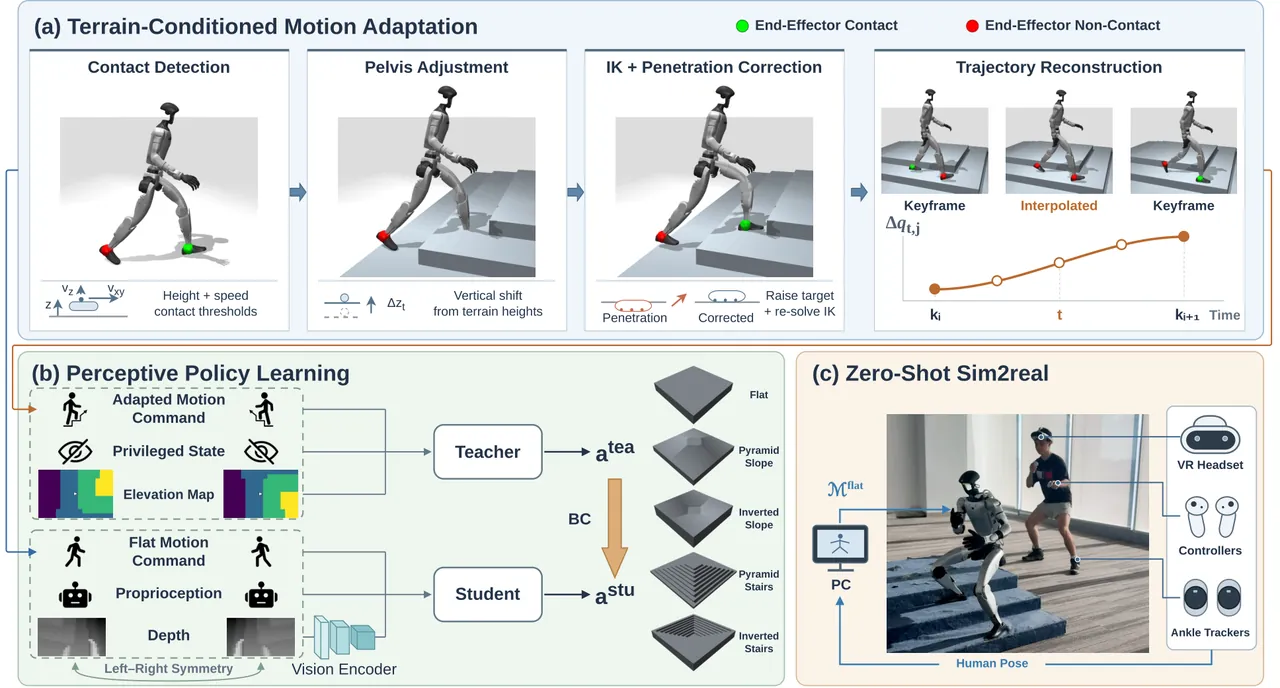
Figure 2: NEXUS overview. Contact-guided adaptation builds paired references, a privileged teacher is trained with PPO, and a depth-conditioned student is distilled for zero-shot teleoperation.
Timing uses a prespecified eight-motion subset across all 16 terrains, with one CPU core and one thread per process and 32 concurrent workers on an Intel Xeon Gold 6530. NEXUS reduces mean generation RTF relative to TCRS by factors of 4.88 and 4.23 in the two contact groups. TCRS also has six process errors, leaving 63/64 and 59/64 valid timing cases, while NEXUS and Root-only complete 128/128. Root-only is much faster, but its zero pose deviation is guaranteed by construction and comes with severe penetration in both groups; it is a diagnostic baseline, not a useful terrain adapter.
The most persuasive geometric evidence is the combination of contact preservation, floating, penetration, and source-pose deviation. NEXUS is not the lowest in every individual metric, but it is the only method in the table that keeps all four dimensions near a usable operating range across both contact groups. The result still depends on the benchmark's thresholds and terrain generator, and the paper does not provide a formal uncertainty model for those labels.
Does the policy generalize beyond its training terrain?
The controller comparison evaluates 160 motions totaling 2.61 hours from PHUMA, 100STYLE, and LaFAN1. The baselines are SONIC v1.1, HumanoidGPT, HoloMotion, and PMT. All policies receive the same flat-ground commands and are tested on flat ground plus four stair and slope conditions. The easy level uses 5 cm steps and 8.5 degree slopes; the hard level uses 15 cm steps and 24.2 degree slopes. NEXUS trains on 10 cm steps and approximately 16.7 degree slopes, so both test levels lie outside the exact training scale.
The flat-ground subset isolates behavioral coverage from terrain adaptation. NEXUS and SONIC track a broad range of actions, while PMT fails on the 100STYLE and LaFAN1 subsets even without terrain. The paper suggest the cause is PMT's locomotion- and dance-oriented corpus. The result is a useful warning: terrain-adapted supervision does not compensate for a narrow behavior distribution. NEXUS's source corpus is deliberately broader and includes dynamic whole-body actions.
On terrain, NEXUS has the highest completion rates across the reported difficulty levels. Terrain-agnostic controllers can absorb mild height changes through proprioception, but their success deteriorates as support conditions move farther from flat ground. NEXUS's advantage is consistent with the hypothesis that paired references teach the student how a flat command should change with local geometry rather than merely teaching it to reject disturbances.
Tracking fidelity requires careful interpretation. NEXUS has the lowest body orientation error and the highest foot-contact F1 on both flat and terrain conditions. HoloMotion has a lower terrain body-position error, but all tracking errors are averaged over each controller's own pre-failure window. A policy that terminates early avoids later difficult segments and can appear artificially accurate. NEXUS's higher completion rate therefore matters when reading every error metric.
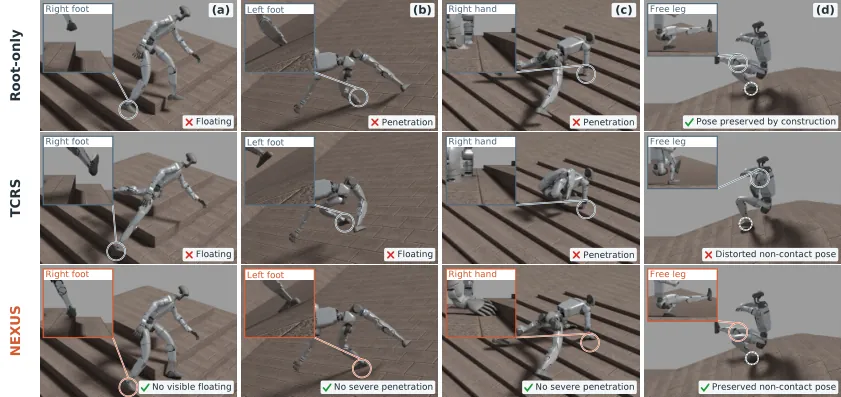
Figure 3: Matched-frame baseline failures. NEXUS reduces foot and hand contact errors while preserving the extended free-leg pose that TCRS distorts.
What does the ablation isolate?
The ablation uses 415 held-out locomotion clips totaling 3601.72 seconds. Each policy is tested on four terrain types at five levels, producing 8300 trials and 20.01 hours of reference motion. Step heights range from 5 to 15 cm and slope gradients from 0.15 to 0.45. The no-vision student shares the teacher and training settings with NEXUS; the single-stage PPO variant uses a different budget because of GPU memory but is trained to convergence.
| Variant | Success rate | Root position error | Body position error | Body rotation error | Contact F1 |
|---|---|---|---|---|---|
| NEXUS | 91.072 ± 14.959% | 19.596 ± 5.398 cm | 7.066 ± 2.949 cm | 0.127 ± 0.010 rad | 80.662 ± 2.545% |
| Without vision | 87.771 ± 19.362% | 20.089 ± 6.651 cm | 7.603 ± 3.753 cm | 0.128 ± 0.010 rad | 80.523 ± 2.876% |
| Without teacher-student | 90.964 ± 15.938% | 31.951 ± 4.472 cm | 9.482 ± 3.533 cm | 0.161 ± 0.015 rad | 79.637 ± 2.859% |
Removing vision reduces the aggregate success rate by 3.30 percentage points. The loss is concentrated on the hard terrain levels, where NEXUS reaches 78.10% and the no-vision variant reaches 70.51%. This pattern is consistent with depth being most useful when the support change is large. Vision also improves body position error and is neutral in rotation error. The contact F1 difference is small, suggesting that the headline aggregate can hide terrain-specific effects.
Removing teacher-student training has a different signature. Success drops only slightly, from 91.072% to 90.964%, but root position error rises from 19.596 to 31.951 cm and body position error rises from 7.066 to 9.482 cm. A success-only summary would therefore conclude that the training architecture barely matters. The error decomposition shows that the student improves trajectory fidelity even when both variants eventually complete many motions.
The results also expose an evaluation tension. Contact F1 is based on thresholded foot labels, while hand contacts and contact timing enter the reward but are not represented equally in this table. A high success rate can include short floating or imperfect palm support, and a low contact F1 can reflect a small threshold shift rather than a large physical failure. The paper would be stronger with separate hand-contact and timing diagnostics in the ablation.
Real-robot deployment and its evidence boundary
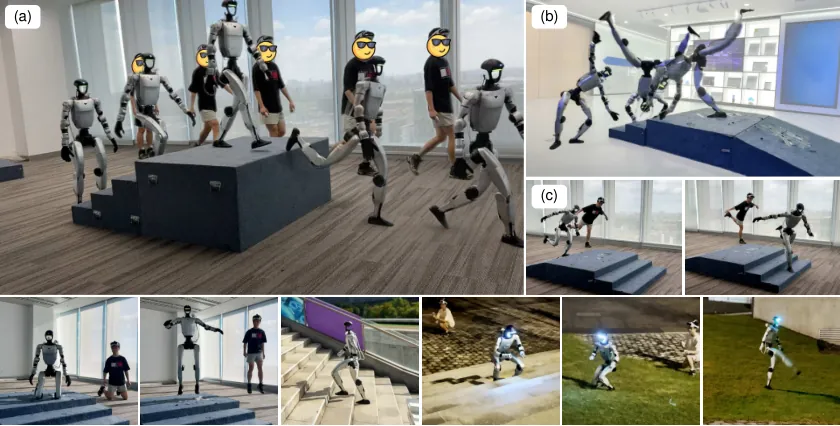
Figure 1: The operator remains on flat ground while the Unitree G1 performs whole-body behaviors on stairs, platforms, ramps, and grassy slopes.
The deployment uses a Unitree G1 and an Intel RealSense D435i. Depth is captured at 60 Hz with a $480\times270$ image, cropped by two pixels on each border, and resized to $32\times18$. Values are clipped to 0 to 2 m and normalized to $[0,1]$. The policy runs onboard with ONNX Runtime on a Jetson Orin NX at a 50 Hz control rate.
Retargeting runs on a separate PC using GMR, and motion references are sent asynchronously over ZeroMQ. The policy window contains one current frame, six historical frames, and six lookahead frames, about 120 ms of future command. If a new reference is delayed or missing, the latest frame is repeated. Depth preprocessing also runs independently. This asynchronous schedule matters because a teleoperation controller must not stall its motor loop whenever one sensor stream jitters.
The paper demonstrates 15 cm stair ascent, stepping down and jumping from a 60 cm platform, cartwheels, single-leg balancing on ramps and steps, kneeling, squatting, kicking, and outdoor motion on slopes reaching roughly 30 degrees. No failures were reported during routine pose tracking, while falls occurred in some drops from the 60 cm platform and some cartwheel attempts. The phrase "zero-shot" is therefore supported in the sense that no robot-specific fine-tuning is applied to the deployed terrain, but it is not a guarantee of robustness.
The real-robot evidence is primarily qualitative. The paper does not report the number of trials per terrain, a confidence interval for success, operator count, latency distributions, or camera calibration variation. The depth representation is only $32\times18$, and the text does not quantify performance on glass, reflective surfaces, narrow steps, or rapidly changing illumination. These omissions do not invalidate the demonstrations, but they limit the strength of any safety or deployment claim.
Limitations and independent assessment
The authors explicitly state that the adaptation algorithm does not support overhanging terrain. All terrain probing in the described pipeline is downward raycasting for a height field and normal, which is well suited to floors, stairs, slopes, and platforms but not to ceilings or surfaces that are not expressible as an upward-facing height map. A climbing or cave-navigation extension would need multi-directional contact queries and a different local geometry representation.
The local IK procedure is not a continuous-time collision-avoidance proof. Clearance and end-effector drift are checked at contact keyframes, while PCHIP reconstructs the interval. A bad keyframe, a contact switch, or a narrow obstacle between keyframes can still produce an invalid in-between pose. The paper acknowledges that local candidate acceptance does not guarantee a collision-free trajectory. This is the most important technical gap between an impressive reference generator and a certifiable motion-planning system.
The policy comparison's pre-failure-window metric is also a limitation. Reporting errors only before termination rewards early failure with fewer difficult frames. The authors mitigate this by also reporting completion rates, and they explicitly warn against using HoloMotion's lower position error as evidence of better full-sequence tracking. Readers should carry that caveat into any secondary summary; a table that drops completion rate would reverse part of the conclusion.
From an external reproducibility perspective, the missing code is significant. The paper describes the pipeline, equations, training scale, and deployment hardware, but it does not expose the controller, adaptation implementation, reward configuration, network dimensions, or real-time communication code. The project page is useful for visual verification, not for reproducing Table I or II. The work is technically legible but not yet independently auditable.
A final open question is whether a depth image is the right representation for contact-rich behavior. The student's terrain input has to encode both local support height and the affordance of a hand or foot. A $32\times18$ image can capture large stairs and slopes, but it may blur thin rails, edges, and small footholds. Elevation maps provide a more direct height representation for locomotion, while depth images preserve a wider field of view and avoid a privileged sensor assumption. The optimum likely depends on the task distribution.
Conclusion
NEXUS contributes a coherent mechanism for terrain-mismatched teleoperation: generate paired references from flat motions by repairing wrist and ankle contacts, train a privileged teacher to track the adapted motion, and distill a depth-conditioned student that sees only deployable observations. The strongest quantitative evidence is the simultaneous improvement in contact preservation, valid time ratio, and non-contact pose fidelity over TCRS, together with the scale of 880 paired trajectories and 39.87 hours of generated motion.
The policy experiments show that perception and teacher-student training should be evaluated separately. Vision improves completion most clearly on hard terrain, while the teacher-student loss has a larger effect on root and body tracking than on aggregate success. The real G1 demonstrations extend the evidence to unseen stairs, slopes, platforms, kneeling, balancing, jumps, and cartwheels, but they remain a qualitative validation rather than a comprehensive reliability study. The next technical step is to add continuous geometric constraints and support for non-height-field contacts, while releasing enough implementation detail for independent reproduction.
A terrain-adaptive controller should preserve the intent of the operator's motion while recomputing how the body meets the ground.